Building Blocks

Christian Art After the Iconoclasm. 1000-1400 AD

Bayeux Tapestry

As Iconographers, I think we all realize that the Byzantine culture was influential in creating a nuanced visual language that was able to convey important principles of religious art .  Can we today consider and contemplate how the Byzantine style developed in order to create a visual language that can bring Christian concepts to our culture today?

An important influence of the development of Christian art in the 11th century was the schism, or split, in Christianity in 1054, which resulted in the Eastern Orthodox Church and the Western Roman Catholic Church. In the next centuries, each division of the church would develop its own culture and approach to worship, prayer, liturgy, and art.

Let’s Take a Look First at the Eastern Church’s Artistic Development

Santa Maria Church, Barcelona, Spain

The expansion of  monasticism was the main force behind the unprecedented artistic and cultural activity of the eleventh and twelfth century. In 963 AD, Athanasius of Trebizond founded the first monastery on Mt Athos, Greece.  Legend has it that early hermits were visited by The Virgin Mary who gave the place her blessing and there are many icons that convey this story and remembrance of the visitation .

In 988, Russia adopted Christianity and in 1017, Prince Yaroslavl the Wise erected the  Cathedral of St. Sophia in Kiev.  A Byzantium team of artists and iconographers, Russian and Greek, decorated the cathedral with beautiful frescoes and mosaics.

Biblia de Burgos, 12th Century

1054 began the schism between the Holy thrones of Rome and Constantinople, resulting in a wide divergence stylistically in religious art making that reflected differences in theological values between the two cultures.  The Eastern Church continued to develop the Icon, keeping the flat pictorial space of Egyptian art, and the simplicity of rendering human forms borrowed from the Greco Roman tradition of the early centuries.

In 1130, A miracle working icon, Our Lady of Vladimir Icon of the Virgin Mary was brought to Kiev. This icon has lasted through the centuries and today is a symbol of Love and Tenderness.

Our Lady of Vladimir

The Paleologue dynasty in Constantinople, 1259-1453, was the last resurgence of Byzantium. The attempt to have a rebirth of Byzantium after the sack of Constantinople in 1204, resulted in the rebuilding and decoration  of many churches, including Chora Church, which is considered one of the highest artistic achievements of that era.

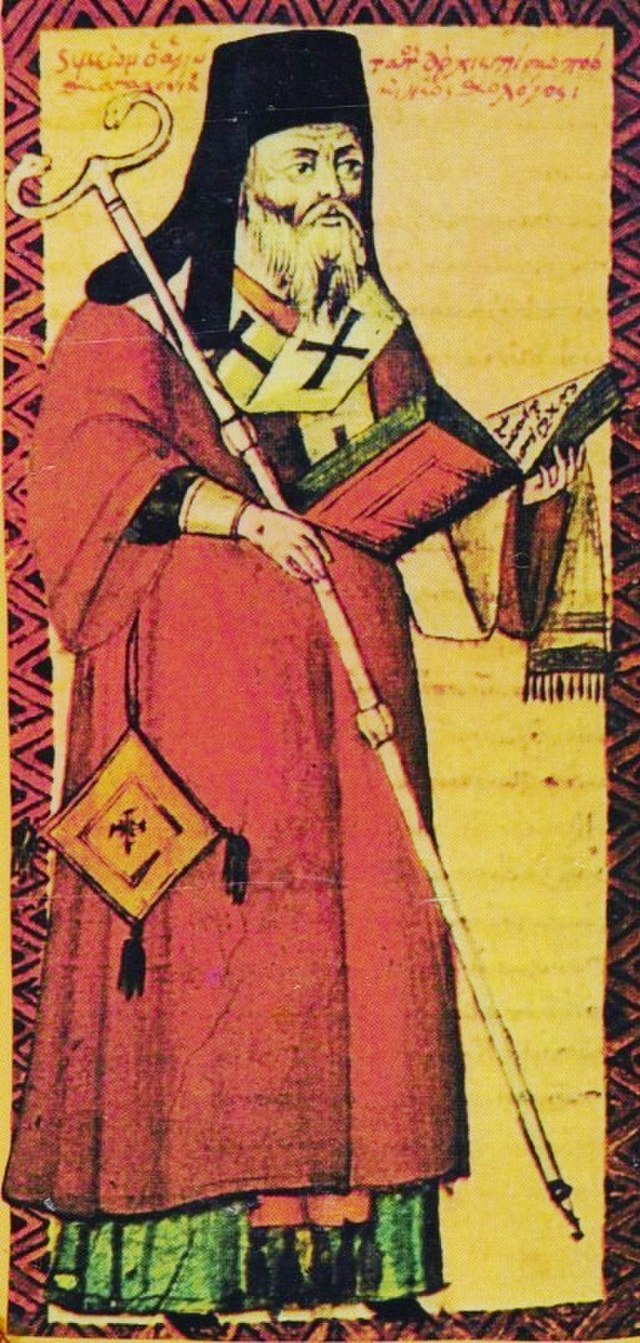
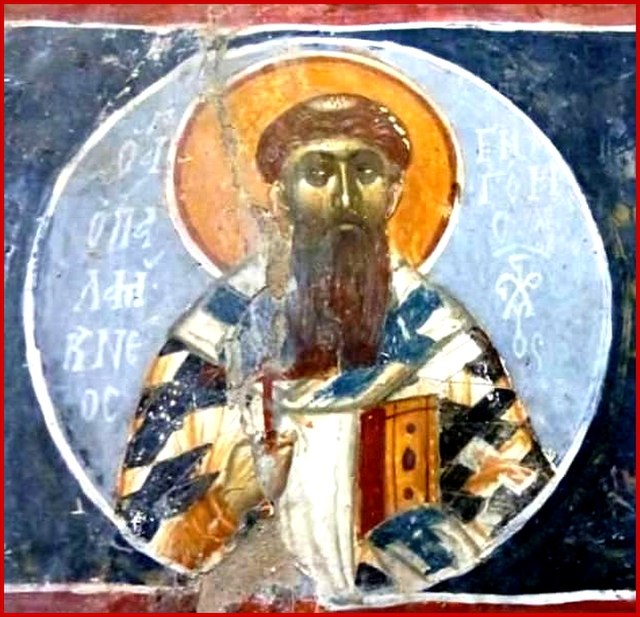
Gregory Palamas, (1296-1359), was the Archbishop of Thessalonica and an eminent theologian  who supported Hesychasm, a mystical movement in Eastern monasticism that promoted fervent prayer, silence, and contemplation.  

Transfiguration by Theophanes

In 1378,  according to legend, Theophanes the Greek came to Russian from Byzantium, and painted the Church of the Transfiguration in Novgorod and many others, along with his student, Andrei Rubylev. This period of icon painting is considered by many to be one of the greatest achievements of Russian Iconography.

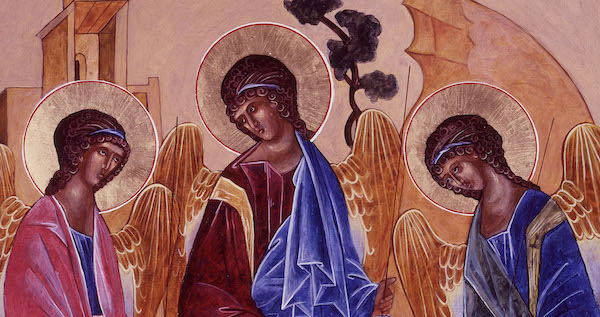
St. Sergius of Radonezh was a great Russian saint who promoted Russia’s spiritual revival.  He dedicated his monastery to the Holy Trinity and preached unity in love.  He taught brotherly love and divine service and commissioned the Holy Trinity Icon to be painted by Andrei Rubylev. Rubylev and St. Sergius were in large part responsible for Russia becoming one of the great centers of spiritual enlightenment in this time. St. Sergius passed away in 1392.

Holy Trinity. by Andrei Rubylev

In the West….

Religious art in 10th century Europe, also known as Romanesque art, was symbolic, vibrant, and hierarchical. It was characterized by its emphasis on the suffering of Christ and other sacred figures, and depicted saints and religious leaders as larger and more important than ordinary people. Artists also used animals, flowers, and fruits to convey religious messages and ideas. Some common symbols used in medieval Christian iconography include: Fire, light rays, or wind to symbolize the Almighty God; Lamb or fish: symbolize Jesus Christ and his love; Crucifix: Depicts Chrstianityand eternal life; a dove symbolizes the holy spirit from heaven or an individual’s soul, and lilies in a vase or water to portray the purity and spirituality of the Virgin Mary.

One of the most spectacular achievements of medieval artists in the west was their desire to emphasize heavenly light in their creation of places of worship.  Beginning with the 12thcentury, heavy, dark, Romanesque architecture began to be replaced by Gothic vaulted ceilings and flying buttresses that made it possible to bring more light into the churches than ever before. Light for a Christian had great significance because of the extensive Biblical associations of the nature of God with Light.

Cimabue, Trinita Madona

 After the sack of Constantinople in 1204 by Christian armies of the Fourth Crusade, precious objects from Byzantium made their way to Italian soil and profoundly influenced the art produced there, especially the brightly colored gold-ground panels that proliferated during the thirteenth century. 

Romanesque Art, one of the first innovative and coherent styles to spread across the western Church,was greatly influenced by the Byzantine art that preceded it.

 European countries of Italy, France, England, and Spain responded to this stylistic innovation that was more in keeping with shifts in cultural values.

The main purpose for the development of Romanesque art was to visually record biblical events and to chronicle important figures, like influential leaders and saints in a more naturalistic way, hoping to bring the viewer into closer contact with God.  

The Bridge Between Eastern and Western Art

At the end of the thirteenth century and beginning of the fourteenth, three great masters appeared who changed the course of painting from the more abstract Byzantine style, to a more naturalistic one:

Cimabue, Italian, (1240-1302) painted religious paintings that were heavily influenced by Byzantine models, yet he was also innovative and eventually broke away from the Byzantine style of religious painting.  For this reason, his work is considered to be a transitional bridge between icon painting and the more naturalistic developments of Renaissance painting.

Ognissanti Madonna, Giotto

Giotto di Bondone, (d. 1337), is believed to have been a pupil of Cimabue, and to have decorated churches in Padua, Florence, Naples, Assisi, and Rome. His volumetric figures are in sharp contrast to the linear, stylized  shapes of Eastern religious art of the same period. In his work, the flatness of icons began to disappear in favor of a new kind of pictorial space that achieved the illusion of depth visible in the natural world. With Giotto, considered by many to be the father of modern European painting, the flat world of thirteenth-century Italian painting was transformed into an analogue for the real world. Giotto’s figures are volumetric rather than linear, and the emotions they express are varied and convincingly human rather than stylized. He created a new kind of pictorial space with an almost measurable depth that prefigured the pictorial developments of the Renaissance.. 

Duccio, (1278 – 1318), is considered to be the father of Sienese painting. Together with Giotto he is considered to be one of the founders of Western art.  His religious paintings introduce lyricism and a refined color sense into the Byzantine tradition he inherited. He became interested in portraying human emotions and a more naturalistic space- both in conflict with Byzantine art principles.  His purpose was to bridge the gap between the spiritual world of the figures he painted and the real world of the viewer by an illusionistic rendering of objects and space- the first of its kind in Western painting, and not a style embraced by Eastern iconography until later centuries.

Maesta. Duccio

Overlapping  of Panel Painting with Icon Painting

Through the fourteenth century in Europe, the primary support for portable paintings was the wooden panel. The lengthy and complex preparation of the panels  had already been the way of icon creation as well, hailing from the very early centuries of Christianity. Many of these methods of icon board preparation are continued in the practice of icon painting today. They are described in detail in Cennini’s Il Libro dell Arte.

So, to summarize, the schism of the Church into an Eastern and a Western Church resulted in different approaches to creating a visual language that would best convey concepts of God, Bible stories and saints. Western culture evolved from a more theocratic culture to a humanistic one with, in my opinion, disastrous results. I think I am more drawn to the Byzantine visual language because of its ability to convey purity, focus on God, and demonstrate a clear difference between God’s world and the naturalistic world we live in.  And I think this ability to transcend the moment and connect with the Divine reality is crucial to humans coping with an increasingly stressful world today. The question is: Can we create a visual spiritual language that will engage modern men and women in a meaningful way?  How will we do that?  What do we learn from the simplified account of religious art development above?  I believe that each of us will be inspired by God to create a variety of approaches, for it is of great importance to the modern world that we do.

Until next month, when we take a look at…The Renaissance and Icon Painting!! Glory to God whose power, working within us, can do infinitely more that we can ask or imagine.

Christine Simoneau Hales

My website: New Christian Icons. My Youtube Channel

Iconoclasm

Iconoclasm in Church Art (600-1000)

Image from Class Chuludov Psalter, 9th Century, scene of Iconoclasm

Key Issues of Iconoclasm

Iconoclasm, the destruction or rejection of religious images, was a major controversy that profoundly impacted the Byzantine Empire from the 7th to the 9th centuries. The debate centered around the Second Commandment, which forbids idolatry, raising the question of whether holy images competed with God or enhanced Christians’ experience and knowledge of God. This controversy tore apart the Byzantine Empire, pitting the iconodules, who venerated icons as a logical progression of Christian art, against the iconoclasts, who believed that any image in a church was idolatry.

The East-West Divide

Sts. Theodore of Amasea and George conquering their enemies; 9th century, Mt. Sinai

In the Western Christian church, where Latin had become the church’s language, the Greek distinction between latria(worship for only God) and dulia (a lesser form of veneration) was not easily understood or accepted. Eventually, however, the Western church allowed images for veneration. Despite sharing one Christian faith, Latin Christendom and Byzantium developed distinct spiritual, intellectual, and institutional traditions, shaping cultural identities that persist today as two distinct divisions of the Church.

Byzantium Under Justinian and Theodora

Theodora, Mosaic, 9th century

In Byzantium, the Emperor Justinian (527-565 AD) and his wife Theodora implemented caesaropapism, ensuring that the emperor controlled both political and religious affairs. This mosaic shows Empress Theodora holding a chalice, with figures standing frontally and almost floating in space, signifying a stylistic break from the Greco-Roman tradition. This new style was associated with the divine world, rather than the naturalistic world. Theodora was murdered for opposing the removal of the Jesus icon on the Chalke Gate of the Great Palace of Constantinople during the iconoclasm movement.

The Iconoclast Controversy

Christ Mosaic, Hagia Sophia

According to traditional accounts, Iconoclasm began when Emperor Leo III removed an icon of Christ from the Chalke Gate of the imperial palace in Constantinople in 726 or 730, sparking widespread destruction of images and persecution of their defenders. In the East, Caliph Yazid issued a decree in 723 banning all holy images in Christian churches. In the West, Emperor Leo banned icons in all public places in 726. Pope Gregory III responded in 731, excommunicating those who denied the sanctity of icons or violated sacred images.

Opposition and Resolution

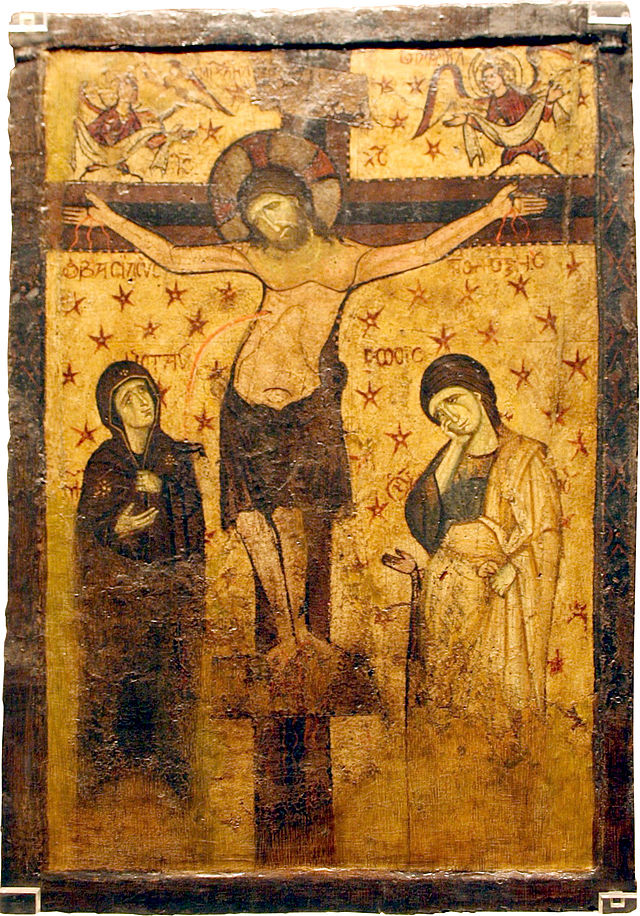
Crucifixion, Byzantine Museum, Athens. Circa 9-13th centuries.

St. Theodore the Studite (b. 759, Constantinople) was a leading opponent of iconoclasm, which disturbed relations between the Byzantine and Roman churches. The period of iconoclasm lasted until 797, with proponents of icons like Saint John of Damascus and the edicts of the Seventh Ecumenical Council supporting the veneration of icons. John of Damascus, an Arab Christian monk and theological doctor, was a prominent figure in the 8th-century Iconoclastic Controversy.

Cultural Impact and the Great Schism

Byzantine Iconoclasm, initiated by Emperor Leo III and continued by his successors, included widespread destruction of religious images and persecution of supporters. The period saw growing divergence and tension between the East and West, though the Church remained unified. The Western Church supported the use of religious images, while the Eastern Church was more divided.

Seventh Ecumenical Council Icon

The Great Schism of 1054 was caused by doctrinal differences, the rejection of universal Papal authority by Eastern patriarchs, and sociopolitical differences. This schism created lasting divisions that affect the study and practice of iconography today.

Modern Perspectives on Iconography

Iconoclasm, Clasm Chuldov Psalter, 9th Century

Today, a schism still exists between Western and Eastern iconographers regarding the nature and purpose of icons. Former Archbishop of Canterbury, Lord Rowan Williams, explained the significance of icons in his talk “Idol, Image, and Icon.” He described an idol as an empty illusion, whereas an image bridges the gap between absence and presence. Icons, made and used in prayer, open us up to God and embody the tension between divine presence and absence. They challenge and transform the viewer, claiming our attention and inviting us to experience the sacred.

Conclusion

Iconoclasm was a pivotal controversy in the history of the Byzantine Empire and the Christian Church, shaping the development of religious art and theological thought. Its legacy continues to influence the study and practice of iconography today, highlighting the enduring tension between tradition and innovation in religious expression.

I’m hoping to achieve Peace in our lifetime, with all those who call themselves Christians actively spreading the Doctrine of brotherly love to all of our neighbors.

INTERESTING LINKS:

Lord Rowan Williams, former Archbishop of Canterbury, Lecture at Birmingham University: Idols, Images, and Icons.

Wax Tempera and Modern Icons

May God continue to bless the eyes of your hearts with His love, until next month,

Christine Simoneau Hales, New Christian Icons

Upcoming Icon Painting Classes

The Uncreated Light

Dear Fellow Iconographers:

Saint Fyodor of Rostov Icon depicting “Theoria”. By the hand of Christine Hales

Recently, while sharing with good friends my current Icon exhibition at All Angels Church in Sarasota, I was pleasantly reminded about the importance of the concept of the “uncreated light” within icons. Having promised to reflect more on this topic, I now share with you some thoughts and research on that very important but sometimes overlooked aspect of icon writing/painting.

The Light of Mt. Tabor: The Light of the Transfiguration and Paul’s Conversion

In the 14th century, Gregory Palamas, an Athonite monk and proponent of Hesychasm, explored the concept of the Uncreated Light. According to the Hesychast mystic tradition of Eastern Orthodox spirituality, a completely purified saint who has attained divine union experiences a vision of divine radiance, the same ‘light’ that was manifested to Jesus’ disciples on Mount Tabor at the Transfiguration and to Saint Paul at his conversion. This profound experience is referred to as theoria. The doctrine of the uncreated light is rooted in Palamas’ interpretation of the teachings of Gregory of Nyssa.

Orthodox Christians also find instances of the Uncreated Light in the Old Testament, such as the Burning Bush.

Burning Bush Icon -Moses and Mary with Christ Child. by the hand of Christine Hales

Joseph the Elder, Hesychast

Joseph the Elder, a 20th century Hesychast and Greek Orthodox monk from Mount Athos, longed for unceasing prayer but faced numerous challenges, including the difficulty of finding a spiritual father and the indifference of many monks toward constant prayer. In his yearning for divine connection, Joseph was ultimately granted a vision of the uncreated light, receiving the gift of ceaseless prayer.

“At once I was completely changed and forgot myself. I was filled with light in my heart and outside and everywhere, not being aware that I even had a body. The prayer began to say itself within me…

O Master, our sweetest Lord Jesus Christ, send forth Your grace and free me from the bonds of sin. Enlighten the darkness of my soul, so that I may apprehend Your infinite mercy, and so that I may love and thank You worthily, my sweetest Savior, Who is worthy of all love and thanks.” Amen

Egon Sendler on Iconic Light

Egon Sendler, in his book “Icon, Image of the Invisible”, explained that the light depicted in icons is distinct from natural light. Iconic light represents incarnate grace and must be received in contemplation.

“In the icon, we see a divine reality that transcends this earthly world while respecting it because it is created by God, to be transfigured in His spirit. If an icon reduces the mystery of God to mere material forms, it loses its soul and spiritual character, becoming an illusion of reality.”

Sendler emphasized that the dynamic nature of icons involves all the pictorial elements moving towards the observer, with light following this movement, creating a transfigured world and bringing the viewer into union with God..

Leonid Ouspensky from “The Meaning of Icons”

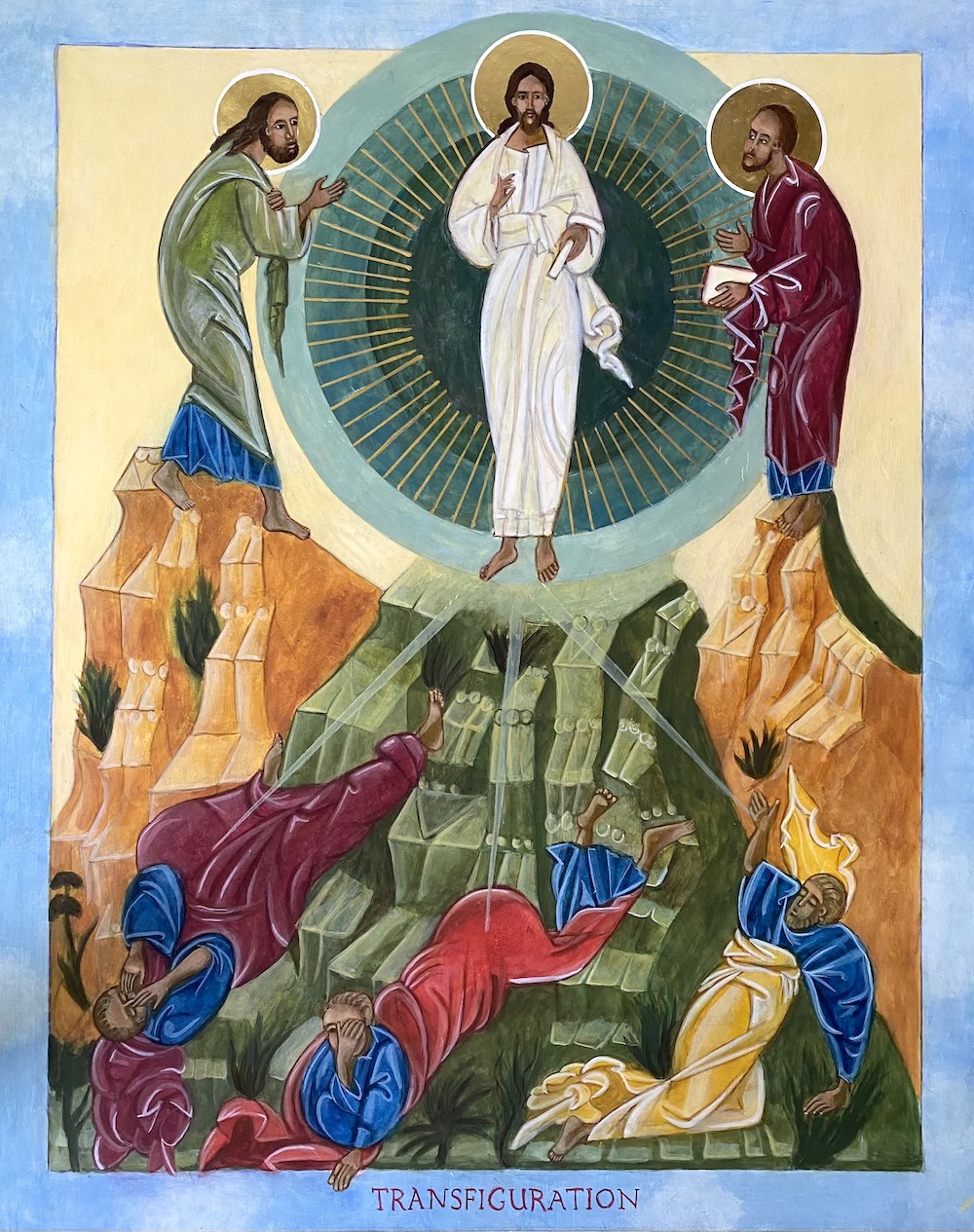
Transfiguration Icon by the hand of Christine Hales

Leonid Ouspensky, in his book entitled “The Meaning of Icons”, highlighted that Church art, particularly icons, visually testifies to the dual realities of God and the world, grace and nature.

“Through the icon, as through the Holy Scriptures, we not only learn about God but also know God. The transfiguration, an illumination of the entire man through prayer by the uncreated light of Divine Grace, manifests man as a living icon of God. The icon represents this transfiguration, depicting a man filled with the Holy Spirit’s grace.”

Ouspensky concluded that liturgical art represents both our offering to God and God’s descent into our midst, facilitating a profound meeting between God and man, grace and nature, eternity and time. Perceiving the uncreated light of God’s grace in an icon leads us toward Holy Communion with God, transcending our natural world.

Conclusion:

The concept of the Uncreated Light in Eastern Orthodox spirituality and iconography emphasizes the profound connection between the divine and the material world. Through the transformative experiences of saints like Joseph the Elder and the theological insights of figures like Gregory Palamas, Egon Sendler, and Leonid Ouspensky, we understand that icons are not merely art but manifestations of divine reality and grace, guiding believers towards a deeper communion with God.  And so, when writing, or painting icons, choosing colors that reflect the uncreated light of God’s grace becomes a subtle, but highly important imperative of icon creation.

Here are some interesting links for Iconographers:

Icon Museum and Study Center, Clinton Massachusetts

Introduction to Icons Video by Patristix

Icon Writing Pigments and other Supplies for Icon Painting

That’s all for this month. May God continue to bless the work of your hands,

Christine Simoneau Hales

New Christian Icons Icon Painting Instruction

Prints of My Icons Christine Hales’ Icon Book

Coptic Icons

Coptic Icon of Saint Michael
Archangel Ethiopian Icon, C. 19th century

Recently, while teaching an online icon writing class on the Transfiguration, the subject of Coptic icons came up.  Each of us spoke admiringly about them, the color schemes, the simplified human forms, and the fact that they are  attractive in many ways.  But we soon realized that we didn’t really know much about them.

Coptic Ethiopian Icon

So, here I have done some research that I now share, and I hope that many of you  with more knowledge will share your thoughts and Coptic icon images on the FB (American Association of Iconographers FB group) page too.

Here’s what I have been able to discover:

In 30 BC, Egypt became a Roman province, and over the next several years, immigrants from Greece, Rome, Libya, and Syria brought their artmaking traditions  and methods to apply to the  art of this time.  According to tradition, the Coptic Church was founded by Mark the Evangelist c. AD 42, and regards itself as the subject of many prophecies in the Old Testament. The first Christians in Egypt were common people who spoke Egyptian Coptic.

Saint Anthony and Saint Paul the Hermit c. 14th C.

The Church of Alexandria was the first Church of Africa, and through it, the  influence of Coptic art spread to Sudan and Ethiopia. Some forms of the Coptic cross are known as the Ethiopian cross and many Churches in Ethiopia show the influence of the Coptic art.

Coptic Cross
Coptic Cross

The early Coptic icons of the third century Egypt, used encaustic paints and later, influenced by the Byzantine tradition, egg tempera.  The Coptic style favors enlarged eyes, frontal figures, and an under emphasis of natural proportions in figures. The figures of saints display eyes and ears larger in proportion to the rest of the face and a smaller mouth, as well as enlarged heads, signifying a spiritual relationship with God and devotion to prayer. Martyrs’ faces were peaceful. Early Coptic icons were influenced in style of painting by the Egyptian Fayum memorial portraits used on Egyptian sarcophagi.

Fayum Portrait

These Fayum portraits from the Egyptian Sarcophagi were painted in the Greco-Roman style of painting and became the basis of both Coptic and Byzantine iconography. Beautiful portraits, they have simple, graceful forms, and employ a simple color palette, using what we now refer to as the Greek Palette- mixtures of red ochre, yellow ochre, white and black.  Although the same painting style was used on each portrait, artists were able to achieve a great variety of resemblances to the persons being depicted.

John the Baptist Coptic Icon
John the Baptist Before the 19th C.

In 641 Muslims conquered Egypt and made it a province of an Islamic Empire whose capital was Damascus.  The religious history that followed is a complicated mixture of acceptance for Christians, and then later in the 9th century, relations were more difficult. The period from the 7th to 13 century was more promising, allowing for Christian Coptic art to flourish once again and to further develop the Coptic style. There was even something of a Renaissance of Coptic art in the 13th century with many Coptic illustrated manuscripts, much like the illuminated manuscripts of the western Church.

After this, for political reasons, there was a sharp decline in productivity of Coptic Art,until the 18th century  when the West re-discovered the attraction of Coptic Icons.

In today’s world there are several Coptic Iconographers who are continuing to develop the Coptic style of iconography.  I am including here links to Dr. Stephan Rene’s website from which a much more nuanced understanding of Coptic iconography can be found, and two other links that may be useful for a more complete perspective.

Saint Paul Icon, 17th C.

Again, please do add to the FB group page more information or images if you would like to share your experience with Coptic Icons with others. I hope this has inspired you to think about different styles of icon writing and how culture and politics can affect the art of their time.

Dr. Stephan Rene’s Website: https://copticiconography.com/2019/12/24/reflections-on-discipleship-and-coptic-iconography/

UK Coptic Icons. https://www.ukcopticicons.com

Until next month,

My very best wishes for God to continue to bless the work of your hands, 

Always,

Christine Simoneau Hales

https://newchristianicons.com

Iconography of Mary

The Iconography of Mary

Icon of the Virgin and Child with Saints Theodore and George, St. Catherine’s Monastery, Mt. Sinai, 6th century

That there are many different types and genres of Mary icons that attest to the need of all Christians to be able to relate to different aspects of her humanity and divinity at different times in their lives.     Some images of Mary depict her in a time of peace, apparently apart from the drudgery and strife of our every day world, but others, like the Virgin of Tenderness and Loving Kindness, evoke the loving and kind aspects of God in ordinary life.

As the Christian Church began to split into factions with emphasis on slightly different aspects of the faith, so too, the iconography of Mary, the Mother of Jesus, has different interpretations within the denominations.  To establish a common ground, I first put forth a history of Mary, both Biblical and inclusive of denominational differences when appropriate.

Mary in the Bible

Saint Luke painting the Virgin and Child with an Angel, Russian Icon

The earliest New Testament account of Mary is in the Epistle to the Galatians, which was written before the Gospels. She is referred to as “a woman” and is not named: “But when the fullness of time had come, God sent his Son, born of a woman, born under the law” (Galatians 4:4).[47]

But Mary is specifically mentioned several times in the canonical Gospels and the Acts of the Apostles:

  • The Gospel of Luke mentions Mary the most often, identifying her by name twelve times, all of these in the infancy narrative (Luke 1:27–2:34).[48]
  • The Gospel of Matthew mentions her by name five times, four of these (1:16, 18, 20: 2:12)[49] in the infancy narrative and only once (Matthew 13:55)[50] outside the infancy narrative.
  • The Gospel of Mark names her once (Mark 6:3) and mentions Jesus’ mother without naming her in Mark 3:31–32.
  • The Gospel of John refers to the mother of Jesus twice, but never mentions her name. She is first seen at the wedding of Cana (John 2:1–12. The second reference has her standing near the cross of Jesus together with Mary Magdalene, and Mary of Clopas (or Cleophas), and her own sister (possibly the same as Mary of Clopas; the wording is semantically ambiguous), along with the disciple whom Jesus loved.” (John 19:25–26). John 2:1–12  is the only text in the canonical gospels in which the adult Jesus has a conversation with Mary. He does not address her as “Mother” but as “Woman”. In the Acts of the Apostles, Mary and the brothers of Jesus are mentioned in the company of the eleven apostles who are gathered in the upper room after the Ascension of Jesus (Acts 1:14).
Crucifixion Icon, From ancient Russian Icon, Christine Hales. 2020

However, most of the details we know about the early life of Mary, and the birth of Jesus taking place in a cave come from the Proevangelism of James, a non-canonical treatise of the second century.

How did canonical imagery for the Mother of God develop?

Vladimir Mother of God Icon , 12th century, currently in Tretyakov Gallery, Moscow

In the early formation of Mary’s iconography, there were three main aspects of her mystery, that is, her pure virginity, her fertile motherhood, and her divine sanctity that contribute to attributes and characteristics visible in depictions in her icons.

As early as the fifth century churches were being dedicated to Mary in Constantinople and the term “Theotokos”,  God Bearer, Mother of God, was introduced at the Council of Ephesus in 431. After the sixth century, more and more icons of various aspects of the Blessed Mother were seen, and attributes of military power were seen as people brought icons of Mary to the battlefield for protection against invaders.  Prayers relating to Mary are found as early as the Gospel of Luke.

Hodegitria Icon, 16th century, Russia

Although there are exceptions, most of the Russian Orthodox icons of Mary can be found within four categories:   Hodegitria, “the Guide, or she who shows the way”; the Eleusa, “Virgin of Tenderness, or loving kindness”; the Oranta, Our Lady of the Sign; and the Akathist “Hymn”. 

Within these categories there exists many iterations named primarily after the town or village that housed them, such as in the Tenderness category there is the Kazan icon, Smolensk icon, Georgian icon,Jerusalem icon, and many more.

Hodegitria Icons of Mary have been brought to battlefields and paraded around cities for protection for centuries. They have been used to invoke military victory but she is never seen with a staff or any other sign of authority.  Her icon of the Hodegetria, Mother of God, was deemed the most powerful weapon against enemies in ancient Russia.

In the Eleusa category of loving kindness, popularized in the twelfth century, The Vladimir Mother of God icon was brought from Constantinople to Vladimir by Prince Andrey Bogolubsky and was believed to protect the city from marauding Mongols.

Our Lady of the Sign Icon by Christine Hales 2000

The Orans Virgin, or sometimes called “Platytera, More Spacious Than the Heavens”, depicts Mary with her arms outstretched in the prayer position, with a young Christ in the center of her figure, and this one is based on the prophesy in Isaiah 7:14.,” Therefore the Lord himself shall give you a sign; Behold, a virgin shall conceive, and bear a son, and shall call his name Immanuel.”

The Akathist (meaning hymn) virgin, is frequently seen depicting Mary as an individual alone, without the Christ child. And without Joseph, her husband.

Our Lady of Korsun created by Christine Hales

Most Greek churches dedicated to the Virgin Mary are called Panagia; the Most Holy; the standard western Christian designation of “St. Mary” is rarely used in the Orthodox East, as Mary is considered the holiest of all created beings and therefore of higher status than the saints.

In paintings, Mary is traditionally portrayed in blue, while in the Eastern Orthodox Marian iconography, her robe is a deep red. There are many more genres of Mary paintings in the Catholic church, variations that address particular prayer needs of the people. Examples of this are Our Lady, Untier of Knots, Our Lady of Perpetual Help, Our Lady of Gudalupe, Our lady of Sorrows, and many more.

Our Lady of Perpetual Help, Christine Hales

The Christian need to believe, venerate, and pray with images of Mary is a powerful one.  In a primarily patristic society, being able to relate spiritually to the most Godly of women is both a solace and source of strength.  Surely the Blessed Mother demonstrated profound strength at the Crucifixion, obedience and humility at the Annunciation, and devotion to Jesus throughout His life and death, and we can draw near to her through her icons and be comforted and strengthened by her virtues and piety.

I will close with one of the oldest known prayers venerating Mary:

            Beneath Thy Protection 

We fly to thy protection,

O Holy Mother of God;

Do not despise our petitions in our necessities,

but deliver us always from all dangers,

O Glorious and Blessed Virgin.

Christine Simoneau Hales

Our Lady of Guadalupe, detail, by Christine Hales

https://newchristianicons.com

Prints: https://christinehalesicons.com

Sources:

“The Dawn of Christian Art in Panel Paintings and Icons”, Thomas Mathews and Norman Muller.

Wikipedia

Wiki Common

Interesting Links For Iconographers:

From Dorothy Alexander, Iconographer in CA :

This is a link to summer internships for those studying a BA, MA, or Phd:

Favored Concepts of Byzantine Iconographic Language

Dear Fellow Iconographers:

I’ve been reading and looking at icons quite a bit recently in an effort to understand what elements of the iconographic language I feel are important to incorporate into a more contemporary approach to writing icons.  Others will have different opinions about this, I’m sure!  But I have always learned best when I share my thoughts with others, either writing or speaking, so feel free to respond with your ideas or opinions on this as well, and thanks for your patience as I attempt to reason this out!!

The Protection of the Holy Virgin, Novgorod School, late 15th century

Depiction of buildings and space within the icon using inverse perspective.  This tends to flatten out the drawing and creates visually the understanding that this is not worldly reality but a spiritual reality we are depicting.  

I love the abstract way that folds on garments are rendered.  They both simplify and abstract the visual reality of the figure, again, pointing to the symbolic nature of the scene being depicted.

The way rhythm and movement are cleverly incorporated into the design by the repetition of curves in roofs, heads, building tops etc.

The Presentation of the Virgin, Novgorod School, fifteenth century

St. Simeon the Stylite shows the creative foreshortening of his column and renders it as a tower with stairs and a door with a balustrade at the top for him to rest upon.  He gives the blessing with his right hand and holds a scroll in the left- again, iconographic language that communicates his blessing and dedication to Holy Scripture.  It is said of him that he exercised an extraordinary spiritual authority and fought against spiritual heresies.1

  1. The Meaning of Icons, Leonid Ouspensky

St. Simeon Stylites, Russian, 16th Century

Another aspect of the iconographic language that I greatly admire is the consistent ways of highlighting faces,  They are somewhat realistic , but yet abstracted when eyes are exaggerate, simplified, and accentuated.  There is a consistency also in the way facial features are drawn.  You can see this in some of the early icon painting manuals- the one I use often is the Egon Sendler book Icons, Images of the Invisible.  Sadly, it is out of print, so is fairly expensive on the second hand book market, but I do recommend it highly if you can get one.  Hair is also stylized so as not to draw attention away from the spiritual reality being depicted.  

Of course, all this is ingenious, and why would we ever want to try to improve on it?  My take on that is that I want to make icons – or religious art- that will attract my community in this time.  Last month I published a photo of one of Stephen Antonakas’ neon art pieces of the Transfiguration.( https://americanassociationoficonographers.com/  )that I think brilliantly captures the essence of the Icon, but its very abstractness renders the actual Transfiguration story unreadable and unknowable if you are not familiar with the Scripture or the story.  However, if you do know the story, his work captures the essence in a new and different way that allows a deeper appreciation and allows us to think differently about that moment. Mark 9:2-13, Matthew 17:1-17, and Luke 9:28-36.

What is the main message of the Transfiguration?

Transfiguration Icon, Russian, Novgorod School, 15th Century

Though the disciples do not understand his meaning, the Transfiguration and Jesus’ charge to the disciples present a promise of what is to come. There is hope, because he will soon triumph over sin and death, and be raised in the fullness of glory – the glory of which they have just been given a glimpse.

So, again, compare and contrast- here is a Russian icon from the Novgorod school, fifteenth century.  Definitely light is emphasized in both the Antonakas neon sculpture as well as the icon, but it is missing the two prophets, Moses and Elijah- Moses representing the dead and Elijah, because he was taken up to heaven, represents the living, calling attention to the message of hope of the Second Coming.  Both had a secret vision from God.  “Christ appears as the Lord of the quick and the dead, coming in glory of the future age.  The Transfiguration was an anticipation of His glorious second coming, says St. Basil, the moment which opened a perspective of eternity and time.”  Meaning of Icons, Leonid Ouspensky P. 212

This beautiful icon of St. Sergius of Radoneh again emphasizes simplicity both in design and color palette.

Saint Sergius of Radoneh, Russian, 20th Century

Byzantine Iconography as a Sacred Art

According to Constantine Cavarnos in his book, ” Guide to Byzantine Iconography”, Byzantine iconography is a sacred art.  It is art that is spiritual in essence and aims.  It has seven functions: (1). to enhance the beauty of the church with a beauty that has the impress of holiness. ( 2). To instruct us in matters pertaining to the Orthodox Christian faith.  (3) To remind us of this teaching. (4) To lift us up to the prototypes, to the holy personages whom the icons depict.  (5) To arouse us to imitate the virtues of these personages. (6) To help transform us, to sanctify us.  (7) To serve as means of worshipping God and venerating His saints.”

So, in closing, I have mentioned some of the concepts that make an icon a sacred work of art.   I expect that each of you will have other favorite and important elements of the iconographic language to emphasize. I look forward to hearing from you on this topic and possibly incorporating your thoughts into future articles.

Until next month, May God bless the work of your hands, and guide your thoughts, waking and sleeping,

Christine Simoneau Hales

https://newchristianicons.com

The Transfiguration Icon by Christine Hales 21st Century

My next online Icon writing class is April 9-12, visit: newchristianicons.com for more details and to register.

Innovation and Change

Innovation and change- not two words one usually associates with Iconography! But in order to have authentic icons today, they need to be able to relate to our culture today as well as to be expressions of our relationship to God today.  In the words of a noted Romanian iconographer today, Todor Mitrovic, “…it is impossible to create authentic ecclesiastical art if we do not engage in a dialogue with contemporary art .   

Last Supper, Todor Mitrovic

Of course, what that dialogue looks like visually, when translated through the filter of Byzantine Iconography, will look different for each iconographer.  And this is right and correct, for each of us are products of different countries and cultures, but one faith.  Our faith is what provides unity in our efforts to serve God with the talents He has blessed us with.

Take Giotto, As an Early Innovator Example

Consider Giotto Bondonne, born approx..1267, taught by the Italian artist Cimabue, known today as the father of the Renaissance.  He always believed that art should be the handmaiden of the Church, but he also believed that art needs to be able to connect with the common man and his faith.  

The Virgin and Child with Saints and Allegorical Figures, Giotto, 1315. Egg Tempera and Gold leaf

Giotto is famous for the Peruzzi Altar Piece, the Bardi Chapel, and Scrovegni Chapel fescoes, among much other sacred art. While the subject matter of his work was Scriptural, it had a strong bias towards depicting everyday life.

Byzantine art was prevalent even in Italy from the sixth century onward since Emperor Justinian brought craftsmen from Constantinople to build churches and monasteries.  Some of these are still seen in San Vitale in Ravenna, San Marco in Venice and Monreale in Sicily. Giotto was influenced and  informed by this Byzantine art as part of his early training. 

During his lifetime, Giotto was heralded as an artist who revived the art of painting, which some felt had fallen into ruin over the course of the Middle Ages. He was famous for painting on a monumental scale, demonstrated by his majestic frescoes in the Scrovegni Chapel in Padua. 

Giotto…”brought back to light an art which had been buried for centuries…So faithful did he remain to Nature…that whatever he depicted had the appearance, not of a reproduction, but of the thing itself, so that one very often finds, with the works of Giotto, that people’s eyes are deceived and they mistake the picture for the real thing.”

Giovanni Boccaccio, a contemporary of Giotto

One of the main stylistic differences from Byzantine art that Giotto introduced was depicting the human form as it appears in nature.  The figures appeared more natural and showed human expressions appropriate to the depicted scene.

The Virgin and Child with Saints and Allegorical Figures, Giotto, 1315. Egg Tempera and Gold leaf, detail

I understand that as Iconographers, we are taught to avoid this kind of naturalism in favor of  stylized , expressionless figures on a flat surface.  So what is my point? Only that it is possible to introduce artistic innovations into church art in order for that art to reach the common man.

Neon Artist , Stephen Antonakos, Icons

Here are a couple of”icons” created in 1989 that incorporate gold leaf, wood, light, and theology. Compare these with Giotto and they seem to apply more to a Byzantine definition of icon than Giotto’s religious art and those of the Renaissance that followed. And yet, Antonakos’s icons are entirely abstract. Do they relate better to our modern culture and create a holy image that brings God to mind? 

“Transfiguration”. By Neon Artist, Stephen Antonakos 1989. Neon, Gold Leaf on Wood

Saint Peter Icon. by Neon Artist, Stephen Antonakos. Neon, gold leaf on wood, 1989

INNOVATION AS A WAY TO ENGAGE THE VIEWER

How do we innovate within a Byzantine Iconographic context today at a time when art making is so widely diverse and even technological?  I don’t have any answers, except to say that it is a worthy challenge for iconographers and religious painters today!

Saint Nicholas.  Todor Mitrovic

I’d like to close with another quote from one of my favorite contemporary Iconographers, Todor Mitrovic:

“In my opinion, church art, approached through its liturgical perspective, must be brought to life by people in actual time. This also means it must be brought to life in an actual cultural context – comparable with, but – at the same time – incomparable with, previously existing cultural contexts. 

We are invited to transform this actual cultural context however impossible it may seem.

It is not expected of us to express the faith of people who once lived on the land we inhabit today, but instead – our own faith.

No matter how primitive and rudimentary our expression is, it has to be done from the heart, through the mind and body, otherwise we are avoiding the responsibility of being part of the Body of Christ. Such expression is part of our attempt to make the Body of Christ present, which is, when speaking about art, making it visible in a material and cultural context. This is why all we can give, all our talent, must be included in the process – otherwise we are denying our skill, burying talents to the ground (to use the Gospel parable), and at the same time doing little more than telling pleasant stories about the Middle Ages.”

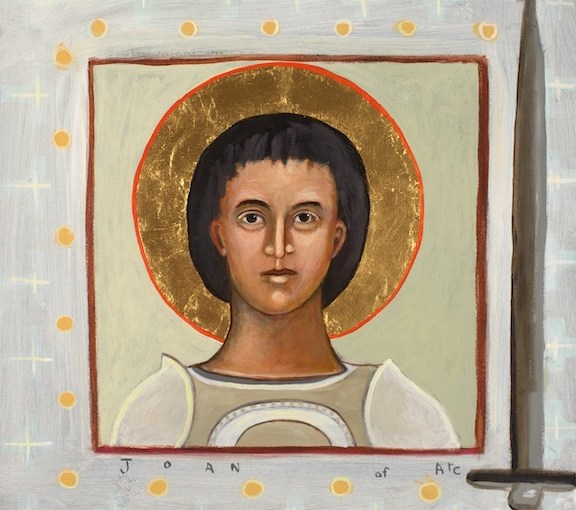
Joan of Arc, Christine Hales


May this article serve as both a challenge and an encouragement for each iconographer, urging us toward exploration, experimentation, and a celebration of diverse styles within contemporary iconography. Let the love of Christ infuse every stroke of our brushes and guide our collective journey as a group of artists profoundly devoted to Christ.

Christine Simoneau Hales

New Christian Icons     My Patreon Page


Sources for this article:

https://www.getty.edu/news/everyones-talking-about-giotto/

Antonakos , by Irving Sandler

A Christmas Journey

A Christmas Journey: Lessons from the Nativity Icon

As we joyfully concluded my latest icon writing class, the crowning achievement was a breathtaking depiction of the Nativity. Beyond the demonstrations and questions, the process became a conduit for spiritual revelations about the Nativity Icon during our retreat. The shared exchange of thoughts and questions revealed the profound spiritual wisdom residing within each class member. I am so grateful for the divine synchronicity that brings such beautiful souls into my classes, contributing to a shared journey of growth and revelation in the span of just four days.

In the spirit of post-retreat reflection, my thoughts turned to the iconic journey of the three wise men. Weary yet resolute, they traversed long and perilous roads, guided only by a celestial star lighting their way to Jerusalem. Their journey, fraught with challenges, reached its culmination under the brilliant radiance of the star directly above, revealing the long-promised redemption in the form of a humble baby nestled in a manger. This divine encounter brought the wise men to their knees in worship and adoration before the embodiment of God’s power and glory.

The resonance between the wise men’s Christmas journey and our own spiritual quests is striking. As we usher in the festivities of 2024, I pray that we may emulate the wise men, offering our heartfelt praise and worship in response to the wonder of the incarnation.

Drawing inspiration from Sarah Young’s “Jesus Calling” (pg. 372), let our perseverance along God’s ordained path be sustained by His strength. Miracles, though not always visible to the naked eye, become apparent to those who live by faith. As we navigate our individual paths, let us watch and wait, expecting miracles and acknowledging that living by faith grants us the clarity to witness divine interventions.

The Nativity Icon by Christine Hales

In this festive season, my heartfelt Christmas prayer for you is to embrace the faith-driven approach of the three wise kings. May your Christmas be filled with the warmth of faith rather than mere sight, positioning you to experience the unfolding glory and power of God in your life. As 2024 unfolds like a gift waiting to be unwrapped, may you draw nearer to Him than ever before, embracing the Christmas spirit with anticipation and receptivity. May your Christmas be blessed with joy, peace, and the wonder of His love.

Christine Hales. Artist, Iconographer

My Website

My Next Online Icon Writing Retreat is April 9-12, 2024

“Unveiling the Secrets of Medieval Icon Painting”

There are so many exciting principles we modern icon painters can learn from medieval icons. The secrets of Sacred geometry and painting are profound, but no less important are the concepts behind medieval iconographic paint application.

St, Nicetas with Deesis and Selected Saints, 15th Century

The simplest statement that icon painting is the consecutive application of layers of colored paint applied on the white surface of a wood board that is primed with gesso- white chalk and animal glue.

This notion of “consecutive layers of paint” is a hallmark of medieval painting because beginning with the Renaissance and the use of oil painting, the Renaissance painter used modeling- application of shadows- thereby obviating the need for the consecutive layers to achieve a modeling effect of figures and shapes.

Holy Trinity Icon by Andrei Rublev

Icon painters can use a few layers, or many, depending on the time available and the effects needed. Although early Christian artists used encaustic (wax) as their painting medium, from the ninth century onward, egg tempera was the medium icon painters used, almost exclusively.Egg Tempera

Egg Tempera

Egg tempera painting consists of painting with dry powdered pigment using egg emulsion as the binder to cause adhesion of pigment to the gessoed surface area. This dry powder was often found in soil and stones finely ground as well as in some plants, roots and insects that could be boiled or pressed to release specific colors.

“Of crucial importance are the choice of the right pigments, the ability to mix them properly, and the application of each consecutive layer when the one below it is quite dry so that the fresh, wet paint does not mix with it.”  A. Yakovleva, “A History of Icon Painting”.

Which Pigments were used in Early Icons?

Studies show that vermillion, red ochre and lead red were the reds commonly used by early iconographers.  Light yellow ochre, yellow sienna, lead tin yellow, and auripigment were the yellow pigments used, natural ultramarine (obtained from azurite) and indigo for blue, malachite and glauconite for greens, charcoal for black, lead white, umber, hematite were the browns and various ochres depending on what was naturally available.

Christ Pantocrator Icon, Svanetia, 13th Century

Three Ways of Mixing Colors

I find it so interesting that the three ways that medieval iconographers mixed their colors could have such a significant effect on the final results of their work.  The first method of mixing colors was simply to mix a powdered pigment with the egg emulsion. (egg emulsion is usually the yolk of an egg mixed with a small amount of water, and a very small amount of vinegar or alcohol as a preservative.) Some of the pigments lent themselves to being ground to a fine powder, but others could only be ground to larger crystals and this variety of textures was put to good use in the third method.

The second method of color mixing is called optical mixing.  This consists of relying on the different color layers to mix optically. This is achieved when rays of light hit the surface, they penetrate through the layers of color and reflect back the impression that it is one color when in reality it is the combination of all the color layers together.  This gives the viewer a very rich viewing experience and is what allows the icons to have a jewel like appearance.  Egg tempera excels at being able to deliver this effect.  For this to happen, the artist needs to apply the layers very thinly in order for this imperceptible color mixing to occur.

The Forty Martyrs of Sebaste, 13th Century. Georgia

The third method employs the use of the rougher pigments with larger particles to be mixed for the lower layer of the icon.  This allows for subsequent layers to settle into the lower layer in irregular and interesting ways.  This method unites the upper layers and lower layers of color, allowing for the appearance of visual harmony.  A combination of all three methods is used by the experienced iconographer.

I hope this explanation of medieval color mixing has been helpful.  Sometimes we need to go back to basics and understand nuances in order to achieve the results we want in our icons. If you would like to pursue the topic further, here is some reading you may appreciate:

“A History of Icon Painting”, L. Evseyeva, Moscow Publishing but available on Amazon

“The Materials and Techniques of Medieval Painting” Daniel V. Thompson, Dover Publishing

Interesting Links For Iconographers:

These are from Dorothy Alexander, an Iconographer in California!:

  • A gold sale? Yes, this is very rare because of a factory overrun on 22kt loose leaf gold and continues through 8/31/23 only. Use the code: SUMMER23 when you check-out. I ordered from them before; for this sale I purchased the 22 kt loose leaf gold (which I use for backgrounds) and it shipped quickly. Here is their website: https://www.goldenleafproducts.com/order-22k-gold-leaf.html    (THIS LINK WAS MORE THAN A MONTH AGO, SO NOT SURE IF THE SALE IS STILL GOING ON BUT THEY ARE GOOD GOLD SUPPLIERS)
  • Russian iconographers in a Greek monastery in California – this article (https://orthochristian.com/113398.html) takes you to the Life-Giving Spring Monastery in Dunlap, CA. It is a very interesting description of the lives and work of iconographers.
  • My Next Online Icon Writing Class is specially prepared for celebrating Advent where we will be painting an icon of the Nativity. Dec 5-8 on Zoom, each session is recorded for playback.   Read more here.

That’s all for this month.  Icon writing is a commitment to a life of prayer, study, and blessing the community with our work.  May you all be blessed and guided by the hand of God.  Our work is even more important especially in these difficult times.

O Almighty God, kindle, we beseech Thee, in every heart the true love of peace, and guide with thy wisdom those who take counsel for the nations of the earth, that in tranquility they dominion may increase till the earth is filled with the knowledge of thy love; through Jesus Christ out Lord, who liveth and reigneth with thee, in the unity of the Holy Spirit, one God, now and forever, amen.”  A Collect for Peace from the Book of Common Prayer.

Blessings,

Christine Hales

Newchristianicons.com

Nativity Icon

You might wonder, why an article on the Nativity icon in October? It seems to me that the element of joy is mightily endangered these days with all the news of climate change disasters, war, etc.  And joy is one of the strongest defenses we have against the spiritual forces of this dark world.  “The joy of the Lord is my strength.”  Nehemiah 8:10  Also, The Nativity icon is a marvelous example of the way icons make Holy Scripture visible in iconographic form.

The Feast of the Nativity of Jesus is one of the most joyful days of the Orthodox Church. It ranks right next to the greatest holiday, the Resurrection of Jesus. The Feast of the Birth of Jesus is also known as the “Incarnation of Christ”, God taking on human form out of His immeasurable love for us. We also call this joyous feast Christmas, so, in preparation, here is the Nativity Icon explained:

“And this shall be a sign unto you; Ye shall find the babe wrapped in swaddling clothes, lying in a manger.” Luke 2:12

Icon of the Nativity

The icon of the Nativity tells the story of Christ’s birth as relayed through the Holy Scriptures. It also shows that all creation is taking part in Christ’s birth. As God gave His only Son to us, the angels give thanks with their song; the heavens give the star; the Wise Men give their gifts of gold, frankincense, and myrrh,the poor, humble shepherds give their praise and amazement, the earth gives the cave, and humanity gives the Virgin.

“In its content the icon of Christ’s nativity has two fundamental aspects: first of all, it discloses the very essence of the event, the immutable fact of the incarnation of God; it places us before a visible testimony of the fundamental dogma of the Christian faith, underlining by it’s details both the Divinity and the human nature of the Word made flesh. Secondly, the icon of the nativity shows us the effect of this event on the natural life of this world.”   L. Ouspensky, “The Meaning of Icons”

The Story of Birth of Christ Made Visible

The Holy Icon of the Nativity reminds one to praise and glorify the Birth of Christ. The celebration of Christmas each year serves to remind each and everyone of us of the joyful news that Christ came for you and me.

“The traditional Orthodox icon of the Nativity tells us what the Bible tells us, and does so in a very clear, vivid, effective manner, by means of forms and colors. “Ouspensky

The story of the Nativity of Christ is beautifully told in the Holy Scriptures. The story is found in Matthew 1:18-25 and in Luke 2:1-20. No matter how often the Birth of Jesus is told, we can experience the wonder of it anew through the responses of the angels, shepherds, and wise men in this icon.

A Timeless Story

Mary and Joseph, who were expecting a baby, travelled to Bethlehem to register for the census. Since there was no room at the inn, Joseph found a cave-like place where they could rest. This place was used by shepherds to protect their sheep in stormy weather. It was here that Mary gave birth to Jesus. The baby was wrapped in swaddling clothes and laid in the straw in the manger.

Opposite the Wise Men is the scene are the humble shepherds with whom heaven enters into direct communication, amid their everyday working life.  An angel proclaims the glad tidings. A young shepherd plays a reed instrument. This scene reveals that the music of the humans was added to the hymn of the angels. Above the shepherds is the heavenly choir of angels. They are giving glory to God. The angels serve two purposes in the Nativity of Christ. They give glory to God and announce the good news to all mankind.

Birth of Christ, 18th Century, Russian Icon

That night the shepherds were out in the fields guarding their sheep. Suddenly, there was a bright light which startled the shepherds. The light was so bright that it turned the night into daylight. An angel appeared and said:

“Fear not for behold, I bring you good tidings of great joy, which shall be to all people. For unto you is born this day in the city of David a Savior; which is Christ the Lord. And this shall be a sign unto you: You shall find the babe wrapped in swaddling clothes, lying in a manger” (Luke 2:11-12).

Angels Praising This Wondrous Event

Then a larger group of angels appeared praising and glorifying God in their songs, “Glory to God in the highest, and on earth peace, and good will toward men” (Luke 2:14). The angels came to glorify God and also to bring glad tidings to men. The shepherds were awed. They didn’t know what to do, but they listened to the angels’ message. They decided to leave their flocks of sheep and go to Bethlehem to see for themselves what the angels had told them. When they got to Bethlehem, they found Mary, Joseph, and the infant Jesus. They fell to their knees and adored Jesus.

“Kings of Distant Lands Will Come”~ Psalm 72:10

On the other side, the Wise Men came from the East for they knew of the coming of Jesus. They had seen a star that told them that a new king had been born to the Jews.  A long ray from this star symbolizes heaven and points directly to the cave and the child they were looking for. The Star led them to Jesus and Mary where they fell down on their knees and worshipped Him. They gave Jesus gifts of gold, frankincense, and myrrh. 

“A virgin shall conceive and bear a son, and they shall call his name Emmanuel.” (Isaiah 7:14)

“For unto us a Child is born, Unto us a Son is given; And the government will be upon His shoulder. And His name will be called Wonderful, Counselor, Mighty God, Everlasting Father, Prince of Peace.” (Isaiah 9:6)

Russian Postage Stamp, 1995

This Holy Icon is an icon with many scenes. First, it stresses the importance of the Theotokos, the Mother of Jesus, who is placed in the center of the icon, and is the largest figure in the icon. In this icon, she is reclining with crossed arms. The Christ Child, just above her in the center of the icon, is in swaddling clothes and is lying in the manger. In the background is the dark cave where He was born. In the cave are an ox and a donkey guarding the newborn Babe. Even though the Gospels say nothing of the cave, this information is from Holy Tradition. Neither do the Gospels speak of the ox and the donkey, but all icons of the Nativity include these animals. Including the animals in the icon fulfills the prophecy of Isaiah 1:3, “The ox knows his master, and the donkey his master’s crib; but Israel does not know me, and the people have not regarded me.” The long ray of light from the star points directly to the cave. This ray comes from the star and travels to all parts of the world. It teaches that this bright star was not only an astronomical happening, it was a messenger from heaven announcing the birth of Jesus.

Icon Details

On the upper left hand side of the icon are the angels. The Wise Men, just below them, who were led by the star, bring their gifts of gold, frankincense, and myrrh to Jesus. These Wise Men, men of learning, have to accomplish a long journey to see the miracle from heaven, and they are of various ages.

One is without a beard. In those days, young men did not wear beards. The other Wise Man has long hair and a long beard, which indicates that he is much older. These details teach that regardless of age and appearance, the Good News was given to each and everyone.

In the lower part of the icon are two more scenes. In the right hand corner are the two women Joseph brought to take care of the Christ child. They are bathing Him just as any baby is bathed. The humanity of Jesus is clearly shown in this setting.

Opposite the bathing of Jesus scene sits a sad and worried Joseph. He is not part of the central group of the Christ Child and the Theotokos, and is not the natural father, but the betrothed of Mary. As Joseph sits troubled by doubts, the devil, disguised as an old man, is tempting Joseph to doubt the virgin birth. Satan is telling Joseph that virgin birth is impossible. He’s telling Joseph that he’s a fool if he believes this. This story comes to us from Holy Tradition. The sad Joseph shows us not only his personal predicament but the dilemma of all mankind the difficulty of accepting that which is “beyond words or reason.”

The tree, which is in the middle of the lower part of the icon, is a symbol of the Tree of Jesse. This tree refers to Isaiah 11:1-2, “But a shoot shall sprout from the stump of Jesse, and from his roots a bud shall blossom. The spirit of the Lord shall rest upon Him.” King David was often mentioned as the son of Jesse and Jesus was from the House of David.

The Holy Icon of the Nativity reminds one to praise and glorify the Birth of Christ. The celebration of Christmas each year serves to remind each and every one of us that Christ came for you and me. And that’s the Good News!

“The Lord is my strength and my shield; my heart trusts in him, and he helps me. My hear leaps for joy, and with my song I praise him.”  Psalm 28:7

Online Advent Icon Writing Class, Egg Tempera and Gold Leaf

I’ll be teaching an Advent Online Icon Writing Class, December 5-8, 2023 on Zoom https://online.iconwritingclasses.com/courses/nativity-icon-Dec-5-8-2023-on-zoom   It will be a wonderful opportunity to pray and write icons to honor Christmas. Hope you can join us.

Blessings and prayers,

Christine Simoneau Hales. New Christian Icons