The Bride With the Ring on Her Finger

Saint Catherine of Alexandria and the Power of the Sacred Image

Feast Day · November 25 · Virgin & Martyr Patron of Philosophers · Scholars · Clergy · Young Women

St. Catherine of Alexandria, St. Catherine’s Monastery, Sinai

Dear Fellow Iconographers — I’ve been deep in research for a commission of Saint Catherine of Alexandria, and I find myself compelled to share what I’ve discovered. The story of this saint has at its very heart a small panel painting of the Virgin and Child that changes a woman’s eternal life.

The hard facts about Catherine’s biography are almost nonexistent. Scholars are fairly confident she was not a historical figure at all. And yet — precisely because her legend was free from the weight of documented biography — her story became a vessel that could carry some of the most luminous theology of the late Middle Ages. She became immensely beloved. The absence of fact left ample room for spiritual truth that is significant to us all.

The Impossible Suitor

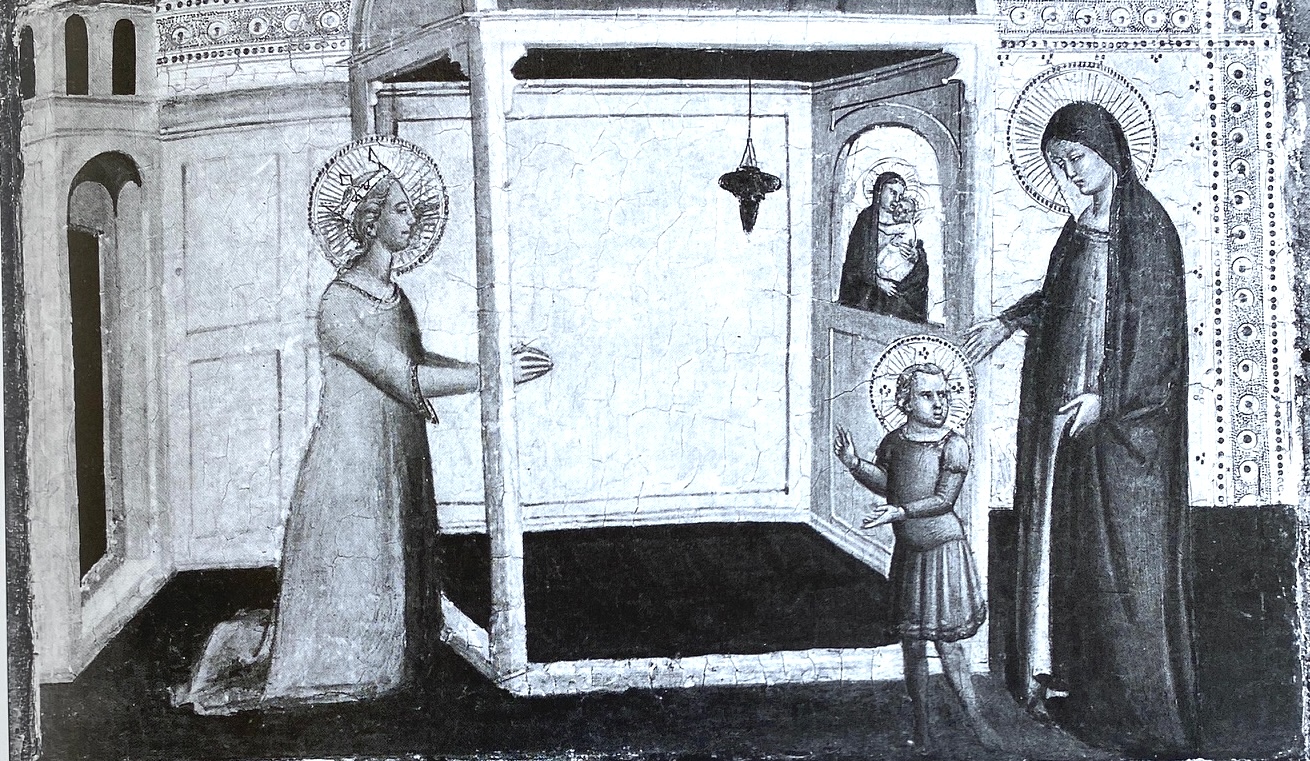
According to legend, Catherine was the daughter of King Kostos of Alexandria — beautiful, fiercely intelligent, and devoted to philosophy above all else. When her family pressed her to marry, she agreed on one condition she knew no earthly man could meet: her husband must equal her in nobility, wisdom, beauty, and wealth. Faced with this impossible standard, her mother consulted a hermit who lived beyond the city walls. He said he knew of a suitable candidate who exceeded even Catherine’s requirements in every way — and to introduce her to this suitor, he gave her a panel painting of the Virgin and Child. He told her to take it home, and that evening, alone, to pray before it and ask the Virgin to show her her Son.

The Icon That Opened a Vision

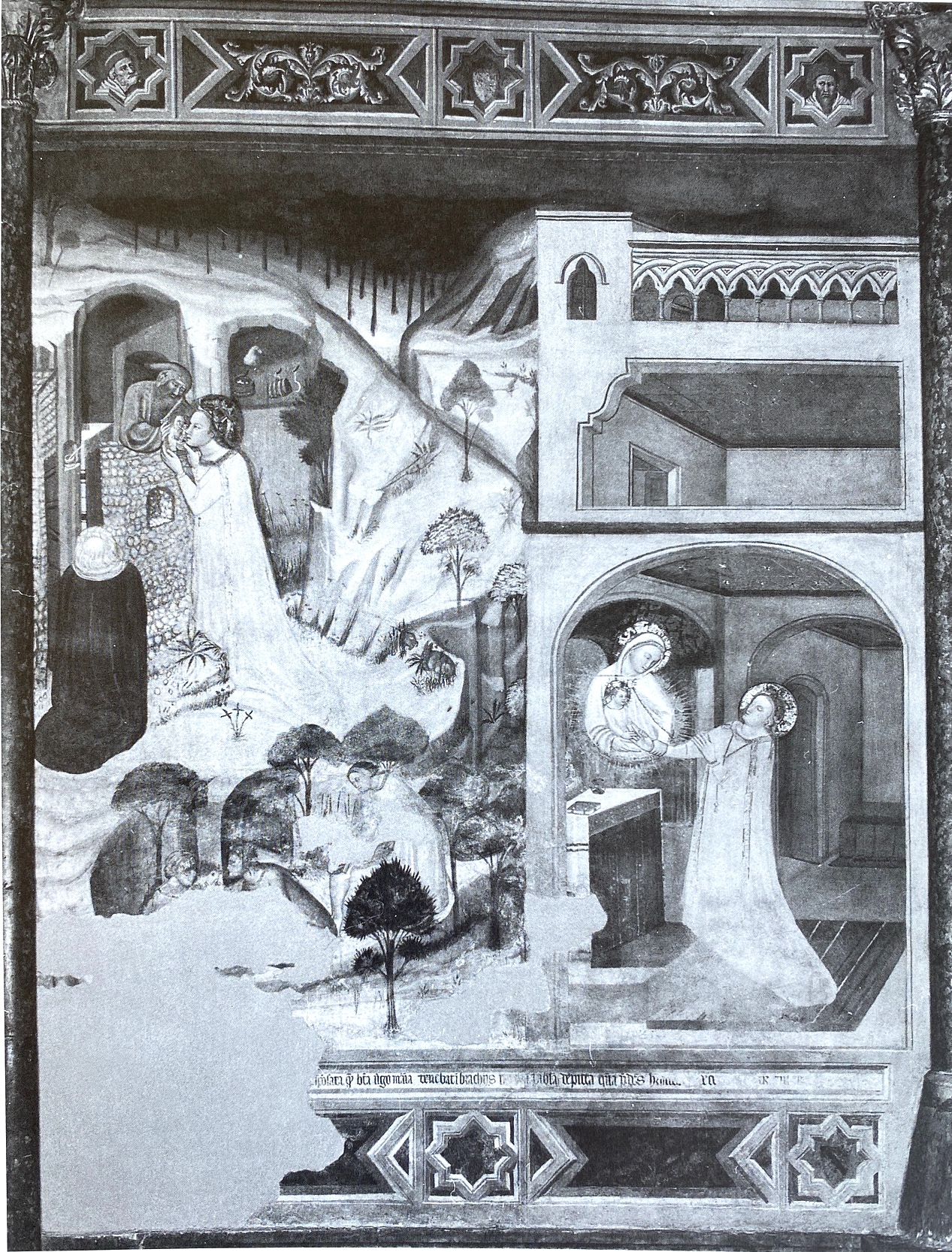
That evening, Catherine knelt before the icon and prayed. She fell asleep, and the Virgin appeared — but the Christ Child kept His face turned away. No matter how Catherine moved around the vision, He would not look at her. She overheard the Virgin asking her Son whether Catherine pleased Him by her beauty, her wisdom, her birth, her wealth. Each time, the Child answered that Catherine was exactly the opposite of what the Virgin described. He told her: return to the hermit, follow his teaching, and come back the following evening.

St. Catherine and the Hermit, Andrea Di Bartoli

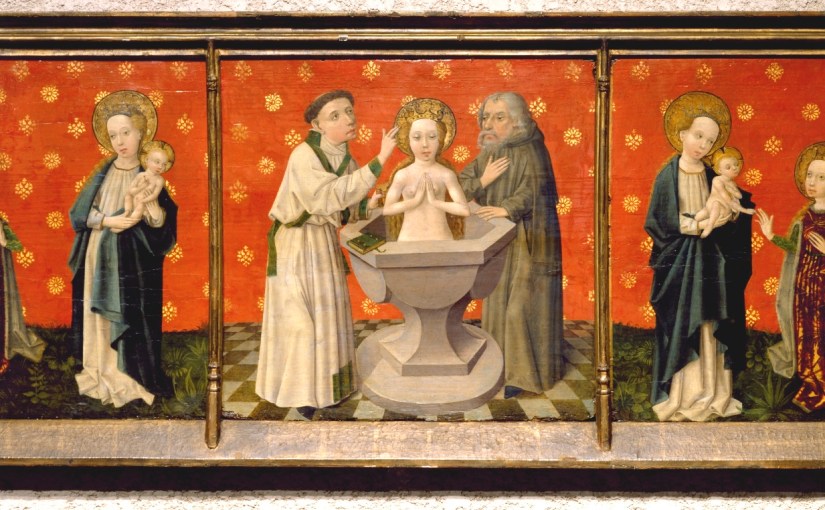
The next morning Catherine went to the hermit, received instruction in the Christian faith, and was baptized. That night, when she knelt again before the image, the Madonna appeared immediately. This time the Child looked directly at Catherine — and His gaze was so radiant that she fell to the ground as though dead. The Virgin raised her up. The Son declared that now Catherine was truly beautiful, wise, noble, and wealthy, and that He was ready to take her as His perpetual spouse. The Virgin took Catherine’s hand, and Christ placed His ring upon her finger.

When Catherine came to herself, the ring was still there.

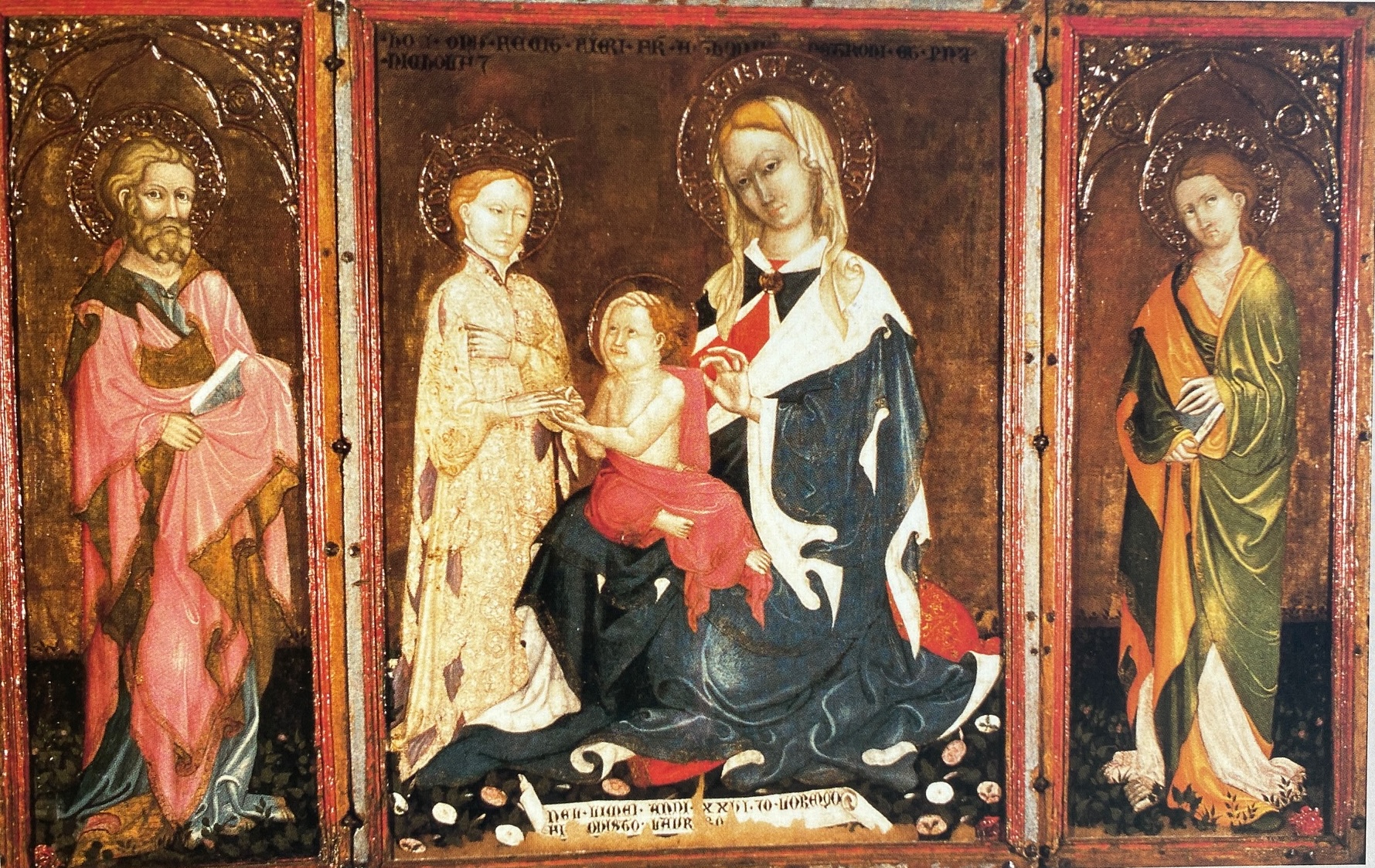
Anonymous (German). ‘Scenes from the Life of Saint Catherine of Alexandria,’ ca. 1430-1450. oil on wood. Walters Art Museum (37.2638): Gift of Mr. and Mrs. Mortimer Brandt, 1988.

Note for iconographers: The panel painting in this legend is not decoration — it is the instrument of encounter. The image acts as the necessary intermediary between earthly and transcendent reality. And the vision it opens is not merely interior: it involves the body. Catherine finds the ring on her finger. This is precisely the theology we invoke every time we pick up a brush.


The Soul as Bride of Christ

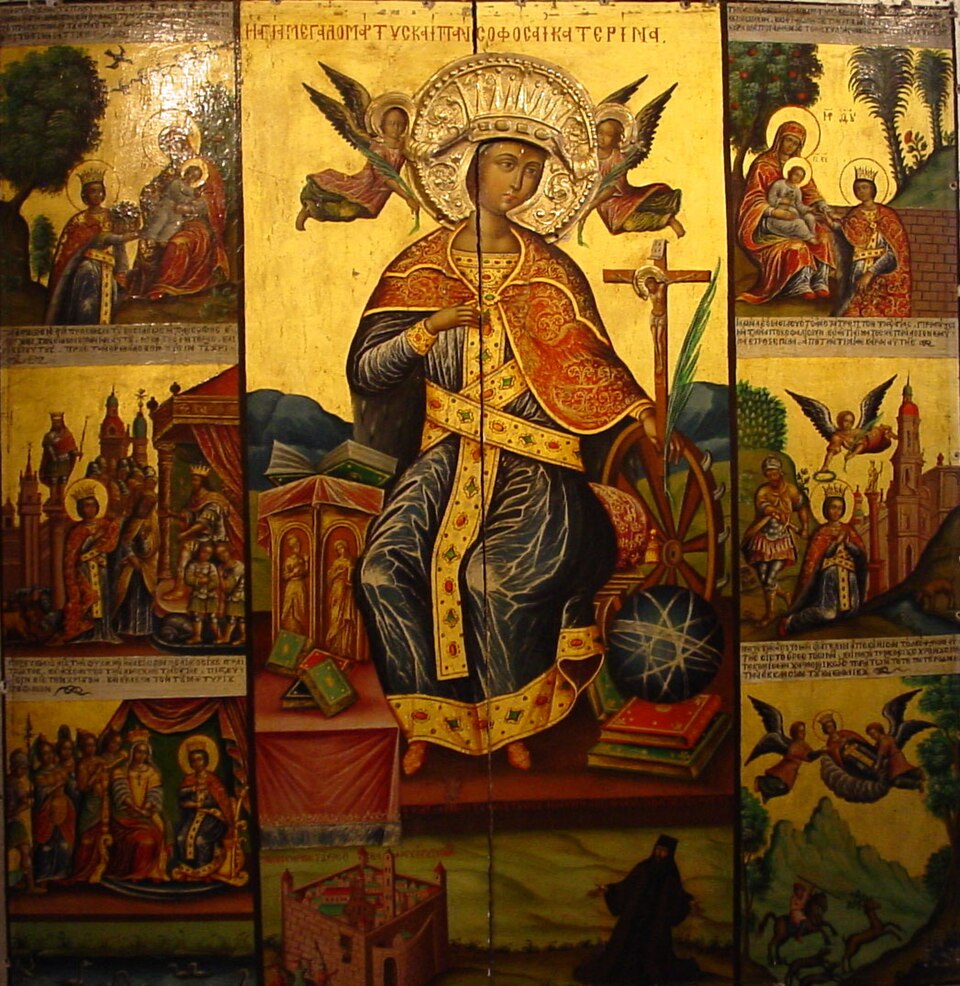
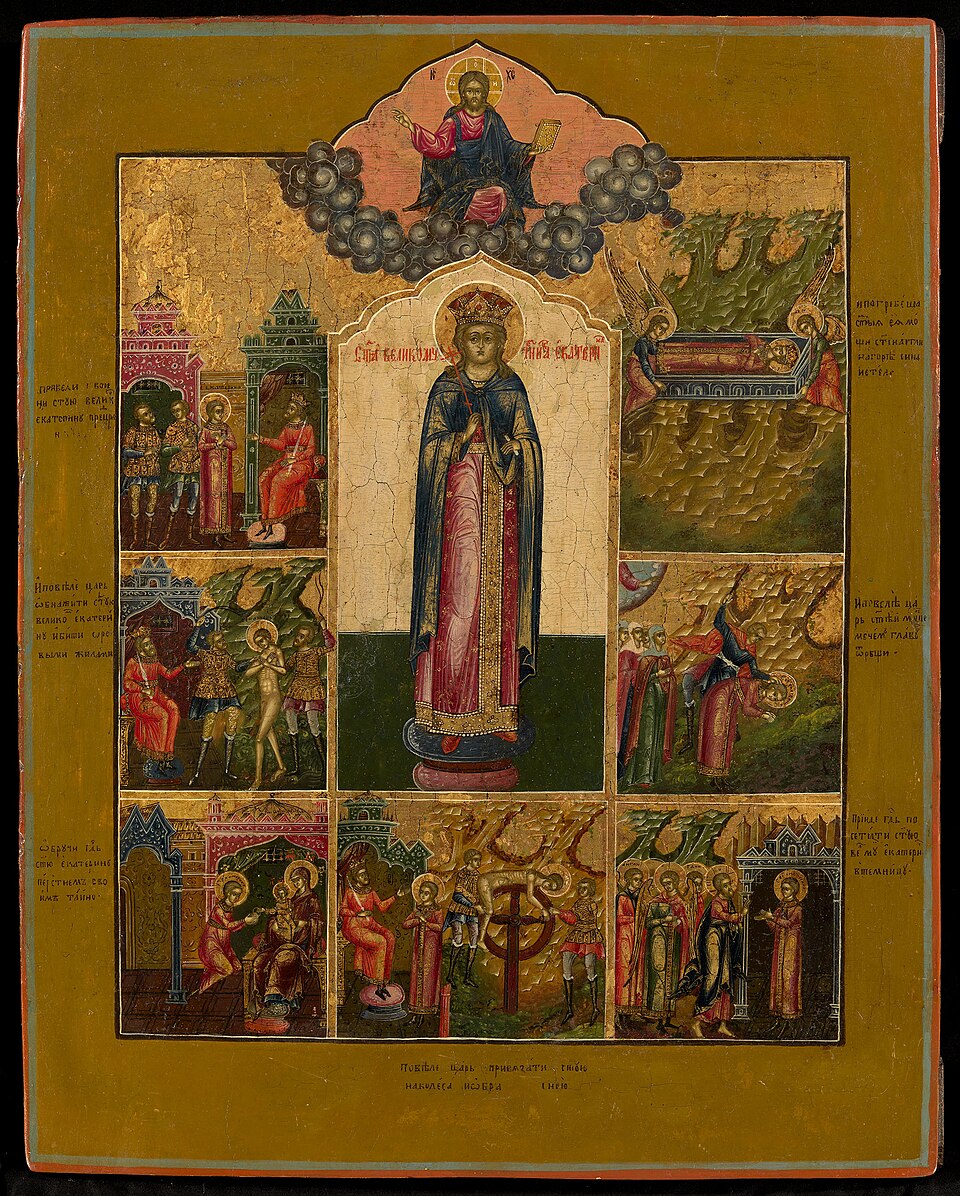
Saint Catherine Vitae Icon

Theologians of the late thirteenth century shaped this legend deliberately. Catherine becomes a type of the contemplative soul — any soul, not only a nun’s — that withdraws from the distractions of the world to be wholly the bride of Christ. She is a model for women who wish to live a deeply religious life while remaining in secular surroundings. Her story says: the sacred marriage is available to you. The icon on your wall can be the beginning of it.

“My beloved is mine, and I am his.” — Song of Songs 2:16


The Wheel, the Sword, and the Milk

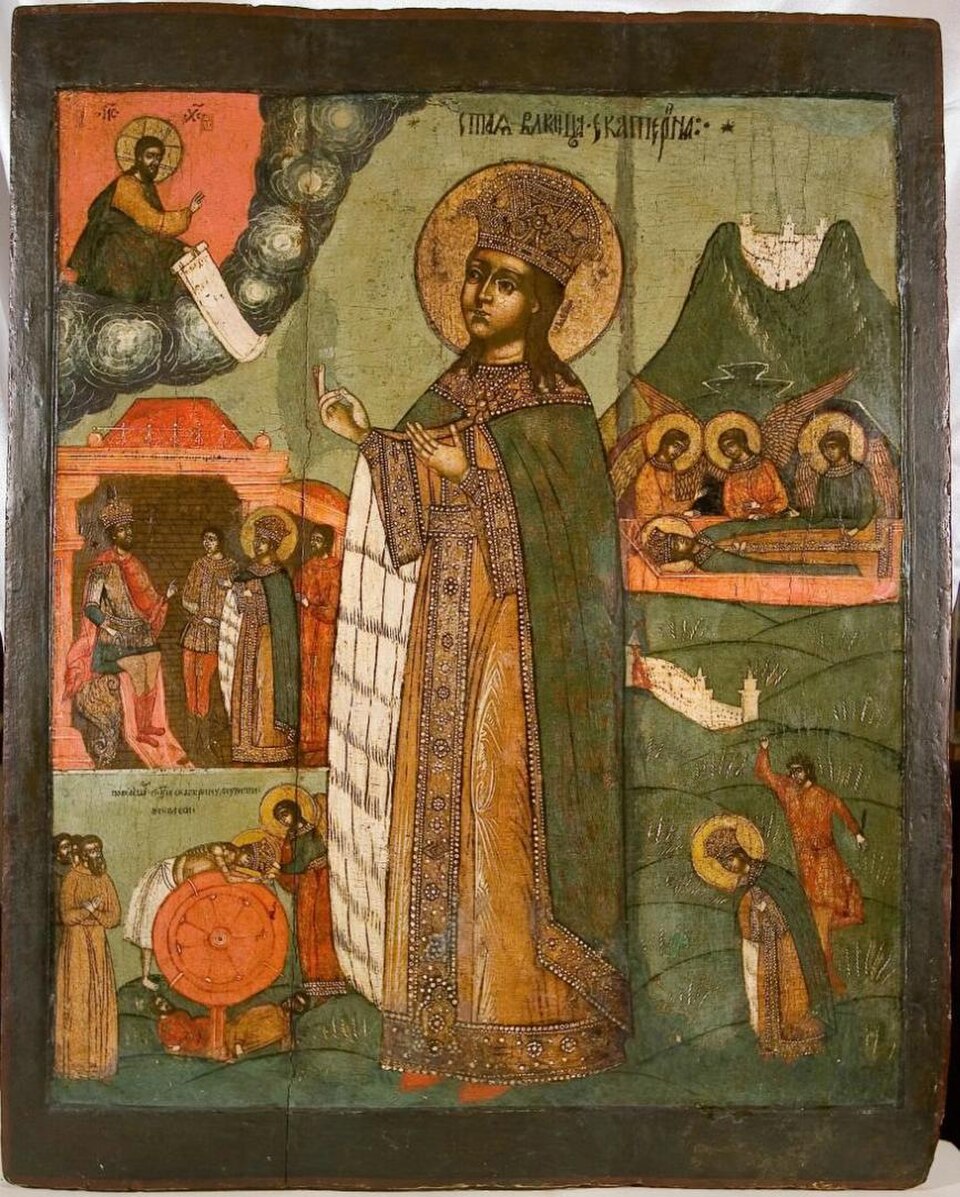
The rest of the legend unfolds with the fierce beauty characteristic of the great martyrs. The Emperor Maxentius ordered fifty philosophers to argue her out of her faith — all fifty were instead converted by her, and burned. He threw her in prison; a dove fed her daily from heaven; Christ Himself visited her cell and promised her a crown of glory. When she refused to marry him, declaring her spouse was already Jesus Christ, he condemned her to the spiked breaking wheel. At her touch, it shattered. She was beheaded. From her neck flowed milk, not blood.

St. Catherine of Alexandria Icon

In the sixth century, the Emperor Justinian established what is now Saint Catherine’s Monastery in Egypt, built around the site of the burning bush of Moses. It has been a place of pilgrimage and miraculous healing for fifteen centuries.


Why She Matters to Us

We paint icons because we believe what the Catherine legend enacts: that the sacred image is not illustration but threshold. It is a place where the invisible agrees to become visible, where the transcendent condescends to the material, where a woman can fall asleep before a small panel painting and wake with a ring on her finger.

Master of the Misericordia, St. Catherine oA alexandria

Among the fourteen most helpful saints, Catherine stands as patron of those who love wisdom. In our work, she reminds us that the image we are writing participates in a story far older and stranger than we can fully see. We are not simply illustrating theology. We are making a threshold.


Researched for a commission of Saint Catherine of Alexandria. Saint Catherine’s feast day is November 25.


Thanks so much for reading! Here are my other websites if you’d like to see some of my work!

Have a blessed June!

Christine

LINKS For  Christine Simoneau Hales   2026

  1. https://newchristianicions.com   my main website
  2. Https://christinehalesicons.com  Prints of my Icons
  3. https://online.iconwritingclasses.com  my online pre-recorded icon writing classes
  4. https://www.youtube.com/channel/UCK2WoRDiPivGtz2aw61FQXA  My YouTube Channel 
  5. Facebook: https://www.facebook.com/ChristineHalesFineArt     or  https://www.facebook.com/NewChristianIcons/
  6. Instagram:   https://www.instagram.com/christinehalesicons/?hl=en
  7. American Association of Iconographers:  FB Group:  https://www.facebook.com/groups/371054416651983
  8. American Association of Iconographers Website: https://americanassociationoficonographers.com

Iconoclasm

Iconoclasm in Church Art (600-1000)

Image from Class Chuludov Psalter, 9th Century, scene of Iconoclasm

Key Issues of Iconoclasm

Iconoclasm, the destruction or rejection of religious images, was a major controversy that profoundly impacted the Byzantine Empire from the 7th to the 9th centuries. The debate centered around the Second Commandment, which forbids idolatry, raising the question of whether holy images competed with God or enhanced Christians’ experience and knowledge of God. This controversy tore apart the Byzantine Empire, pitting the iconodules, who venerated icons as a logical progression of Christian art, against the iconoclasts, who believed that any image in a church was idolatry.

The East-West Divide

Sts. Theodore of Amasea and George conquering their enemies; 9th century, Mt. Sinai

In the Western Christian church, where Latin had become the church’s language, the Greek distinction between latria(worship for only God) and dulia (a lesser form of veneration) was not easily understood or accepted. Eventually, however, the Western church allowed images for veneration. Despite sharing one Christian faith, Latin Christendom and Byzantium developed distinct spiritual, intellectual, and institutional traditions, shaping cultural identities that persist today as two distinct divisions of the Church.

Byzantium Under Justinian and Theodora

Theodora, Mosaic, 9th century

In Byzantium, the Emperor Justinian (527-565 AD) and his wife Theodora implemented caesaropapism, ensuring that the emperor controlled both political and religious affairs. This mosaic shows Empress Theodora holding a chalice, with figures standing frontally and almost floating in space, signifying a stylistic break from the Greco-Roman tradition. This new style was associated with the divine world, rather than the naturalistic world. Theodora was murdered for opposing the removal of the Jesus icon on the Chalke Gate of the Great Palace of Constantinople during the iconoclasm movement.

The Iconoclast Controversy

Christ Mosaic, Hagia Sophia

According to traditional accounts, Iconoclasm began when Emperor Leo III removed an icon of Christ from the Chalke Gate of the imperial palace in Constantinople in 726 or 730, sparking widespread destruction of images and persecution of their defenders. In the East, Caliph Yazid issued a decree in 723 banning all holy images in Christian churches. In the West, Emperor Leo banned icons in all public places in 726. Pope Gregory III responded in 731, excommunicating those who denied the sanctity of icons or violated sacred images.

Opposition and Resolution

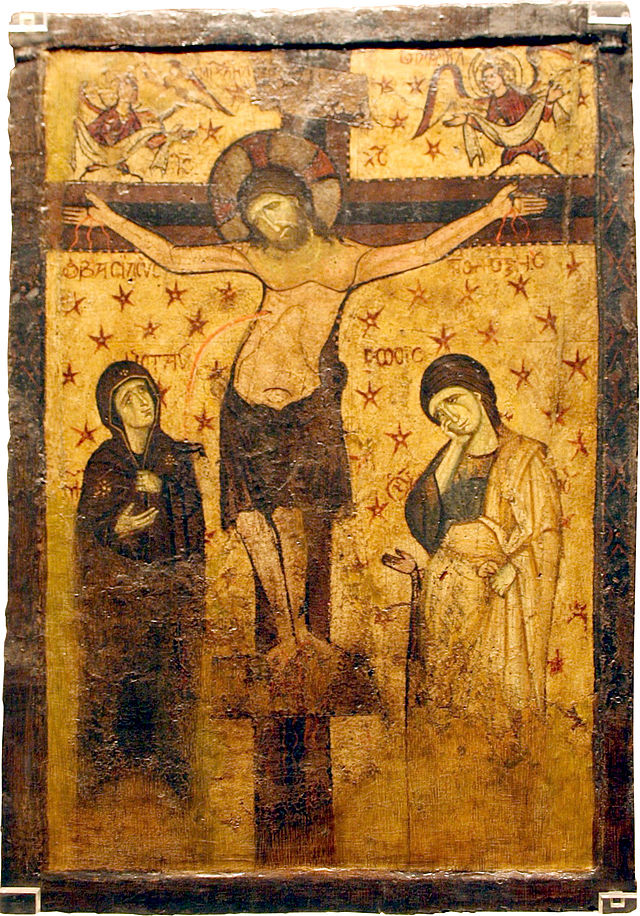
Crucifixion, Byzantine Museum, Athens. Circa 9-13th centuries.

St. Theodore the Studite (b. 759, Constantinople) was a leading opponent of iconoclasm, which disturbed relations between the Byzantine and Roman churches. The period of iconoclasm lasted until 797, with proponents of icons like Saint John of Damascus and the edicts of the Seventh Ecumenical Council supporting the veneration of icons. John of Damascus, an Arab Christian monk and theological doctor, was a prominent figure in the 8th-century Iconoclastic Controversy.

Cultural Impact and the Great Schism

Byzantine Iconoclasm, initiated by Emperor Leo III and continued by his successors, included widespread destruction of religious images and persecution of supporters. The period saw growing divergence and tension between the East and West, though the Church remained unified. The Western Church supported the use of religious images, while the Eastern Church was more divided.

Seventh Ecumenical Council Icon

The Great Schism of 1054 was caused by doctrinal differences, the rejection of universal Papal authority by Eastern patriarchs, and sociopolitical differences. This schism created lasting divisions that affect the study and practice of iconography today.

Modern Perspectives on Iconography

Iconoclasm, Clasm Chuldov Psalter, 9th Century

Today, a schism still exists between Western and Eastern iconographers regarding the nature and purpose of icons. Former Archbishop of Canterbury, Lord Rowan Williams, explained the significance of icons in his talk “Idol, Image, and Icon.” He described an idol as an empty illusion, whereas an image bridges the gap between absence and presence. Icons, made and used in prayer, open us up to God and embody the tension between divine presence and absence. They challenge and transform the viewer, claiming our attention and inviting us to experience the sacred.

Conclusion

Iconoclasm was a pivotal controversy in the history of the Byzantine Empire and the Christian Church, shaping the development of religious art and theological thought. Its legacy continues to influence the study and practice of iconography today, highlighting the enduring tension between tradition and innovation in religious expression.

I’m hoping to achieve Peace in our lifetime, with all those who call themselves Christians actively spreading the Doctrine of brotherly love to all of our neighbors.

INTERESTING LINKS:

Lord Rowan Williams, former Archbishop of Canterbury, Lecture at Birmingham University: Idols, Images, and Icons.

Wax Tempera and Modern Icons

May God continue to bless the eyes of your hearts with His love, until next month,

Christine Simoneau Hales, New Christian Icons

Upcoming Icon Painting Classes

Favored Concepts of Byzantine Iconographic Language

Dear Fellow Iconographers:

I’ve been reading and looking at icons quite a bit recently in an effort to understand what elements of the iconographic language I feel are important to incorporate into a more contemporary approach to writing icons.  Others will have different opinions about this, I’m sure!  But I have always learned best when I share my thoughts with others, either writing or speaking, so feel free to respond with your ideas or opinions on this as well, and thanks for your patience as I attempt to reason this out!!

The Protection of the Holy Virgin, Novgorod School, late 15th century

Depiction of buildings and space within the icon using inverse perspective.  This tends to flatten out the drawing and creates visually the understanding that this is not worldly reality but a spiritual reality we are depicting.  

I love the abstract way that folds on garments are rendered.  They both simplify and abstract the visual reality of the figure, again, pointing to the symbolic nature of the scene being depicted.

The way rhythm and movement are cleverly incorporated into the design by the repetition of curves in roofs, heads, building tops etc.

The Presentation of the Virgin, Novgorod School, fifteenth century

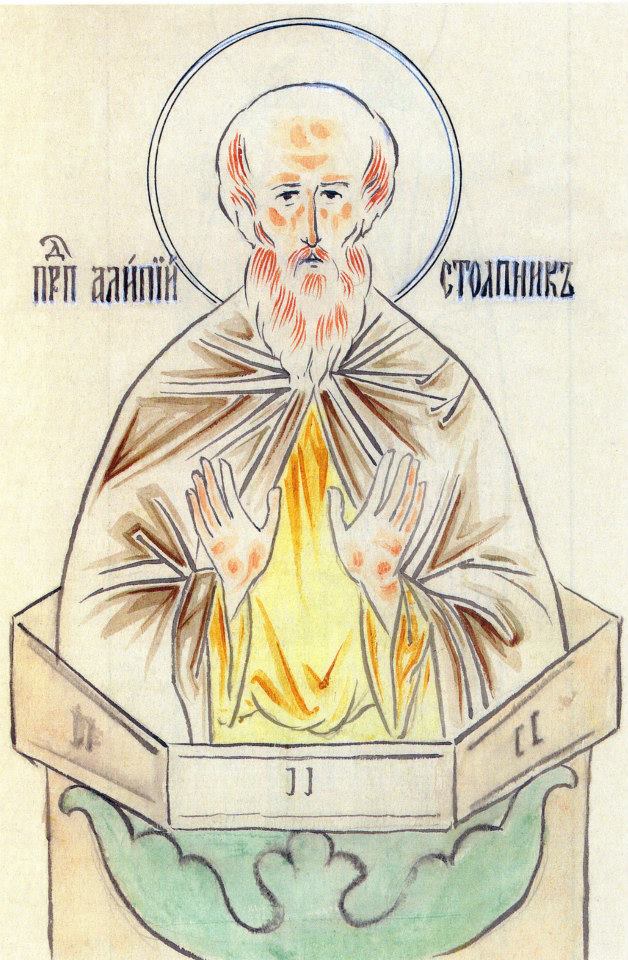
St. Simeon the Stylite shows the creative foreshortening of his column and renders it as a tower with stairs and a door with a balustrade at the top for him to rest upon.  He gives the blessing with his right hand and holds a scroll in the left- again, iconographic language that communicates his blessing and dedication to Holy Scripture.  It is said of him that he exercised an extraordinary spiritual authority and fought against spiritual heresies.1

  1. The Meaning of Icons, Leonid Ouspensky

St. Simeon Stylites, Russian, 16th Century

Another aspect of the iconographic language that I greatly admire is the consistent ways of highlighting faces,  They are somewhat realistic , but yet abstracted when eyes are exaggerate, simplified, and accentuated.  There is a consistency also in the way facial features are drawn.  You can see this in some of the early icon painting manuals- the one I use often is the Egon Sendler book Icons, Images of the Invisible.  Sadly, it is out of print, so is fairly expensive on the second hand book market, but I do recommend it highly if you can get one.  Hair is also stylized so as not to draw attention away from the spiritual reality being depicted.  

Of course, all this is ingenious, and why would we ever want to try to improve on it?  My take on that is that I want to make icons – or religious art- that will attract my community in this time.  Last month I published a photo of one of Stephen Antonakas’ neon art pieces of the Transfiguration.( https://americanassociationoficonographers.com/  )that I think brilliantly captures the essence of the Icon, but its very abstractness renders the actual Transfiguration story unreadable and unknowable if you are not familiar with the Scripture or the story.  However, if you do know the story, his work captures the essence in a new and different way that allows a deeper appreciation and allows us to think differently about that moment. Mark 9:2-13, Matthew 17:1-17, and Luke 9:28-36.

What is the main message of the Transfiguration?

Transfiguration Icon, Russian, Novgorod School, 15th Century

Though the disciples do not understand his meaning, the Transfiguration and Jesus’ charge to the disciples present a promise of what is to come. There is hope, because he will soon triumph over sin and death, and be raised in the fullness of glory – the glory of which they have just been given a glimpse.

So, again, compare and contrast- here is a Russian icon from the Novgorod school, fifteenth century.  Definitely light is emphasized in both the Antonakas neon sculpture as well as the icon, but it is missing the two prophets, Moses and Elijah- Moses representing the dead and Elijah, because he was taken up to heaven, represents the living, calling attention to the message of hope of the Second Coming.  Both had a secret vision from God.  “Christ appears as the Lord of the quick and the dead, coming in glory of the future age.  The Transfiguration was an anticipation of His glorious second coming, says St. Basil, the moment which opened a perspective of eternity and time.”  Meaning of Icons, Leonid Ouspensky P. 212

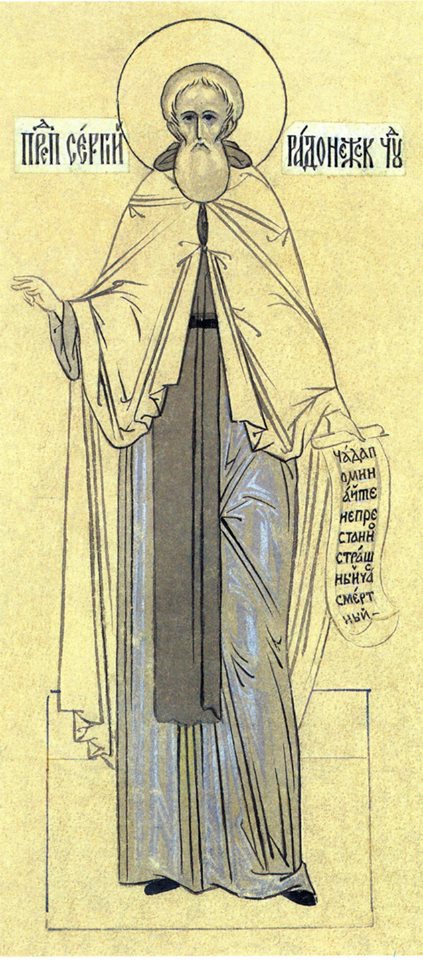
This beautiful icon of St. Sergius of Radoneh again emphasizes simplicity both in design and color palette.

Saint Sergius of Radoneh, Russian, 20th Century

Byzantine Iconography as a Sacred Art

According to Constantine Cavarnos in his book, ” Guide to Byzantine Iconography”, Byzantine iconography is a sacred art.  It is art that is spiritual in essence and aims.  It has seven functions: (1). to enhance the beauty of the church with a beauty that has the impress of holiness. ( 2). To instruct us in matters pertaining to the Orthodox Christian faith.  (3) To remind us of this teaching. (4) To lift us up to the prototypes, to the holy personages whom the icons depict.  (5) To arouse us to imitate the virtues of these personages. (6) To help transform us, to sanctify us.  (7) To serve as means of worshipping God and venerating His saints.”

So, in closing, I have mentioned some of the concepts that make an icon a sacred work of art.   I expect that each of you will have other favorite and important elements of the iconographic language to emphasize. I look forward to hearing from you on this topic and possibly incorporating your thoughts into future articles.

Until next month, May God bless the work of your hands, and guide your thoughts, waking and sleeping,

Christine Simoneau Hales

https://newchristianicons.com

The Transfiguration Icon by Christine Hales 21st Century

My next online Icon writing class is April 9-12, visit: newchristianicons.com for more details and to register.