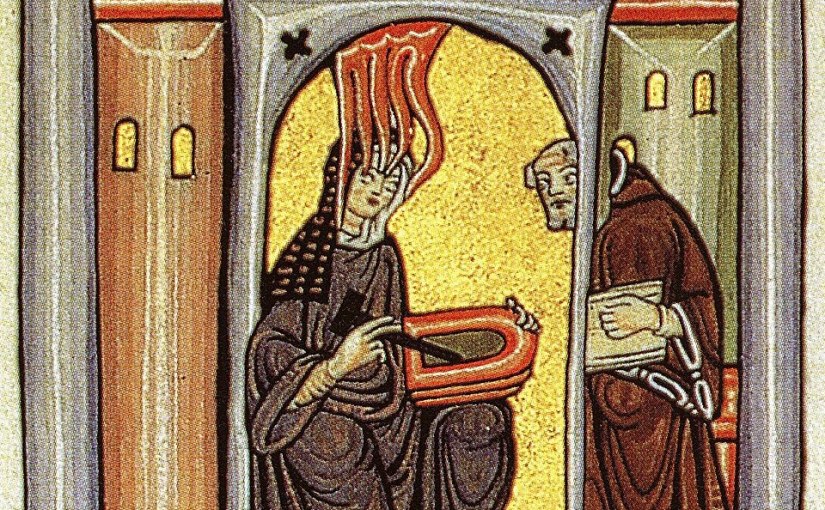

The Middle Ages was perhaps the last period in the West to possess a truly living cosmology—a worldview in which mysticism, theology, nature, and everyday life were understood as an inseparable whole. Rather than seeing creation as something separate from God, medieval mystics lived within the conviction that all things exist in God, and God is present in all things.
As iconographers, this is precisely the vision we seek to recover. Every icon proclaims that the material world is capable of revealing the Divine. Wood, pigment, gold, and light become vehicles of grace because the Incarnation forever united heaven and earth.
Among the great mystics who embodied this vision, one stands out as an extraordinary source of inspiration: Hildegard of Bingen (1098–1179).
A Woman of Astonishing Gifts
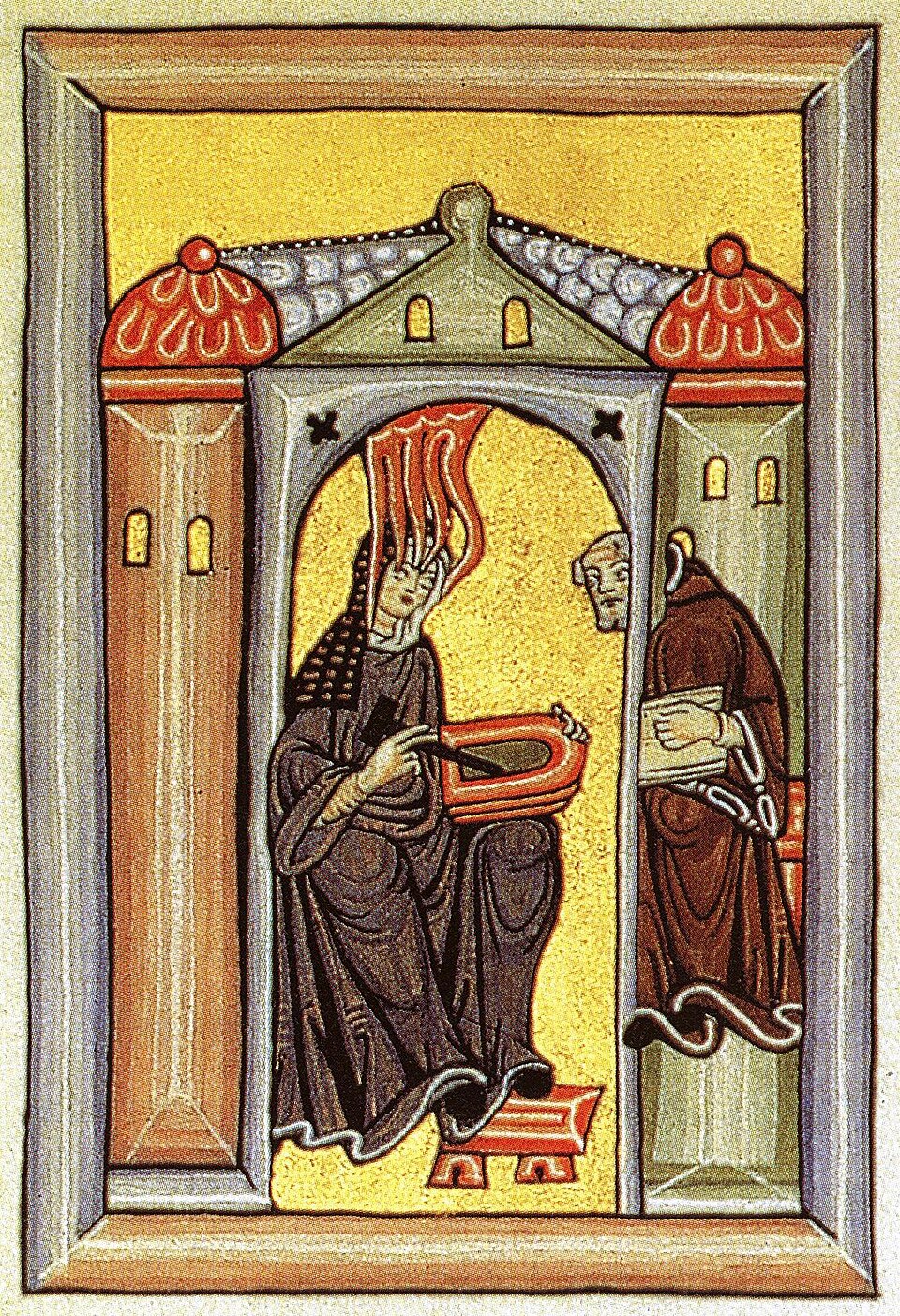
Hildegard of Bingen was a Benedictine abbess, visionary, theologian, composer, scientist, physician, botanist, poet, artist, and philosopher. Few people in history have excelled in so many disciplines. Her remarkable intellect and creativity earned her the title “The Sibyl of the Rhine.”
Born in 1098 in present-day Germany, Hildegard was the tenth child of a noble family. Following the custom of the time, she was dedicated to the Church as a child and entered a Benedictine monastery, taking her vows at the age of fifteen. Within the monastery she received an exceptional education and devoted her life to prayer, study, and the service of God.
From childhood she experienced powerful visions that she understood to be revelations from God. Initially reluctant to speak publicly about them, she eventually believed she had been commanded to write them down. Because women were rarely granted authority to teach theology during the twelfth century, Hildegard sought—and received—papal approval to publish her writings and even to preach publicly.
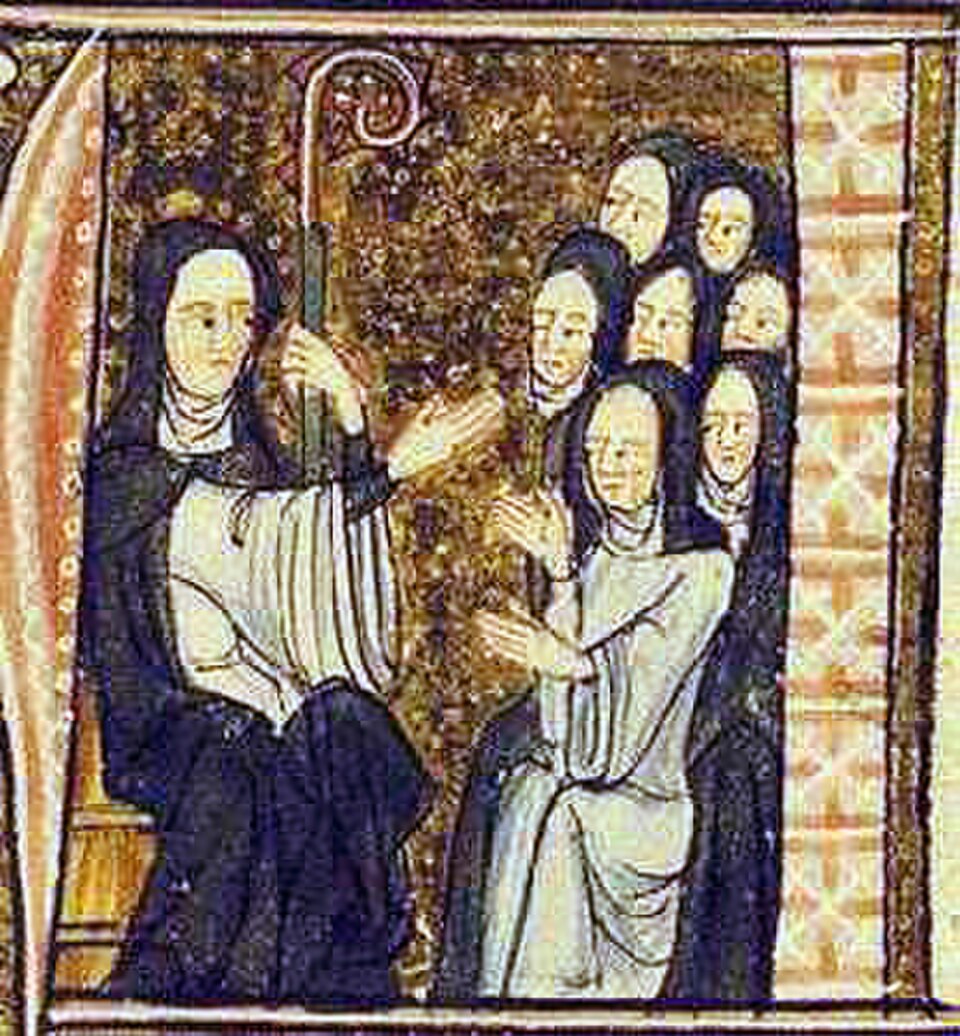
She later founded her own convent at Rupertsberg near Bingen, where she continued to write, teach, compose music, correspond with emperors, bishops, abbots, and popes, and care for those seeking spiritual and physical healing.
A Universal Scholar
Hildegard’s accomplishments remain astonishing nearly nine centuries later.
In theology, she wrote visionary masterpieces including Scivias (“Know the Ways of the Lord”), richly illustrated with symbolic images that communicate profound spiritual truths. These visionary illuminations continue to inspire artists and theologians alike.
In music, she composed more than seventy liturgical songs whose soaring melodies expanded the musical vocabulary of the medieval Church. Her works are still performed and recorded throughout the world.
As a physician and botanist, Hildegard authored treatises describing the healing properties of more than two hundred plants while exploring the causes and treatment of illness through a holistic understanding of body, mind, and spirit.
Her curiosity even extended to linguistics. She created an entirely original language, the Lingua Ignota (“Unknown Language”), complete with its own alphabet and vocabulary—one of history’s earliest constructed languages.
Her achievements across theology, science, medicine, music, literature, and art established her as one of the great universal scholars of the Middle Ages.

Nature Filled with Divine Light
One reason Hildegard speaks so powerfully to iconographers is her vision of creation.
She saw the natural world as radiant with God’s presence. Mountains, trees, rivers, herbs, stars, and human beings all participated in the life of the Creator. Rather than separating the spiritual from the material, Hildegard saw them as united.
Her writings frequently celebrate what she called viriditas—the “greening power” or life-giving vitality of God flowing through all creation. This image beautifully parallels the iconographer’s task. Icons reveal not merely the appearance of the visible world but its transfigured reality, illuminated by divine life.
Like the icon, Hildegard’s vision teaches us to see beneath appearances into the deeper reality of God’s presence.
Mystic and Prophet
Hildegard was not only a contemplative but also a prophet.
She fearlessly challenged corruption wherever she found it, addressing emperors, bishops, abbots, and even popes with remarkable courage. She often compared herself to the prophet Ezekiel, whose symbolic visions exposed the spiritual failures of his own generation.
For Hildegard, prophecy was never about predicting the future. It was about awakening people to truth.
Prophets, she believed, illuminate the darkness. They call people to responsibility, repentance, justice, and deeper communion with God.
Her book Scivias invites readers to “know the wise ways” rather than the foolish ones. Her other major works—including Liber Vitae Meritorum (Book of Life’s Merits), De Operatione Dei (The Book of Divine Works), Physica, and Liber Compositae Medicinae—combine theology, ethics, medicine, natural science, and spiritual wisdom into a unified vision of human flourishing.
Throughout her writings she repeatedly emphasizes one practical virtue: usefulness. The purpose of knowledge, prayer, and creativity is not self-glorification but the building up of God’s people.
Lessons for Today’s Iconographer
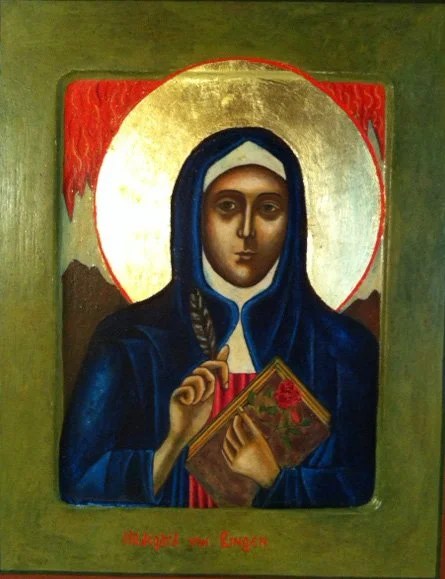
Hildegard’s life offers profound encouragement for those called to write icons.
She reminds us that artistic excellence and deep spirituality are not separate pursuits but expressions of the same vocation. The iconographer must cultivate prayer, theological understanding, careful observation of creation, disciplined craftsmanship, and openness to the inspiration of the Holy Spirit.
She also teaches us that creativity flourishes when rooted in contemplation. Because Hildegard remained faithful to her mystical experiences while embracing music, medicine, science, theology, and art, she models an integrated life in which every gift serves God.
Perhaps this is why she continues to inspire Christians from many traditions. Her work points toward a unity that transcends divisions—a unity grounded in the conviction that all truth belongs to God.
In 2012, Hildegard of Bingen was declared a Doctor of the Church, becoming only the fourth woman to receive this distinction. She is also widely honored as a patron of ecology because of her profound understanding of humanity’s relationship with creation.
For iconographers, her life serves as a reminder that our work is not simply the production of sacred images. It is participation in God’s ongoing work of revealing His glory through the beauty of creation.
When we grind pigments, lay gold leaf, or prayerfully draw the face of Christ or one of His saints, we participate in the same sacramental vision that Hildegard proclaimed nearly nine hundred years ago—a world alive with Divine Light.
Viriditas, is a latin term for “greenness”, a concept Hildegard used for healing as a metaphor for the divine life force, vitality, and the healing energy that permeates all of nature and the human soul. In iconography, we could equate that concept with the concept of the uncreated light that icons capture. The light of God as distinct from the light of the sun. Viriditas was “the greening power of God.” It was in everything, including humans. This “greenness” was an expression of heaven, the creative power of life
I hope this blog is of interest and look forward to hearing your comments!
Blessings,
Christine Hales
Suggested Reading
- Illuminations of Hildegard of Bingen, text by Hildegard of Bingen with commentary by Matthew Fox
- Christian Mysticism by Manuela Dunn Mascetti
- Hildegard’s own writings, including Scivias, The Book of Divine Works, Physica, and Book of Life’s Merits
Interesting Links for Iconographers:
Betsy Porter hosts regular Zoom get togethers for all iconographers. She is an iconographer in California and a member of St. Gregory’s Church. To get on her mailing list for zoom links, visit her website: Betsy Porter
Dorothy Alexander holds an Icon writing get together for iconographers , also in California. To get on her email list, contact me – she doesn’t seem to have a website.
My Internet Accounts
- https://newchristianicons.com my main website
- Https://christinehalesicons.com Prints of my Icons
- https://online.iconwritingclasses.com my online pre-recorded icon writing classes
- https://www.youtube.com/channel/UCK2WoRDiPivGtz2aw61FQXA My YouTube Channel
- Facebook: https://www.facebook.com/ChristineHalesFineArt or https://www.facebook.com/NewChristianIcons/
- Instagram: https://www.instagram.com/christinehalesicons/?hl=en
- American Association of Iconographers: FB Group: https://www.facebook.com/groups/371054416651983
- American Association of Iconographers Website: https://americanassociationoficonographers.com
- 9. my Patreon Account: christinehalesfineart