Iconoclasm

Iconoclasm in Church Art (600-1000)

Image from Class Chuludov Psalter, 9th Century, scene of Iconoclasm

Key Issues of Iconoclasm

Iconoclasm, the destruction or rejection of religious images, was a major controversy that profoundly impacted the Byzantine Empire from the 7th to the 9th centuries. The debate centered around the Second Commandment, which forbids idolatry, raising the question of whether holy images competed with God or enhanced Christians’ experience and knowledge of God. This controversy tore apart the Byzantine Empire, pitting the iconodules, who venerated icons as a logical progression of Christian art, against the iconoclasts, who believed that any image in a church was idolatry.

The East-West Divide

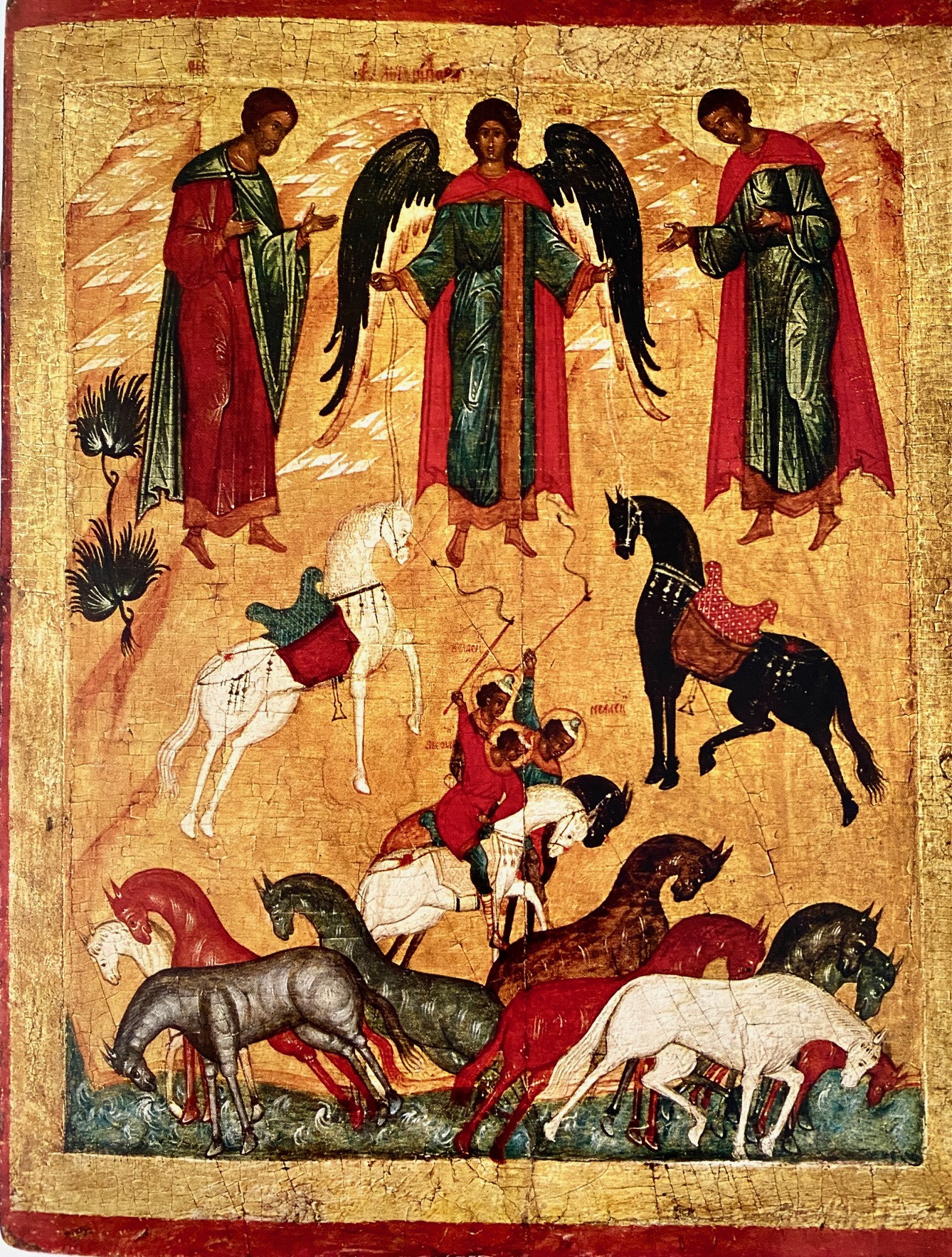
Sts. Theodore of Amasea and George conquering their enemies; 9th century, Mt. Sinai

In the Western Christian church, where Latin had become the church’s language, the Greek distinction between latria(worship for only God) and dulia (a lesser form of veneration) was not easily understood or accepted. Eventually, however, the Western church allowed images for veneration. Despite sharing one Christian faith, Latin Christendom and Byzantium developed distinct spiritual, intellectual, and institutional traditions, shaping cultural identities that persist today as two distinct divisions of the Church.

Byzantium Under Justinian and Theodora

Theodora, Mosaic, 9th century

In Byzantium, the Emperor Justinian (527-565 AD) and his wife Theodora implemented caesaropapism, ensuring that the emperor controlled both political and religious affairs. This mosaic shows Empress Theodora holding a chalice, with figures standing frontally and almost floating in space, signifying a stylistic break from the Greco-Roman tradition. This new style was associated with the divine world, rather than the naturalistic world. Theodora was murdered for opposing the removal of the Jesus icon on the Chalke Gate of the Great Palace of Constantinople during the iconoclasm movement.

The Iconoclast Controversy

Christ Mosaic, Hagia Sophia

According to traditional accounts, Iconoclasm began when Emperor Leo III removed an icon of Christ from the Chalke Gate of the imperial palace in Constantinople in 726 or 730, sparking widespread destruction of images and persecution of their defenders. In the East, Caliph Yazid issued a decree in 723 banning all holy images in Christian churches. In the West, Emperor Leo banned icons in all public places in 726. Pope Gregory III responded in 731, excommunicating those who denied the sanctity of icons or violated sacred images.

Opposition and Resolution

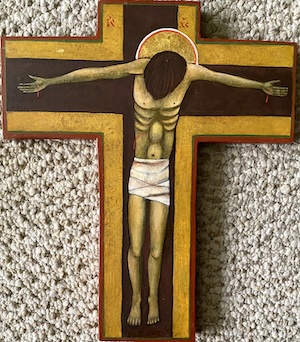
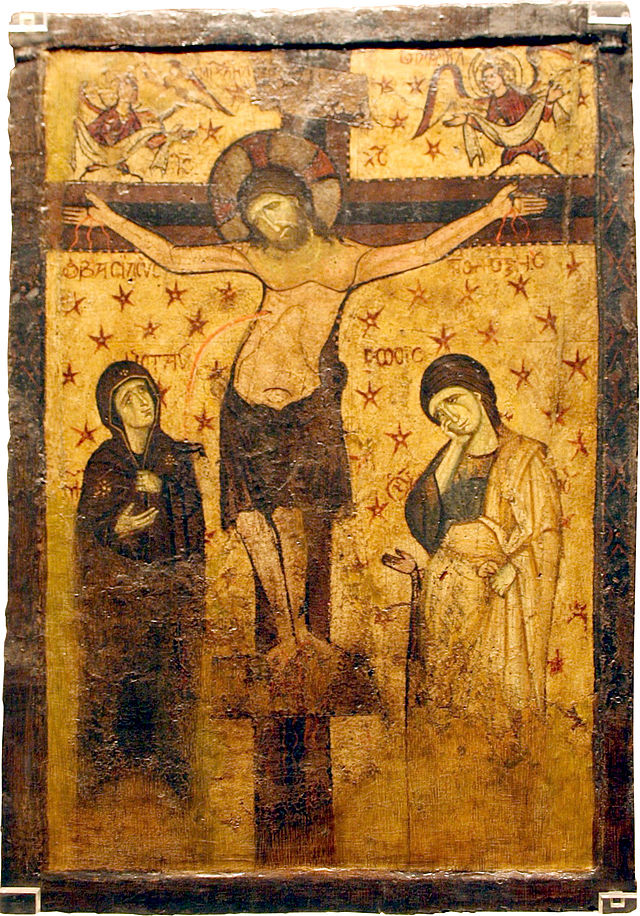
Crucifixion, Byzantine Museum, Athens. Circa 9-13th centuries.

St. Theodore the Studite (b. 759, Constantinople) was a leading opponent of iconoclasm, which disturbed relations between the Byzantine and Roman churches. The period of iconoclasm lasted until 797, with proponents of icons like Saint John of Damascus and the edicts of the Seventh Ecumenical Council supporting the veneration of icons. John of Damascus, an Arab Christian monk and theological doctor, was a prominent figure in the 8th-century Iconoclastic Controversy.

Cultural Impact and the Great Schism

Byzantine Iconoclasm, initiated by Emperor Leo III and continued by his successors, included widespread destruction of religious images and persecution of supporters. The period saw growing divergence and tension between the East and West, though the Church remained unified. The Western Church supported the use of religious images, while the Eastern Church was more divided.

Seventh Ecumenical Council Icon

The Great Schism of 1054 was caused by doctrinal differences, the rejection of universal Papal authority by Eastern patriarchs, and sociopolitical differences. This schism created lasting divisions that affect the study and practice of iconography today.

Modern Perspectives on Iconography

Iconoclasm, Clasm Chuldov Psalter, 9th Century

Today, a schism still exists between Western and Eastern iconographers regarding the nature and purpose of icons. Former Archbishop of Canterbury, Lord Rowan Williams, explained the significance of icons in his talk “Idol, Image, and Icon.” He described an idol as an empty illusion, whereas an image bridges the gap between absence and presence. Icons, made and used in prayer, open us up to God and embody the tension between divine presence and absence. They challenge and transform the viewer, claiming our attention and inviting us to experience the sacred.

Conclusion

Iconoclasm was a pivotal controversy in the history of the Byzantine Empire and the Christian Church, shaping the development of religious art and theological thought. Its legacy continues to influence the study and practice of iconography today, highlighting the enduring tension between tradition and innovation in religious expression.

I’m hoping to achieve Peace in our lifetime, with all those who call themselves Christians actively spreading the Doctrine of brotherly love to all of our neighbors.

INTERESTING LINKS:

Lord Rowan Williams, former Archbishop of Canterbury, Lecture at Birmingham University: Idols, Images, and Icons.

Wax Tempera and Modern Icons

May God continue to bless the eyes of your hearts with His love, until next month,

Christine Simoneau Hales, New Christian Icons

Upcoming Icon Painting Classes

The Uncreated Light

Dear Fellow Iconographers:

Saint Fyodor of Rostov Icon depicting “Theoria”. By the hand of Christine Hales

Recently, while sharing with good friends my current Icon exhibition at All Angels Church in Sarasota, I was pleasantly reminded about the importance of the concept of the “uncreated light” within icons. Having promised to reflect more on this topic, I now share with you some thoughts and research on that very important but sometimes overlooked aspect of icon writing/painting.

The Light of Mt. Tabor: The Light of the Transfiguration and Paul’s Conversion

In the 14th century, Gregory Palamas, an Athonite monk and proponent of Hesychasm, explored the concept of the Uncreated Light. According to the Hesychast mystic tradition of Eastern Orthodox spirituality, a completely purified saint who has attained divine union experiences a vision of divine radiance, the same ‘light’ that was manifested to Jesus’ disciples on Mount Tabor at the Transfiguration and to Saint Paul at his conversion. This profound experience is referred to as theoria. The doctrine of the uncreated light is rooted in Palamas’ interpretation of the teachings of Gregory of Nyssa.

Orthodox Christians also find instances of the Uncreated Light in the Old Testament, such as the Burning Bush.

Burning Bush Icon -Moses and Mary with Christ Child. by the hand of Christine Hales

Joseph the Elder, Hesychast

Joseph the Elder, a 20th century Hesychast and Greek Orthodox monk from Mount Athos, longed for unceasing prayer but faced numerous challenges, including the difficulty of finding a spiritual father and the indifference of many monks toward constant prayer. In his yearning for divine connection, Joseph was ultimately granted a vision of the uncreated light, receiving the gift of ceaseless prayer.

“At once I was completely changed and forgot myself. I was filled with light in my heart and outside and everywhere, not being aware that I even had a body. The prayer began to say itself within me…

O Master, our sweetest Lord Jesus Christ, send forth Your grace and free me from the bonds of sin. Enlighten the darkness of my soul, so that I may apprehend Your infinite mercy, and so that I may love and thank You worthily, my sweetest Savior, Who is worthy of all love and thanks.” Amen

Egon Sendler on Iconic Light

Egon Sendler, in his book “Icon, Image of the Invisible”, explained that the light depicted in icons is distinct from natural light. Iconic light represents incarnate grace and must be received in contemplation.

“In the icon, we see a divine reality that transcends this earthly world while respecting it because it is created by God, to be transfigured in His spirit. If an icon reduces the mystery of God to mere material forms, it loses its soul and spiritual character, becoming an illusion of reality.”

Sendler emphasized that the dynamic nature of icons involves all the pictorial elements moving towards the observer, with light following this movement, creating a transfigured world and bringing the viewer into union with God..

Leonid Ouspensky from “The Meaning of Icons”

Transfiguration Icon by the hand of Christine Hales

Leonid Ouspensky, in his book entitled “The Meaning of Icons”, highlighted that Church art, particularly icons, visually testifies to the dual realities of God and the world, grace and nature.

“Through the icon, as through the Holy Scriptures, we not only learn about God but also know God. The transfiguration, an illumination of the entire man through prayer by the uncreated light of Divine Grace, manifests man as a living icon of God. The icon represents this transfiguration, depicting a man filled with the Holy Spirit’s grace.”

Ouspensky concluded that liturgical art represents both our offering to God and God’s descent into our midst, facilitating a profound meeting between God and man, grace and nature, eternity and time. Perceiving the uncreated light of God’s grace in an icon leads us toward Holy Communion with God, transcending our natural world.

Conclusion:

The concept of the Uncreated Light in Eastern Orthodox spirituality and iconography emphasizes the profound connection between the divine and the material world. Through the transformative experiences of saints like Joseph the Elder and the theological insights of figures like Gregory Palamas, Egon Sendler, and Leonid Ouspensky, we understand that icons are not merely art but manifestations of divine reality and grace, guiding believers towards a deeper communion with God.  And so, when writing, or painting icons, choosing colors that reflect the uncreated light of God’s grace becomes a subtle, but highly important imperative of icon creation.

Here are some interesting links for Iconographers:

Icon Museum and Study Center, Clinton Massachusetts

Introduction to Icons Video by Patristix

Icon Writing Pigments and other Supplies for Icon Painting

That’s all for this month. May God continue to bless the work of your hands,

Christine Simoneau Hales

New Christian Icons Icon Painting Instruction

Prints of My Icons Christine Hales’ Icon Book

Coptic Icons

Coptic Icon of Saint Michael
Archangel Ethiopian Icon, C. 19th century

Recently, while teaching an online icon writing class on the Transfiguration, the subject of Coptic icons came up.  Each of us spoke admiringly about them, the color schemes, the simplified human forms, and the fact that they are  attractive in many ways.  But we soon realized that we didn’t really know much about them.

Coptic Ethiopian Icon

So, here I have done some research that I now share, and I hope that many of you  with more knowledge will share your thoughts and Coptic icon images on the FB (American Association of Iconographers FB group) page too.

Here’s what I have been able to discover:

In 30 BC, Egypt became a Roman province, and over the next several years, immigrants from Greece, Rome, Libya, and Syria brought their artmaking traditions  and methods to apply to the  art of this time.  According to tradition, the Coptic Church was founded by Mark the Evangelist c. AD 42, and regards itself as the subject of many prophecies in the Old Testament. The first Christians in Egypt were common people who spoke Egyptian Coptic.

Saint Anthony and Saint Paul the Hermit c. 14th C.

The Church of Alexandria was the first Church of Africa, and through it, the  influence of Coptic art spread to Sudan and Ethiopia. Some forms of the Coptic cross are known as the Ethiopian cross and many Churches in Ethiopia show the influence of the Coptic art.

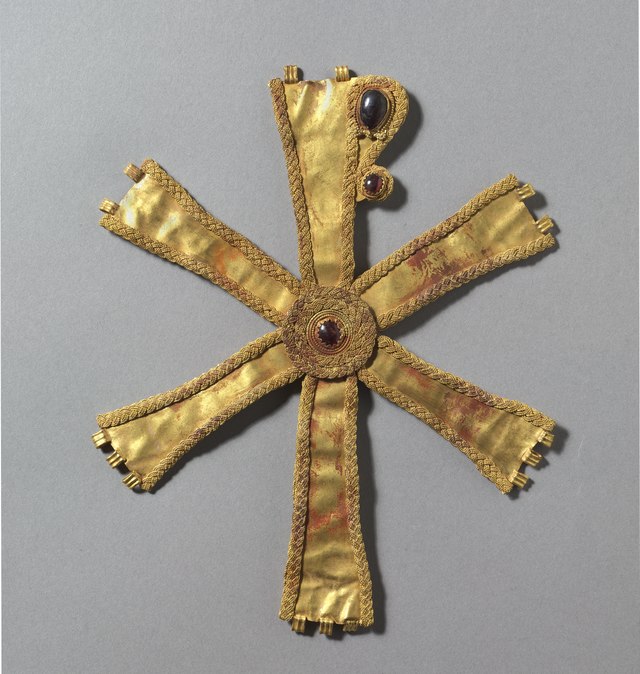
Coptic Cross
Coptic Cross

The early Coptic icons of the third century Egypt, used encaustic paints and later, influenced by the Byzantine tradition, egg tempera.  The Coptic style favors enlarged eyes, frontal figures, and an under emphasis of natural proportions in figures. The figures of saints display eyes and ears larger in proportion to the rest of the face and a smaller mouth, as well as enlarged heads, signifying a spiritual relationship with God and devotion to prayer. Martyrs’ faces were peaceful. Early Coptic icons were influenced in style of painting by the Egyptian Fayum memorial portraits used on Egyptian sarcophagi.

Fayum Portrait

These Fayum portraits from the Egyptian Sarcophagi were painted in the Greco-Roman style of painting and became the basis of both Coptic and Byzantine iconography. Beautiful portraits, they have simple, graceful forms, and employ a simple color palette, using what we now refer to as the Greek Palette- mixtures of red ochre, yellow ochre, white and black.  Although the same painting style was used on each portrait, artists were able to achieve a great variety of resemblances to the persons being depicted.

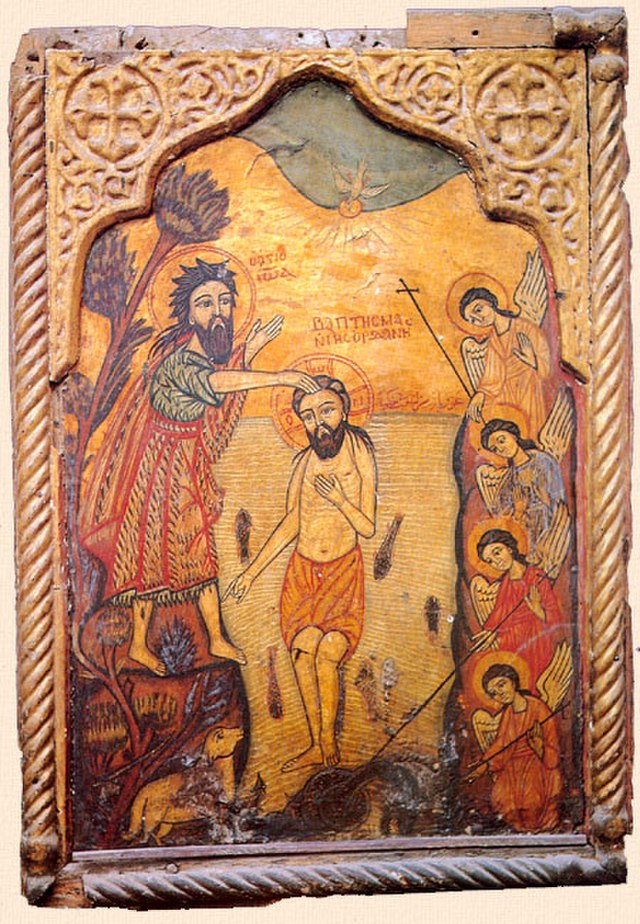
John the Baptist Coptic Icon
John the Baptist Before the 19th C.

In 641 Muslims conquered Egypt and made it a province of an Islamic Empire whose capital was Damascus.  The religious history that followed is a complicated mixture of acceptance for Christians, and then later in the 9th century, relations were more difficult. The period from the 7th to 13 century was more promising, allowing for Christian Coptic art to flourish once again and to further develop the Coptic style. There was even something of a Renaissance of Coptic art in the 13th century with many Coptic illustrated manuscripts, much like the illuminated manuscripts of the western Church.

After this, for political reasons, there was a sharp decline in productivity of Coptic Art,until the 18th century  when the West re-discovered the attraction of Coptic Icons.

In today’s world there are several Coptic Iconographers who are continuing to develop the Coptic style of iconography.  I am including here links to Dr. Stephan Rene’s website from which a much more nuanced understanding of Coptic iconography can be found, and two other links that may be useful for a more complete perspective.

Saint Paul Icon, 17th C.

Again, please do add to the FB group page more information or images if you would like to share your experience with Coptic Icons with others. I hope this has inspired you to think about different styles of icon writing and how culture and politics can affect the art of their time.

Dr. Stephan Rene’s Website: https://copticiconography.com/2019/12/24/reflections-on-discipleship-and-coptic-iconography/

UK Coptic Icons. https://www.ukcopticicons.com

Until next month,

My very best wishes for God to continue to bless the work of your hands, 

Always,

Christine Simoneau Hales

https://newchristianicons.com
Iconography of Mary

The Iconography of Mary

Icon of the Virgin and Child with Saints Theodore and George, St. Catherine’s Monastery, Mt. Sinai, 6th century

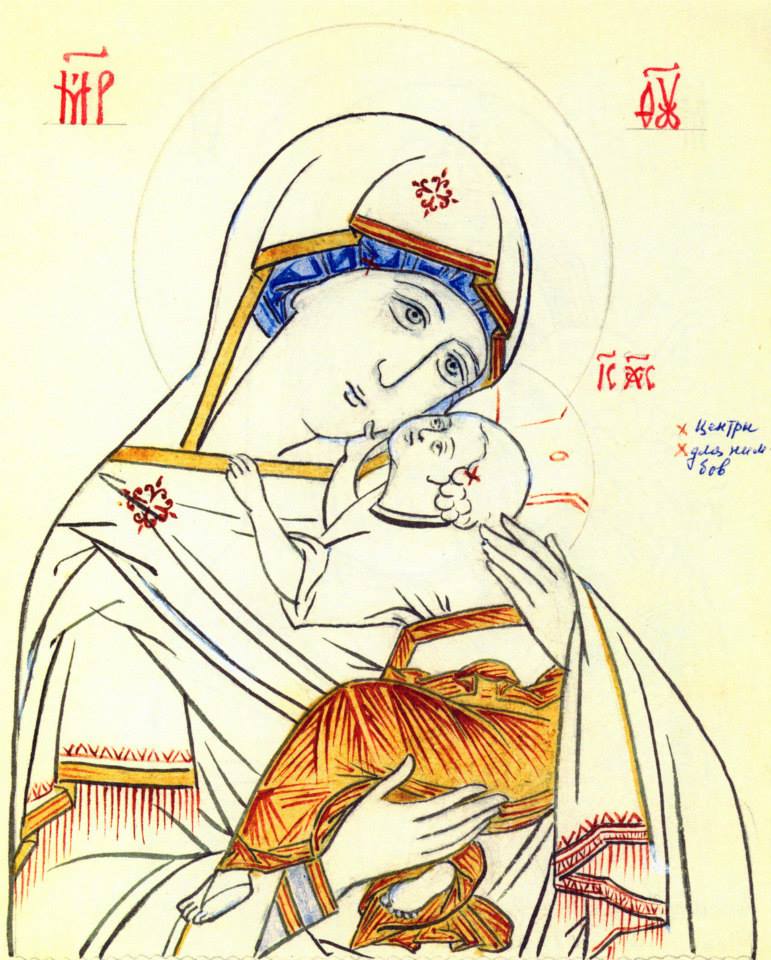
That there are many different types and genres of Mary icons that attest to the need of all Christians to be able to relate to different aspects of her humanity and divinity at different times in their lives.     Some images of Mary depict her in a time of peace, apparently apart from the drudgery and strife of our every day world, but others, like the Virgin of Tenderness and Loving Kindness, evoke the loving and kind aspects of God in ordinary life.

As the Christian Church began to split into factions with emphasis on slightly different aspects of the faith, so too, the iconography of Mary, the Mother of Jesus, has different interpretations within the denominations.  To establish a common ground, I first put forth a history of Mary, both Biblical and inclusive of denominational differences when appropriate.

Mary in the Bible

Saint Luke painting the Virgin and Child with an Angel, Russian Icon

The earliest New Testament account of Mary is in the Epistle to the Galatians, which was written before the Gospels. She is referred to as “a woman” and is not named: “But when the fullness of time had come, God sent his Son, born of a woman, born under the law” (Galatians 4:4).[47]

But Mary is specifically mentioned several times in the canonical Gospels and the Acts of the Apostles:

  • The Gospel of Luke mentions Mary the most often, identifying her by name twelve times, all of these in the infancy narrative (Luke 1:27–2:34).[48]
  • The Gospel of Matthew mentions her by name five times, four of these (1:16, 18, 20: 2:12)[49] in the infancy narrative and only once (Matthew 13:55)[50] outside the infancy narrative.
  • The Gospel of Mark names her once (Mark 6:3) and mentions Jesus’ mother without naming her in Mark 3:31–32.
  • The Gospel of John refers to the mother of Jesus twice, but never mentions her name. She is first seen at the wedding of Cana (John 2:1–12. The second reference has her standing near the cross of Jesus together with Mary Magdalene, and Mary of Clopas (or Cleophas), and her own sister (possibly the same as Mary of Clopas; the wording is semantically ambiguous), along with the disciple whom Jesus loved.” (John 19:25–26). John 2:1–12  is the only text in the canonical gospels in which the adult Jesus has a conversation with Mary. He does not address her as “Mother” but as “Woman”. In the Acts of the Apostles, Mary and the brothers of Jesus are mentioned in the company of the eleven apostles who are gathered in the upper room after the Ascension of Jesus (Acts 1:14).
Crucifixion Icon, From ancient Russian Icon, Christine Hales. 2020

However, most of the details we know about the early life of Mary, and the birth of Jesus taking place in a cave come from the Proevangelism of James, a non-canonical treatise of the second century.

How did canonical imagery for the Mother of God develop?

Vladimir Mother of God Icon , 12th century, currently in Tretyakov Gallery, Moscow

In the early formation of Mary’s iconography, there were three main aspects of her mystery, that is, her pure virginity, her fertile motherhood, and her divine sanctity that contribute to attributes and characteristics visible in depictions in her icons.

As early as the fifth century churches were being dedicated to Mary in Constantinople and the term “Theotokos”,  God Bearer, Mother of God, was introduced at the Council of Ephesus in 431. After the sixth century, more and more icons of various aspects of the Blessed Mother were seen, and attributes of military power were seen as people brought icons of Mary to the battlefield for protection against invaders.  Prayers relating to Mary are found as early as the Gospel of Luke.

Hodegitria Icon, 16th century, Russia

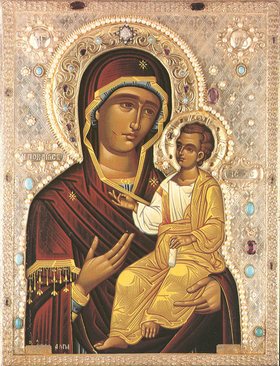
Although there are exceptions, most of the Russian Orthodox icons of Mary can be found within four categories:   Hodegitria, “the Guide, or she who shows the way”; the Eleusa, “Virgin of Tenderness, or loving kindness”; the Oranta, Our Lady of the Sign; and the Akathist “Hymn”. 

Within these categories there exists many iterations named primarily after the town or village that housed them, such as in the Tenderness category there is the Kazan icon, Smolensk icon, Georgian icon,Jerusalem icon, and many more.

Hodegitria Icons of Mary have been brought to battlefields and paraded around cities for protection for centuries. They have been used to invoke military victory but she is never seen with a staff or any other sign of authority.  Her icon of the Hodegetria, Mother of God, was deemed the most powerful weapon against enemies in ancient Russia.

In the Eleusa category of loving kindness, popularized in the twelfth century, The Vladimir Mother of God icon was brought from Constantinople to Vladimir by Prince Andrey Bogolubsky and was believed to protect the city from marauding Mongols.

Our Lady of the Sign Icon by Christine Hales 2000

The Orans Virgin, or sometimes called “Platytera, More Spacious Than the Heavens”, depicts Mary with her arms outstretched in the prayer position, with a young Christ in the center of her figure, and this one is based on the prophesy in Isaiah 7:14.,” Therefore the Lord himself shall give you a sign; Behold, a virgin shall conceive, and bear a son, and shall call his name Immanuel.”

The Akathist (meaning hymn) virgin, is frequently seen depicting Mary as an individual alone, without the Christ child. And without Joseph, her husband.

Our Lady of Korsun created by Christine Hales

Most Greek churches dedicated to the Virgin Mary are called Panagia; the Most Holy; the standard western Christian designation of “St. Mary” is rarely used in the Orthodox East, as Mary is considered the holiest of all created beings and therefore of higher status than the saints.

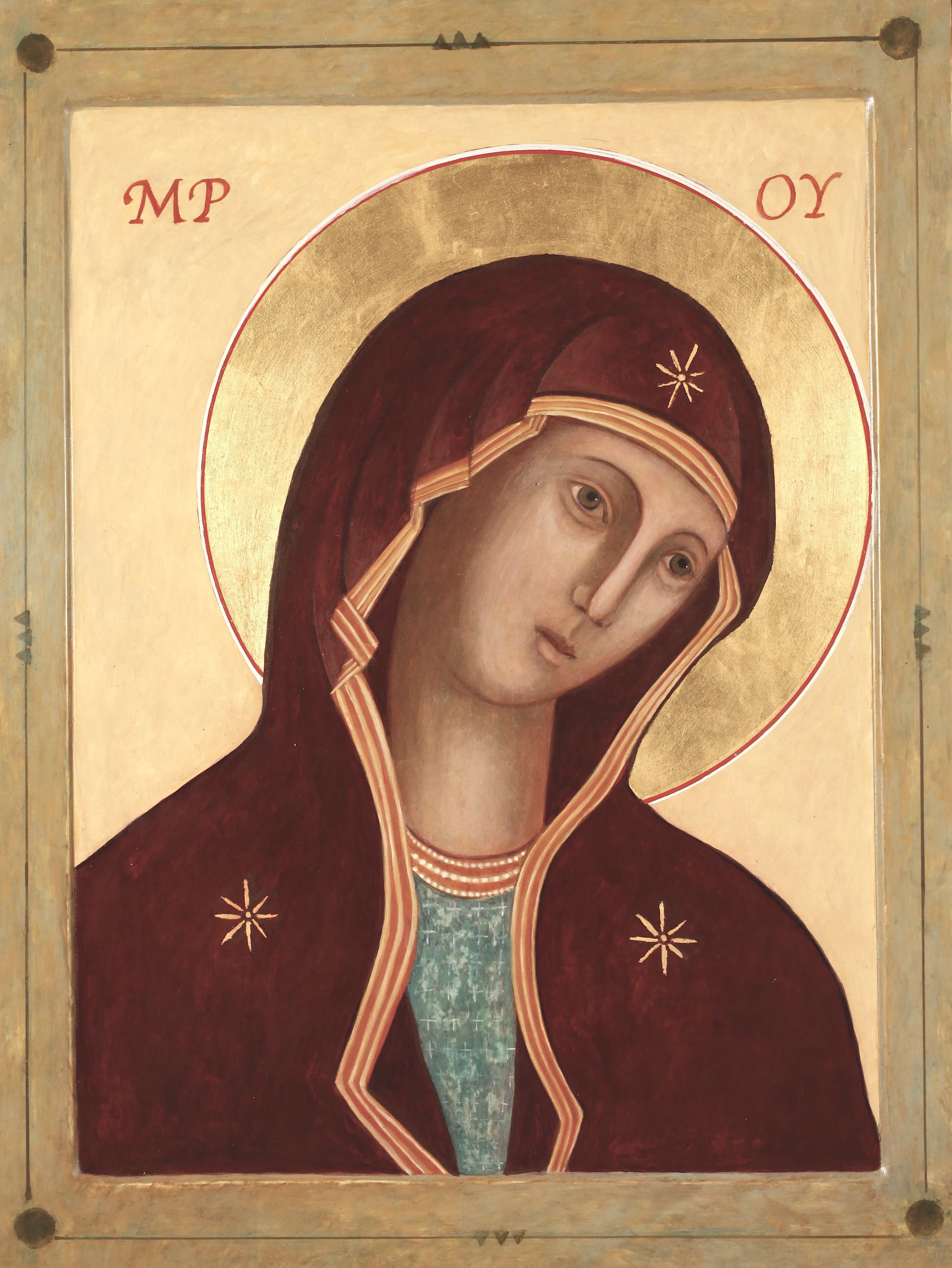
In paintings, Mary is traditionally portrayed in blue, while in the Eastern Orthodox Marian iconography, her robe is a deep red. There are many more genres of Mary paintings in the Catholic church, variations that address particular prayer needs of the people. Examples of this are Our Lady, Untier of Knots, Our Lady of Perpetual Help, Our Lady of Gudalupe, Our lady of Sorrows, and many more.

Our Lady of Perpetual Help, Christine Hales

The Christian need to believe, venerate, and pray with images of Mary is a powerful one.  In a primarily patristic society, being able to relate spiritually to the most Godly of women is both a solace and source of strength.  Surely the Blessed Mother demonstrated profound strength at the Crucifixion, obedience and humility at the Annunciation, and devotion to Jesus throughout His life and death, and we can draw near to her through her icons and be comforted and strengthened by her virtues and piety.

I will close with one of the oldest known prayers venerating Mary:

            Beneath Thy Protection 

We fly to thy protection,

O Holy Mother of God;

Do not despise our petitions in our necessities,

but deliver us always from all dangers,

O Glorious and Blessed Virgin.

Christine Simoneau Hales

Our Lady of Guadalupe, detail, by Christine Hales

https://newchristianicons.com
Prints: https://christinehalesicons.com
Sources:

“The Dawn of Christian Art in Panel Paintings and Icons”, Thomas Mathews and Norman Muller.

Wikipedia

Wiki Common

Interesting Links For Iconographers:

From Dorothy Alexander, Iconographer in CA :

This is a link to summer internships for those studying a BA, MA, or Phd: