Discover the Spiritual Depth of Icons and Saints

Two Books That Open the Heart Through Icons and the Saints

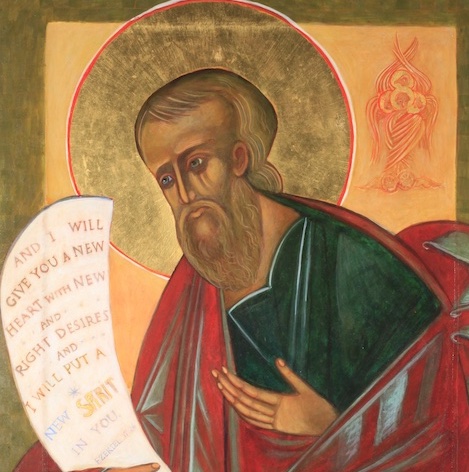
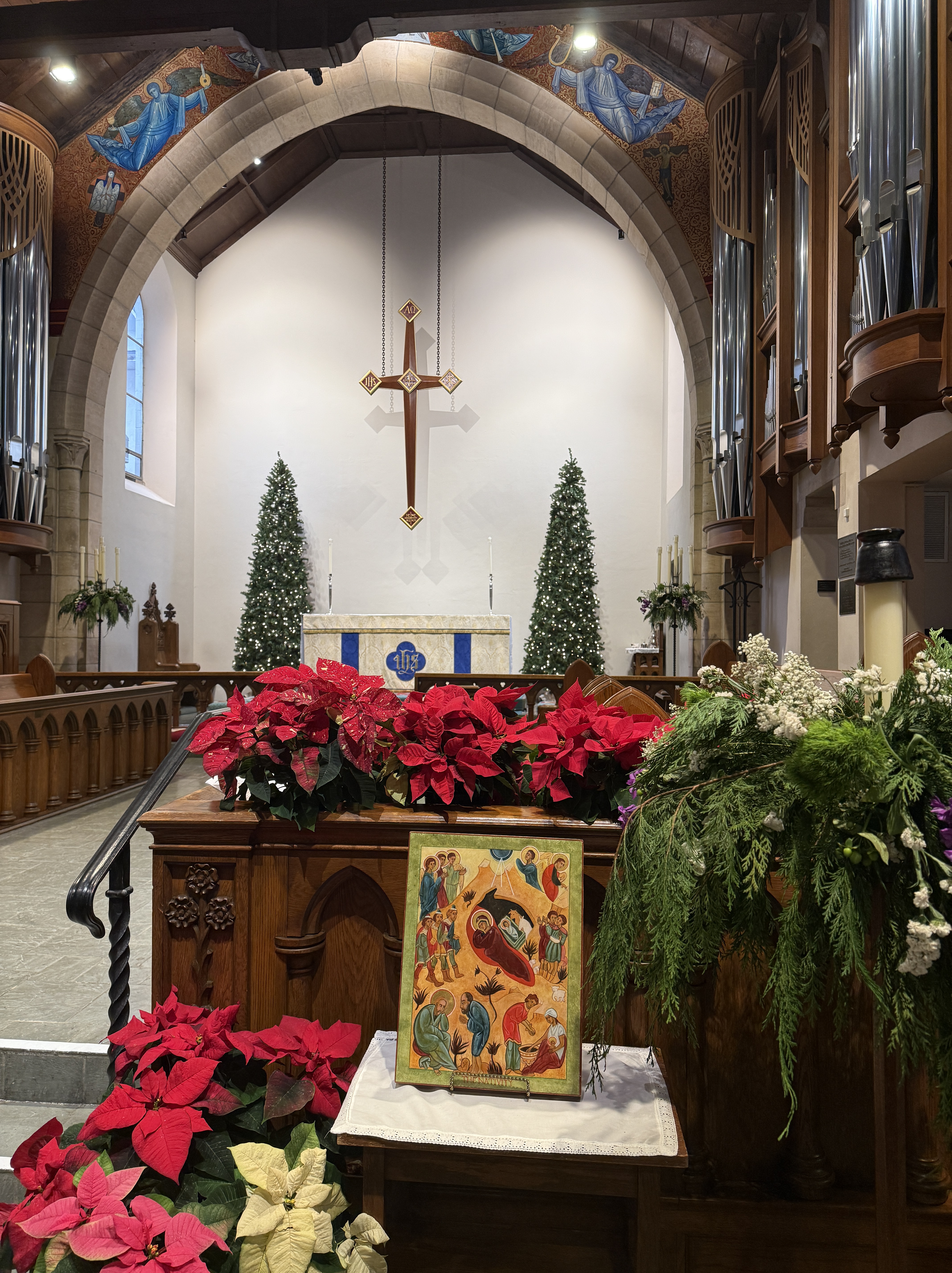
John the Baptist Icon. written by Christine Hales

In the world of Christian spirituality, a beautiful mystery unfolds whenever art and prayer meet. Two icon related books—The Dwelling of the Light: Praying With Icons of Christ by Dr. Rowan Williams, and The Song of Saints: Celebrating the Saints with Anglican Prayer Beads by Catherine Gotschall—offer readers rich opportunities to encounter that mystery with depth and devotion. Though very different in scope, each invites us to slow down, to look more deeply, and to let the Holy Spirit reshape how we see God, the world, and ourselves.

Seeing Christ Anew: Rowan Williams on Praying With Icons

When The Dwelling of the Light was first published in 2003, Dr. Rowan Williams had just begun his tenure as Archbishop of Canterbury. Already a respected theologian and scholar, Williams offered the world a slim but luminous volume on praying with icons of Christ. It remains one of his most beloved spiritual works.

Madonna and Child. Written by Christine Hales

At the heart of the book lies a profound reverence for icons—not as decorative artifacts, but as encounters with divine presence. Williams writes:

“In their presence you become aware that you are present to God and that God is working on you by his grace, as he does in the lives and words of holy people.”

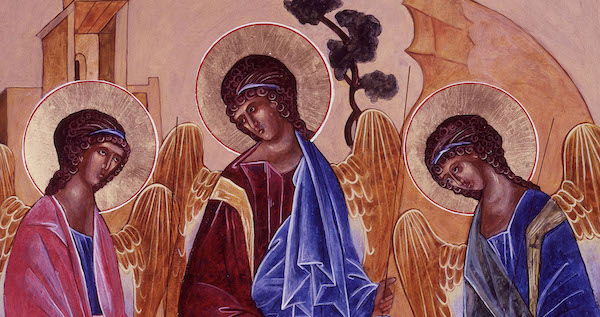
Using four deeply significant icons—The TransfigurationThe ResurrectionThe Hospitality of Abraham, and Christ Pantocrator—he guides the reader into a prayerful way of seeing. Icons, he suggests, are not depictions of a moment frozen in history; they reveal a life “radiating the light and force of God.”

Resurrection Icon. written by Christine Hales

In Williams’ hands, each icon becomes not only an image but a doorway: a way for Christ’s transfiguring presence to shape our own vision of the world. The book is small enough to read in an afternoon but expansive enough to ponder for years.

I have always appreciated Dr. Williams’ viewpoint on icons and sacramentals in the Anglican Church. Sometimes on my lunch break I like to pick up one of his books for some quick inspiration!

Williams wrote a companion volume a year earlier—Ponder These Things: Praying With Icons of the Virgin (Canterbury Press, 2002)—which offers a similar depth of prayer through icons of Mary.

Related Links
• Image Journal: Conversation with Rowan William
 Author Page with additional works by Dr. Williams

Praying With the Cloud of Witnesses: Catherine Gotschall’s The Song of Saints

While Williams leads us to contemplate the face of Christ, Catherine Gotschall invites us to pray with the saints themselves. A lifelong Episcopalian, Gotschall has created an extraordinary resource in The Song of Saints: Celebrating the Saints with Anglican Prayer Beads.

I met Catherine at the Episcopal Convention of South West Florida several weeks ago and want to share this interesting book with you all since first class books on the lives of the saints are hard to come by!

Her book presents the lives of more than fifty saints from across the centuries—men and women whose faithful witness continues to echo through Christian history. Arranged within the six cycles of the liturgical year, the saints span the 1st to the 20th century and represent Roman Catholic, Orthodox, and Protestant traditions.

Mary of Egypt Icon by Christine Hales

But what makes the book truly distinctive is its prayer practice. For each saint, Gotschall offers:

  • A brief biography
  • Prayers drawn from the saint’s own writings—letters, sermons, and vitae
  • A way of praying these words with Anglican prayer beads

She describes a saint as:

“someone who has led a sacramental life… an outward and visible sign of deep and abiding inner spiritual grace.”

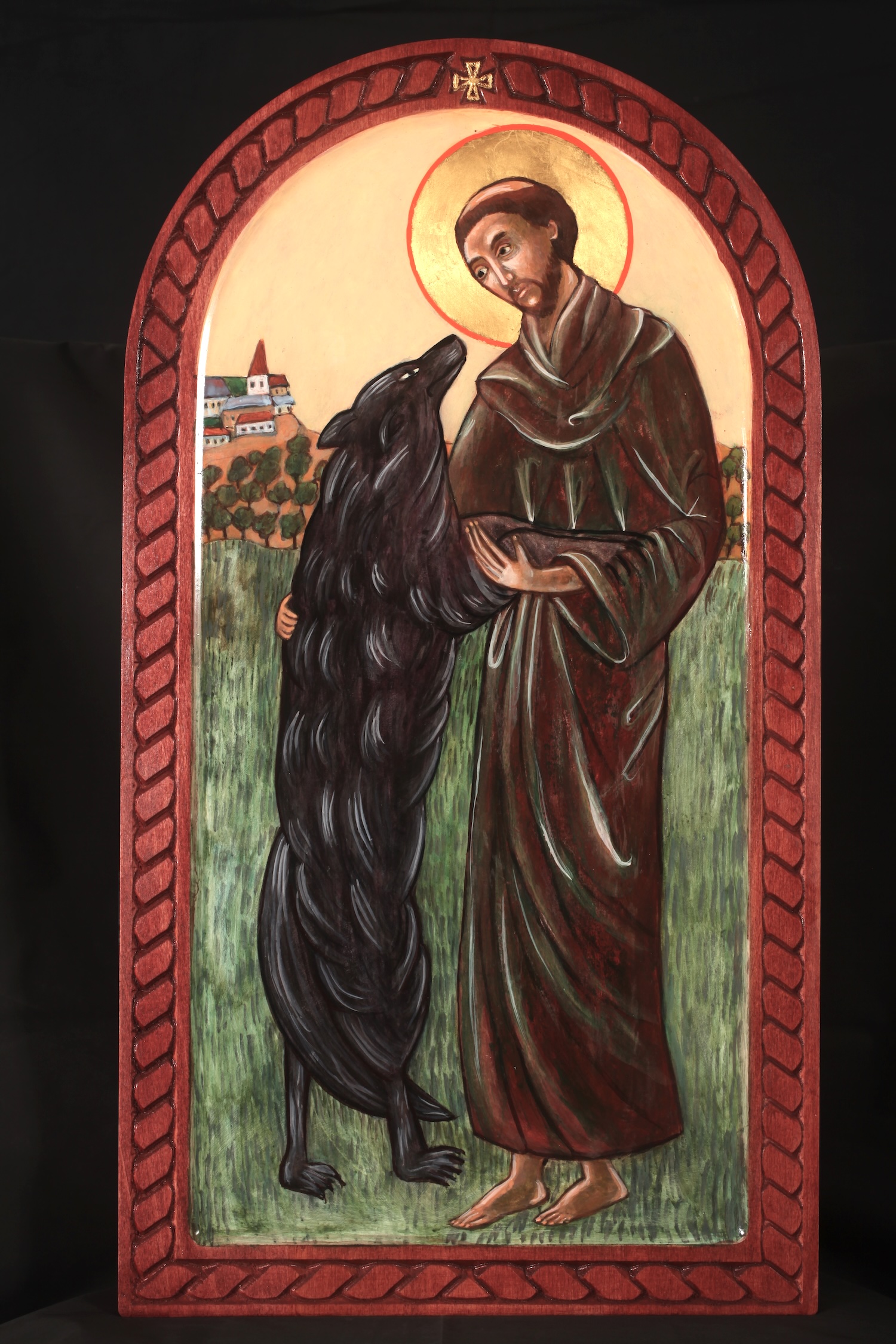
St, Francis and the Wolf of Lubbio written by Christine Hales

This is more than a book of history or devotional snippets—it is a tool for moving devotion “from head to heart.” Through the rhythm of the beads and the wisdom of the saints, readers are invited into a lived experience of prayer that feels both ancient and deeply personal.

Link to Purchase Book on Amazon

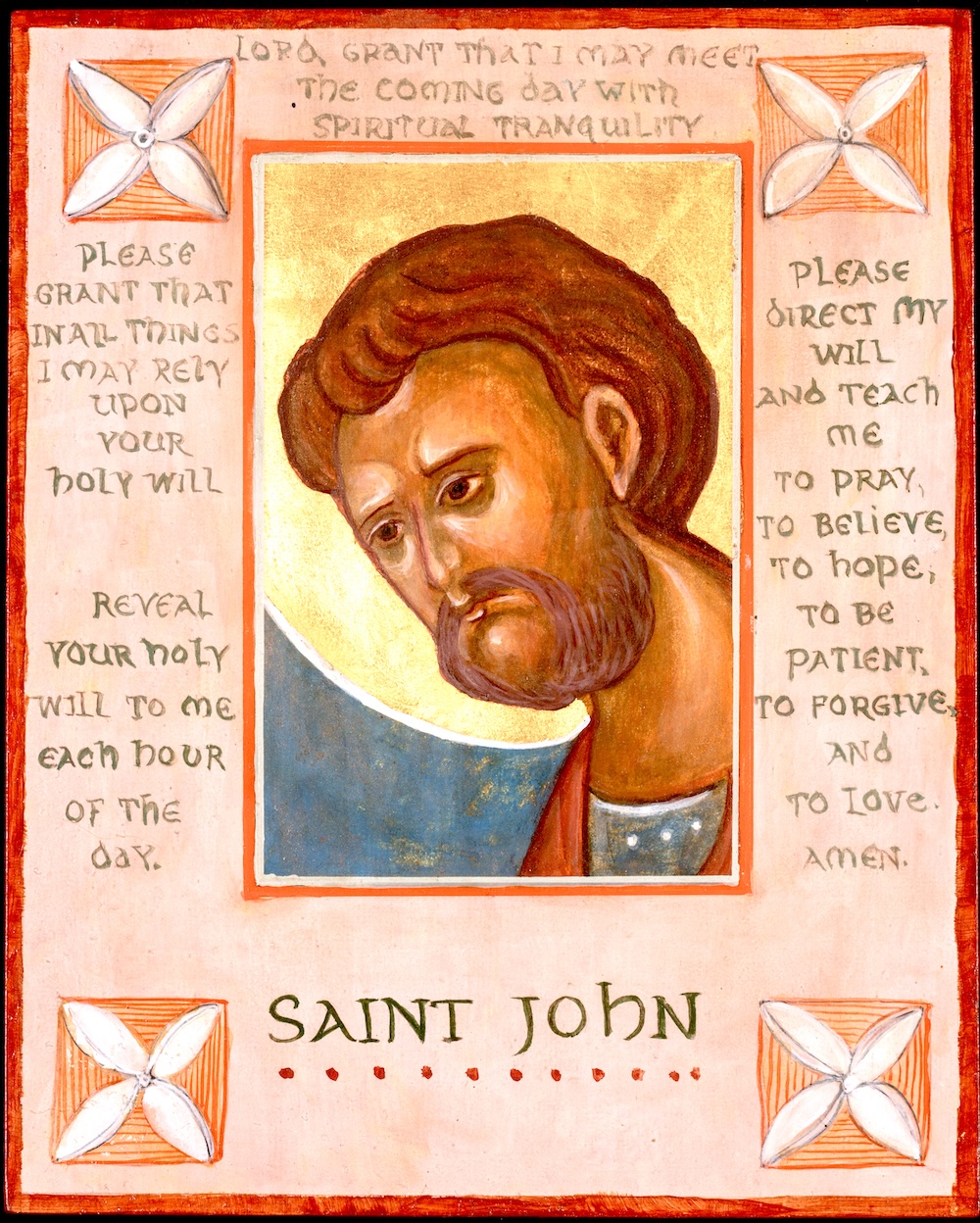
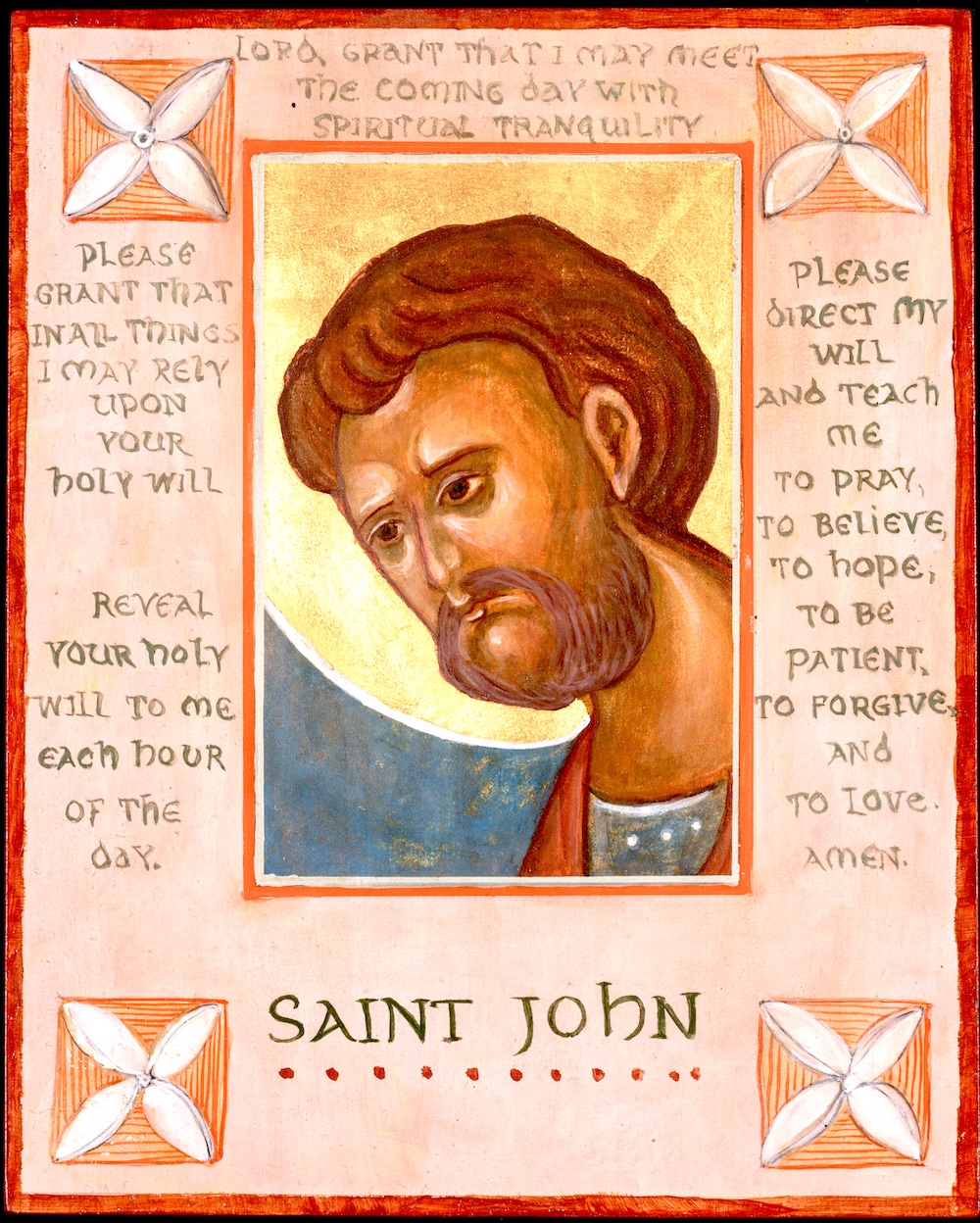
St. John Theologian Icon by Christine Hales

Art, Prayer, and the Ever-Living Presence of God

Together, these two books remind us of something essential: authentic Christian prayer is not an escape from the world but a way of seeing it more truthfully. Icons illuminate the radiant presence of Christ at the center of all things. The saints show us what life looks like when that presence is welcomed, trusted, and lived boldly across centuries and cultures.

Whether you are drawn to the serene gaze of Christ Pantocrator or to the stirring witness of those who followed him, these works offer gentle, profound companions for the spiritual journey.

They invite us—quietly but insistently—to ponder, to pray, and to be transformed.

Until next month, be blessed and be a blessing! And don’t forget, if you write an informative article about your icons or icon related information, please email me with your ideas and proposals. It would be wonderful to have articles written by more of you!

Love and prayers,

Christine Hales

Recent Posts on Saints; Stories of Saints and Icons and

All Saints Day.

My Next in- Person Icon Writing Retreats for 2026

LINKS For  Christine Simoneau Hales   2025

  1. https://newchristianicions.com   my main website
  2. Https://christinehalesicons.com  Prints of my Icons
  3. https://online.iconwritingclasses.com  my online pre-recorded icon writing classes
  4. https://www.youtube.com/channel/UCK2WoRDiPivGtz2aw61FQXA  My YouTube Channel 
  5. Facebook: https://www.facebook.com/ChristineHalesFineArt     or  https://www.facebook.com/NewChristianIcons/
  6. Instagram:   https://www.instagram.com/christinehalesicons/?hl=en
  7. American Association of Iconographers:  FB Group: https://www.facebook.com/groups/371054416651983

American Association of Iconographers Website: https://americanassociationoficonographers.com
Contact Christine: chales@halesart.com

El Greco

And the Enduring Influence of Byzantine Icon Training

Hello Fellow Iconographers:

As you probably already know, I love making connections between Byzantine iconography and modern art. I always think that icons were the contemporary art of their time, so how can we bring a contemporary approach to our icon writing? This article about the work of ElGreco shows how one iconographer of the 16th century made that transition. The approaches each iconographer takes to contemporary iconography will be as individual as the iconographers themselves, but some things will remain. Here is an account of how this issue played out in the life and work of ElGreco.

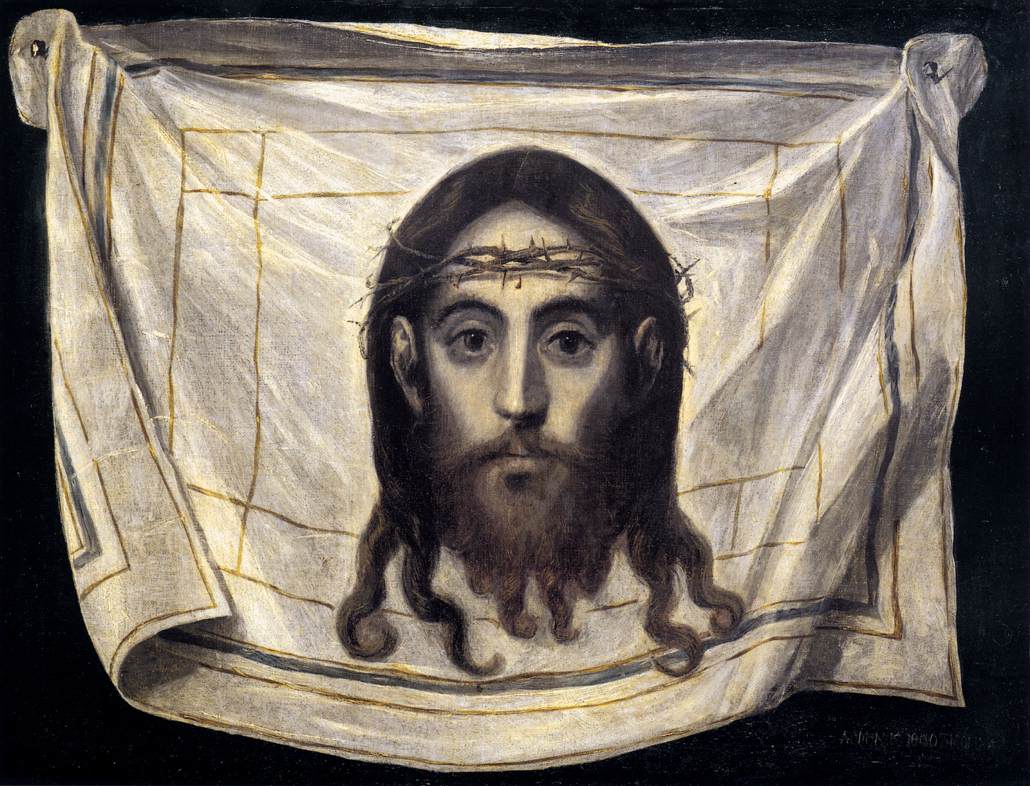
Veronica’s Veil, El Greco

Doménikos Theotokópoulos—better known as El Greco—has long fascinated scholars of Early Modern art. While his mature works in Toledo are celebrated for their dramatic elongations, expressive color, and visionary intensity, less often explored in depth is the formative influence of his early training in the Byzantine icon tradition. This article examines how the discipline of icon-painting, rooted in the post-Byzantine Cretan School, left an enduring imprint on El Greco’s aesthetic, technique, and theological vision. His icon training, I argue, was not a youthful chapter to be overcome, but a structural foundation that underlay his later innovations.

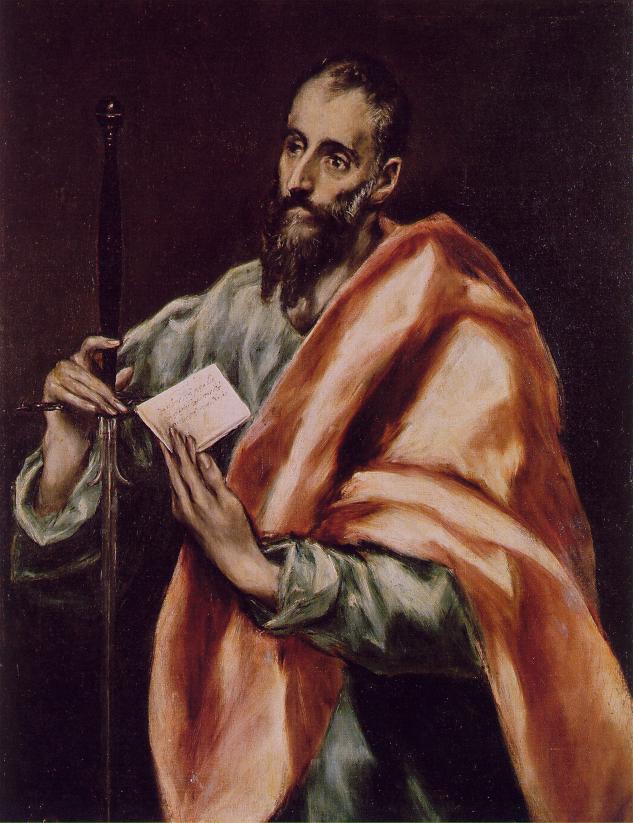
Saint Paul by El Greco

From Crete to Venice

Although he was born in Crete in 1541, after receiving icon painting training in his early life, Domenikos left Crete in 1567 for Venice. Some key characteristics Domenikos learned from the icon painters were:

A hieratic vocabulary of elongated, stylized figures and flattened pictorial space intended for devotion.

The use of traditional materials and techniques—tempera, wooden panels, and gilding.

An emphasis on spiritual vision over empirical realism.

But in Venice he was encountering the artistic milieu of the Italian Renaissance and Mannerism, absorbing the vibrant color, dynamic composition and spatial experimentation of artists such as Tintoretto and Titian.  This Western training did not supplant his icon-foundation but merged with it. One of his trademark features—elongated, upward-reaching figures, almost defying gravity—can be traced back to the hieratic verticality of icons, in which figures are often elevated beyond the earthly realm. In his mature altarpieces in Toledo, this physical stretching expresses a spiritual tension: the human yearning toward the Divine.

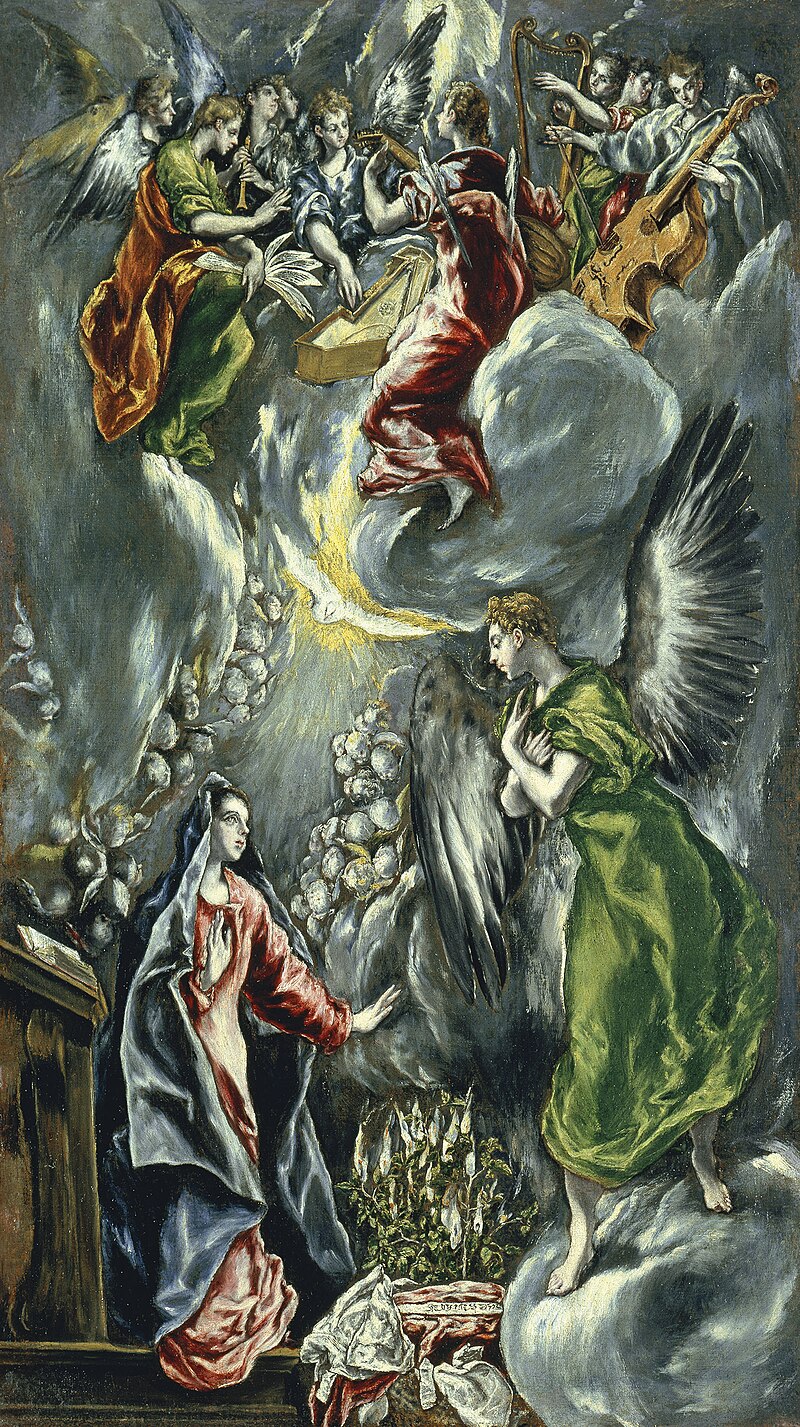
Annunciation by El Greco

Rome, Toledo, and the Transformation of a Style

From Venice, El Greco moved to Rome (1570–1576), where he sought patronage but struggled to achieve success amid the competitive papal art world. In 1576, he relocated to Spain, where his career flourished under the patronage of the Church and the Spanish nobility. His first major commission came from the dean of Toledo Cathedral: three altarpieces for the Church of Santo Domingo el Antiguo, works that already reveal a synthesis of iconographic form, Mannerist stylization, and Venetian color.

Even as his technique evolved, the influence of icon-painting persisted. The vertical elongation of figures—one of El Greco’s most recognizable traits—can be traced to the hieratic verticality of Byzantine icons, where figures are elevated beyond the earthly realm. In El Greco’s mature altarpieces, this elongation expresses a spiritual tension, a reaching upward toward the Divine.

Annunciation El Greco

Similarly, his treatment of space often resists Renaissance perspectival illusion. Instead of a fully realistic spatial construction, El Greco employs stacked planes and compressed layers to evoke a metaphysical dimension. Scholars have linked this to his Byzantine roots, where sacred space functions symbolically rather than empirically.

Theological Continuities: Painting as a Spiritual Act

Beneath the stylistic parallels lies a deeper continuity: El Greco’s theological conception of painting. In the icon tradition, the painter’s task is to serve as a mediator of divine light, not merely an imitator of nature. This conception of sacred art as a spiritual discipline—requiring prayer, fasting, and inner illumination—found new expression in El Greco’s Spanish works.

His figures seem animated not by physical energy but by spiritual light, glowing from within. In this, El Greco remained faithful to the iconographer’s conviction that beauty reveals the presence of God.

Pentecost, El Greco

Reception and Legacy

“El Greco is one of the few old master painters who enjoys widespread popularity,” writes Keith Christiansen of the Metropolitan Museum of Art. Rediscovered in the nineteenth century by collectors, critics, and artists, El Greco was hailed as both the quintessential Spaniard and a proto-modern painter of the spirit.

For members of the Blue Rider school, including Franz Marc, El Greco embodied a mystical resistance to materialism—a painter who, as Christiansen writes, “felt the mystical inner construction of life.”

Conclusion: The Icon as Foundation of Innovation

El Greco’s artistic evolution cannot be fully understood without acknowledging the foundational role of his icon-training on Crete. Far from being a mere apprenticeship, this discipline remained the structural ground of his mature art—shaping his understanding of color, form, space, and the sacred.

His work ultimately represents a synthesis of:

  • The spiritual economy of the icon,
  • The painterly brilliance of Venice and Rome, and
  • The religious fervor of Counter-Reformation Spain.

For students of sacred art and iconographers today, El Greco offers a powerful model: discipline does not restrict creativity—it frames and empowers it. His art demonstrates that fidelity to tradition can be the very source of visionary originality.

My Baptism of Jesus Icon at the Cathedral of Saint Peter, Saint Petersburg

I hope you have enjoyed this article and that it is food for thought. The battle for art is not won or lost in an academic tradition, but in the spiritual realm where God is all powerful. God wants each of us to give glory to His name in each individual way that he has created us.

Here are some interesting links that are passed on from Dorothy Alexander, a friend and iconographer in California:

1.How Icons Are Made” is the fourth and final lecture by Aidan Hart presented at St. Julian’s Church in Shrewsbury, England. https://www.youtube.com/watch?v=Of2eq-NiDVE&t=82s. He speaks on both the theology as well as the practical details of making an icon.

2.You can see the beauty of natural pigments as you watch how vivianite is made from the mineral. This also helps to understand why it is not cheap to buy. The example at the end shows the versatility of the color

https://www.youtube.com/watch?v=Ww2QRpSG4fA&t=40s&pp=2AEokAIB

3. This slow moving video is an example of Instacoll gilding, faulting (repairing or filling in any holes) and burnishing with a cloth. https://youtu.be/bK1gKiO2sSo?si=CaLsBN_NLJbjt85g

That’s all for this month!

God bless you all,

Christine

These are my links if you’d like to see more of what I do:

LINKS For  Christine Simoneau Hales   2025

  1. https://newchristianicions.com   my main website
  2. Https://christinehalesicons.com  Prints of my Icons
  3. https://online.iconwritingclasses.com  my online pre-recorded icon writing classes
  4. https://www.youtube.com/channel/UCK2WoRDiPivGtz2aw61FQXA  My YouTube Channel 
  5. Facebook: https://www.facebook.com/ChristineHalesFineArt     or  https://www.facebook.com/NewChristianIcons/
  6. Instagram:   https://www.instagram.com/christinehalesicons/?hl=en
  7. American Association of Iconographers:  FB Group: https://www.facebook.com/groups/371054416651983
  8. American Association of Iconographers Website: https://americanassociationoficonographers.com

Creating an Icon

Hello Dear Friends and Fellow Iconographers:

Sarasota, Lido Beach, September 2025

As we move into fall, it’s always a good time to reflect on the summer time that is past and imagine what we hope to accomplish this winter season.  I’ve been doing a lot of Icon writing teaching this past summer, which I have loved.  But it does come at the expense of having creative time to create icons, so I am very happy to have some time ahead of me to create new icons and experiment with different colors and techniques.  I hope to have some work to share with you by the end of the year!

One of the main ways I have of supporting students as they move from taking classes to working on their own is through Patreon.  On this platform, for a nominal monthly fee, I offer a few different levels of membership that can help new iconographers to grow, ask questions, share concerns about their icon painting techniques and receive feedback.  If you are interested, you can go to Patreon and look up Christine Hales Icons, or I will put a link for you at the end of this article.

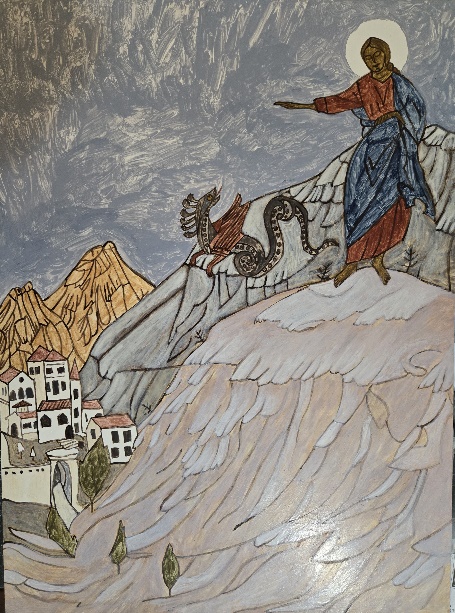
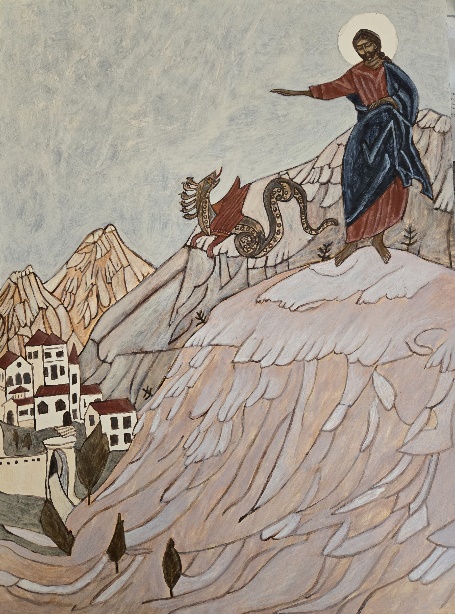
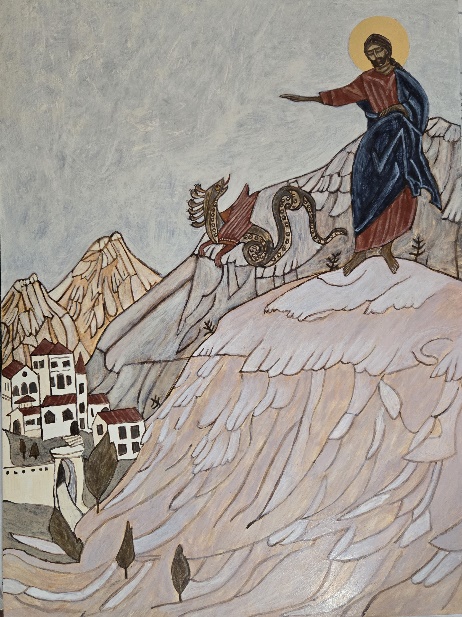
All this to say, that one of my long time students has created an original and insightful icon, “The Temptation of Christ”, which I would like to share with you this month. Sue Valentine is a minister who wanted to have the icon speak to that moment of Christ’s temptation by the devil.  Along the way, through many changes and transitions, the creating of the icon has provided a space for discussing and reflecting upon this moment in Christ’s ministry, and we worked together discerning how best to portray the meaning and message in iconographic form.

Sue has generously shared about her thoughts and process which I include here, along with some sequential images of the changes the icon went through until completion.

The Temptation of Christ Icon written by the Hand of Sue Valentine

“Jesus faced three temptations before He began His public ministry.  The final temptation is the subject of this icon.  The devil led Jesus to a high place, showed Him in an instant all the kingdoms of the world, and offered them to Jesus now, without having to suffer and die, if only Jesus would worship him.

This is a less familiar story to some, and because I wanted people to understand what they were seeing, the haiku at the bottom is an attempt to summarize the scripture for them:

“Kingdoms, if you bow.”

“Away from me, O Satan.”

“Worship God, alone.”

         Matthew 4:8-10

People struggle with the idea of whether Jesus could be tempted.  Sometimes the word is translated “test”.  But whether He was tempted or tested, for this to be a true “test”, it had to have been possible for Jesus to fail it.  What would have happened to us had He failed the test and worshipped Satan?  

Kingdoms are tempting.  Power is tempting.  The ground surrounding the kingdoms depicted in the lower left are painted with gold to depict a counterfeit of heaven’s “streets of gold”, and subtle gold highlights in the windows imply there is something desirable yet hidden within.  I decided not to make the kingdoms look more obviously attractive by applying gold to the outsides of the buildings.  Kingdoms are, after all, seductive.  But thankfully, Jesus wasn’t motivated by kingdoms. He was motivated by rescuing us.

More Progress Photos

The Homily, or Application of the Story

I felt His clarity of purpose as He responded to Satan, “Worship God, alone”, as He pointed His finger at the dragon.  I find it interesting that there is no agitation on Jesus’ face.  His eyes are closed.  He is serene.  But His conviction is clear.

Like most people, I would like to receive a reward from God without suffering, or without having to walk the whole road He has for me.  I felt that as I wrote this icon.  I struggled mightily with color choices, especially with the mountains and the inner background, and changed them many times asking the Holy Spirit to help me.  

It’s tempting to want to design our own roads.  It’s tempting to want an easy life.  But that is not the way of a disciple.  Worship of God includes acknowledging that He determines our path, including the subjects of our icons and the process we go through as we write them.”

Sue Valentine

I’m so grateful that Sue has shared this with all of us, and I hope that this can provide a model not only for discerning how to paint a particular icon, but also for allowing God to speak to us through the process of icon writing and convey that to the viewer.

With this, I put out a request to those of you with icons and their development to share with us all in next month’s newsletter. Just email me with your thoughts and photos: chales@halesart.com

I close this month’s newsletter with a prayer and quote from Psalm 106:

“For your lovingkindness is greater than the heavens, and your faithfulness reaches to the clouds. Exalt yourself above the heavens O God, and your glory over all the earth, so that those who are dear to you may be delivered, save with your right hand and answer me.”

May God grant you all peace and the ability to be peace makers, and bless the work of your hands,

Love and prayers,

Christine Simoneau Hales

My Links:

MY PATREON: CLICK HERE

  1. https://newchristianicions.com   my main website
  2. Https://christinehalesicons.com  Prints of my Icons
  3. https://online.iconwritingclasses.com  my online pre-recorded icon writing classes
  4. https://www.youtube.com/channel/UCK2WoRDiPivGtz2aw61FQXA  My YouTube Channel 
  5. Facebook: https://www.facebook.com/ChristineHalesFineArt     or  https://www.facebook.com/NewChristianIcons/
  6. Instagram:   https://www.instagram.com/christinehalesicons/?hl=en
  7. American Association of Iconographers:  FB Group: https://www.facebook.com/groups/371054416651983
  8. American Association of Iconographers Website: https://americanassociationoficonographers.com

CHRISTINE HALES ICONS ON PATREON

The History and Development of Christian Icons. Part III

This is the third in a four-part series of articles that examine the historical evolution of Christian icons that I have written for the Anglican Digest.  This article appears in the fall issue.  In this article we will explore the significance of a symbolic visual language of icons in contrast to a more realistic one that began to develop from the late Byzantine period through the beginnings of the Italian Renaissance paintings. 

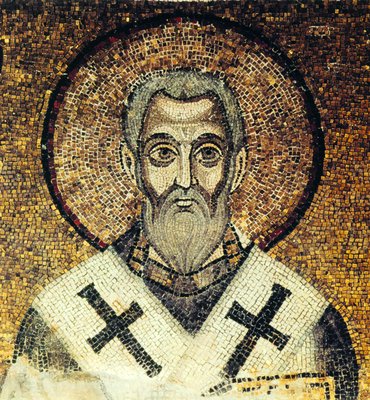
Saint Epifani, Mosaic, 1030

This stylistic change is very important.  It helps to define the difference between holy icons and the religious painting that grew out of the Renaissance.  This difference became ever more pronounced as time went on, and the shift from symbolic to realistic imagery and storytelling can be compared to the difference between a parable and a narrative story.  The parable can have more eternal, universal and varied meanings, while realism points to a particular moment in time, a specific meaning.  Eastern church traditions preserved the integrity and spiritual function of icons, while Western Europe began to explore art’s potential to engage both the senses and the intellect.

Church Art From the 11-15th Centuries

Duccio, 1230, Maesta

From the 11th to the 15th centuries, art saw significant development, transitioning from medieval styles to the Renaissance.  The rise of Romanesque and Gothic art occurred in the Middle Ages, with Romanesque art taking shape in the eleventh century, initially developing in France then spreading to Spain, England, Flanders, Germany, Italy, and other regions. 

Annunciation, St. Sophia’s Cathedral, Kiev. 1050

One of the most spectacular achievements of medieval artists which was their desire to pursue heavenly light in their creation of the worship space.  The importance of this play of light had its beginnings in the 12th century when the heavy, dark Romanesque architecture began to be replaced by Gothic development of pointed arches, vaulted ceilings, and flying buttresses- all of which made it possible to admit more light into the sanctuary than would have been possible before.

Light for Christian culture had great significance because of the extensive Biblical associations of light with God himself, beginning with Genesis, “Let there be light”, and in the writings of Saint John the Divine.  At this point, the Bible had become an important source of ideas about beauty, both esthetically and also in a moral sense.  Illuminated Manuscripts flourished.

Icons and Art of the Eastern European Church

The developments of Church art in the East can be understood in several stages, or periods of Byzantine Culture: The Macedonian period, from 867-1056, the Komnenian period from1081-1185,and the Palaeologan Period 1259-1453.  These political and cultural periods influenced the style of icons as we will see.

Macedonian Period (867-1056)

Macedonian Workshop at Paraskevi

Macedonian art grew with advancements in learning and significant church construction and restoration following the period of Iconoclasm. (see my previous article). The artistic achievements of the Macedonian dynasty reflected grace, drawn from the fourth century, with the strength and beauty of earlier Hellenistic traditions. This blend of qualities infused religious art and icons with a distinctive dignity, refinement, and balance. These characteristics became synonymous with Byzantine design, aligning harmoniously with religious themes.

Komnenian Period (1081-1185)

Mosaïque des Comnène, Sainte-Sophie (Istambul, Turquie)

The Komnenoi were great patrons of the arts, and with their support Byzantine artists continued to move in the direction of greater humanism and emotion, of which the Virgin of Vladimir  is an important example. Ivory sculpture and other expensive mediums of art gradually gave way to frescoes and icons, gaining widespread popularity across the Empire. Although the art produced in the Byzantine Empire was marked by periodic revivals of a classical aesthetic, it was above all marked by the development of a new aesthetic defined by its abstract or anti-naturalistic character. If classical art was marked by the attempt to create representations that mimicked reality as closely as possible, Byzantine art seems to have abandoned this attempt in favor of a more symbolic approach.

Palaeologan Period (1259-1453)

Fresco from Leshovsky Monastery, 1347

Paelogan Byzantine artists developed icons, which became a popular medium for artistic expression, and were characterized by a less austere attitude. This appreciation for purely decorative qualities of painting and meticulous attention to details is sometimes referred to a Palaeologan Mannerism. Russian icon painting began by entirely adopting and imitating Byzantine art, as did the art of other Orthodox nations, and has remained extremely conservative in iconography. 

The fall of Constantinople in 1453 was a significant event in the history of the Byzantine Empire, and it had a profound impact on the art world. Many Byzantine artists migrated to Italy, where they played a vital role in shaping the  Italian Renaissance. of the Byzantine Empire in the preceding centuries.

The splendour of Byzantine art was always in the mind of early medieval Western artists and patrons, and many of the most important movements in the period were conscious attempts to produce art fit to stand next to both classical Roman and contemporary Byzantine art.

Religious Painting and Icons in the Western Church

The influence of Byzantine art on Italian art was significant, with Byzantine artists bringing their techniques and knowledge to Italy, especially the use of gold leaf and mosaics.

Three Italian painters of the 14th century, Cimabue, Duccio, and Giotto, are generally considered the link between the earlier iconic style of painting with its flattened pictorial space, and simple, abstract compositions and little if any naturalistic details, and the Renaissance.  In their work you will see that transition and the theme of the early development of naturalism that is the precursor to the Renaissance and the end of iconographic perspective.

Cimabue 1240-1302

Cimabue Maesta, di Santia Trinita

The paintings of Cimabue were heavily influenced by Byzantine iconography, and gradually they began to break away from that tradition into a more naturalistic rendering of human forms and space. His work is a transitional step in the development of western painting bridging the Medieval and Renaissance periods.  His work clearly influenced the styles of other Italian artists at the time such as Duccio di Buoninsegna and showcases the ongoing evolution of Italian art.

Duccio  1250-1391.  Sienna, Italy

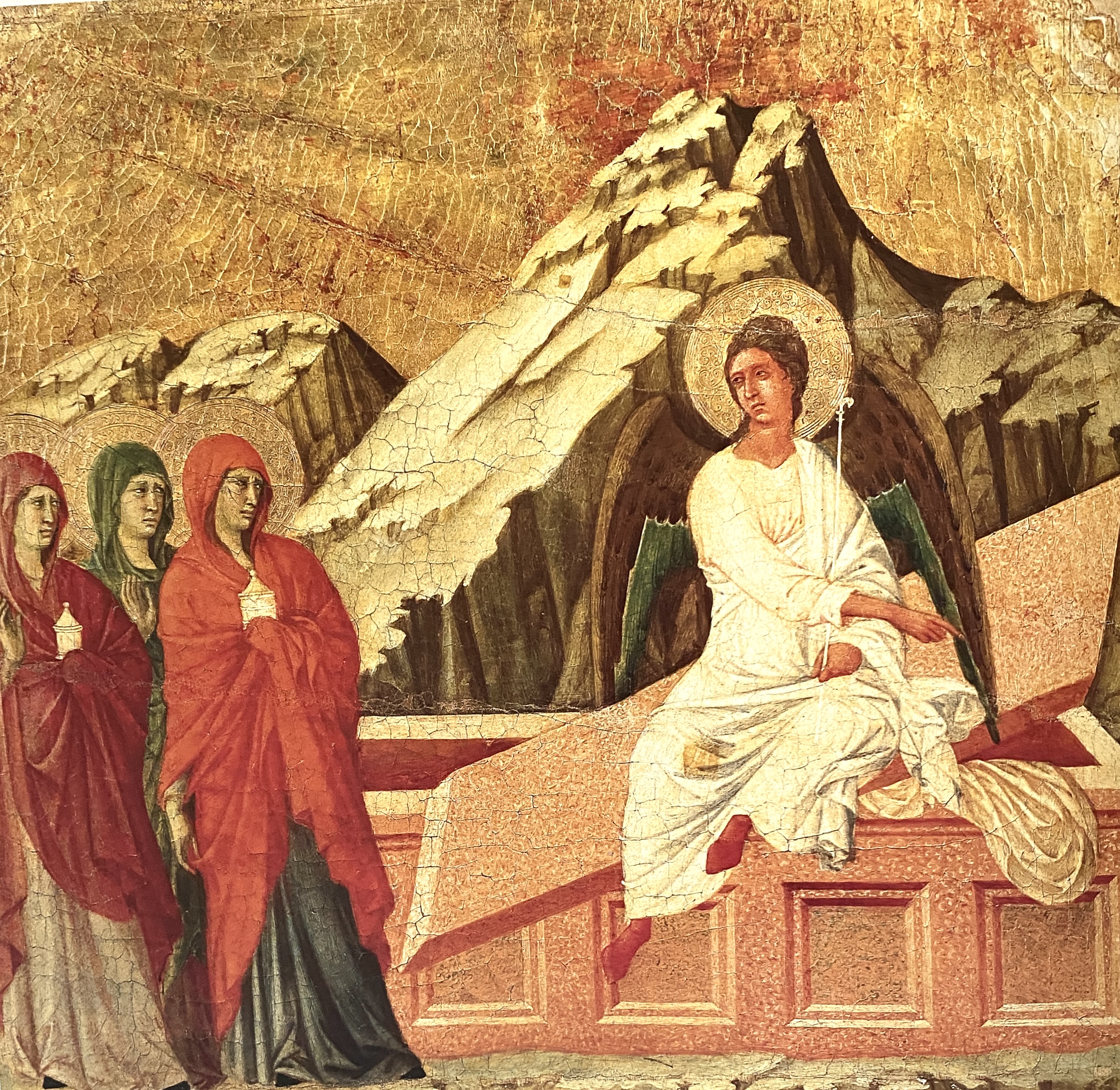
Duccio, The Three Mary’s at the Tomb

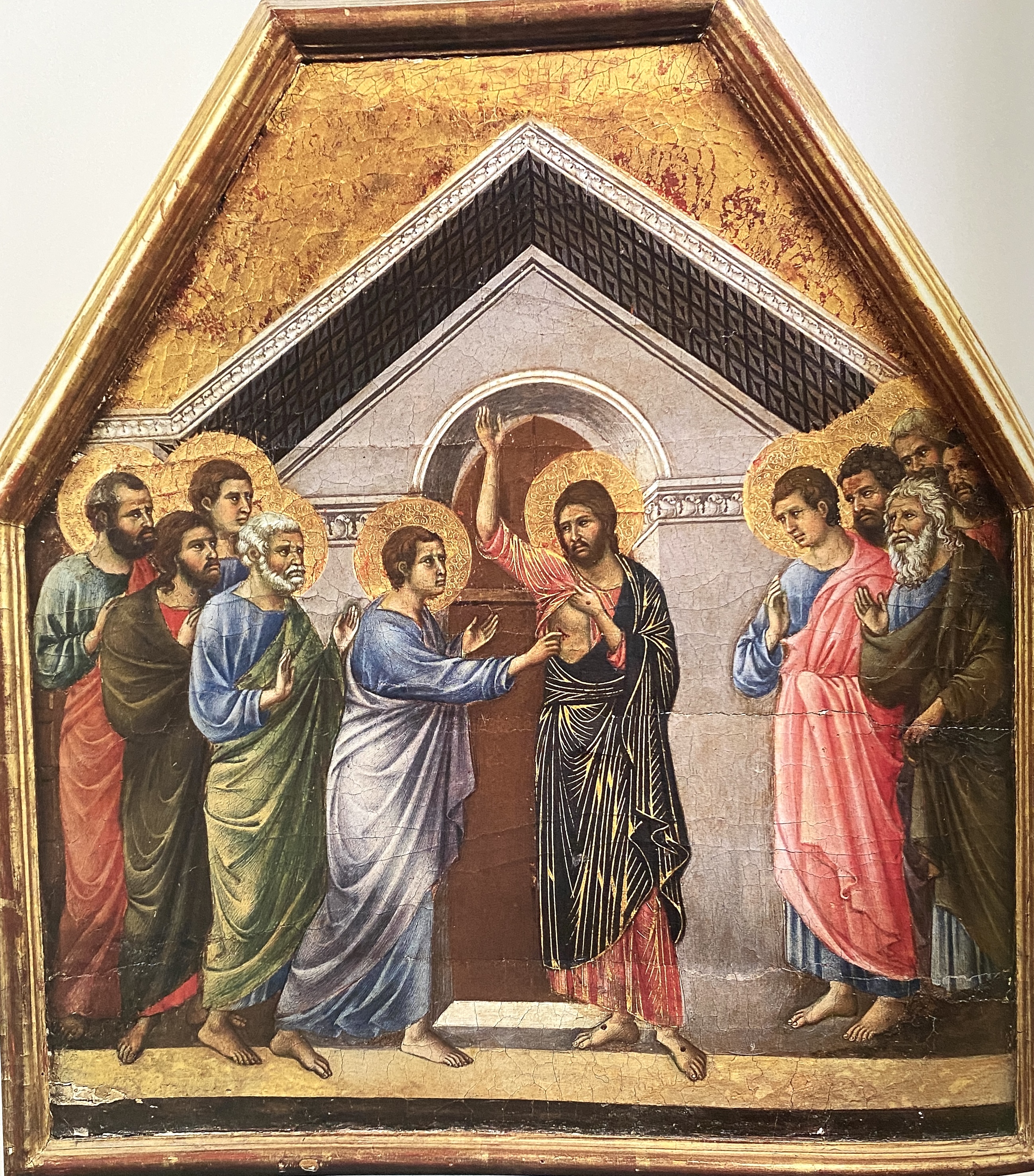
 Duccio , as the founder of the Sienese school of painting,was the predominant painter of the 14th century.He ran a large workshop which shaped generations of Sienese artists.   His religious paintings brought a lyrical expressiveness and intense spiritual gravity to the Italo-Byzantine tradition.  In a small devotional panel of the Madonna and Child, Duccio bridged the gap between the spiritual world of the figures and the real world of the viewer in very much the same way that Icons do.   His holy figures were majestic, his pupils were influential in Florentine art, and his greatest work was the double-sided altarpiece, the ‘Maestà’, made between 1308-11.  Both Duccio and Cimabue began their careers producing iconic altarpiece paintings in the flat, two dimensional style of Byzantine icons, and ended their careers with more naturalistic paintings.  Both were enlivened and inspired by the Franciscan spirituality of their time.

Giotto di Bondone, Italian,   1267-1337

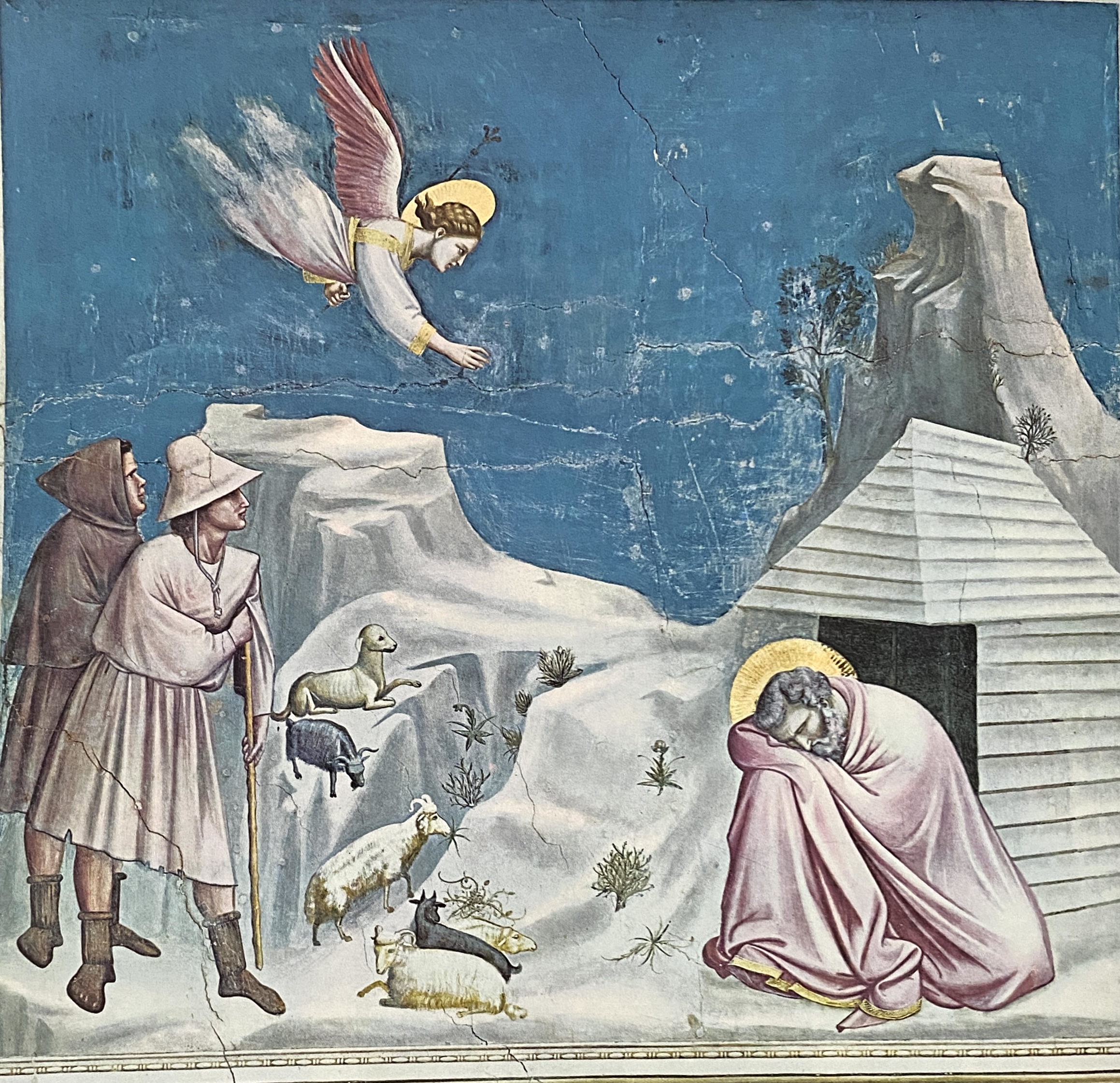
Giotto, The Dream of Joachim, 1330

Giotto was a Florentine painter and architect who is revered as the father of Western painting. It is believed that he was a pupil of Cimabue, and to have decorated chapels in Assisi, Rome, Padua, Florence, and Naples with frescoes and panel paintings in egg tempera. 

Giotto’s figures are volumetric rather than linear, with varied human emotions expressed in a human style rather than the stylized faces of Byzantine icons.  He also created a new kind of pictorial space with an almost measurable depth, transforming the flat world of thirteenth century painting in a more naturalistic view of the real world.  For this, he is considered the father of modern European painting.

The great accomplishment of Giotto’s painting was to make the events of the Gospel and the lives of the holy saints both credible, beautiful, and appealing to the ordinary people of his day.

Conclusion

These artists were followed by the Renaissance in the 14th-16th centuries. Renaissance art, particularly in Italy, focused on realism, classical themes, and a renewed interest in the human form. It moved away from symbolism and abstraction in favor of naturalistic rendering of light, form and nature. In the next and final article in this series, I will explain the effect this development has had on religious painting and contrast Renaissance painting with Icons.  Why is the Renaissance such a strong dividing line in religious art? Because it ushered in a humanistic world view as opposed to the theocratic world view prevalent before. The focus of our culture has gradually progressed from honoring God as creator to revering man’s creations, the truth of science over religious principles, and eventually to a nihilism in our culture that doesn’t recognize any power greater than ourselves.  And that is why as an artist, I have chosen Icons as my art form, desiring to promote and demonstrate visually, God’s universe over man’s universe! 

I hope you have enjoyed this article! Perfect for an end of summer, beginning of fall reading!

Here is a lovely video that talks about Siennese Icon Painting

May God continue to bless the work of your hands. Please join with me in prayer for the world :

“God is our refuge and strength, an ever present help in trouble. Therefore we will not fear, though the earth give way and the mountains fall into the heart of the sea, though its waters roar and foam and the mountains quake with their surging…..”Be still and know that I am God. I will be exalted in all the earth.” Psalm 46:1-3, 10.

Christine Simoneau Hales

https://newchristianicons.com

Illuminating the Spirit: A Summer Reading Guide for Iconographers

Books and Inspiration to Enrich Your Icon Writing Practice

Summer unfurls like a painted scroll—light streaming through open windows, quiet hours stretching across the day, and, for the iconographer, a rare invitation to rest, reflect, and replenish the wellspring of inspiration. Whether you are a seasoned writer of icons, a beginner who has just dipped their brush into the egg tempera, or simply a lover of sacred art, the summer months offer an ideal time to step back from the demands of daily creation and immerse yourself in the wisdom, history, and spirituality that underpin the venerable and holy tradition of iconography.

Why Read in Summer? The Sacred Pause

In the stillness of summer, reading becomes a sacred pause—a time to deepen your understanding of icons not just as objects of devotion, but as living prayers in color and line. Iconographers often speak of their art as an act of contemplation: every stroke is a prayer, every layer a meditation. So too can reading be a contemplative act, enriching the mind and spirit while opening new vistas for creativity.

Foundational Texts: Revisiting the Roots

  • The Meaning of Icons by Leonid Ouspensky and Vladimir Lossky. This classic introduces the theological, spiritual, and artistic foundations of iconography. Through its pages, readers are led to understand the icon as a window to the divine, a theology in pigment, and a bridge between heaven and earth.
  • Icons and Saints of the Eastern Orthodox Church by Alfredo Tradigo. Tradigo’s compact yet richly illustrated guide offers both historical context and practical wisdom. Each page is a pilgrimage through time, introducing saints, feasts, and the symbolic language of orthodox sacred art.
  • Icons as Communion by George Kordis. Kordis brings the ancient tradition into the present, with notes and observations on the drawing stages in icon painting. Amazon Link
  • Orthodox Icon Patterns, Patterns and sketches for Iconographers: This is the revised version of Patterns & Sketches for Iconographers, with added content and additional patterns. A valuable resource for iconographers, this book contains a wide variety of patterns and sketches. Content including; icon patterns of the Nativity, the Theotokos, archangels, male and female saints, as well as halo patterns and 2 beautiful crucifixion crosses. Buildings and fabric/ background designs and icon borders. Each pattern is accompanied by color recommendations which are meant as a general guide allowing for adjustments due to differences in color names between pigments used with egg tempera and acrylic paints.  (There is also a Volume II if you like this one.). Amazon Link

Summer reading need not always be heavy with theory or thick with history. Sometimes, lighter fare—biographies, memoirs, and even novels—can kindle the imagination and nurture the soul of the artist. You might consider adding a few of these to your summer list:

  • Praying with Icons by Jim Forest. Accessible and warmly written, Forest’s reflections on the role of icons in prayer lift the heart and draw the reader into a deeper appreciation of how icons shape and are shaped by the life of faith.
  • The Mystical Language of Icons by Solrunn Ness.  Nes explores in depth a number of famous icons, including those of the Greater Feasts, the Mother of God, and a number of the better-known saints, enriching her discussion with references to Scripture, early Christian writings, and liturgy. She also leads readers through the process and techniques of icon painting, showing each step with photographs, and includes more than fifty of her own original works of art. Amazon Link
  • And if you would enjoy a deep dive into the life of the Blessed Mother Mary, I recommend “The Life of the Blessed Virgin” from the visions of Ann Catherine Emmerich, Incredibly revealing and edifying background of Our Lady, her parents and ancestors, St. Joseph, plus other people who figured into the coming of Christ. also available on Amazon: Amazon Link
  • And also “True Devotion to Mary” by Louis de Montfort: Considered by many to be the greatest single book of Marian spirituality ever written, True Devotion to Mary is St Louis de Montfort’s classic statement on the spiritual way to Jesus Christ though the Blessed Virgin Mary. Amazon Link
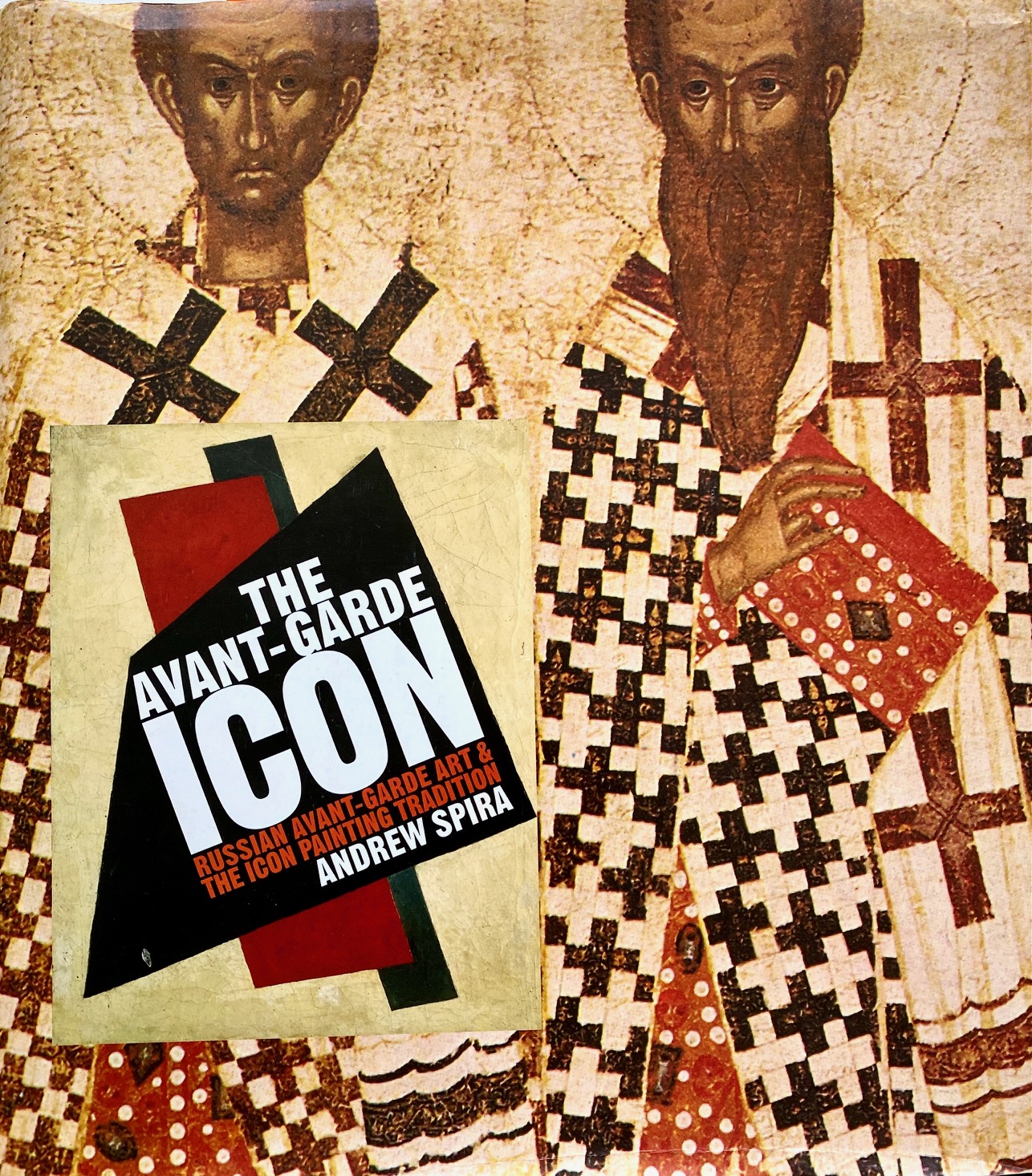
  • And last, but not least, is my own book on Icon writing, “Eyes of Fire, How Icons Saved My Life As an Artist”, with an appendix full of directions as well as an explanation of how modern art has been influenced by icons and how some of those principles can be used in present day icon creation.  Amazon Link

As the art historian Roger Lipsky says in his book, “An Art of Our Own, the Spiritual in Twentieth Century Art”, “One of the tasks of the spiritual in art is to prove again and again that vision is possible; that this world, thick and convincing, is neither the only world nor the highest, and that our ordinary awareness is neither the only awareness nor the highest of which we are capable.”

And so my purpose in sharing this list of inspirational summer reading is to encourage you to engage with the ‘pause” of the longer summer days, and ponder on the beauty of nature and be open to glimpses of eternity that a fresh perspective can often foster. And then let this “higher”perspective inform your icon practice in the coming year,. In the words of Aidan Hart, in his book, “Beauty, Spirit, Matter, Icons in the Modern World, “The Icon invites us to see the world as God sees it.” With nature all around of us. may God bless us with His perspective and insights to carry forward into our work.

Until next month,

Christine Simoneau Hales, Iconographer/artist

My Websites:

  1. https://newchristianicions.com   my main website
  2. Https://christinehalesicons.com  Prints of my Icons
  3. https://online.iconwritingclasses.com  my online pre-recorded icon writing classes
  4. https://www.youtube.com/channel/UCK2WoRDiPivGtz2aw61FQXA  My YouTube Channel 
  5. Facebook: https://www.facebook.com/ChristineHalesFineArt     or  https://www.facebook.com/NewChristianIcons/
  6. Instagram:   https://www.instagram.com/christinehalesicons/?hl=en
  7. American Association of Iconographers:  FB Group: https://www.facebook.com/groups/371054416651983
  8. American Association of Iconographers Website: https://americanassociationoficonographers.com

Icons For Lent

If ever there were icons that personified the phrase, “Icons as theology in Color” it would be Lenten and Easter Icons.

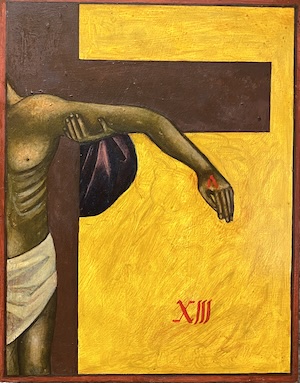
We could start with the Stations of the Cross Icons.

I wrote these icons many years ago in a small village in the Hudson Valley New York.  I had been asked by my priest at the beginning of Lent to write these icons and have them finished by Good Friday!!!  Those of you who have written icons know how impossible a task that seemed! And so it was, that I embarked on that somber and deep journey of walking with Christ as I created each icon with prayer and sometimes tears.  I do want to mention that I was studying icon writing at that time with a nun at the New Skete Monastery in upstate New York, Sister Patricia Reed.  When I would go up to work with her, I often watched her as she created her Stations of the Cross icons for the All Saints Cathedral in Albany New York.  So, I asked for her help and she kindly gave me color photographs of her stations, which I used to create these icons here.  That was a big help, and it is part of the traditions of icon writing, that the designs are handed down from generation to generation, from teacher to pupil, thus ensuring a correct understanding and transmitting the means and methods of icon writing from master to student.

These currently hang in the chapel of the Cathedral of Saint Peter in Saint Petersburg, Florida. The tradition of walking the path of Christ’s Passion dates back to the earliest Christian pilgrims, who visited the sites in Jerusalem believed to be where Jesus walked to his crucifixion. By the 13th and 14th centuries, the Franciscans—who had been granted custody of Christian holy places—popularized this devotion in Europe by constructing “stations” that mirrored the Via Dolorosa. Over time, different numbers of stations were used, until Pope Clement XII fixed the total at fourteen in 1731.

During the late Middle Ages, devotion to the Stations of the Cross was tied to the idea of indulgences, leading some Protestants to reject the practice. Nonetheless, Francis of Assisi and his order played a pivotal role in promoting veneration of Christ’s Passion, establishing shrines and receiving papal recognition as custodians of the holy sites. By the 15th and 16th centuries, the Franciscans built outdoor Stations of the Cross across Europe, often placing them in small chapels or along paths leading to churches.

The titles of each Station, and the Scripture relating to it are as follows:

Station One. The accusing hand condemns Jesus to crucifixion.  Matthew 27:31

Station Two. Jesus Picks up His cross.  The strong diagonals give a powerful sense of unrest, explosive energy.  John 19:6

Station Three. Jesus Falls For the First Time from the weight of the Cross. John 19: 1-3

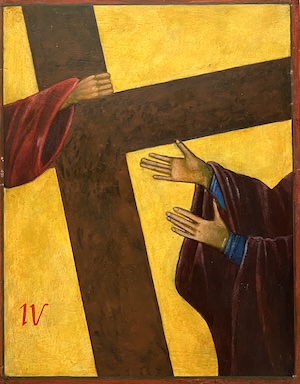
Station Four. Jesus Meets His Blessed Mother. Luke 2: 34-36 …and a sword shall pierce your heart…

Station Five. The Cross is laid on Simon of Cyrene. Luke 23:26-27. Bent over double, the cross almost crushes Jesus.

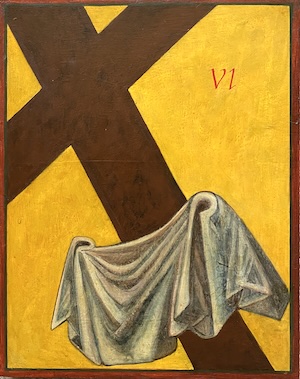
Station Six  Saint Veronica wipes the face of Jesus. Isaiah 53:2-3

Station Seven: Jesus Falls for the Second Time This time the diagonal of the cross is pointing forward- this is the halfway point of the Passion

Station Eight: The Women of Jerusalem mourn our Lord Luke 23:28-29

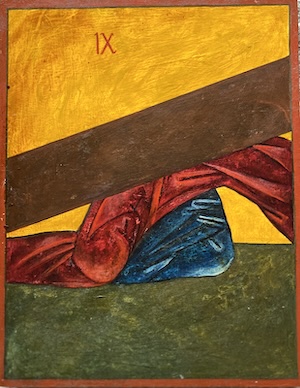
Station Nine:  Jesus Falls for the Third Time.  Isaiah 53:4-6

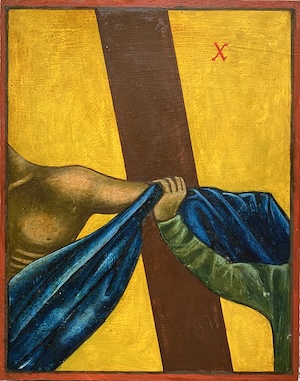
Station Ten: Jesus is Stripped of His Garments. Luke 23: 34-35

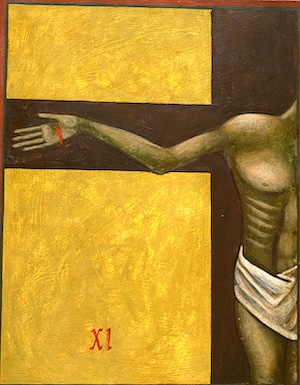
Station Eleven : Jesus is nailed to the Cross. Luke 23:33

Station Twelve:  Jesus Dies On The Cross        Luke 23:44-47. Into your hands I commend my spirit… The rectangle is broken- split apart, showing visually the magnitude  of this event forever changes the world.

Station Thirteen: Jesus is Taken Down from the Cross.   Matthew 27: 54-55.  The position of the hand shows that he is dead.

Station Fourteen:  Jesus is Laid in the Tomb.  Matthew 27:59-62

With these, you may notice that no faces are visible, and the flesh color is neither white, black or any particular ethnicity. This is because these icons are meant to be a universal visual language to be “read” and related to by all humans, because God’s plan is to save all people.

Some other of my icons that relate to Lent and Easter that are also currently at the Cathedral of Saint Peter- until after May 1, are :

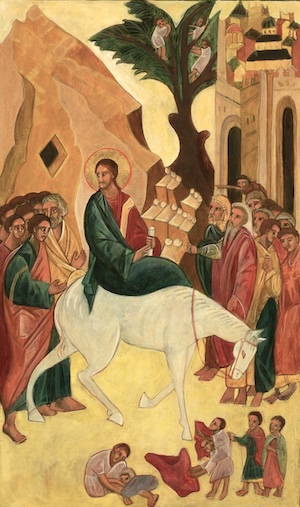
Entry into Jerusalem. Written by Christine Hales
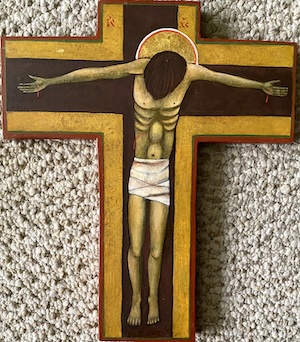
Crucifixion. Christine Hales
Lamentation. Christine Hales
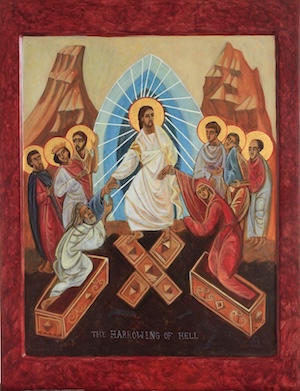
Harrowing of Hell. Christine Hales

Thinking about the Cross and Icons, I came across this writing of St. Theodore the Studite, an Abbot in a monastery in Bithynia in the late 800’s: “THE CROSS AND THE ICON. “Should the cross be venerated more than the icon?” the heretics ask. “Should it be venerated equally, or in a lesser degree?”

“Since there is a natural order in these things, I think you are speaking superfluously. If by ‘the cross’ you mean the original cross, how could it not have priority in veneration? For on it, the impassable Word suffered, and it has such power that by its mere shadow it burns up the demons and drives them far away from those who bear its seal. But if you mean the representation of the cross, your question is not intelligent. The effects receive differing honor just as much as the causes differ, since whatever is received for some use is less honored than that for the sake of which it was received. Thus the cross is received for the sake of Christ, because it was formerly an instrument of condemnation, but was later hallowed, when it was accepted for the use of the divine passion.” St. Theodore the Studite, On The Holy Icons.

Having just given a talk and written an article attempting to explain the period of iconoclasm, I include the above quote as an eloquent explanation not only of the veneration of the Cross, but also of the obvious distinctions between veneration due to the original source and that due a replication of it.

I’ll close this month’s blog with a prayer and a blessing for God to bless each of you especially during this Holy Season of Lent and Easter:

“Gracious Father, whose blessed Son Jesus Christ came down from heaven to be the true bread which gives life to the world; Evermore give us this bread, that He may live in us, and we in him; who lives and reigns with you and the Holy Spirit, One God, now and forever. Amen.” From the Book of Common Prayer.

With love and prayers,

Christine Hales

Some Interesting Links for Iconographers

Sacred Geometry with Donald Duck! A fun explanation for beginners

Interview with Todor Mitrovic, Orthodox Arts Journal

Christian Iconography Shows Us the Pattern of Reality: Jonathan Pageau, St. Tikhon’s Seminary

My Links:

LINKS For  Christine Simoneau Hales   2025

  1. https://newchristianicions.com   my main website
  2. Https://christinehalesicons.com  Prints of my Icons
  3. https://online.iconwritingclasses.com  my online pre-recorded icon writing classes
  4. https://www.youtube.com/channel/UCK2WoRDiPivGtz2aw61FQXA  My YouTube Channel
  5. Facebook: https://www.facebook.com/ChristineHalesFineArt     or  https://www.facebook.com/NewChristianIcons/
  6. Instagram:   https://www.instagram.com/christinehalesicons/?hl=en
  7. American Association of Iconographers:  FB Group:  https://www.facebook.com/groups/371054416651983

American Association of Iconographers Website: https://americanassociationoficonographers.com

Icons As Theology in Color

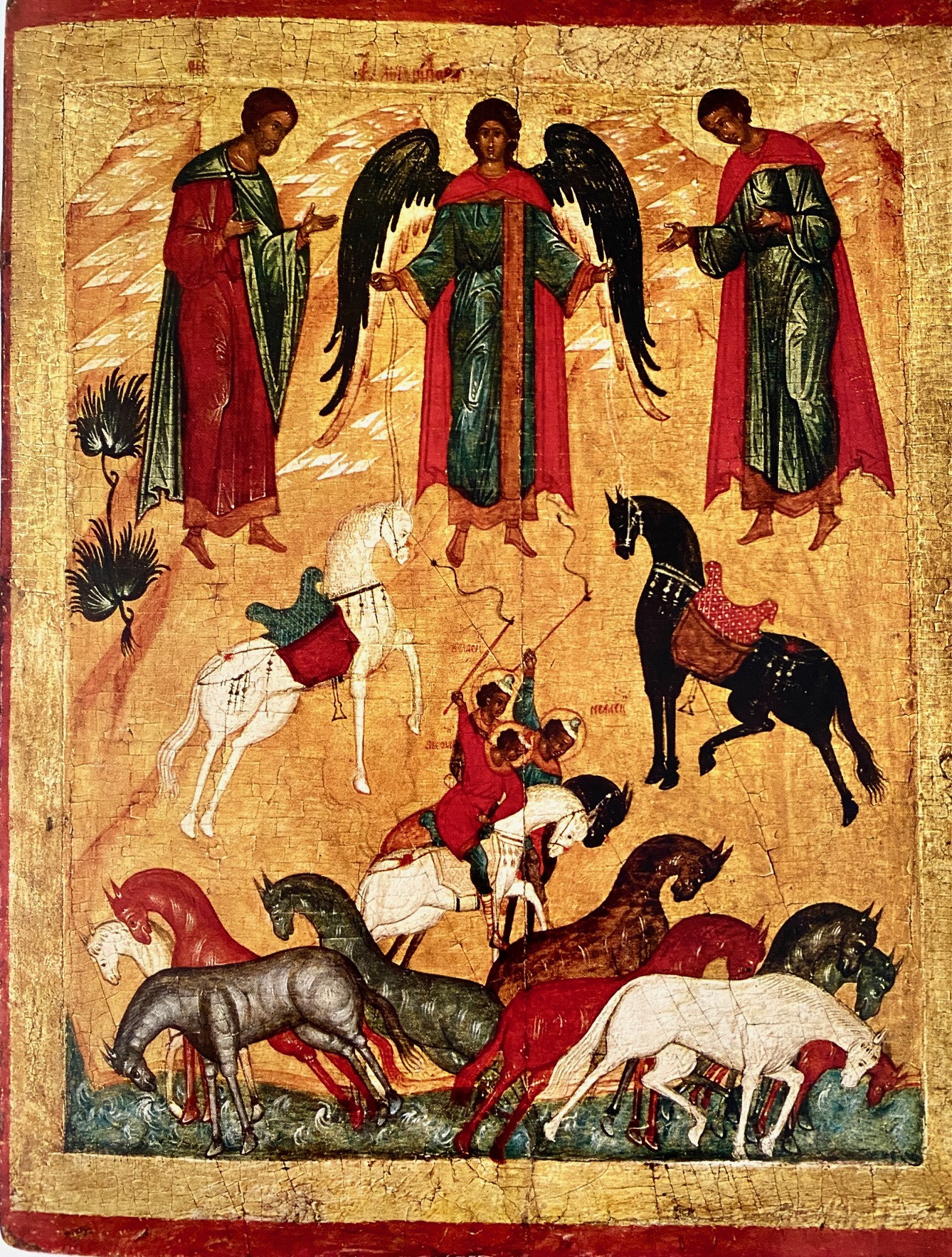
Saint George, Novgorod, 16th century

In the realm of Christian spirituality, icons stand as more than mere religious art. They are a visual form of divine communication, a sacred language that transcends time and culture. As Leonid Ouspensky notes, icons do not serve religion in a utilitarian sense but are an intrinsic part of it—one of the means through which believers encounter and commune with God. When I think of Icons as theology in color, I inevitably go to the Novgorod Icons which were created in Russia from the 14th to 17th centuries.

Sts. Florus and Laurus 16th century, Novgorod

Icons as Liturgical Art

An icon, much like sacred scripture, is a vessel of divine revelation. In the same way that words in liturgy guide the faithful toward deeper understanding, icons serve as instruments of knowledge and communion with God. They are not decorations; they are theological expressions rendered in color and form, inviting contemplation and prayer.

Tradition and the Role of the Holy Spirit

Christian tradition is often misunderstood as mere adherence to historical customs, but its essence is far more profound. As stated in theological reflections, true Tradition is the life of the Holy Spirit in the Church. It is through the Spirit that believers gain the faculty to perceive divine Truth—not merely through human reason but through the illumination of faith. Icons, shaped by this Tradition, bear witness to a spiritual reality that is ever-present and active.

The Power of Signs and Symbols

The Good Shepherd, From the Roman Catacombs

The material and spiritual worlds are not separate; rather, they are deeply intertwined. This is evident in the role of symbols, which serve as bridges between the seen and unseen. Early Christian symbols carried layers of meaning—the image of a saint in the catacombs could signify a soul in paradise, an embodiment of prayer, or even the Church itself. Through repeated sacred gestures and imagery, the faithful are invited to enter into the mystery of divine presence.

The Evolution of Christian Symbolism

Christianity has always expressed its mysteries through symbols. Early believers adapted existing signs from the surrounding world—such as the dove, peacock, and anchor—infusing them with new, transcendent meaning. As time passed, explicitly Christian symbols emerged, such as the fish (Ichthys) and the lamb, both representing Christ. These symbols, while rooted in human expression, point to eternal truths beyond words.

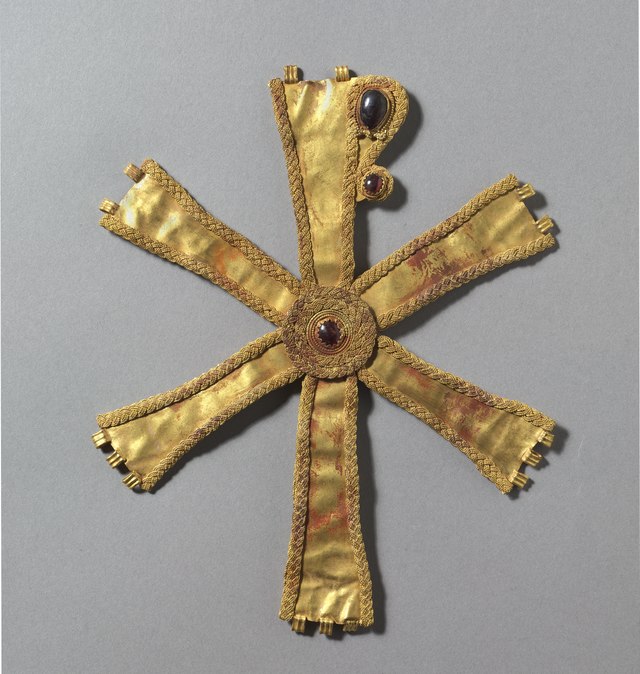
6th Century Byzantine Chi Rho Symbol

Icons: Transcendent Yet Concrete

While maintaining the depth of symbolic language, the icon introduces a unique dimension—the human element. Unlike abstract symbols, the icon makes divine mysteries visually accessible. It brings the infinite into finite form, allowing the ineffable to be expressed in a way that speaks directly to the soul. In the words of Egon Sendler, the icon transforms the abstract into something both transcendent and concrete, revealing the invisible through the visible.

Conclusion

Detail, Face of Christ Icon by the hand of Christine Hales

Icons are not simply religious images; they are theology in color, sacred windows into the divine. Through tradition, symbolism, and the work of the Holy Spirit, they continue to guide believers into a deeper relationship with God. Whether through the gaze of a saint, the presence of Christ, or the gestures of the liturgy, icons remind us that the sacred is always near, calling us into communion with the eternal.

I hope this article has been not only food for thought, but helps to build a solid foundation of theology for contemporary icon development.

“So, my dear brothers and sisters, be strong and steady, always enthusiastic about the Lord’s work, for you know that nothing you do for the Lord is ever useless.” 1 Corinthians 15:58

Until next month. Blessings,

Christine Simoneau Hales, Iconographer

LINKS For  Christine Simoneau Hales   2025

  1. https://newchristianicions.com   my main website
  2. Https://christinehalesicons.com  Prints of my Icons
  3. https://online.iconwritingclasses.com  my online pre-recorded icon writing classes
  4. https://www.youtube.com/channel/UCK2WoRDiPivGtz2aw61FQXA  My YouTube Channel
  5. Facebook: https://www.facebook.com/ChristineHalesFineArt     or  https://www.facebook.com/NewChristianIcons/
  6. Instagram:   https://www.instagram.com/christinehalesicons/?hl=en
  7. American Association of Iconographers:  FB Group:  https://www.facebook.com/groups/371054416651983

American Association of Iconographers Website: https://americanassociationoficonographers.com
How Important Is Drawing?

Often when I teach icon writing classes, I am asked to critique students’ previous icons, and almost always, my comments revolve around drawing more.  Re-draw the composition, or the faces, or the figures. And so, for this blog post I am including some random ideas for improving your icon drawing.  

Drawing by Nun Juliana

First, I’d like to share about an iconographer whose drawings I particularly admire- Nun Juliana. Mother Juliana was a Russian icon painter who was a prominent figure in the renewal of sacred arts in Russia during the second half of the 20th century. 

Drawing by Nun Juliana

She was also a teacher of iconography, discussing the meaning of the subject matter, technique, materials, and style. Mother Juliana’s work was part of a rediscovery and renewal of sacred arts that has reached world wide proportions.

Today Mother Juliana is considered a saint by the Orthodox Church and is credited with preserving the tradition of icon painting in Russia and beyond through her work and those she taught. 

During the first decades of Soviet rule in Russia holy images, especially icons, were subjected to harsh persecution. It was a period of unrestrained, militant atheism during which, together with the closing of churches and monasteries, great numbers of icons were destroyed. From this it is easy to comprehend the difficulties faced by those who wished to preserve the traditions of Russian icon painting. 

Drawing by Nun Juliana

The nun Juliana, known to the world as Maria Nikolajevna Sokolova, preserved the living tradition of ancient Russian icon painting, transmitting it to her successors during one of the most difficult periods in the history of the Russian Church. This is the basis of her significance for modern icon painters.

Drawing by Christine Hales

Egon Sendler’s states in his foundational book, “The Icon, Images of the Invisible”, that “The drawing is of great importance because it gives structure and movement to the icon and determines the surfaces to be painted.  The ancient iconographers religiously kept the sketches of their icons so they could use them again in their later works.  These collections of drawings were called podlinik, pattern books.”

We know that in the Byzantine method, a relational system of proportions was employed, thus giving a consistency to the visual images that allow the viewer to concentrate on the meanings of the icon. This system of relational proportions was probably inherited by Egyptian artists who also used a simple grid system to standardize proportions of figures.

Egyptian Grid Drawing

Byzantine compositional drawing develops a relationship with rhythm and space in the icon that enables the viewer and the icon to meet- the dynamic elements of the icon are intentionally created to engage the viewer and bring them into a relational experience with the subject of the icon.

Without depth, the vertical method of composition is used in Byzantine compositional drawing, for example, objects which are behind in the icon are placed above in the composition, and those in front are placed on the lower section of the composition. The Nativity icon is a very good example of this principle.

Nativity Icon by Christine Hales

The last set of ideas I wish to share with you derive from Iconographer George Kordis in his book, “Icon as Communion”.  In speaking of the artistic principles of Byzantine art this is what he says, “This is what we recognize as Byzantine art, and it bears the following characteristic features:  

  1. The absence of artistic depth (there is no movement behind the artistic surface.)
  2. The essential role and fundamental importance of color in rendering form: forms are defined through color and not through the use of black or shadow..
  3. The essential role and fundamental importance of line, which determines how color is applied…
  4. The plasticity of artistic form (the juxtaposition of light and dark) in order to give the feeling of movement outward from the artistic surface toward the beholder.
  5. The pursuit of rhythm (the sense of movement that relates the figure to the viewer, uniting the two.)
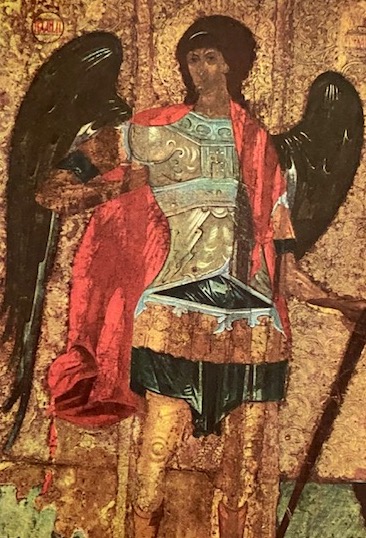
Archangel Michael Drawing in Moscow

Obviously this article is presenting the tip of the iceberg!  Hopefully these thoughts stimulate your creative process and help your icons become the best representation of God’s kingdom possible.   Although I am familiar with all of these principles, I find that I need to read them often to keep them constantly in mind when I draw.

Below are some interesting links from Iconographer Dorothy Alexander:

Here is a link to the Icon retreats I am teaching this year: Icon Retreats

And here is link describing the Artist in Residence program I am participating in at the Cathedral of Saint Peter, Saint Petersburg, Florida.

Until next month,

Blessings,

Christine Simoneau Hales

New Christian Icons

Saint Peter

I’ve recently noticed the influence of Saint Peter in my life as an iconographer. Over the years, I have been commissioned to paint many icons of Saint Peter, for churches and priests, and friends. Although each one is different, I have begun to study more deeply into who Saint Peter was and what the significance of his ministry has been over the last 2000+ years of Christianity.

Commission to paint “The Confession of Saint Peter” for Saint Peter’s Church in Lakewood, Ohio,

Saint Peter’s original name was Simon Bar Jonah, which means Simon, son of Jonah.  Jesus gave him the name of Peter when Jesus called him Cephas (in Aramaic) which means rock or stone.  Human frailty.  Born in first century CE in Bethsaida vicinity, in modern day Syria. 

Peter was a fisherman with a couple of small fishing boats.  He was married, had children and lived with his Mother-in-law. In Capernum .  Luke 4:28 Jesus healed his mother-in law.

Shortly after this healing incident, Jesus stepped into Peter’s boat and asked him to row a few feet off shore so that Jesus could preach to the crowd at the Sea of Galilee.  After Jesus was finished, he told Peter to cast his net into the sea, upon which Peter then hauled out a very full net.  There were so many fish in the nets that Peter was afraid the nets would rip apart. Tin fact, the weight was so heavy that the boats began to sink.  Peter said to Jesus, “depart from me for I am a sinful man”. But Jesus said, “do not be afraid, from now on you will be a catcher of men.”

My recent “Calling of Peter and Andrew” Icon

Saint Peter was recognized as the leader of the 12 disciples, and the Roman Catholic Church regards Peter as the first of its unbroken succession of Popes.

History

St. Peter, originally Simon Bar Jonah, was a Jewish fisherman called to follow Jesus as one of His first disciples. He lived in Capernaum and worked as a fisherman with his brother St. Andrew and others. The New Testament, especially the Gospels, Acts, and letters, provides most of the information about him. Peter was married, and despite being untrained in Mosaic Law, he became a central figure in the early Church.

Peter’s personality was marked by both strengths and weaknesses. He was sometimes impulsive and unsure but displayed loyalty, leadership, and faith. He was the first to confess Jesus as the Christ and was entrusted by Jesus as the “rock” upon which the Church would be built. His denial of Jesus was followed by repentance and reaffirmation of his faith.

After Jesus’ resurrection, Peter emerged as the leader of the early Christian community, preaching at Pentecost, performing miracles, and advocating for Gentile inclusion. Despite occasional conflicts, such as with Paul over Gentile practices, Peter played a vital role in spreading Christianity and leading the Church until his eventual departure from Jerusalem and missionary work elsewhere.

Peter’s acceptance of Gentiles into the Christian faith marked a pivotal moment in early Christianity, as it symbolized the breaking down of barriers between Jews and non-Jews. Here’s a detailed explanation of this significant event:

The Conversion of Cornelius (Acts 10:1–48)

  1. Vision from God: While staying in Joppa, Peter received a vision of a sheet descending from heaven, filled with various animals considered unclean under Jewish dietary laws. A voice commanded him to “kill and eat.” When Peter objected, the voice said, “What God has made clean, you must not call unclean” (Acts 10:15). This vision occurred three times, emphasizing its importance.
  2. Summoned by Cornelius: Cornelius, a Roman centurion described as devout and God-fearing, also received a vision instructing him to send for Peter. Cornelius, though a Gentile, was respected for his prayers and acts of charity.
  3. Peter’s Journey to Caesarea: Understanding the vision’s meaning, Peter traveled to Cornelius’ home. He acknowledged that, under Jewish law, associating with Gentiles was forbidden, but he declared, “God has shown me that I should not call anyone impure or unclean” (Acts 10:28).
  4. Peter’s Sermon: Peter preached the Gospel to Cornelius and his household, proclaiming that God shows no partiality and accepts people from every nation who fear Him and do what is right. He testified about Jesus’ life, death, and resurrection.
  5. Outpouring of the Holy Spirit: While Peter was speaking, the Holy Spirit descended upon the Gentiles, just as it had upon the Jewish believers at Pentecost. This astonished the Jewish Christians who had accompanied Peter. Recognizing this as God’s work, Peter declared, “Can anyone withhold the water for baptizing these people who have received the Holy Spirit just as we have?” (Acts 10:47). He then baptized Cornelius and his household.
Saint Peter Icon

Significance of the Event

  • Breaking with Tradition: By baptizing Gentiles without requiring them to first undergo Jewish rites (e.g., circumcision), Peter challenged longstanding Jewish customs. This act demonstrated that salvation was available to all through faith in Christ, not adherence to Mosaic Law.
  • Divine Validation: Peter’s actions were justified by the visible descent of the Holy Spirit, signaling God’s approval of the inclusion of Gentiles into the faith.

Conflict and Resolution

  • Criticism from Jewish Christians: Upon returning to Jerusalem, Peter faced criticism from Jewish Christians for eating with Gentiles (Acts 11:1–3). In response, Peter recounted his vision and the events at Cornelius’ house, concluding, “Who was I to think that I could stand in God’s way?” (Acts 11:17). This explanation satisfied his critics, who glorified God, saying, “So then, even to Gentiles God has granted repentance that leads to life” (Acts 11:18).
  • Jerusalem Council (Acts 15): The inclusion of Gentiles later became a major issue debated at the Jerusalem Council. While Paul was the main advocate for Gentile inclusion, Peter’s testimony about Cornelius played a crucial role. He reminded the council that God had chosen him to bring the Gospel to the Gentiles and argued against imposing Jewish laws on them (Acts 15:7–11).
My New St. Peter Icon

Impact on Christianity

Peter’s acceptance of Gentiles set a precedent that allowed the Church to grow beyond its Jewish roots, becoming a universal faith open to all ethnicities and cultures. His leadership in this matter helped shape Christianity as a global movement, emphasizing grace and faith over legalistic adherence to the Law.

I hope this brief exploration into the life and contribution of Saint Peter has given you some insight and inspiration for this month! I have been reading 1 Peter and 2nd Peter in short meaningful increments and adding those to my spiritual journal each day this past month and it has brought forth many helpful insights that are applicable to current day events.

Icon Exhibition, Cathedral Church of Saint Peter, Saint Petersburg, Florida, January 12- May 1, 2025

The upcoming exhibition will include over 50 of my icons, including the Stations of the Cross, along with commentary from or about Saint Peter as a way of inviting the viewers to enter personally into each iconographic scene through the eyes of Saint Peter.

May God continue to bless the work of your hands, and give you insight and awareness of His Presence in your world.

Until next month,

Christine Simoneau Hales

Icon Museum and Study Center.

My Website. My Icon Print Website. My Patreon

A Good Source of Gessoed Icon Boards: Bob’s Icon Boards

Mystics, Healing, and Icons

Dear Fellow Iconographers:

My husband and I were honored to be inducted into the Order of Saint Luke this past summer.  The Order of Saint Luke is an international, inter-denominational organization made up of healing communities of faith, prayer, and service.  And so I have been thinking a lot about icons, miracles, mysticism and healing.  Can an Icon heal?  That’s a trick question!  Only God can heal, but an icon can bring the person into remembrance of Jesus’ healing ministry to inspire and strengthen faith in God’s desire and commitment to heal His people.

Christ in Glory created by the hands of Christine Hales

So how do we define healing?  True healing is Salvation. What is Salvation?  It can mean being saved from danger, disease, and the consequences of sin by the power of the Resurrection of Jesus Christ.  So, by these definitions, we create a field where an Icon can bring the viewer into visual relationship, remembrance and anticipation of the action of God’s grace which He freely gives us.

Not all icons need to be healing icons.  Some are created as vehicles for instruction in Biblical and Gospel truths, some for aiding in prayer and the liturgy, and inspiring God’s people through holiness, sacredness and beauty. My mission is to carry this healing charism in icons forward into our present day.  There’s quite a strong historical foundation of the healing ministry in the Christian church, beginning with our Lord Jesus. Many of the Christian mystics experienced people being healed wherever they went.

St. Fyodor of Rostov painted by the hand of Christine Hales

Mystics and Healing

The mystical spiritual tradition that has existed through the centuries is accepted by both the Eastern and Western Church.  In its simplest form, mysticism is a desire to touch or experience God in some tangible way. And when we touch God, we are transformed.

Both ancient and modern mystics practiced contemplation, insight, intuition, prayer in deep experience of worship in order to increase their direct relationship with God. In medieval times, men and women had a keen sense of God acting in the world around them through people, animals, and forces of nature. Mystics cultivate a devotion to God’s Holy Spirit and have their eyes open to God’s miracles happening around them.

Early Christian Mystics

Irenaeus, (c.130-202), one of the early church fathers, wrote: “It is impossible to number the gifts which the Church throughout the world has received from God in the name of Jesus Christ…Those who are in truth his disciples, receiving grace from Him, do in His name perform (miracles), so as to promote the welfare of other men, according to the gift each one has received from Him.”

Symeon the New Theologian

Symeon the New Theologian (949-1022), emphasized the importance of having a direct personal experience with God through grace and prayed often to receive the gifts of the Spirit. “Leave the world…do not be concerned about the present life. Knock at the gates of Christ’s Kingdom for the Son will give the Spirit to whoever asks, and he who seeks will certainly find and be enriched with the fullness of all God’s gifts.”  “Pentecost to the Present”, by Jeff Oliver.

Gregory of Palamas

Gregory of Palamas (1296-1359) was a Greek Monk and theologian who, while a Bishop of Thessalonica, would defend the traditions of the Hesychasts mystical prayer practice as opposed to the more rational and intellectual approach to prayer and worship that was in fashion at the time. 

Bernard of Clairvaux

In the West, Bernard of Clairvaux (1090-1153), wrote “We have all, I think, received the Spirit unto salvation, but not to all has he been given unto fervor.  In fact, only very few appear to be filled with this Spirit of fervor, very few show any desire to obtain it.  We are content with our own cramped littleness, and make no endeavor to rejoice in or at least to aspire to the liberty of the spirit which that Spirit confers.” Bernard believed in a personal, immediate  and direct personal faith with Christ as opposed to any rational or ritualistic approach.  When the Pope commissioned Bernard to preach the enrollment for the second crusade, Bernard preached to an open field who, upon hearing him, enlisted en masse. He then passed into Germany where miracles reportedly followed: “The breathing, the touch, the prayer, the benediction of Bernard had wonderful effects.  At his voice, the most chronic conditions disappeared instantly and entire populations related with astonishment the cures to which they had been witnesses. Everywhere along his route the blind regained their sight, the deaf and dumb heard and spoke; paralytics recovered the use of their limbs; those supposed to be possessed by evil spirits were calmed and restored to reason.

Icons, Mystics, and Healing

Why am I relating these early church fathers to creating icons in the twentyfirst century?  Perhaps what we need to be emulating is not the outward form of early icons, but the Spirit that created them, and how we too can create Holy Spirit filled icons that will bless God’s people in our generation and in generations to come.  I hope these monthly articles inspire and help give direction to all who seek to bless God’s people by creating holy icons.  May we hold each other in prayer for protection and the grace of God to bless the work of our hands.

Until next month,

Christine Hales

New Christian Icons Prints of My Icons

If you would like to read a post I wrote on “All Saints Day”, here’s the link: https://wordpress.com/post/americanassociationoficonographers.com/28287

If you would like to read a post I wrote on ” Miracle Working Icons” here is the link: https://americanassociationoficonographers.com/2021/11/30/miracle-working-icons/#:~:text=How%20can%20icons%20be%20miracle,some%20of%20them:%20Russian%20Icons.&text=There%20are%20many%20kinds%20of,a%20long%20period%20of%20time.

Source: Much of the information shared above comes from Jeff Oliver’s excellent book: “Pentecost to the Present”, The Holy Spirit’s Enduring Work in the Church.