This month I am presenting some writings and images from a beautiful exhibition of Eastern European icons dating from the nineteenth to sixteenth centuries that is hosted by a non-profit gallery of icons located in Žilina (Slovakia). The Gallery of Icons (OZ IKONY) in Žilina is found at: https://ikony.hour.sk/en/
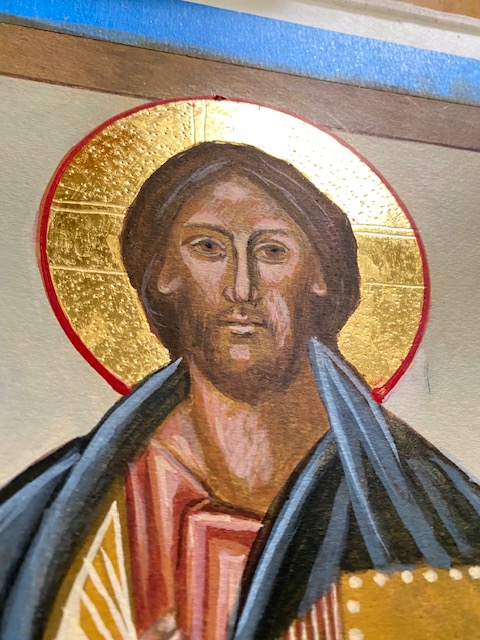
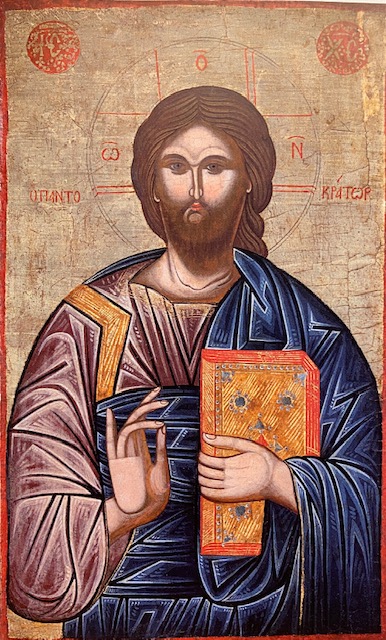
Christ Pantocrator, Albania, seventeenth century, Courtesy, OZ IKONY
Gallery of Icons – OZ IKONY
The gallery was established in 2015 as the result of a private collection of East Christian icons. During the last 7 years of existence, the gallery has collected about 300 icons from Russia, Ukraine, Belarus, Cyprus, Greece, Romania, Bulgaria, North Macedonia or Albania. The icons are dated from the 14th until the beginning of the 20th century. Among the main activities of the gallery, I can name the presentation of the icons from various regions of Eastern Christian cultures, the conduct of research on icons and providing space for and organizing of conferences, lectures and concerts. The aim of the exhibition is to present the spiritual and artistic beauty of Eastern Christian icons and to create a living bridge between the East and the West.
In March 2021 the gallery celebrated its 5th anniversary. The current exhibition called The Mysterious Face of Jesus Christ is the fifth in a row after the exhibitions dedicated to the themes of The Old Testament Prophets, The Church Feasts, The Icons of the Mother of God, and Wisdom Hidden in Icons.
The 5th exhibition is opened from the 15th of September 2020 until June 2023. There are 25 artistically and historically valuable icons on display. Most of them are exhibited in Slovakia for the first time. There are Russian and Greek icons, one Romanian, Macedonian, and Albanian icon, and one icon from Mount Athos among the exhibits.
The Only Begotten Son and the Word of God, Russia, nineteenth century, Courtesy, OZ IKONY
American Association of Iconographers’ Goals
Even as this is a newsletter to foster the development of American iconographers, we all owe a debt of gratitude to our Eastern Orthodox brothers and sisters who, through the centuries have produced so many beautiful and deeply spiritual icons worth imitating and learning from. The aim of this exhibition is to create a living bridge between the East and the West, which is closely aligned with the goals of the American Association of Iconographers.
Membership to the American Association of Iconographers is without financial obligation to its members and is open to all friends and lovers of icons around the world. It is an ecumenical, primarily Christian group of icon collectors, scholars, icon writers and those whose mandate is education in the liturgical arts.
We invite members to contribute educational articles that might benefit all who love icons. Email: christinehales@me.com for submission details.
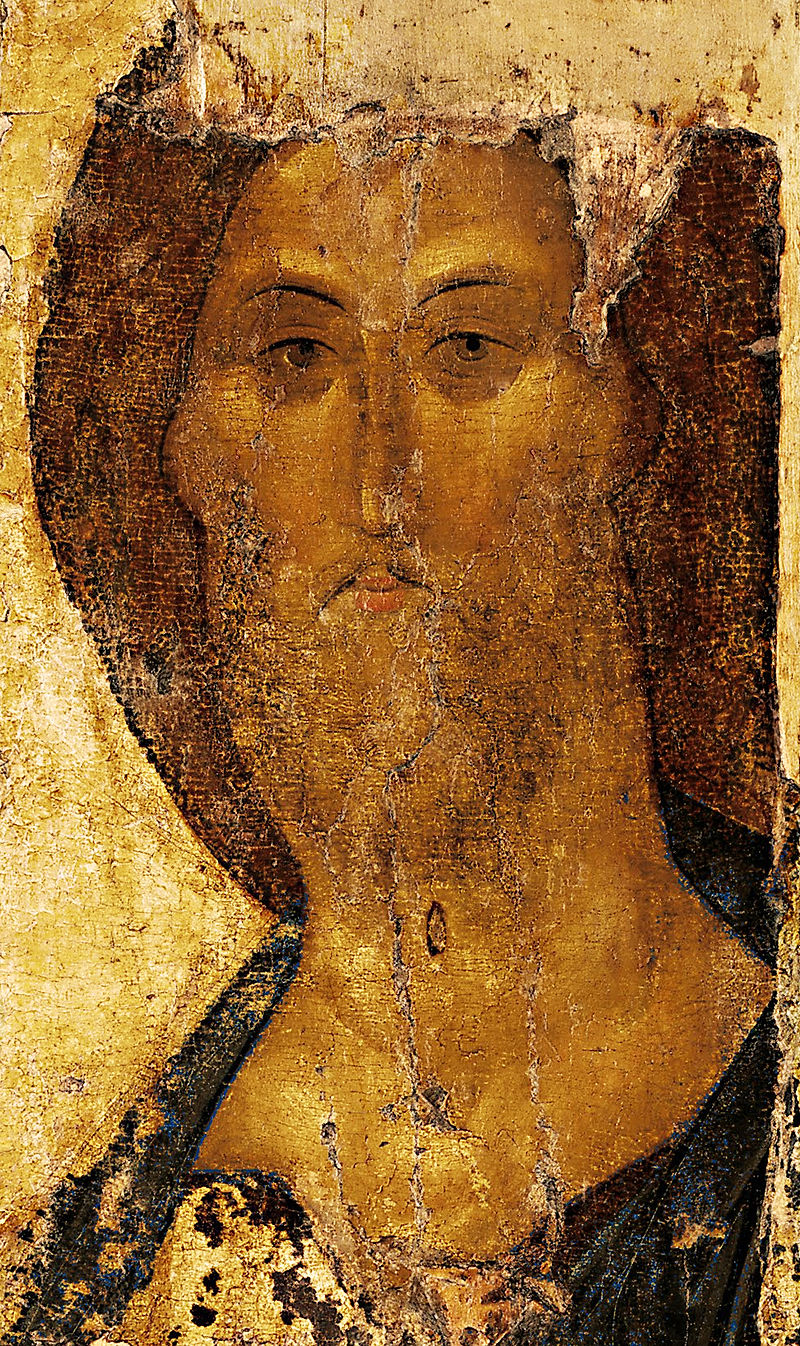
The Saviour Depicted up to His Shoulders, Russian, sixteenth century, Courtesy OZ IKONY
Quotes from Milan Lach SJ, Bishop of the Eparchy of Parma, Ohio
“St John of Damascus (+749) once said: “When someone asks you about your faith, take him to church and show him the icons.” … Icons are liturgical objects. They speak- communicate. Persons depicted on icons are already in the Heavenly Kingdom. They are transformed by uncreated light and participate in the life of the Most Holy Trinity.
Icons are not merely art, as Western culture would perceive it. They are more than art. Through an encounter with the person of Jesus Christ, the Most Holy Theotokos, and the saints depicted on the icon, we can have a personal experience with the living God.
The icon is a tool of evangelization, through which the Church proclaims the living Jesus Christ. To His person is dedicated this exhibition of twenty five beautiful icons, here at the Gallery of Icons in Zilina.”
I hope this virtual exhibition enriches your understanding and scope of possible models for future icons. Sending prayers for God to bless the work of your hands and minds, to the service of His Holy Church.
Recently I have been reading a book by Sister Gabriela about Father Sophrony that includes many of his drawings and icons. I’m inspired by his approach and work and want to share that with you here.
While attending art school in Russia in the 1920’s, one of his teachers was Vassily Kandinsky. Soon after, Sophrony moved to Paris where he exhibited his paintings and was not interested in pursuing a Christian life. This changed drastically and in 1926 he entered the Monastery of Panteleimon on Mt Athos where he remained until finally settling in Essex, UK at the Monastery of Saint John the Baptist.
Father Sophrony Drawing
To learn more about Father Sophrony, please read Sister Gabriela’s excellent books: “Being, The Art and Life of Father Sophrony”, or “Seeking Perfection in the World of Art”, or “Painting As Prayer: The Art of A. Sophrony Sakharov.”
I include here several quotes from the “Painting as Prayer” book that I know will be inspiring to all of you as well:
“An artist is a person who believes with deep conviction in the rightness of what he creates; who devotes his entire life to art for mankind. Only in such people does the Divine spark burn, brightly an unquenchably. And this is what’s most important in art.”
Drawing by Father Sophrony
Kandinsky
This is a quote in the book attributed to Kandinsky: ” the artist must not consider himself master of the situation, but the servant of nobler aims- a servant whose obligations are majestic, distinctive, and sacred. He must nurture himself and plumb the depths of his inner life, he must conserve his inner life and develop it lest his outer talent becomes empty, like a lost glove, the empty and vain likeness of a hand.”
Painting as Prayer, Book by Sister Gabriela
“The Icon is an art which expresses the spiritual world in form and color. It is made with a stylistic language of its own which introduces the person looking at it into another sphere of being, another world of perception. Intentionally it follows a different logic of perspective and reality, placing emphasis on the inner life because its main purpose is either to depict the face of God or convey the soul of the saint or the essence of the scene being depicted. Deliberately this makes it somewhat abstract. The artist seeks divine inspiration for their work and in order to receive this, rather than some other influence, he needs a humble and prayerful attitude, recognizing that he is not master of the situation.
Inspiration from on high depends to a considerable extent on us- whether we open our heart so that the Lord- The Holy Spirit Who ‘stands at the door and knocks’ does not have to enter forcibly.
The iconographer will try to free himself from all that hinders or is contrary to the action of Divine Inspiration. This requires both humility and asceticism, but as ascetic feats may lead to pride, and thus deter grace, it is humility that is the essential part. This keeps him both open to others and their suggestions and open to grace. It preserves a rigorous questioning and checking in prayer with his conscience and with the ideal which is the humble example of Christ.”
Orthodox Journal Article
I first learned about Father Sophrony’s work from an excellent article on the Orthodox Journal. Here is the link .
“For me, the most fascinating part of the study was the subject of Father Sophrony as an iconographer. His approach to iconographic practice is described and this section is rich in quotations and comments of great interest. Sister Gabriela writes that by having “absorbed the iconographic tradition through observation and living with it, while leading a strict ascetical life…one’s understanding goes deeper, beyond the external aesthetic aspect.” “…he understood iconography in its essential form, as an inspiration for prayer, and a “springboard”, as he called it himself, to eternity. In this sense he was free from any attachment to any specific school or iconographic movement. His sole interest was to render the icon as authentically as possible.” As a result of this it is apparent that “One cannot classify his icons into any particular style or school. He took what he found best from each. His only concern was the icon itself, how best to express the given situation.”
In summation Sister Gabriela writes of Father Sophrony’s life that “This is the search for Christ, the yearning for close contact with Him and, within this, striving to portray His face in a correct and worthy manner, both in the inner life and in iconographic panting.”
Additional Link to Icon Gallery in Slovakia
I have recently seen a lovely online exhibition of Eastern European Icons at The Gallery of Icons. Here is the link.
That’s all for this month. Please email me with suggestions for future articles on understanding and appreciating icons.
What is so special about Novgorod Icons? In addition to being known for their beautiful colors and lively compositions, Novgorod Icons offer a rich history and background to the study of icon writing.
Novgorod is one of the oldest cities in Russia, dating from about 859 AD. The period from the 12th to the 17th centuries was especially bountiful in producing many beautiful icons. This period of time is sometimes referred to as “the Proto- Renaissance” because it still embraced the union of religious and aesthetic ideas.
Saints John Climacus, George, and Blaise, 13th Century
The Effects of the Western Renaissance on Icon Writing
The Proto- Renaissance that was operational in Russia was able to encompass all the cultural phenomena of its time within the context of religion and produce icons of spiritual depth without being overly influenced by Humanism.
In the West from the 14th to 16th centuries, the Renaissance moved art, even religious art, more toward man’s interests and became more human, less religious. Even Christianity in the West at this time became more rational and scholastic and emphasized the emotional experiences of the subject.
In the practice of writing icons, we tend to strongly favor copying icons from before the Renaissance for this very reason. Iconographers agree that imagery from before the Renaissance is preferred because we want our icons to reflect a culture that placed God as the center of the universe, not human reason.
Nativity of the Virgin, 14th Century
Fourteenth Century Russian Culture
Russian culture of the late fourteenth and early fifteenth centuries developed strong ties with Byzantium, particularly in Novgorod and Pskov. The great iconographer, Andrei Rublev was part of this cultural and spiritual movement. The famous Byzantine master Theophanes the Greek worked in Novgorod in 1378. His magnificent frescoes in the Church of Our Savior in Ilyina Street formed a bridge between the art of Novgorod and Byzantium.
The Transfiguration by Theophanes
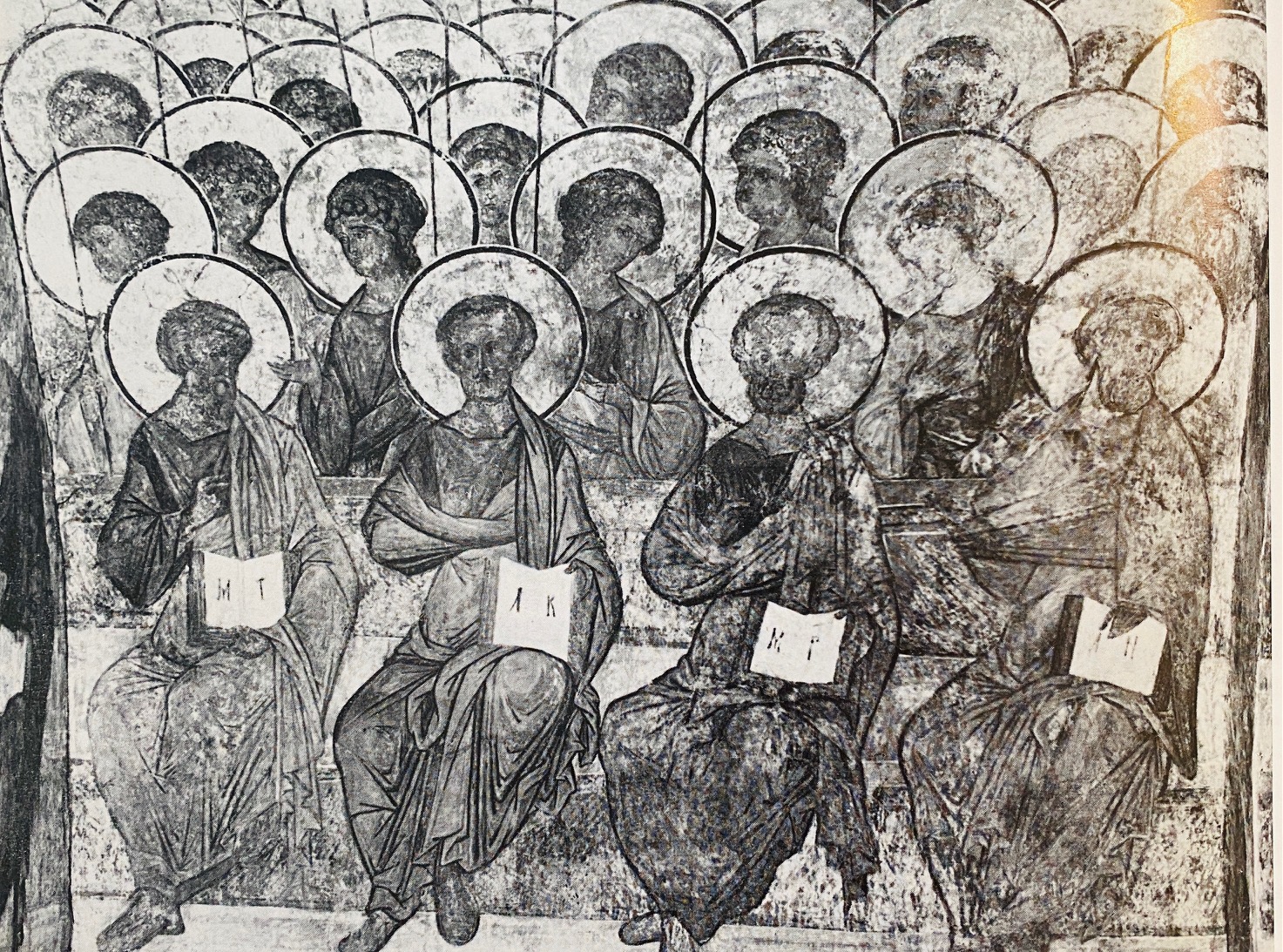
The Artistic Language of the Novgorodian icon is simple, laconic and precise; the composition is based on large contrasting shapes. The rhythm and coloring are tense and mobile, the drawing energetic. Colors are especially important and tend to be simple and bright. Faces, while classical. Tend to have large, expressive eyes. They are painted in a gentle manner with subtle gradations of value. The linear design of the hair, lips, nose and eyes is in contrast to the subtle tonal gradations. In the earlier icons, the minimal color scheme of olive and yellow prevails.
Saint Nicholas Icon
In the thirteenth century icon of Saint Nicholas from the Novgorodian monastery of the Holy Spirit, we see clearly the simplicity of composition, the harsh linear forms, and sparse contrasting colors that complement the restraint of the image. This icon, as well as the is very characteristic of Novgorodian twelfth and thirteenth century painting.
Saint Nicholas
Presentation of the Virgin Icon and Boris and Gleb Icon
In these icons of the late thirteenth, early fourteenth centuries we see the qualities of simplicity of composition combined with monumental, flat graphic qualities balanced by relative depth of form. The colors show an abundance of cinnabar, white, ochre, brown and green.
Presentation of the Virgin
At this time, Novgorodian painting came closer to Byzantine icons of the Palaeologus period. Icons became monumental and soon were given to freer and more complex compositions. Here we find images with inner tension, power and a classical simplicity. We also see the beginnings of interest in man and his feelings and this affects both color and composition.
Boris and Gleb Icon
I need to end this here, but will pick it up again in a subsequent blog in order to continue the historical development of icons in this most important period of icon history. For further reading I suggest the book: Novgorod Icons, 12-17th Century by Aurora Art Publishers, Leningrad.
Some of the best characteristics of Novgorodian icons are their rational yet popular imagery, economy of means, and a brilliant use of color. Definitely a period of icon writing worth exploring for every aspiring iconographer!
“Come then, let us run with him as he presses on to his passion. Let us imitate those who have gone out to meet him, not scattering olive branches or palms in his path, but spreading ourselves before him as best we can, with humility of soul and upright purpose. So may we welcome the Word as he comes, so may God who cannot be contained within any bounds, be contained within us...
Today let us too give voice with the children to that sacred chant, as we wave the spiritual branches of our soul: ‘Blessed is he who comes in the name of the Lord, the King of Israel. “ Saint Andrew of Crete
This month, as we all observe Lent in our prayer lives and churches, I have gathered a collection of Icons related to this season that encompasses the mystery and Passion of our Lord. If any of you readers have written icons on this theme, please send them in and I will post them on the FB page for the American Association of Iconographers.
Entry Into Jerusalem
Entry Into Jerusalem Icon by Christine Hales
“Seated in heaven upon Thy throne and on earth upon a foal, O Christ our God, Thou hast accepted the praise of the angels and the songs of the children who cried out to Thee: Blessed art thou that comest to call back Adam”. From the Kontakion for the Feast
The Holy Washing of the Feet, Icon
Romanian Icon 19th Century
Peter, the Apostle is seated on a bench, on the floor is a basin with water, Jesus has his mantle pulled up to keep it dry, Jesus is wiping the with a towel Peter’s right foot.
The other disciples are grouped on the right and left sides, some are loosening their sandals, Christ is the only figure shown with a halo. Only two are shown without a beard, because of their youth.
This was a lesson in humility. Christ says that he gave them an example to be imitated by them.
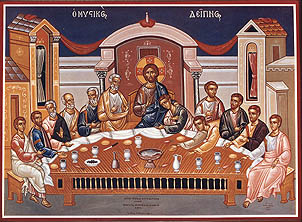
The Mystical Supper
“As a mystical event, the “Supper takes place at every Divine Liturgy or Eucharistic Feast. “ Of Thy Mystical Supper, O Son Of God, receive me today as a communicant, for I will not speak of the mystery to thine enemies.”
A long table inside a house, usually Christ is seen in the center, his head inclines slightly to the right and with his right hand he blesses. Peter is seated on the right side and John on His left side- Jesus rests his hand on John’s shoulder. This is depicted in John’s Gospel, 13:23-24. Judas is stretching out his hand in order to dip his bread in the dish. Matthew 26:23
All the disciples are shown without halos. Halos are not proper before Pentecost. The disciples should not have their backs to the viewer.
The D shaped table was first seen in the 6th century Ravenna mosaics. Psychological perspective calls for Christ to be at the center of the table. ” ( Guide to Byzantine Iconography, Constantine Cavarnos)
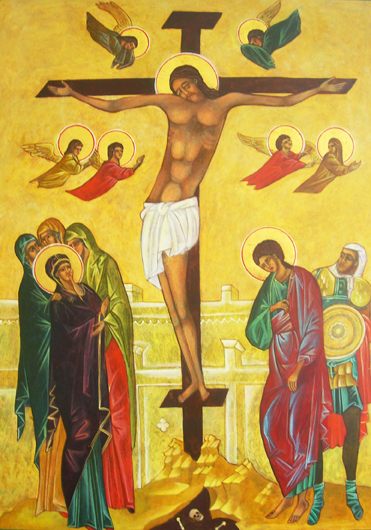
The Crucifixion Icon
Crucifixion Icon by Christine Hales
The Bridegroom of the Church is transfixed with nails. The Son of the Virgin is pierced with a spear. We venerate Thy Passion, O Christ. Show us also Thy Gkorious Resurrection.
“The traditional Crucifixion icon is a hand-painted icon with the scene of Jesus Christ’s Crucifixion in the center of the composition. Christ is usually surrounded by the Blessed Virgin Mary, Mary Magdalene, St. John the Apostle, Longinus the Centurion, and several other onlookers. All the figures depicted in the Crucifixion icon show emotions associated with grief, but nothing suggests sound. Their mouths are not open, and the icon holds silence. Christ Himself is depicted with His eyes closed and His head bowed as if showing His last minutes of life on earth.
The composition of the Crucifixion icon also often includes an open cave with the skull and bones of Adam right at the bottom of the Cross. According to the legend, Adam’s bones, which had been buried under Golgotha by the descendants of Noah, appeared on the surface at the moment of Christ’s death due to a great earthquake that split apart the rocks. Christ’s blood flowed down from the Cross and on to Adam’s bones, bringing the redemption to the First Man and the whole human race.” to read more follow this link for The Russian Icon Blog.
Descent From the Cross Icon
Descent From the Cross Icon c. 1350
The Descent from the Cross Icon, sometimes called “The Deposition”, shows Joseph of Arimathea and Nicodemus taking Christ down from the cross after his crucifixion. The Gospel mentions women attending, probably Mary Magdalene, Mary, the Mother of Christ and Mary Salome alongside St.John.
The Lamentation
Lamentation Icon by Christine Hales
The aim of this icon is to impart the mystical, spiritual truth of the lamentation. The colors, the composition, and even the lines of the figures all lead the viewer upward, they raise our thoughts beyond the crucifixion to the upward movement of Christ himself and the Ascension. It’s a sacred and divinely inspired icon, full of truth and transcendence of emotions to the spiritual realm of faith and hope.
The Resurrection Icon
Resurrection Icon
The Icon of the Resurrection evokes the fragrance of immortality and the fulfillment of the reclamation of Adam and all who have come after. The simple truths are depicted without theatricality.
“Though Thou didst descend into the grave, O Immortal One, yet didst Thou destroy the power of hades, and didst arise as victor, O Christ God, calling to the Myrrh bearing women, Rejoice, and giving peace unto Thine apostles, O Thou who does grant resurrection to the fallen. ” Kontakion for Easter
The Resurrection brings light and joy to all creation. May Pascha, Easter, and Lent be Holy and blessed times for you all and bring joy to your hearts.
Born in the 1360’s in Moscow , Andrei Rublev is widely considered the one of the greatest painters of Russian Orthodox Icons. For a large part of his life he lived in the Trinity-St. Sergius Lavra near Moscow and his spiritual teacher was St. Sergius of Radonezh. He was able to express the spiritual ideals of his time and integrate the tenets of Byzantine Iconography into his icons in a way no one has been able to do before or since.
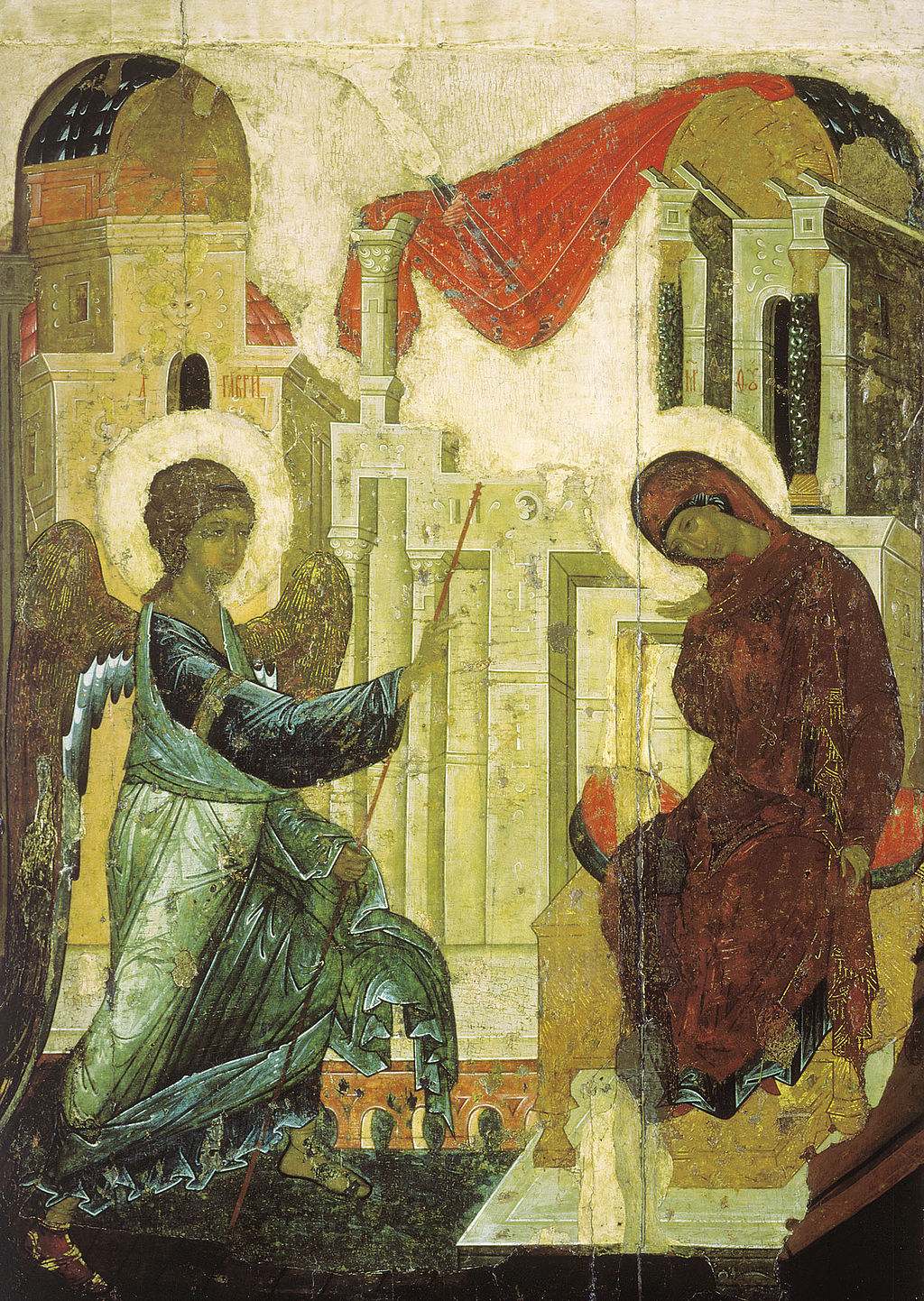
Andrei Rublev , along with the icon painter Theophanes, painted the icons for the Cathedral of the Annunciation in Moscow. Theophanes is generally considered to have been Rublev’s teacher in icon painting and one can certainly see the similarities in their work.
The Moscow Icon painters of the early 15th century transformed the rather heavy Byzantine style of the iconostasis and Rublev was among those, along with Theophanes, who created the Russian style of the Iconostasis. This fully developed representation of the Festal Scenes along with the central figures of Saints John, Mary, and the Archangels Michael and Gabriel is often found arranged in tiers at the high altar of Orthodox churches. Many of these also include a tier of prophets as well.
Iconostasis of the Cathedral of the Holy Trinity in the Trinity Monastery of St. Sergius
Rublev and Theophanes introduced full figure saints into the Iconostasis as opposed to the Byzantine style of using half figures. This brought a much greater sense of presence to the icons, allowing the viewer to feel present with the saints as they worshipped.
The Assumption Cathedral in Vladimir was painted by both Rublev and Daniel Chorny in about 1408. They worked together also to paint the Trinity Cathedral at the Trinity Lavra between 1425-1427.
Rublev’s most famous Icon, the Trinity, now hangs at the Tretyakov Gallery in Moscow, where it continues to stun viewers both by its great size as well as the artistic levels of excellence he was able to achieve in this work. St. Sergius of Radonezh consecrated his Monastery Cathedral to the Holy Trinity, “So that the sight of the Holy Trinity would serve to vanquish fear of the hateful strife within this world”.
Rublev’s work carries with it a luminosity and elegance of expression in the figures depicted. The harmony Rublev achieved through the use of sacred geometry in the compositions also evoked a sense of clarity and purity.
One of the key characteristics of Rublev’s works is spiritual harmony, the blending of both inner and outer beauty in the saints he depicts. This is an aspect of the Byzantine spiritual system- the harmony between beauty of body and beauty of spirit. “When the human being is wholly dissolved in Divine love, then outwardly he reflects the glow of his inner spirit.” St. John Climacus
Understanding as we do, the importance of keeping our gaze on things above, one can see that the ideals manifested so exquisitely in Rublev’s work would be good ones to bring forward to our world of today.
May God continue to bless the work of your hands, and may He guide our thoughts and actions that we could do all that is honorable and pleasing to the One we serve, Jesus Christ.
The Secret Supper (or The Last Supper) Todor Mitrovic (b. 1972) Serbia, 2006 Egg tempera on wood panel
As I view FB posts and blogs about contemporary Icons there is a lot of talk about what is a “real” icon. There are as many different viewpoints as there are people! I think we all agree that icons cannot be relevant to only one denomination of Christianity . Nor can they stay stagnant in the past if icons are to be authentic to our time.
A current exhibition at the Museum of Russian Icons in Clinton, Massachusetts, is a wonderful collection of contemporary Orthodox iconographers from around the world that addresses some of these issues. Within this collection there is wonderful diversity and creativity. It shows that even within the Orthodox community of iconographers, some icons are more painterly and less formalistic than others.
For those who are not able to go in person to the exhibition, I include here some images and text from the exhibition materials. This is an important exhibition that can also be viewed online virtually on the website: Museumofrussianicons.org
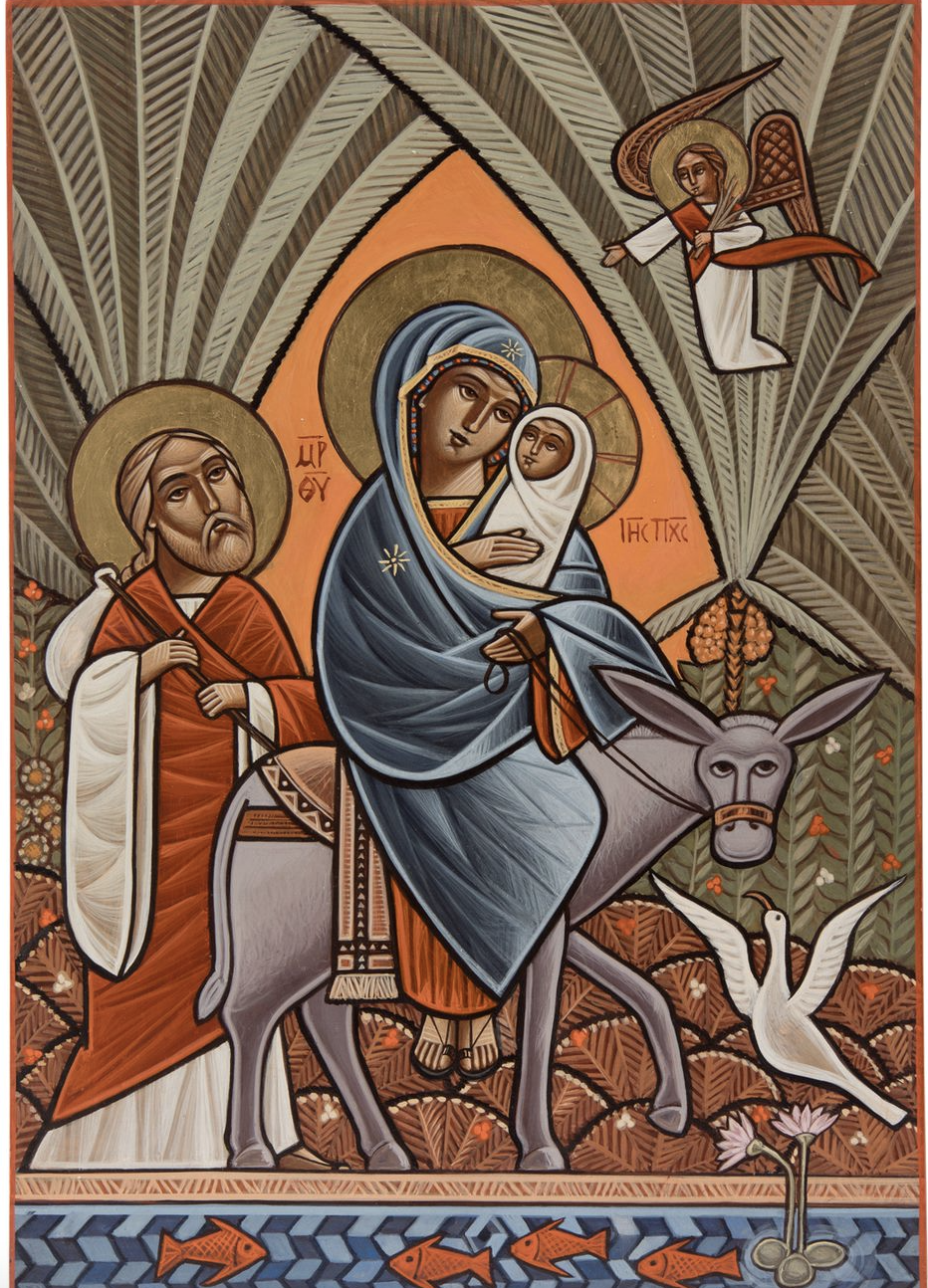
Flight into Egypt Stéphane René (b. 1954) Egypt, 2021 Egg tempera on wood
Icons For Our Time
Icons for Our Time: Orthodox Art from Around the World, is an exhibition of 15 icons by some of the most important contemporary icon painters today. New works by artists from Armenia, Belarus, Bulgaria, Cyprus, Egypt, Georgia, Greece, Japan, Montenegro, Russia, Serbia, the UK and the US have been specially commissioned for this anniversary exhibition.
“There will be pieces by artists from all over the world – some are from Orthodox countries like Greece and Bulgaria, but there will also be works from Britain and Japan. Some of the artists identify as religious believers (Eastern Orthodox or other), some do not. Few of the icons strictly follow the traditional canon. As a curator, working with some of the big names in contemporary icon painting, I wanted to leave as much freedom as possible to each artist – so long as their work could be described, experienced, and felt as an icon.” Dr. Clemena Antonova, curator.
Cosmic Christ/Suffering Logos (Second Version) Ouresis Todorovich (b. 1977) Greece, 2021 Mixed media on wood
Icons of Our Times will examine the spread of Orthodox Christian art through the medium of icons and explore three paradoxes: the icon as a living tradition, the icon as a signature feature of Orthodox Christianity, and the concept and relevance of the contemporary icon in modern culture.
“These three paradoxes pose some immediate questions and problems for contemporary icon-painters, viewers of religious images, as well as to museums that exhibit religious art. Is the icon mainly a medieval art form, which we view inspired by our interest in history, in the same way that we experience an ancient Greek temple? Or is it a living, constantly evolving artistic tradition, which has the capacity to respond to the concerns and needs of our times? Is the icon inextricably tied to Eastern Orthodox Christianity? Can one create or experience an icon without any knowledge of Orthodox culture and theology? Does the icon make sense in a context stripped of religious meaning?”
Holy Sophia Vladislav Andrejev (b. 1938) United States, 2021 Egg tempera on wood
“These are not easy questions and very likely neither a conference nor the present exhibition will offer straight-forward answers,” continues Antonova. “What we aim to do with this exhibition is to create a space which provokes us to reflect on the meaning and function of icons for our times.”
On the Museum’s website are links to talks given by Dr. Antonova and also the link to the virtual exhibition. I’m so grateful for the Museum’s dedication to providing a forum for the appreciation of ancient icons as well as for the development of contemporary ones.
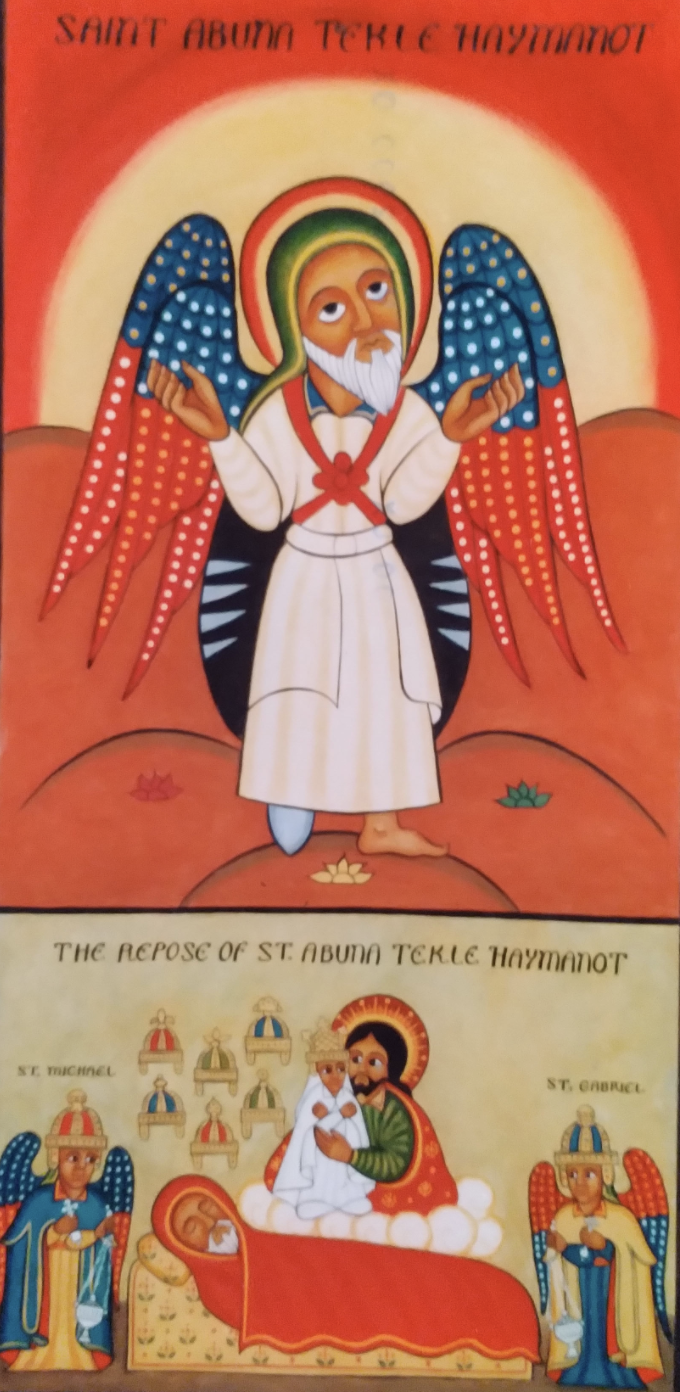
St. Tekle Haymanot Christopher Gosey (b. 1962) United States, 2021 Acrylic and natural clay pigments on wood
As we enter this New Year, let us pray for each other, for God’s grace and Holy Spirit to enable us to do His work with great love, humility and brotherly love.
Saint Sebastian Icon, believed to be effective in prayers for protection from the plague.
During these uncertain times, I’m drawn to thinking of how to address current issues like the covid epidemic, disunity, lack of brotherly love within the context of icon writing. How can icons be miracle working? The grace of God determines what can bestow His miracles, but are there ways we can support miracle working icons as a means of increasing the faith of viewers? Perhaps by bringing to mind those icons that we know of that are considered miracle working is a beginning.
Since Icons are windows to heaven, they actually remind us of the power of God at work, either through the written images of Christ Himself or of those gone before us who have followed Him completely and became saints. It is a miracle that something so simple as a prayerfully-written icon can do so much to help us on our journey toward Him.
Mother of God icons are well known for their miracle working through the ages. Throughout history, many Icons of the Most Holy Mother of God have had miracles attributed to them. Here’s a link to some of them: Russian Icons.
Tikhvin Mother of God Icon
There are many kinds of miracles associated with icons. Some are healing miracles, where the prayers of the viewers have been answered with healings of many kinds, spiritual and physical. There are also the “weeping” icons – ones that exude an oily substance over a long period of time.
Healing Icons
I am most interested in the healing icons. In reality, most miracle-working Russian icons are actually copies (which is what in the Orthodox tradition they call copies of the original miracle-working icons) of a venerated original. The copies are believed to inherit the original’s miraculous powers. Hundreds of the faithful have experienced miracles from even these copies and this is testified through the gifts of jewelry and flowers that abundantly decorate the icons.
The Tikhvin Icon is one of the most revered icons in Russia, and the original is reputed to have been painted by Luke the Evangelist himself. It is called the Protectress of Russia and has a long history of both saving Russia from political enemies as well as being taken to other locations for safety. Here’s a link to a more complete article on its history: Orthodox Christianity. One of the copies of the Tikhvin icon became well known for many miraculous healings of children. This icon is commemorated June26/July 9.
Here is the Troparion associated with this icon:
“Today, like the eternal sun, your icon appears in the sky, O Theotokos. With rays of mercy it enlightens the world. This land accepts the heavenly gift from above, honoring you as the Mother of God. We praise Christ our Lord, who was born of you. Pray to him, O queen and sovereign virgin, that all Christian cities and lands be guarded in safety, and that He saves those who kneel to His Divine and Your Holy Image, O unwedded bride.”
Please consider contributing articles about miracle working icons throughout the next year so that we can become more familiar and understand them through God’s grace.
Important link for Iconographers
ECVA CONVERSATIONS
Sacred Art & Iconography
This is a series of conversations hosted by ECVA and moderated by Mary Jane Miller, Iconographer, open to everyone.
Please join us!
WHEN: 6 Thursdays in December 2021 and January 2022 5:00pm EST, 4:00pm CST, 2:00pm PST
WHERE: Online Zoom Conference
All artists and contemporary iconographers are invited to participate in a series of 6 online conversations on Sacred Art and Iconography. We are planning six themes to discuss, with the hope of sharing our thoughts, our work, and what happens in our spiritual life. This program series is open to all and is free of charge. The series moderator is Mary Jane Miller, whose collection of contemporary sacred art are visual meditations whose root is in traditional Icon Painting.
If you are interested please sign up today by sending an email to
Saint John the Evangelist Drawing by Christine Hales
“O dear Disciple, you reclined on the breast of Christ at the supper of the Lord and drew ineffable mysteries from it which you were allowed to reveal. Your heavenly voice thundered out to all, “In the beginning was the Word, and the Word was with God, and the Word was God.” He is Christ our God, the Saviour of our souls and the true Light who enlightens everyone who comes into the world.”
Last month I was blessed to teach an online Icon writing class painting Saint John the Theologian. We had some wonderful prayer time as we painted and learned more about this saintly man who was so beloved of Jesus. In this blog I want to share with you some of what we learned and prayed about. The following is excepted from an article on “Orthodox Christianity Then and Now”.
The Life of Saint John the Evangelist
The Holy Apostle and Evangelist John the theologian was the son of Zebedee and Salome, the daughter of Joseph. He was called away from his fisherman’s nets to preach the gospel when our Lord Jesus Christ, walking along the sea of Galilee, chose his apostles from amongst the fisherman. Jesus had already summoned two brothers, Peter and Andrew, when he caught sight of two other brothers, James and John, sons of Zebedee. They were mending their nets in a boat with their father when he called them. Immediately abandoning their boat and their father, they followed after Jesus Christ.
Saint John the Evangelist Icon in progress by Christine Hales
At the time of his calling, John was called son of Thunder by the Lord, for his theology would be heard like Thunder throughout the world. John followed Jesus, learning the wisdom that preceded from his lips. John was well loved by his Lord Jesus. The Lord honored him as the fairest of the 12 apostles, and he was one of three of Christ’s closest closest disciples. When Jesus went to raise up the daughter of Jairus, only John, Peter and James were allowed to accompany him. Also when Jesus prayed in the garden, he took Peter, James and John to pray with him. Also on Mt. Tabor, the scene of the Transfiguration it was James, John and Peter who accompanied Jesus. We also know from the Icons of the Crucifixion and the Lamentation, that John never left Jesus’ side. From the Cross, Jesus instructed John to take his mother, Mary into his home and care for her and regard her as his own mother.
Patmos Today
Saint John on Patmos
Saint John and his scribe, Saint Prochorus, were ready to leave the isle of Patmos when there were almost none on the island of Patmos that he had not converted to Christ. The Christians learning of his intention, asked him not to leave them forever. However, the apostle did not wish to remain with them but desired to return to Ephesus. Seeing the Saint was intent on leaving, they asked him to leave behind a memorial with them – the Gospel which he had written there. For one, day having commanded all to fast, he had taken his disciple Prochorus outside the city and together the ascended a high mountain. Here they spent three days in prayer. After the third day a great clap of Thunder sounded, lightning flashed, and the mountain shook. Prochorus fell to the ground with fear. Turning to him, John raised him up and said to him , “Write what you hear from my lips”.
John Writes the Gospel
Lifting up his eyes to heaven, John began to pray again. When he had finished, he began to speak; “In the beginning was the Word…” and the Gospel of Saint John was committed to paper. Saint John agreed to leave a copy in Patmos for the Christians in accordance with their request, but the original copy he kept with himself.
On the same island, Saint John wrote also the Apocalypse, or Book of Revelation. Tradition relates that one day John and his disciple Prochorus departed from the city to a cave in the wilderness where he spent 10 days with Prochorus and another 10 days alone. These latter 10 days he ate nothing but only prayed to God, entreating him to reveal what he should do. A voice came to John from on high saying John, John! John answered “What doest Thou command, Lord? The Voice from on high said “Wait 10 days and thou shall receive a revelation of much that is great.” John remained there 10 more days without food, then something marvelous occurred. The angels of God came down to him and proclaimed much that was ineffable. When Prochorus returned, John sent him back for ink and paper, and for two days thereafter John spoke to Prechorus of the revelations he had received. John’s disciple wrote them down.
John’s Death
At the end of John’s life, when he was becoming very weak, he reduced his teaching to the unceasing repetition of “Little children love one another”. One day when his disciples asked him why he repeated this to them incessantly, John replied with the following words; “This is the Lord’s commandment and if you keep it, it is enough.”
When the Apostle was more than 100 years old, he left the house of Dominus with his family of disciples and after reaching a certain place, John commanded them to sit down. It was then morning and he went a stone’s throw away from them and began to pray. Afterwards his disciples dug him a cross shaped grave in accordance with his will. He ordered Prochorus to go to Jerusalem and remain there until the end of his life. John preached yet one more time to his disciples, and kissing them farewell, the apostle said; “Take the earth, my mother, and covered me with it.” He kissed his disciples and they covered him to the knees. When he had kissed them again, they covered him to his neck leaving his face uncovered. Once again they kissed him, and with great weeping, covered him entirely. Hearing of this, the bretheren came from the city and dug up the grave. But they found nothing there! They all wept greatly, then praying they returned to the city. Each year on the 8th of May a fragrant myrrh comes from the grave, and at the prayers of the holy Apostle the sick are healed thereby, to the honor of God, who is glorified in the Trinity unto the ages of ages Amen.
Patmos
The small island of Patmos, part of the Dodecanese complex in the central Aegean, is known, above all, as the location where John the Apostle received his visions and recorded them in the Book of Revelation, the final book of the New Testament. An impressive monastic complex, dedicated to him, was founded there in the early 11th century.
Interior of the Monastery of Saint John the Theologian (by Thanasis Christodoulou via Wikimedia Commons)
The monastery stands on the site where Saint John is believed to have written his Gospel, including the Book of Revelation (also known as the Apocalypse); it is also located near the grotto where the apostle is said to have received his Revelation, hence called the Cave of the Apocalypse. Both the Monastery and the Cave, along with the rest of the historic centre of the island’s Chora (main town) have been declared a joint World Heritage Site by UNESCO in 1999 as an “exceptional example of a traditional Greek Orthodox pilgrimage centre of outstanding architectural interest”.
The site of the revelatory visions, known as the Cave of the Apocalypse, is situated halfway along the road linking the port with the Chora (main town), which sits on top of the island’s mountain. The Holy Cave of the Apocalypse has been transformed into a place of worship, where visitors can see the dent on the wall of the cave, where the Evangelist was said to lay his head; according to tradition, the Voice of God could be heard coming from a cleft of the rock, which is also still visible today. The southern part of the cave has been turned into a church dedicated to Saint John the Theologian, while later a Chapel of Saint Anne (mother of Mary) was added, incorporating the cave, which is now entered through the chapel.
In 1091, Christodoulos began the construction of the monastery of Saint John the Theologian, over the ruins of a fourth-century basilica also dedicated to Saint John.
APOLYPTIKA
“O beloved apostle of Christ our God, come quickly to rescue your helpless people. The one on whose breast you leant will accept you as intercessor. O Theologian, implore Him to disperse the clouds of darkness and grant us peace and great mercy.”
May God continue to bless you with His peace and love,
What is it that makes one saint more popular that others? Why do so many of the icons we paint tend to be of the same saints? Certainly there are many answers to those questions, but also, there are some saints who exist powerfully in the imagination of many people and thus are frequently used to focus prayers and our understanding of God’s power . Saint George is one of those, and since we recently painted his icon in the recent color theory and icons class I taught on line, I share with you some of the important aspects of Saint George that we discovered.
Saint George was one of the saints most highly regarded in ancient Russia. He was venerated not only as a warrior but also as a protector of agriculture. His feast day is April 23, which coincides with the beginning of the agricultural season. The icon we painted is Saint George and the Dragon. This one shows Saint George with his spear ready to pierce the dragon, who symbolizes evil. The hand of God in the upper corner completes the meaning that man, with God’s help, conquers evil in the world.
Both Catholics and Protestants maintained fidelity to St. George through the Reformation and its aftermath. During the seventeenth and eighteenth centuries, England’s Catholics observed his feast each year as a holy day of obligation.
In Henry V, Shakespeare has the title character invoke St. George at Harfleur before the battle of Agincourt: “Follow your spirit, and upon this charge cry ‘God for Harry, England, and Saint George!'” And of course, Saint George is the patron saint of England.
In French, the word “cheval” means horse, and so it happens, as Chesterton once observed, that in the concept of chivalry, the very name of the horse has been given to the highest mood and moment of man. The combination of man and horse, he continues, evokes feelings of so high an order that earlier ages happily portrayed in their art Christian heroes on winged stallions. The most famous of these images was that of St. George, the mounted knight, defender of the good, piercing with his lance the dragon, that representation of evil rampant in the world. Some of this material is excerpted from ( Fr. James’ Newsletter, April 21, 2021, St. Procopious Abbey).
George’s real importance in the lives of Slavic peasants was as the mythical hero “Yegoriy the Brave,” the militant protector of cattle from wolves and bears, associated not only with the well being of horses but also with the greening of the grass after winter and the pasturing of the cattle. St. George became a kind of nature god, like the Prophet Elijah, whose chariot rolling across the heavens made the thunder. George was, in Russian peasant lore, the one who brought the spring. (Icons and their Interpretation)
The Significance of Saint George Today
Yet another reason for Saint George’s popularity with people today is that he symbolizes a spiritual truth which places the power of God firmly on the throne. It is only with God’s help that victory is achieved. Just as David, in 2 Samuel 5:6-6:23, asked God before he went into battle if he should go forth or not, giving God’s will preference over his own, here Saint George’s message is similar. He doesn’t trust in his own strength, but in God’s Strength. And this message is in contradiction to the message of humanism that our culture has inherited from the cultural developments after the Renaissance. Before the 1300’s, the world was defined with a theistic world view. As part of that world view, every creature as well as heaven had a clearly defined place in the hierarchy established by the laws of God. The good of all required devotion, community and cooperation with one’s neighbor. Humanism cultivated the reliance of man upon his own strength and abilities for answers and salvation from life’s problems. So, Saint George is a visual reminder to us to always seek our help for above, from God himself, and then our victory is assured.
May God bless the work of your hands and protect you from all that is not of Him,
I first met Sue Valentine during an extraordinary Icon workshop I taught in March, 2020, at Mt. Calvary Monastery in Santa Barbara California. It was extraordinary for several reasons- first, we all were just beginning to understand that Covid was seriously dangerous, but our worlds hadn’t changed yet to quarantine measures. Extraordinary too, because sadly, Mt. Calvary monastery is now closed forever. And then there were the students- such an interesting and dedicated group, of which Sue was one. Recently I have seen how profoundly moving her icons are and they are developing in such a wonderful way that I invited her to share about her experiences with Icon writing and here is her article:
The Suffering Servant
While new to iconography, I have appreciated from the very first icon I wrote just one year ago how God is using icons to speak to me.
I have been considering God’s call to be a servant, and learned I both significantly misunderstood how highly the Lord thinks of His servants, and also how profoundly they suffer. These days I ponder these things as I paint.
I find I am becoming used to the conventions in icons: a blue outer robe representing Christ’s divinity and a red inner robe representing Christ’s humanity. Then the Lord pointed out there is no blue robe in this icon, because as Philippians 2:5-8 tells us, Jesus voluntarily removed His blue robe when He came to earth to become one of us, to serve us, to suffer for us, and to save us. Then, in Matthew 27:28, after Jesus was arrested and convicted, the soldiers stripped Him of His humanity, removing His red robe, and mocked Him, pretending to worship Him as a king, all the while spitting on Him and beating Him.
Jesus’ servant life and suffering stripped Him of both robes.
With the icon now complete, as I gaze on it, I’m feeling the robe I have painted on Jesus is somewhat jarring. I’ve introduced alizarin crimson, a new color for me. I can’t even remember why I chose that color. Only later do I realize that when the soldiers stripped Jesus of His red robe, they put on Him a scarlet robe which is what I have painted. This icon is the picture of Jesus, not robed in humanity, but covered with the soldier’s scorn for His kingship as they dressed Him in a scarlet robe. With that realization, I see more fully what He suffered and the servant life I am invited into.
Jesus is no longer robed in scarlet, in red or even in blue, all of which I can attempt to paint as I am learning this new way to pray. What I cannot capture or even attempt is what I know is true of Jesus now and read in scripture: Jesus is finally robed not in finite colors, but in the splendor and majesty He deserves.
John the Theologian
This is John the Theologian. John is my favorite gospel, and this is the icon of the gospel writer John who had incredible revelations of the Lord later in life, and he wrote them down.
He has an ink well at the ready, and an angel whispering inspiration in his ear.
The verse written in the book is John 16:33 “I have told you these things, so that in me you may have peace. In this world you will have trouble. But take heart! I have overcome the world.”
I have been wrestling with the Lord about how to live out my calling as a teacher. The Lord has told me until those opportunities open up, I should write. But writing seems less appealing to me.
So when asking the Lord, “Why this icon of John?”, He reminded me that this type of painting is called icon writing. If this is the kind of writing the Lord wants me to do, then I’m very interested.
The Lamentation
This is my first larger icon, 16 x 20”. I chose it because my daughter was struggling severely, and I felt I needed to sit with many faces of grief, from the demonstrative Mary Magdalene with her arms raised to the strangely peaceful woman in green, as they mourned over the body of Jesus and as I mourned.
Just the process of painting a larger icon forced me to sit with those feelings of grief longer.
The Disorientation
This is another 16×20” icon, and a sequel to “The Lamentation.” Jesus is now risen from the dead, leaving only His graveclothes behind, so I am surprised this icon is never called “The Resurrection.” Of the many renderings of this icon, I chose this one because Jesus was still visibly present, even though only one of the women noticed He was there. Their focus was on the grave clothes, and so, largely, was mine. I was feeling a kind of desolation, but at least Jesus was with me.
I found this icon very difficult to do and the larger format made that more plain to me. There were long periods when I could not work on it at all. I didn’t even know what I was feeling, and I sought the Lord for insight. Finally, the Lord gave me a word for it: disorientation, which is how I titled this icon. That word helped me unpack what I was feeling. Things were moving very quickly in my life, I was under intense stress, deeply sad, and in shock. I was just hoping that as I painted, the Lord would keep speaking.
The turning point in completing this icon came when the Lord told me that the graveclothes were my false self. Like Jesus, I needed resurrection. I needed to arise from those graveclothes and leave them behind.
As soon as He spoke that to me, the work accelerated and was completed quickly and set in motion the courage to make other changes in my life as I embraced what gave me life.
Sue Valentine is from Chicago. She has a B.A. in Behavioral Science and an M.B.A. from the University of Chicago, has a certification in Spiritual Direction from North Park Theological Seminary, and is a licensed minister in the Vineyard Church. She is a worship leader, teacher, contemplative, practicing spiritual director and aspiring iconographer.
That’s all for this month. If you have a suggestion for an article or wish to submit one, please contact me for submission requirements- we are always looking for articles that promote the joy of icon writing!