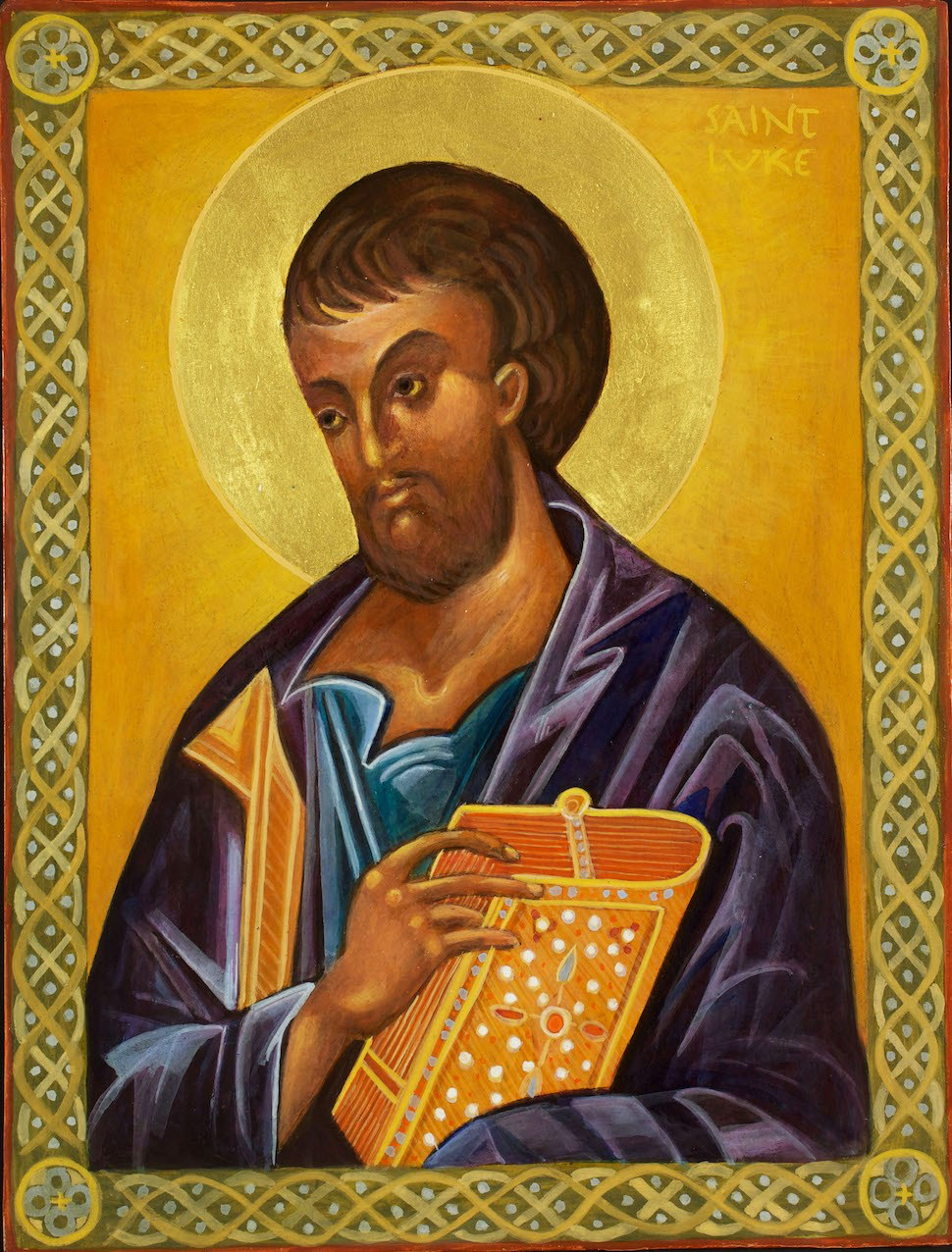
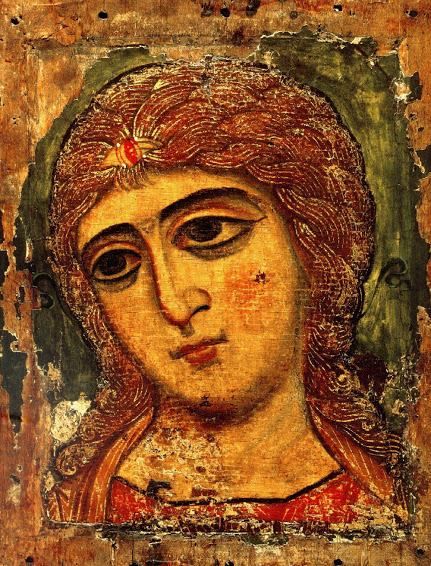
Are you an Icon collector? Collecting Icons is similar to collecting fine art in that the beauty is often times in the eye of the beholder. Icons carry meaning in addition to the esthetics we expect from visual art. That meaning, or content, might relate on a very personal level to the viewer and thus have a high degree of value, regardless of the aesthetic qualities. For example, an Icon of Saint Luke will resonate with artists, Iconographers, physicians, and bachelors because Saint Luke is their patron saint. Icons have the ability to enhance our prayer life as we venerate the saints depicted.
St. Luke Icon by Christine Hales
Venerating Icons
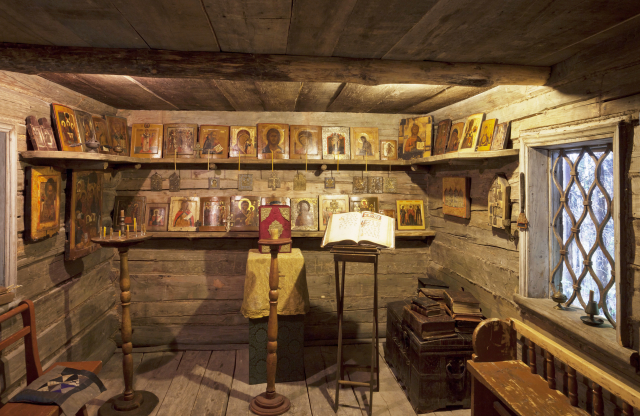
We use the word venerate to talk about our interactions with Icons. To venerate means to cherish, honor, exalt, be in awe of, appreciate and reverence. In old Russia, during times of religious persecution, people who could afford it would create a beautiful corner in their homes, or a small chapel. This would hold the Icons that this family particularly revered and understood as important parts of their family prayer lives.
Icons can deepen our prayer life with specific, focused prayer.
Icons can enhance our connection to the God we adore through specific, focused prayer. Therefore, collecting Icons is a means of keeping our vision on God’s Kingdom in our homes, and sharing that with our families and friends.
Collecting Icons from Antiquity
Another aspect of collecting Icons is that of finding Icons from earlier centuries that have added value because of their age and provenance. One of the foremost Icon Galleries for ancient Icons is the Temple Gallery in London, UK. It was founded in 1959 as a center for study, restoration and exhibition of ancient Icons and sacred art. With ancient Icons, their monetary value rises in accordance with their condition, provenance, size, and age.
People often ask about the value about the icons they have discovered in their travels or have had handed down in their families. TheMuseum of Russian Icons, in Clinton, Massachusetts, will do Icon evaluations on certain dates. They will also provide conservation and appraisal services upon request. The museum has a beautiful permanent collection as well as changing exhibitions.
A Living Traditon
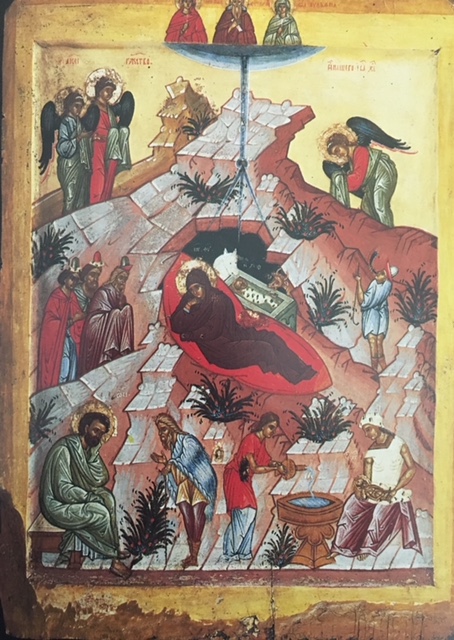
Nativity Icon Melissotopos Olishta 19 Century
Iconography is a living tradition, bringing the elements of the Christian faith to believers through the centuries. Icons are often painted in the same way that they have been for hundreds of years. And, as a living Tradition, Icons painted today are bringing along the traditions of the past and marrying them to contemporary faith and art practices. Truly it is an exciting time to be collecting Icons!
May God bless your Icon creating and collecting especially this Advent Season!
Teaching Icon classes as I do in monasteries, churches and art centers, the question that always arises at the end of class: How can I continue with Icon painting? Practice is what I always say. For that reason, this month’s blog for the American Association of Iconographers is a collection of information and links to help with further studies.
Ideally, someone who is learning to write Icons will choose a style or a teacher which whom to study. But even with that, one can only realistically take one or two workshops per year. What to do in the meantime? Here are my suggestions:
Practice
Using sketch paper and pencil, draw as much as possible. Copy Icons from books, prints, or the internet. Drawing is the number one art skill needed in Icon writing, as it is in all painting. Learning to think on paper is a valuable skill. A book that I recommend to beginners is: Drawing on the Right Side of the Brain by Betty Edwards. You can copy Icons in some of her exercises and you will be surprised at how quickly your drawing will improve.
Raising of Lazarus Icon Sketch in Black and White. Christine Hales
Sketch of Icon
Tonal sketch of Icon
Icon to be copied
Simplified Palette
Use watercolor paper and the four basic color of Icon writing: red ochre, black, white and yellow ochre. Make color and tonal studies of Icons on water color paper. Again, this simple practice will yield large results.
John the Baptist watercolor sketch Christine Hales
Icon Retreats and Workshops
For those who choose to study with me, here is a link to upcoming classes. My teaching method is always evolving and inspired by my prayer life. I particularly enjoy helping students who have had some experience writing Icons and now want to create their own Icon (still copied from before the Renaissance). If you do sign up for one of my classes and wish to do this, please email me well before the class date so that we can prepare you for getting the most out of the retreat.
Resources for viewing Iconographic Imagery
Kolomenskaya Versta is a site selling Icon books and materials. It is based in Russia and they regularly post free images to copy as well as links to all kinds of Iconographic information. Also known as Russian Modern Orthodox Icon, here is a link to their FB page.
A beautiful FB page with many good examples of Byzantine Icons- Byzantine Art
Museum of Russian Icons, 203 Union Street, Clinton, Mass. There is an exhibition of Prosopon Icons currently in addition to their permanent collection.
Jacob Wrestling with the Angel, Nikita Andreiv
Resources for Icon Materials
Natural Pigments They have pigments, red clay, gold leaf adhesives, brushes, etc..
Kremer Pigments has a shop in NYC but you can also order on linear an immense array of pigment choices and other materials like stand oil, linseed oil, etc.
East X West online Icon Course with Sr. Petra offers many video tutorials and a thorough grounding in Iconographic history, drawing and painting.
That’s all for this month. Please let me know if this has helped you, and I wish you peace and joy in spreading the beauty of Icons throughout the world!
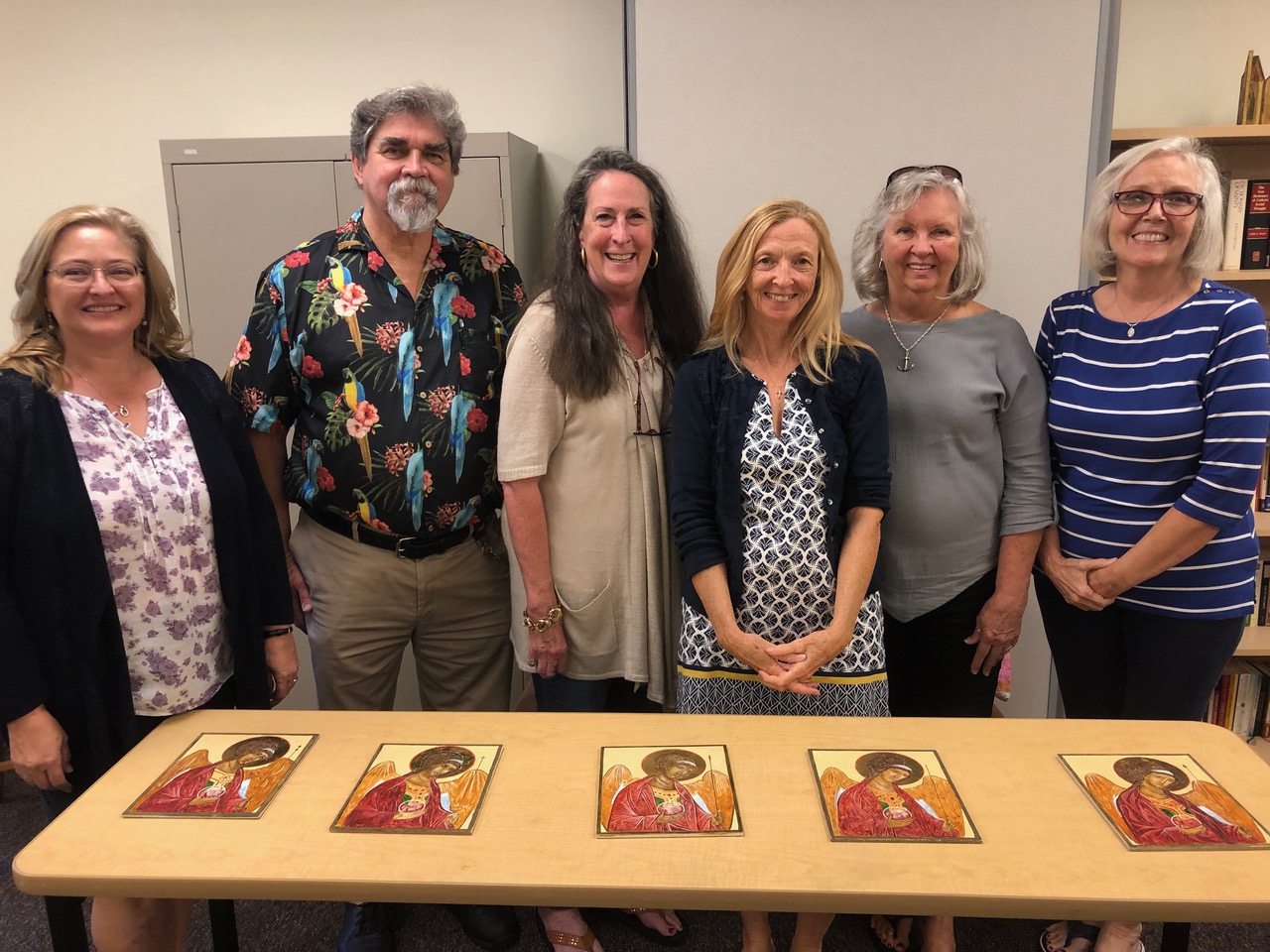
Having just finished an Icon writing workshop where we painted the Archangel Michael, and today is the day the Episcopal Church celebrates the Feast of Saint Michael and All Angels, this blog is full of information about the angels!
Saint Patrick’s Icon Class
We celebrate the Feast Day of the Archangels each year at this time, but who are the Archangels and what do they mean to us?
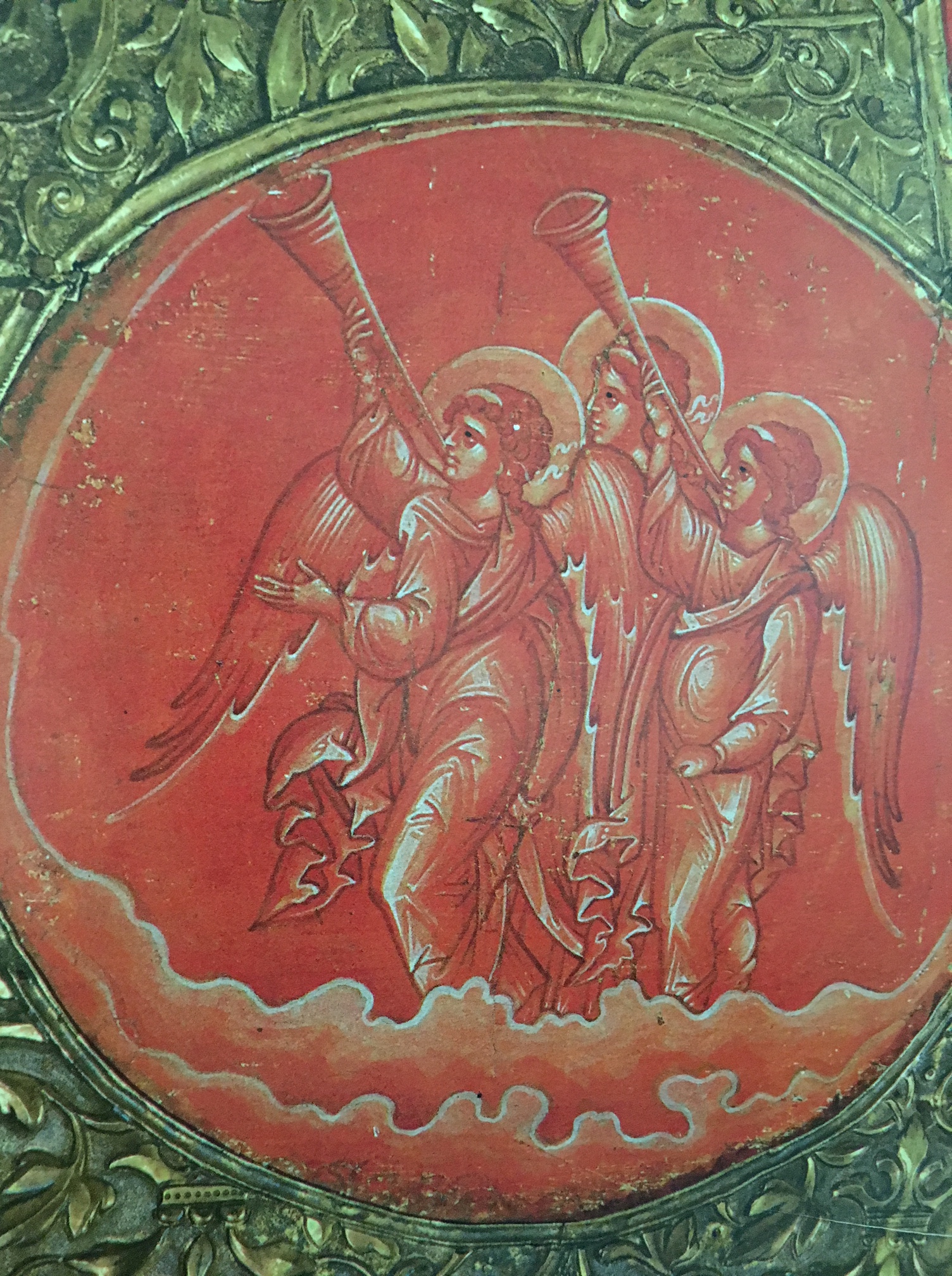
The angels are known to us as ministering spirits, sent to announce or accomplish the will of God on earth.
We read in the Bible that the angelic hosts seek to defend creation against the spiritual powers which seek its ruin.
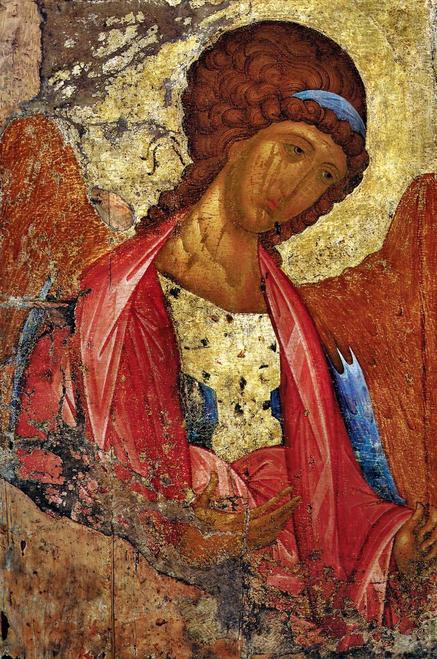
Archangel Michael
Andrei Rublev Michael the Archangel
In Revelation 12:7-9 we read of the Apocalypse and the celestial war in which Archangel Michael and his angels fight against the dragon and his angels.According to L. Ouspensky in his book “The Meaning of Icons” ,this is….” a war that continues on earth in the spiritual combats in which men are assisted by angels.Hence the warrior like character that angelic apparitions often take.”
Saint Michael Prayer
Angels in Battle
Saint Michael the Archangel, defend us in battle.Be our protection against the wickedness and snares of the devil.May God rebuke him, we humbly pray; and do Thou, O Prince of the Heavenly Host, by the Divine Power of God, cast into hell Satan and all the evil spirits who roam throughout the world seeking the ruin of souls.Amen.
In Joshua 5:13-15 the Captain of the Host of the Lord appeared to Joshua with a sword in his hand.Again, quoting from “The Meaning of Icons” by Ouspensky “
“The Archangel Michael “chief captain ofthe host” presides over the struggle against the forces of demons: “there where thy grace appears, the power of the demons is pursued; for the fallen Lucifer cannot bear to see thy light.We pray thee then to extinguish his burning features, directed against us…and to free us from his temptations.”
Archangel Gabriel
The name Gabriel means God is my strength. In the Gospel of Luke, Gabriel is the angel who announces to Mary that she will give birth to a son and name him Jesus. He is known as the patron saint of communication, giving strength and helps children is many ways.
Announcing Angels
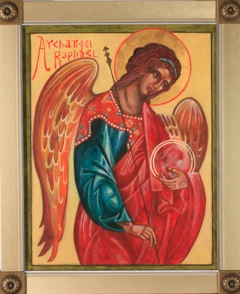
Archangel Raphael
We learn about the Archangel Raphael, the heavenly guide and companion from the Book of Tobit in the Apocrypha.He is known as the healing angel, also the patron saint of travelers.
Archangel Raphael Icon by Christine Hales
The Prayer of St. Raphael
O Raphael, lead us toward those we are waiting for, those who are waiting for us;
Raphael, angel of happy meeting, lead us by the hand toward those we are looking for.
May all our movements be guided by your light and transfigured with your joy.
Angel, guide of Tobias, lay the request we now address to you at the feet of him on whose unveiled face you are privileged to gaze.
Lonely and tired, crushed by the separations and sorrows of life, we feel the need of calling you and pleading for the protection of your wings, so that we may not be as strangers in the province of joy, all ignorant of the concerns of our country.
Remember the weak, you who are strong, you whose home lies beyond the region of thunder, in a land that is always peaceful, always serene and bright with the resplendent glory of God.
May your prayers before the angels always be heard, and may you sleep with the angels!
This month I am recommending two articles that have been published in an on-line journal- The Orthodox Arts Journal– as elements contributing to good training for Iconographers. As I go around the country teaching an “Introduction to Icon Writing Class”, I am aware of how little knowledge people in general have about Icon painting. It is impossible to gain enough knowledge of this art from a few classes to be able to make truly authentic Icons. I recommend two things: look at as much art and as many Icons as you possibly can. Books, online resources, museums, all of these will help your painting to become mature as you practice what you see. The second thing I recommend is to read as much as you can about the history as well as the technique of Icon writing. Both of these activities go hand in hand with taking workshops and practicing at home.
Two Articles for Iconographers in Training.
First Article
Mustard Seed Manual of Painting
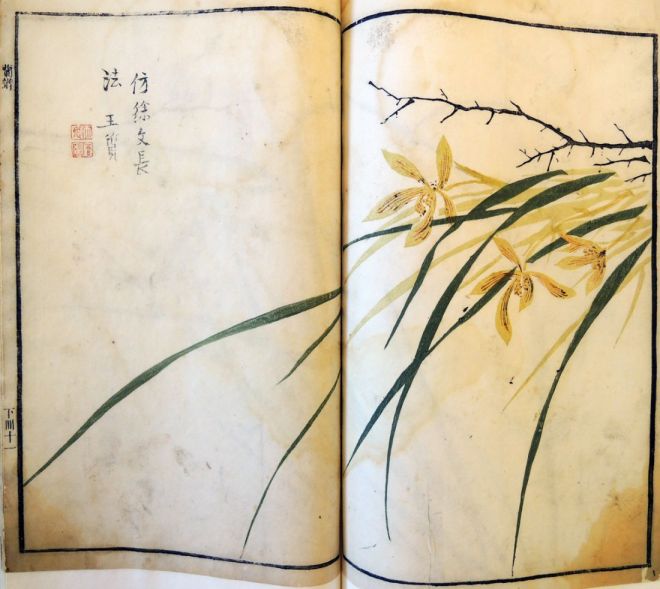
The first article is written by English Iconographer Aidan Hart and it is entitled, ” The Mustard Seed Garden Manual of Painting,: A Chinese Painting Manual Offers Inspiration to Iconographers.” This article contains quotes from the Chinese manual as well as comments by Aidan Hart as to their usefulness for Iconographers. It is quite a beautiful and clear article that speaks to some of the nuances of Icon painting. Here is a quote from that article. The italics are quotes from the manual, and the regular text is Aidan Hart’s commentary:
“You must learn first to observe the rules faithfully; afterwards, modify them according to your intelligence and capacity. The end of all method is to seem to have no method. (17)
When we learn a second language, we consciously study its rules of grammar and learn its norms. But as we gain knowledge and confidence, we find our own voice. Iconography should be the same.
I have heard it said by some Orthodox thinkers that iconography is not art. I disagree. The icon is indeed more than art because it is part of the liturgy and exists for more than aesthetic delectation. But it is at least art. Although the icon’s sacred purpose means that its aesthetic categories are more extensive than those of secular art, it should nonetheless include them. The same universal colour theories and composition principles apply.”
One more quote:
“If you aim to dispense with method, learn method. If you aim at facility, work hard. If you aim for simplicity, master complexity.(19)
Hard work is the only path to the authentic abstraction. In the years that I have taught iconography I have found that drapery is the most common stumbling block for learners. Prolonged and analytical study is required to understand the drapery that the icon tradition abstracts. Drapery’s complexity needs to be mastered in order to make sense of its simplification, otherwise it becomes irrational, not supra-rational. Lines need to be understood as horizons of forms and not strings hanging in space.
The Second article is written by Anton Daineko “The Living Icon”, also published in the Orthodox Arts Journal. In this article, Anton grapples with the issue of what is the criterion used to make authentic Icons? This is not a simple or easy question to answer. He cites examples of Iconographers from the past such as Andrei Rublev, Hilandar and Panselinos in order to visually show the necessary qualities of good Icons.
In this article, he also speaks about the importance of the Iconographer’s direct experience, through prayer, with God.
“The Criterion
Commenting on copying in iconography, Father Igor, a priest from Minsk and himself an icon painter, noted that “There are no icon copies; each icon is a REVELATION”. Naturally, this raises questions: is it even possible to define such a delicate matter as REVELATION, and what aspects should be included under the resultant definition?
It cannot be answered in a few simple words. With some icons, everything is easy: one look at the Redeemer from the Zvenigorod deesis tier, and you feel that it really is a REVELATION. But with most icons, the matter is far more complicated.
Confession of St. Peter Icon
“It would be appropriate here to recall the words in the epigraph to this article, the Apostle Peter’s reply to Our Lord’s question “Who do you say that I Am?” – “YOU ARE THE CHRIST, THE SON OF THE LIVING GOD“.
Perhaps this line holds the key to understanding much about the Church, including the canonical texts: in those texts, the early Christians saw an image of the LIVING GOD, crucified and raised from the dead. And that is what is most precious in the Church. It is precisely the PRESENCE of the Living God that sets the Christian Church apart from other religions and other communities. And it is precisely this PRESENCE that we can observe in scripture as well as virtually everything else in church life. The icon is no exception in this regard.
The iconic image consists of many simple elements: strokes, stripes, and smudges, while the different colors are obtained by various combinations of minerals and egg yolk. Taken separately, none of these elements carry any artistic – let alone spiritual – meaning in and of themselves. But when these elements come together in a particular combination, a miracle occurs: the strokes, the stripes, and the smudges cease to exist, and we see the Face of the Living God looking directly at us. It is as much of a miracle as the image of the Living God emanating from the simple words of the Gospels’ narrative.”
I suggest again, reading the entire article in order to fully understand the nuances and also to see more examples of the Icons mentioned in the article. We are so blessed today to have great contemporary Iconographer who are sharing their wisdom and experience to those who are eager to learn.
Enjoy, as we come to the official close of summer, and may God bless all of your Icon writing with His Presence.
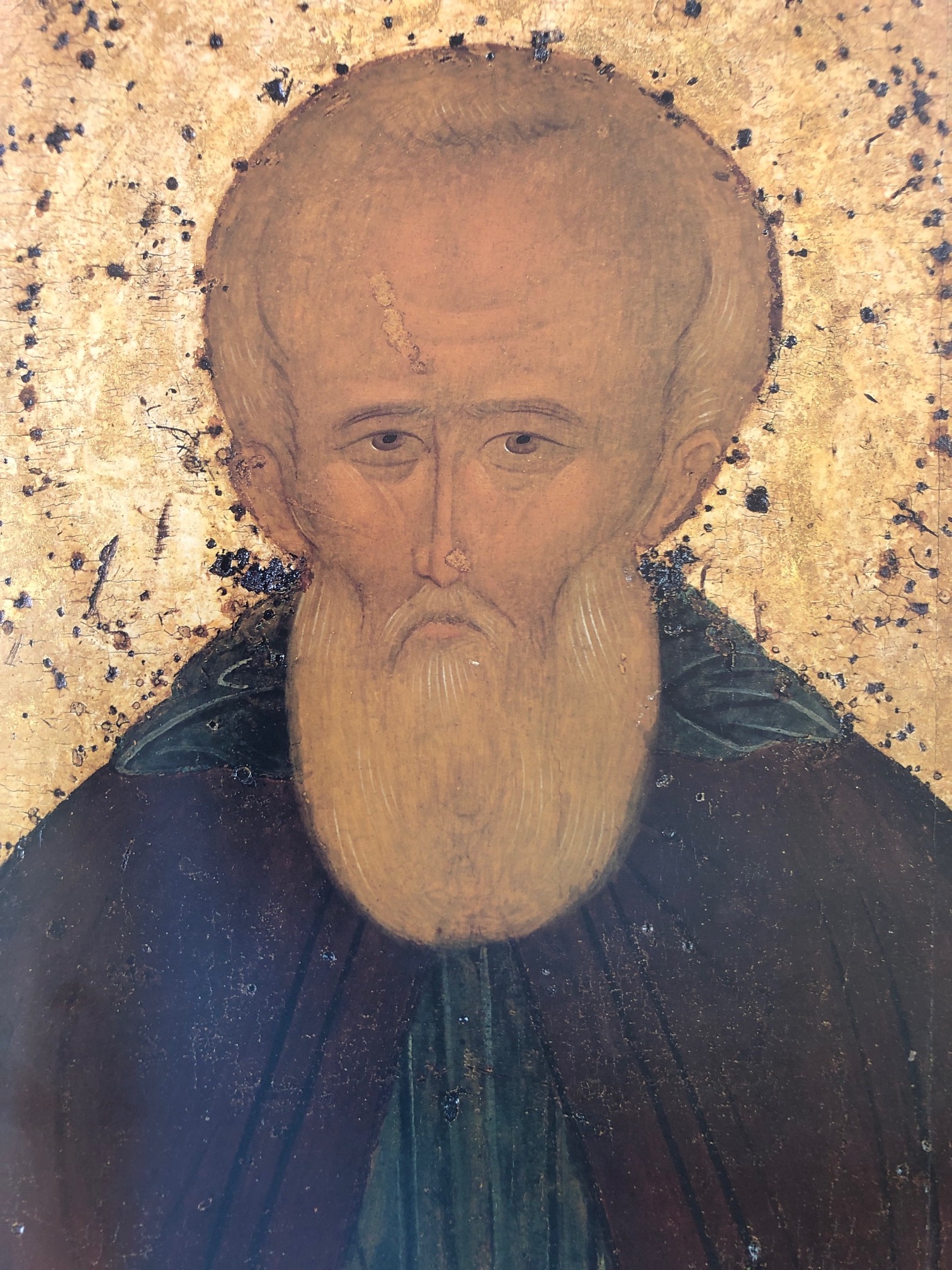
This month the focus is on the fifteenth century Iconographer, Dionysus.
Born sometime in the 1440’s near Borovsk, a small town southwest of Moscow, Dionysus’ earliest works are wall paintings at the Parfuntiev Monastery. Throughout his life, he was attracted to the beautiful and colorful Novgorodian style of Iconography. Dionysius’ colors were delicate and transparent and his elongated figures increased the elements of elegance and symbolism in his work.
Certainly he must have been aware of the work of Andrei Rublev (c.1360-1430), who painted in the old Iconographic tradition. However, Dionysus’ work reflected a new development in compositional style that increased the energy and vitality of the Icon.
One of the Last of the Old Master Iconographers
Dionysius’ style was called “Muscovite Mannerism” and it bridged the gap between Novgorodian Icon painting and the later Stroganov school. His best frescoes are in the Ferapontov Monastery, which include the beautiful “The Meeting of Mary and Elizabeth”. Dionysus and his sons completed all the frescoes on the Virgin and scenes from her life at this monastery. In addition to egg tempera, he was a master of encaustic painting as well.
Personal Style
Dionysus ‘ color palette was strongly influenced by a group of early Renaissance artists from Italy who arrived in Moscow. This can be seen in the delicately blended and balanced soft pigment colors such as pink, lilac and turquoise, creating harmonious chords of color in his frescoes and Icons. The lyrical effect of his style of coloration affected much of the Iconography of the 16th century.
In 1482 Dionysus was called to Moscow to paint the Deesis on the Iconostasis in the Cathedral of the Dormition. After also painting murals in two of the chapels, he and his sons were asked to paint one hundred Icons for the Volokolamsky Monastery. With this, Dionysus devoted the remainder his life to icon panel painting, but today many of those Icons are either lost or un-restored.
Joseph-Volokolamsk was a wealthy patron who commissioned Dionysius to paint over ninety Icons. But the most comprehensive collection of his work is to be found at the Ferapontov Monastery. It is a series of frescoes depicting the life of Mary.
Dionysus Fresco, Mary
Dionysus Fresco
Christ Fresco, Dionysus
When writing(painting) Icons, it is always helpful to study from the great Iconographers of the past. Although their work speaks specifically to their time, these early Masters used principles of composition, color, and space in harmonious ways, and that kind of perspective has been largely missing in the art of our time. Copying these works helps educate Iconographers and helps bring valuable knowledge forward into today’s Icons.
This blog is created to share valuable ideas and information with Iconographers around the world. Below are some useful links for Iconographic materials. Until next month:
December 2, we enter into that period of Advent that is so full of excitement and anticipation. How appropriate that it comes for us in the Americas at a time of profound seasonal change- the end of summer and the beginning of winter. Advent marks the end of all that we know belonging to the old Testament and the beginning of the fulfillment of the Old Testament prophesies with the birth of Christ, our Redeemer.
Advent is a journey into the heart of promise and fulfillment with the Birth of Christ.
We share the hope of the Archangel Gabriel and Mary and witness the incredible faith journey that began the earthly life of Jesus Christ. Mary models for us the essence of spiritual preparedness, the willingness of a faith filled acceptance of God’s will manifesting in her life. Her surety and preparedness for this miracle is again a model for us to develop such a surety and willingness for all that God has for us.
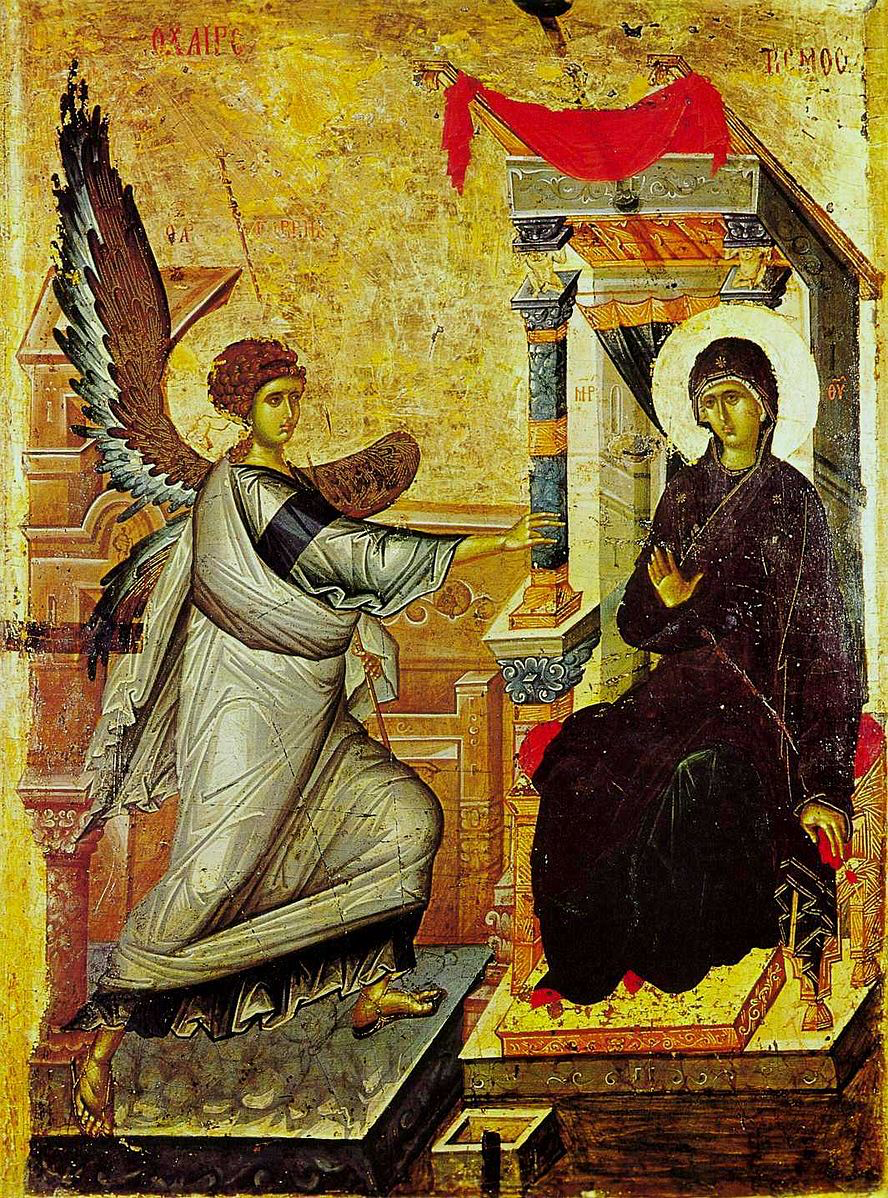
Annunciation Icon by Ohrid, 14th Century
Byzantine Iconography and Advent
And there is a similarity between Byzantine Iconography and Advent. Canon Edward West, in his article on Byzantine Religious Art said that an Icon is “notably the reflection of something which exists, but in its own way, it conveys something which actually exists and conveys it really….Byzantine religious art is concerned with conveying truth, witnessing to the truth, and indeed, making it possible for the sensitive and aware Christian to have some part in that truth…”. The birth of Christ 2000 years ago allows us to be in the present tense with God today, to experience His love, protection and guidance. One could also say that Icons share in that ability to bring us into God’s presence, as symbols of the incarnation.
Canon West, who was a noted Iconographer in addition to serving at the Cathedral of Saint John the Divine in New York City for over forty years, goes on to say that what makes an Icon important is, “that it is a meeting point of this continuum from the past with the vertical thrust of the Spirit of God at the right moment- in terms which the individual Christian can understand. It is essential that we remember this attitude about Tradition. The Byzantines were concerned in Witnessing to the Truth.”
Icons in 2019
May we all be blessed with Mary’s patience, devotion, and willingness to carry out God’s plan in the coming year. May our Icons be bearers of God’s Grace and Presence as we move towards a world where Holy Scripture is made visual through the sacred imagery of Icons and made available to all those who seek Him.
‘Icons for Unity’ Thursday 15th to Saturday 17th of November 2018 at
St Savior’s Church, St.George’s Square, Pimlico London, SW1V 3QW
“”There will be a fee of £5 for each icon entered and it will be possible for you to arrange the sale of your own icons with no sale commission due to the BAI.
After 1st May further details and registration forms (Intention to Exhibit form) for the event will be emailed by Rhian to those who have paid for hanging space. Please note all submissions must be made by 31stAugust 2018 to enable their inclusion in the catalogue
It is an exhibition for everyone and whilst the talent and expertise of the professional iconographers will always be discernible, the work of artists old and new to iconography will also be welcome. Please distribute the flyers included with this Review to publicise the event.
“We need members to help by preparing for the exhibition and as curators during the event. So please volunteer and make the event a great success………”
We offer the BAI as a means of maintaining contact between members and of providing them with support in their work and their devotions. We hope that it might be of benefit both to people who are interested in the use of icons in their spiritual life and to those whose interest is in icons as a sacred art form. The aims of the Association are to establish contact with iconographers, learners, beginners and those with a greater proficiency, to deepen our knowledge and understanding of icons and the spirituality associated with them (including Orthodoxy); to offer a forum for the interchange of ideas and techniques; to offer information about forthcoming exhibitions, courses or other events of interest and to be a means of sharing ideas and experiences. We produce a Review four times a year together with a meditation on the icon of a particular saint or festival. This includes the historical background and hymnody associated with the subject. We would also value any comments and ideas that you might have, in particular, any material that you think would be of interest to other members which we could include in the Review. If you would like to join, please write to the Membership Secretary (see Page 38)
We feel there is a risk that people practising this art form might feel isolated; if so do join BAI.
If you would like to become a member of BAI, it is fairly simple: visit their website www.bai.org.uk and go to the contact page. There are a few membership options to choose from and payment can be made through PayPal.
“I think it is promising that today we are witnessing a rebirth of Christian art,, reconnecting with the art the Icon, of a Christian art that endures in the great norms of the iconological art of theist but that also extends to today’s experiences and vision.” Benedict XVI
ICON WRITING CLASSES taught by Christine Hales at Holy Cross Monastery in West Park, NY:
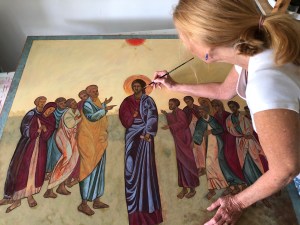
Basic concepts of Icon writing, history and methods of painting will be demonstrated. We will also have meditation and prayers on Mary as this is Mother’s Day Weekend and we will do a Mary Icon together. Icons have played an important role in healing and bringing forth peace to nations, and there are many examples of Icons in Belarus, and Eastern Europe that are attributed to healing miracles, often these are Mary Icons. $580 includes Icon Materials, meals and overnight accommodations at the Monastery $120 deposit
This is a special class. Beginners are welcome, and it is also for advanced Iconographers who want to learn more about color in Icons. We will cover color symbolism, color theory, the Iconographer’s palette, and more fun and in depth topics on color. We will write the Icon of Jesus as the Good Shepherd. If you have a different Icon you’d like to paint, email hales@halesart.com Christine with the image and you can work together before the class to make that possible. $580 Fee includes Icon Materials, meals and overnight accommodations.
This is the class when we discuss in depth the sacred geometry that is the foundation of Icon compositions. Sacred geometry is a method of understanding the pictorial space and relationships of images and colors within the Icon and It is an essential part of an Iconographer’s training. There will be a slide talk one evening as well as hands-on exercises to demonstrate the concepts. We will endeavor to complete an Icon by the end of this workshop using sacred geometry. $580 includes materials, overnight accommodation at the monastery and meals.
Contact
Lori Callaway, Guest House Manager
Email: guesthouse@hcmet.org
Phone: 845-384-6660, ext. 1
Tuesday – Friday
9:00 AM until Noon
1:30 PM until 4:30 PM
One more important item to share: The Museum of Russian Icons in Clinton, Massachusetts has a Center for Icon Studies. Their Journal of Icon Studies has some interesting articles on a variety of Iconographic topics.
“He who forms the mountains, who creates the wind, and who reveals His thoughts to mankind, who turns dawn to darkness, and treads on the heights of the earth– the LORD God Almighty is His name.” –Amos 4:13
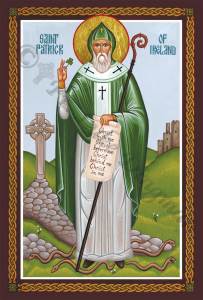
Saint Patrick of Ireland
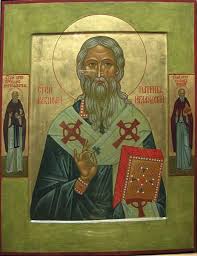
Saint Patrick Icon
As a young boy, Patrick was kidnapped by brutal pirates and carried away to Ireland where he was sold as a slave. For the next six years he was a shepherd in Northern Ireland. This is where he learned to pray. “In a single day I would say as many as a hundred prayers, and at night only slightly fewer.”The Confession of St. Patrick.
“I arise today
in a mighty strength
calling upon the Trinity,
believing in the Three Persons
saying they are One
thanking my creator.”
In the experience of slavery and exile, the young boy discovered God . In the midst of this terrible alienation brought on by his exile from family and country, Patrick experienced a deep abiding connection that enabled him to feel strengthened by God.
St. Patrick baptizing the Irish drawing by Christine Hales
He is a legend in Irish history and spirituality. Patrick’s story of being kidnapped by Irish pirates eventually gave rise to a remarkable inner transformation that led him eventually to return to Ireland, serving the Irish people by bringing God’s love to them.
Like St. Francis, Patrick chose a lifestyle of poverty, preferring to single-mindedly focus on the Divine connection within. “For I know full well that poverty and adversity suit me better than riches and delights.”
Saint Patrick Icon
One often sees Icons of St. Patrick holding a shamrock, an illustration of how he used the humble clover leaf to illustrate the Trinity- three in one- to the largely pagan population Ireland. Pre-Christian Ireland was where God sent Patrick. His spiritual story is told in “The Confession of St. Patrick”, along with many Scriptural references that relate to his experiences.
Patrick was born in Britain about 385, and began his mission in Ireland during the early 400’s.He became fluent in the Irish dialect during his period of slavery, and despite much hostility and danger, he was very effective in bringing the Gospel to Ireland.
Saint Patrick founded many churches and monasteries across Ireland.
Saint Patrick Icon
Holy Bishop Patrick,
Faithful shepherd of Christ’s royal flock,
You filled Ireland with the radiance of the Gospel:
The mighty strength of the Trinity!
Now that you stand before the Savior,
Pray that He may preserve us in faith and love!
Icon notes for March:
The American Association of Iconographers now has a Facebook Page which you are welcome to join. The rules of the page are that postings may be submitted by any member and the content needs to be of interest and benefit to Iconographers.
Video of Iconographer George Kordis beginning a Christ Pantocrator dome:
First, a thank you to all of you who have been subscribers to this blog over the last couple of years. Particularly, thank you for being patient with all the changes in format and stylistic content as I try to understand the needs and purpose of this community of Iconographers.
I have changed format again, this time getting closer to my original purpose of having a substantial list of Iconographic resources and links to help Iconographers in creating and learning about Icons. If you look at the left sidebar you will see a page of “resources” on which I have started to add links, and will continue with this throughout the year so that it becomes a valuable resource.
Russian Icon of the Epiphany
As it is New year’s Eve and we are on the verge of the Feast of Epiphany , here are some images of the Epiphany in different Iconographic styles, taken from a more nuanced article by Hokku about the wise men on the blog ” Icons and Their Interpretation”.
Icons for the Epiphany range in subject matter from stories of the wise men finding Jesus in a manger, to the Baptism of Jesus in the river Jordan.
Epiphany is described as the manifestation of Jesus to the Gentiles as represented by the Magi- who were not Jews but were from the East; it is also the church feast day commemorating the Epiphany on January 6; and a manifestation of a divine, supernatural being. Webster’s dictionary describes Epiphany as “ a sudden, intuitive perception of or insight into the reality or essential meaning of something, usually initiated by some simple, homely, or commonplace occurrence or experience.”
Russian Epiphany Icon
The birth of Jesus, the Son of the most high God in a manger certainly fulfills that definition. Epiphany represents the discovery that Jesus was born for not only the Jews, but also the Gentiles- for the whole world.
Baptism of Jesus Icon by Christine Hales
In the Baptism of Jesus Icon, we see in the central axis of the Icon, the God the Father, represented by the half circle at the center; The Holy Spirit, represented by the rays of gold coming from the half circle,and Jesus, the Son of God. In the Gospel, God’s audible voice announces “This is My Son, the Beloved, with whom I am well pleased.” Matthew 3:17
It is a revelation similar to the one of the magi- a sudden perception that transforms mundane, earthly existence into one of light, meaning, and grace.
Icons bring to our remembrance important Gospel and Old Testament stories that brighten our everyday existence. As we move into this coming week towards the celebration of Epiphany and then the Baptism of Jesus, let us pray together to receive an Epiphany of God’s grace in each of our lives today, and as Baptism makes permanent and concrete the role of God’s grace in us, may that sudden awareness be awakened and kindled as an important part of our lives in 2018.
I know that many of you lead busy lives and are able to take Icon classes only once or twice a year- and those classes usually last only a few precious days. The best way to really benefit from our intermittent classes is to do as much reading and preparation on Icons as possible. With that in mind, I want to refer you to a series of four articles written by Father Silouan Justinian for the Orthodox Journal. It is a series called: “Imagination, Expression, Icon, Encountering the Internal Prototype.”
As there are many nuances involved in writing Icons that cover both the spiritual life of an Iconographer and the artist’s creative skills, I encourage you to take a look at these. Here are the links to each part of the series:
My suggestion would be to bookmark or print out each article to read at a time where you have leisure to ponder and think about each one. Eventually, I hope to compile a book of such essays and other instructional materials for the potential Iconography student. As this field continues to grow in popularity, a high standard of training that incorporates the writings of leading contemporary authors along with practical, good artistic training would be a beneficial addition to the field.
detail of Fr. Paul Wattson Icon at Graymoor Monastery
We all know that the lifestyle of an Iconographer is one of prayer and fasting. Also, we know that being part of a Church, having good spiritual direction, receiving the Sacraments regularly are also important to writing Icons. Within this context, good artistic training is also important. What a task! But as you all have experienced, it is an exciting and blessed task. No one will be able to do everything perfectly, but willingness and diligence to seriously undertake the study will have very positive effects.
St. Benedict Icon by Christine Simoneau Hales
In St. Benedict’s Prologue to “Saint Benedict’s Rule For Monks” he says:
“My son, listen carefully to your master’s teaching. Treasure it in your heart. Be open to receive and generous to respond to the counsel of a loving father. You have strayed from God by the sloth of disobedience. Return to him then, by the work of obedience. Accordingly, I speak to you, whoever you may be, who giving up your own will and taking the strong and bright weapons of obedience, are prepared to fight for the true King, Christ”.
In taking up the task of Icon writing, we always need to remember that it is about much more than just our own will. Here is a quote from the above mentioned Part 4 of Father Silouan’s article:
“In other words, the icon painter should not repeat the resultof encounter, but rather his work should arise and re-present (ex-press) a true, fresh and living re-encounter with the subject depicted. But, this, of course, is not to promulgate the modernist cult of individualism or so called “artistic genius.” On the contrary, as just mentioned, life in the Body of Christ presupposes the flourishing of ourselves as unique and truepersons[x]in loving communion with one another, in contradistinction to our ego-centric or individualistic identity in which we wither as isolated numerical “units.”[xi]Moreover, let us not forget that in this ecclesial life, “there are diversities of gifts, but the same Spirit.”[xii] That is, inner union in the Spirit does not mean uniformity at the expense of diversity. Each person as a member, in a unique manner, contributes towards the edification of the whole Body. Therefore, the traditional practice of “anonymity,” that is, of not signing the icon, should not be understood as an aspiration towards the complete obliteration of the iconographer’s gifts and creative temperament.[xiii] It is rather a reminder that only in humble cooperation with the Divine Craftsman, in becoming one with Him through the Holy Spirit, will his true self and art flourish to the fullness of their capacity. Obedience becomes liberation. Thereby he will be able to uncover nuances contained in the prototypes previously unnoticed and contribute unrepeatable expressionsof Tradition. In undermining this side of the icon, seeking to protect it from “artistic license” and foreign cultural influences, we may in fact blunt its power, making of it a purely mechanical act that contradicts basic principles of Orthodoxy.”
Understanding and correct application of the Traditions and Canons of Iconography can only come through time and experience.
One final quote from Part 4:
Mourning Christ by Christine Simoneau Hales
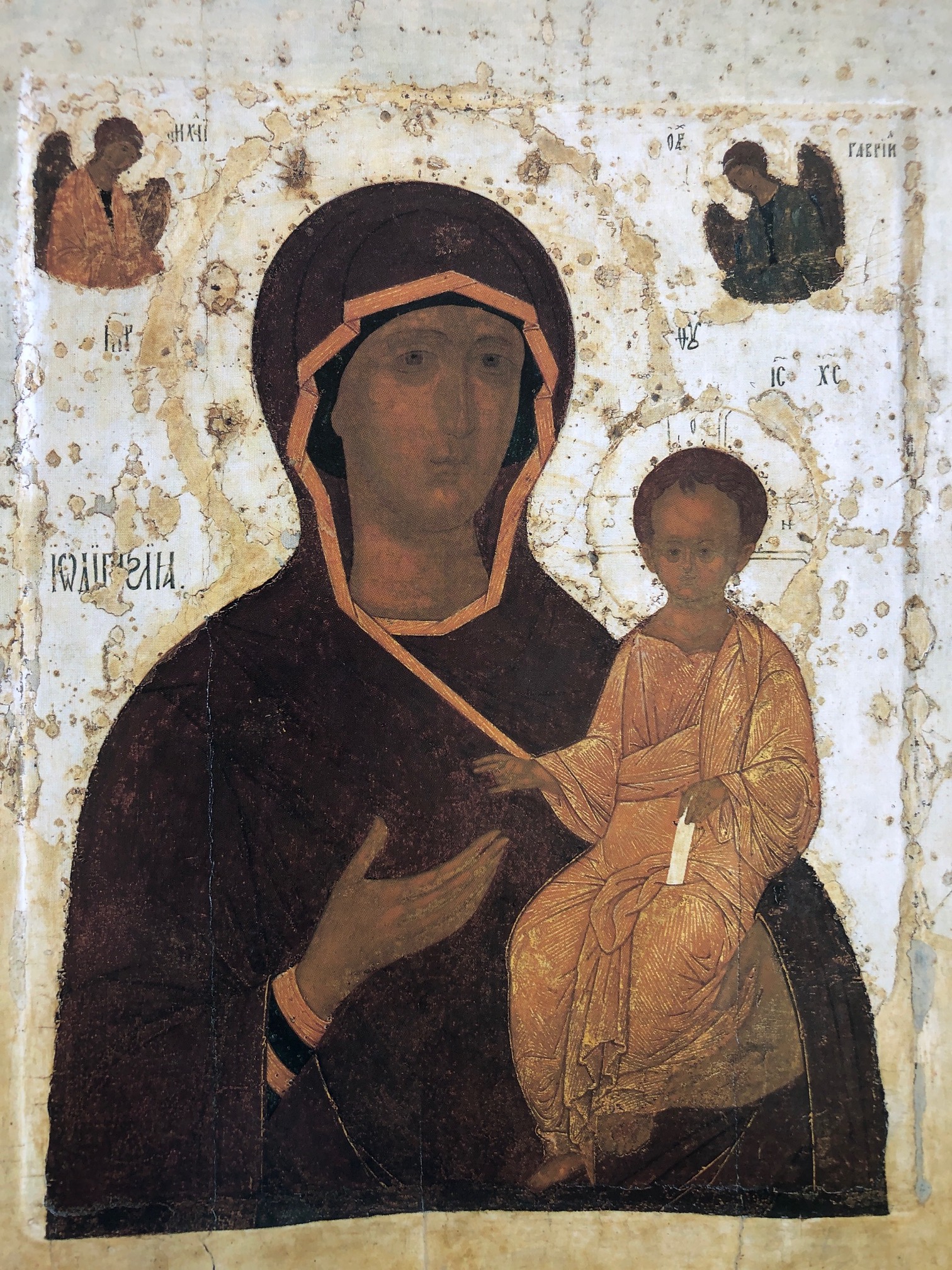
” The iconographer preaches the Gospel in colors and chants hymns of praise, trembling as he says, in the words of the Nativity sticheron, “How hard it is to compose hymns of love, framed in harmony.” With his art he paints the Word, plastically manifesting, indeed enfleshing the Logos. This is truly an “artistic license” of kerygmatic expression in free will. For as Christ Himself has ordained: “Go into all the world and preach the Gospel to every creature.”[xxii]”
I look forward to seeing you all in Icon classes, or now on the Facebook Page you are welcome to post your work or any important links about Icons that you think will benefit the Community of Iconographers.
May God bless you and the work of your hands,
Christine Simoneau Hales
The Lord is My Shepherd Icon by Christine Simoneau Hales