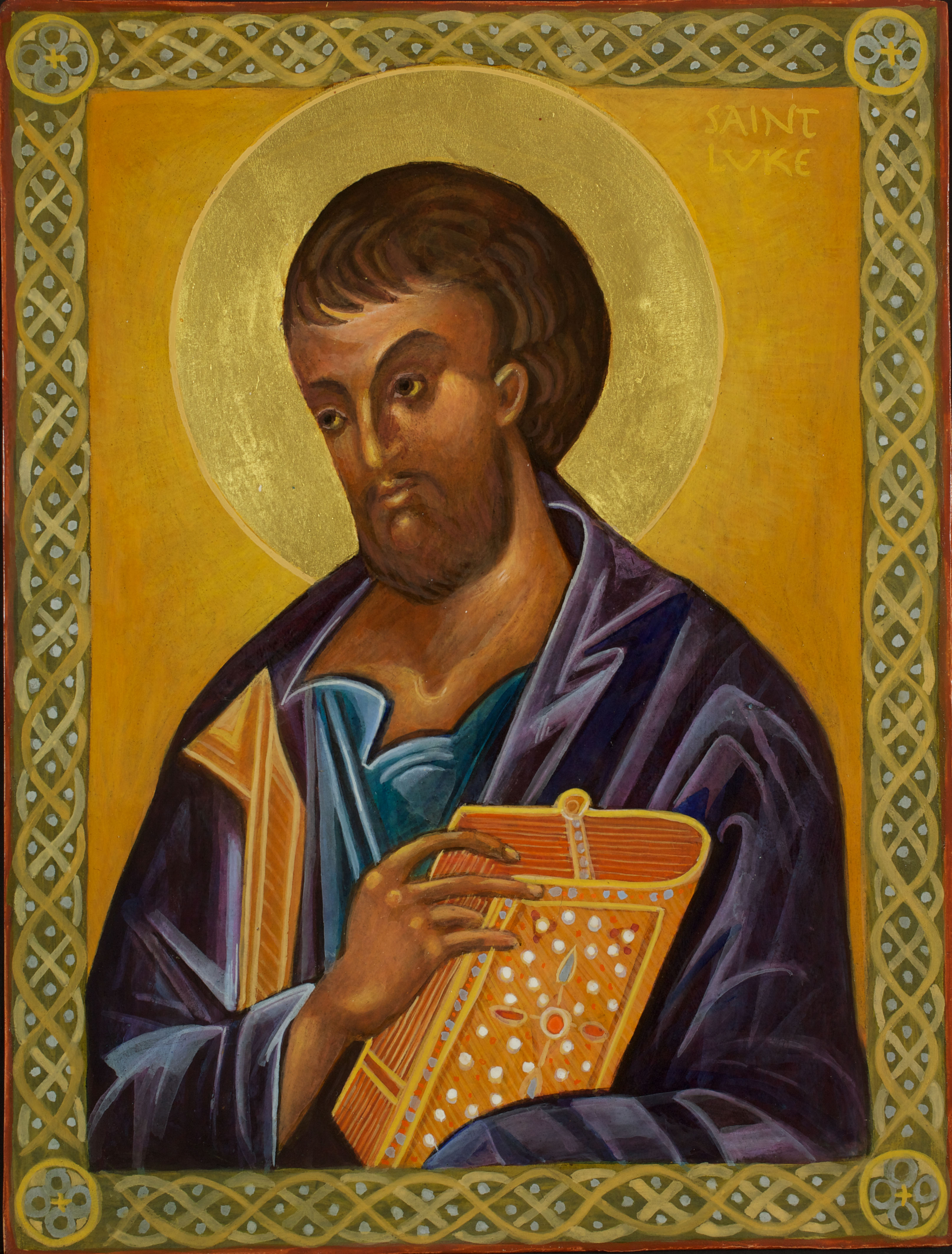
The Blessed Virgin:

A Life Anchored in Grace, Obedience, and the Miraculous

Serbian Annunciation Icon, 14th c.

The Blessed Virgin Mary is believed by many to be the greatest of Christian saints, after her Son, she is exalted by divine grace above angels and men. holds a place of profound honor in Christian faith and tradition. Known as the Mother of God, Queen of Heaven, and spiritual guide to all believers, her life offers us a powerful model of obedience, grace, and unwavering faith in difficult times.  Since today is the Feast of the Visitation- one of my favorite icons- I thought it would be good to share some random thoughts about Mary and her significance to our faith.

I’ve been reading a book about Mary, The Life of the Blessed Virgin Mary: From the Visions of Blessed Anne Catherine Emmerich, as part of my spiritual discipline for May and want to share some of the insights in this month’s blog. Since I have previously written a blog about Mary (see the link below), I didn’t try to replicate the insights in that one here.  Mary is such a central figure in Christian icons, her visual presence stretching from the earliest Christian art in the catacombs to contemporary icons and I hope to add more nuance to our appreciation and ability to relate to her unique role in salvation history and Icons of Mary.

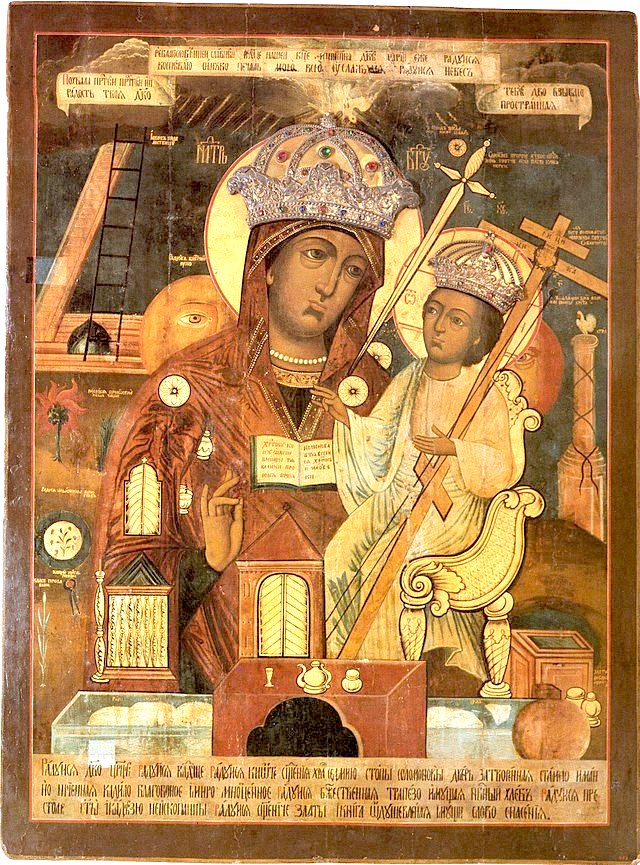
Smolensk Mother of God

Symbols and Icons

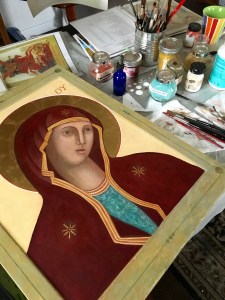
In Orthodox iconography, Mary’s  veil is deep red, the color of divinity, while the clothes under the veil are either green or blue, the colors of humanity. This is the opposite of the usual depiction of Christ’s robes’ colors. In western religious art depictions of Mary, her robes usually are a light blue.  It’s always important to include the names of saints in icons, and icons of Mary usually have the letters “MP OY”, an abbreviation of the Greek: “Mater Theos” – the Mother of God to identify her. The lily represents her purity and virginity while the rose stands for her love and beauty. These symbols invite the viewer to reflect on Mary’s unique holiness and place within God’s plan for man’s salvation.

Mary’s Character Strengths

Mary’s faith and devotion are clearly seen in some of the pivotal moments of Christianity.  In the Annunciation icon, the angel Gabriel announces to Mary that she will bear the Son of God, highlighting her acceptance of God’s will, her humility, and deep courage. The Nativity shows the birth of Christ, the fulfillment of God’s promise, and the Flight into Egypt reveals Mary’s protective care in seeking safety for her son. Probably the most poignant is Mary’s presence at the Crucifixion, where her strength and sorrow are deeply felt.  These icons not only narrate biblical events but also emphasize Mary’s prayerful and devoted character.  Mary’s humility is evident in her acceptance of her Divine mission; her strength is shown in the trials she endures, and her holiness shines forth as the holy and blessed woman chosen to bear the Messiah.  Mary, known  as the Theotokos, or Mother of God, is a title that affirms Jesus’ divine nature. Throughout history, artists have returned to images of Mary and her son to express the deep bond between humanity and divinity.
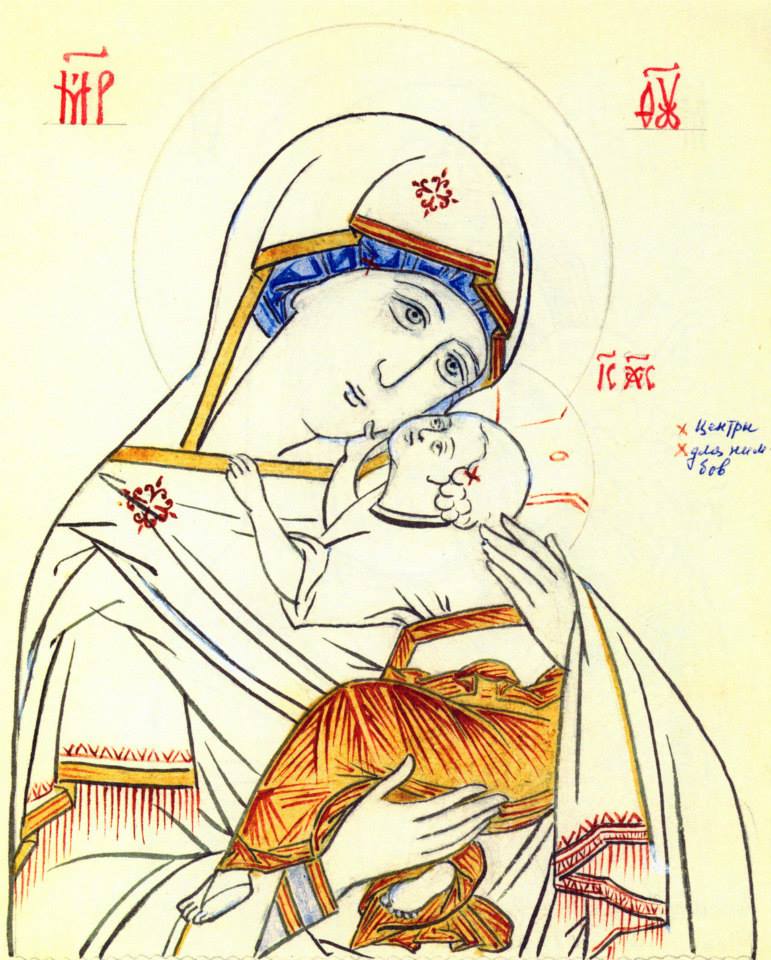
Madonna and Christ Child Drawing by Nun Juliana

Theological Themes

While dogmas such as the Immaculate Conception, the Assumption, Mary’s perpetual virginity, and her role as Mother of God are complex, Mary’s icons offer us a way to engage with these truths visually and these icons help believers grasp profound theological ideas with personal reflection and inspiration.

Icons of Mary continue illuminate her theological roles, demonstrate her virtues and connect her life story to the faith of believers past and present. I have seen many new icons of Mary, such as Mary, Untier of Knots, at least I believe it is a new prototype.  If you have created an icon of Mary that you have created and would like to share it with us, please email it to me along with a description and I will add it to this post. Sharing our work with each other can often lead to fresh insights for ourselves and others.

Miracles and Apparitions

Icon of Our Lady of Guadalupe written by Christine Hales

The Virgin Mary is associated with numerous miracles and apparitions, often attributed to her intercession with God. These include miraculous healings, apparitions like those at Lourdes and Fatima, and the transformation of water into wine at Cana, among others

The Blessed Virgin Mary has been reported to appear to people in various locations, often offering messages of hope, repentance, and love. These apparitions are often followed by reports of miraculous physical and spiritual healings. 

Lourdes, France, is a well-known example, with over 7,000 reported cases of miraculous healings and 70 scientifically validated by the Lourdes Medical Bureau. Mary is also associated with spiritual healing, helping people find solace and guidance in their faith.  Some stories highlight the transformative power of Mary’s intercession on people’s spiritual lives, leading to conversion and deeper faith. 

Sites of Miraculous Apparitions

Lourdes, France: This is perhaps the most famous site associated with Marian healing miracles. After St. Bernadette Soubirous reported visions of the Virgin Mary in 1858, a spring of water with purported healing properties was discovered there. The Catholic Church established the Lourdes Medical Bureau to investigate reported cures, and out of over 7,000 recorded instances of unexplained healing, 70 have been officially recognized as medically inexplicable miracles. The strict criteria for such recognition include that the healing is instantaneous, complete, permanent, and scientifically inexplicable.

Fatima, Portugal: Following apparitions of Mary to three shepherd children in 1917, various miracles were reported, including healings associated with a spring of water discovered after the apparitions. In one case, a woman whose illness Our Lady promised would be cured if she converted experienced healing. The “Miracle of the Sun,” a widely witnessed astronomical phenomenon, is also associated with the apparitions.

Attribution of Miracles: It’s crucial to understand that the Catholic Church attributes miracles to God’s power, often interceded through Mary’s prayers, not as something Mary performs independently.
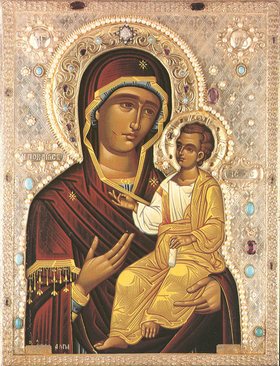
Theotokos Iverskaya

Scientific and Theological Perspectives: The Catholic Church utilizes a rigorous process involving medical and theological experts to investigate reported miracles, seeking to discern if they are truly inexplicable by natural means and align with Catholic teachings.

Significance: Recognized miracles are viewed as signs of God’s love and mercy that can strengthen faith, not as a requirement for Catholic doctrine or devotion. 

It is important to note that accounts of miraculous healings attributed to Mary are deeply rooted in faith and devotion. While some claims have undergone rigorous investigation and medical validation, the ultimate belief in their miraculous nature rests on faith in God.

I hope that these reflections may encourage you to explore the beauty and spiritual richness found in Marian art and discover anew the profound significance of Mary, Mother of God, and share them with this post or another post in the future!

Blessings and prayers,

Christine Simoneau Hales, Iconographer
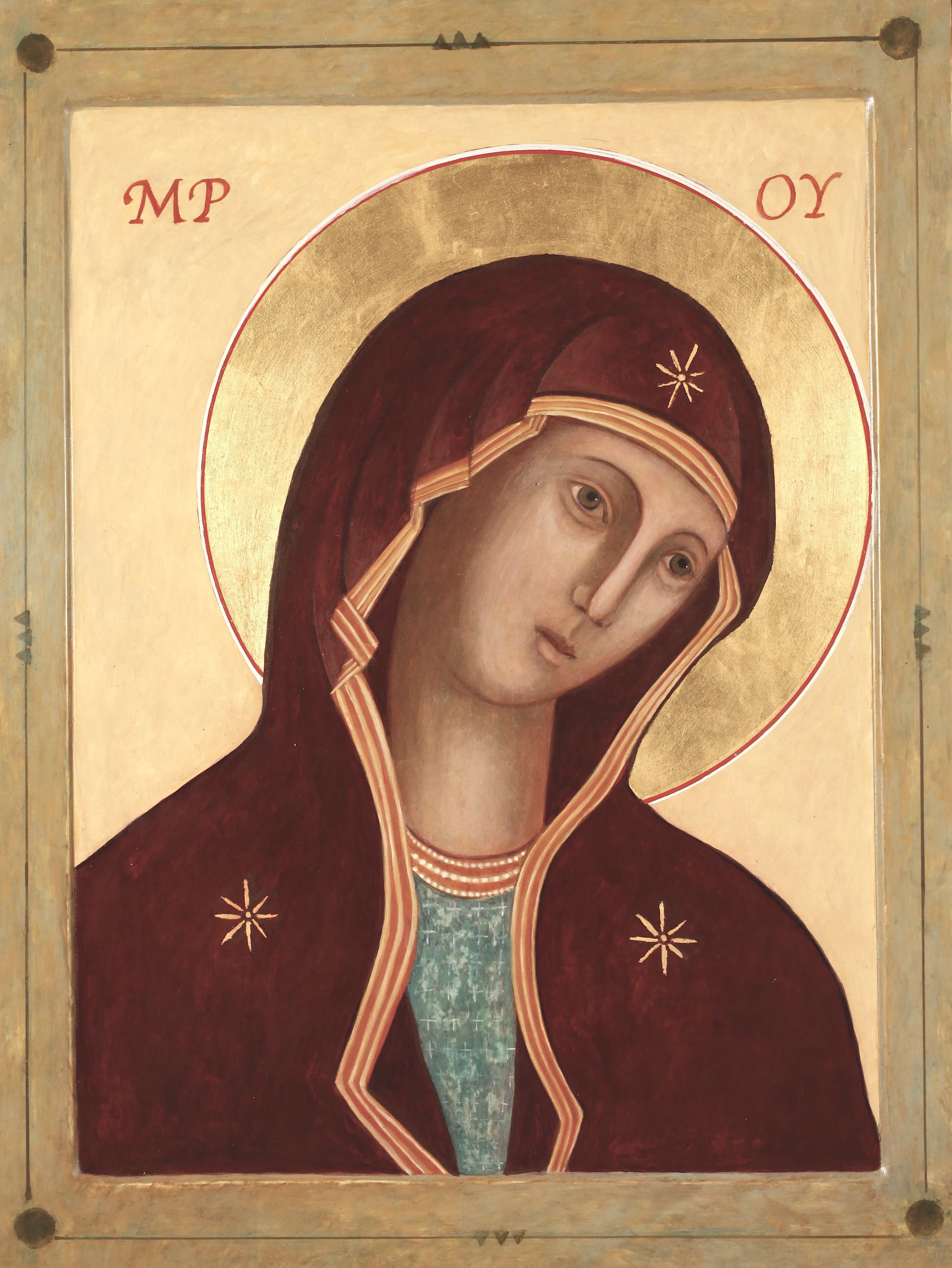
Atakhist Mary Icon written by Christine Hales

Below is my previous blog post about Mary.

INTERSTING LINKS FOR ICONOGRAPHERS

Orthodox Arts Journal Article About the Work and life of Father Zinon

The Meaning of Icons, Father Maximos Constas

My Links:LINKS For  Christine Simoneau Hales   2025

American Association of Iconographers Website: https://americanassociationoficonographers.com

https://newchristianicions.com   my main website

Https://christinehalesicons.com  Prints of my Icons

https://online.iconwritingclasses.com  my online pre-recorded icon writing classes

https://www.youtube.com/channel/UCK2WoRDiPivGtz2aw61FQXA  My YouTube Channel

Facebook: https://www.facebook.com/ChristineHalesFineArt     or  https://www.facebook.com/NewChristianIcons/

Instagram:   https://www.instagram.com/christinehalesicons/?hl=en

American Association of Iconographers:  FB Group:  https://www.facebook.com/groups/371054416651983

RENEWAL IN LITURGICAL ART

Renewal in Liturgical Art- Encompassing Differing Worldviews in One Faith

A world view is a pattern of ideas and beliefs. Everyone seeks answers to the questions of “why are we here? What is the meaning and purpose of life? Is there a difference between right and wrong? Is there a God?  Do our actions have consequences?  Is there a connection between this visible world and an invisible one?  Our world view helps us to make sense of our being, our God, our purpose in this world.  The Christian worldview has a narrative of all history, as told in the Old and New Testaments.  

What is our world view as Christian artists and Iconographers?  For each of us this may be defined differently with fine nuances, depending on our denominational affiliations.  The Eastern and Western Churches evolved from the same beginning, yet have grown to have differences in art, liturgy, theology, etc.

So, finding common ground, much as our forefathers and mothers all experienced in the early church, is a worthy goal for Sacred Art makers of today.

Christian Renewal

The renewal of the mind involves a transformation of the way a person thinks and lives, which can be achieved through the power of the Holy Spirit as we reflect on God’s word. By being transformed in this way, believers can discern what is good, acceptable, and perfect according to God’s standards.

“Don’t copy the behavior and customs of this world, but let God transform you into a new person by changing the way you think>”. Romans 12:2

I’ve researched some very good books on related subjects and have gathered some thoughts for you.  I include at the end of this article titles and authors of each book mentioned here.

Liturgical Art Renewal

Our goal, as iconographers, is to help others to see the sacred more deeply proclaim the Gospel more faithfully and pray together more honestly, using our eyes, our hearts, and our minds. And our hands.

An icon mediates or contains the Holy Presence

“The artist’s task is not merely to record but also to present the result of the encounter as it is shaped by that disciplined imagination…One can be in a kind of dialogue with the thing being observed or between the thing imagined and that which is produced. 

Christian worship is aided immeasurably by our sense of sight.  In worship we see each other and gain a glimpse of what it means to be the body of Christ.” Beauty, Spirit, Matter, Icons in the Modern World., Aidan Hart

“The spirit which knows God naturally comprehends divine beauty and seeks to delight in it alone. . .To contemplate divine beauty, to delight in it and partake in it is a requirement of the Spirit and is its life and heavenly life.” Theophan the Recluse (1880)

The icon is a radical way of seeing and therefore suggests a radical way of acting. When we look at an icon we are seeing as a saint sees.

An icon is not merely a painting of a religious subject but a crystallization of a whole culture, a culture which worships God and therefore venerates the material world that He created as a gift.’

Art is something essential to the shaping of faith and religious experience.

Sacred art is always abstract, in that word’s literal sense. In that it draws out the essence of its subject.  It uses stylistic abstraction to suggest these invisible realities….Sacred art typically reveals the union of the inner with the outer, the invisible with the visible.    Iconographic depictions of great suffering, such as the Crucifixion, keep this suffering united to love and hope.  They show that the suffering is genuine, but they also show that this suffering is on the road to the Resurrection.  An icon always joins opposites.

An icon brings the good news into the world by showing the face of Jesus Christ: God became man.  Moreover, through Christ, the icon reveals to us the true image of humanity transfigured and deified; it is the image of the kingdom of heaven, the kingdom that is to come and that will restore the harmony now marred by sin…if an icon depicts a saint, its real purpose is to bring us face to face with someone in whom God’s goodness shines forth.” Irina Yazykova

“Eyes of fire perceive each thing as the outer sign of an inner fact, or the local sign of a distant power.  For such eyes nothing is lonely matter, all things are caught up in a mysterious, ultimately divine whole that challenges understanding over a lifetime.  Eyes of flesh focus on the thing itself, eyes of fire on facts but still more intently on their participation in a larger meaning by which they are raised.” An Art of Our Own, the Spiritual in Twentieth Century Art,  Roger Lipsey

Books and Related Links

  • The Substance of Things Seen, Art, Faith, and the Christian Community by Robin M. Jensen
  • An Art of Our Own, the Spiritual in Twentieth Century Art,  Roger Lipsey
  • Beauty, Spirit, Matter, Icons in the Modern World, Aidan Hart
  • Eyes of Fire, Christine Hales

An Excellent Series of Talks at the Cathedral of All Saints Divine, Albany NY, by Brynna Carpenter-Nardone :

Lots to think and pray about! That’s all for this month,

May God continue to renew your minds in Him, and bless the work of your hands,

Christine Hales

newchristianicons.com online.iconwritingclasses.com

Lifestyle of an Iconographer

Hello Iconographers!

Icon of Mary
Icon of Mary by Christine Simoneau Hales

I know that many of you lead busy lives and are able to take Icon classes only  once or twice a year- and those classes usually last only a few precious days.  The best way to really benefit from our intermittent classes is to do as much reading and preparation on Icons as possible.  With that in mind, I want to refer you to a series of four articles written by Father Silouan Justinian for the Orthodox Journal.  It is a series called: “Imagination, Expression, Icon, Encountering the Internal Prototype.”


As there are many nuances involved in writing Icons that cover both the spiritual life of an Iconographer and the artist’s creative skills, I encourage you to take a look at these.   Here are the links to each part of the series:

Part One 

Part Two

Part Three

Part Four

My suggestion would be to bookmark or print out each article to read at a time where you have leisure to ponder and think about each one.  Eventually, I hope to compile a book of such essays and other instructional materials for the potential Iconography student.  As this field continues to grow in popularity, a high standard of training that incorporates the writings of leading contemporary authors along  with practical, good artistic training would be a beneficial addition to the field.

Fr. Paul Wattson
detail of Fr. Paul Wattson Icon at Graymoor Monastery

We all know that the lifestyle of an Iconographer is one of prayer and fasting.  Also, we know that being part of a Church, having good spiritual direction, receiving the Sacraments regularly are also important to writing Icons.  Within this context, good artistic training is also important.  What a task!  But as you all have experienced, it is an exciting and blessed task.  No one will be able to do everything perfectly, but willingness and diligence to seriously undertake the study will have very positive effects.

Saint Benedict Icon by CS Hales
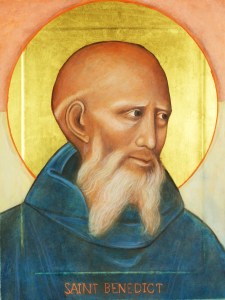
St. Benedict Icon by Christine Simoneau Hales

In St. Benedict’s Prologue to “Saint Benedict’s Rule For Monks” he says:

“My son, listen carefully to your master’s teaching. Treasure it in your heart. Be open to receive and generous to respond to the counsel of a loving father.  You have strayed from God by the sloth of disobedience.  Return to him then, by the work of obedience.  Accordingly, I speak to you, whoever you may be, who giving up your own will and taking the strong and bright weapons of obedience, are prepared to fight for the true King, Christ”.

In taking up the task of Icon writing, we always need to remember that it is about much more than just our own will. Here is a quote from the above mentioned Part 4 of Father Silouan’s article:

“In other words, the icon painter should not repeat the resultof encounter, but rather his work should arise and re-present (ex-press) a true, fresh and living re-encounter with the subject depicted. But, this, of course, is not to promulgate the modernist cult of individualism or so called “artistic genius.” On the contrary, as just mentioned, life in the Body of Christ presupposes the flourishing of ourselves as unique and true persons[x] in loving communion with one another, in contradistinction to our ego-centric or individualistic identity in which we wither as isolated numerical “units.”[xi]Moreover, let us not forget that in this ecclesial life, “there are diversities of gifts, but the same Spirit.”[xii] That is, inner union in the Spirit does not mean uniformity at the expense of diversity. Each person as a member, in a unique manner, contributes towards the edification of the whole Body. Therefore, the traditional practice of “anonymity,” that is, of not signing the icon, should not be understood as an aspiration towards the complete obliteration of the iconographer’s gifts and creative temperament.[xiii] It is rather a reminder that only in humble cooperation with the Divine Craftsman, in becoming one with Him through the Holy Spirit, will his true self and art flourish to the fullness of their capacity. Obedience becomes liberation. Thereby he will be able to uncover nuances contained in the prototypes previously unnoticed and contribute unrepeatable expressionsof Tradition. In undermining this side of the icon, seeking to protect it from “artistic license” and foreign cultural influences, we may in fact blunt its power, making of it a purely mechanical act that contradicts basic principles of Orthodoxy.”

Understanding and correct application of the Traditions and Canons of Iconography can only come through time and experience.

One final quote from Part 4:

Mourning Christ by Christine Simoneau Hales

” The iconographer preaches the Gospel in colors and chants hymns of praise, trembling as he says, in the words of the Nativity sticheron, “How hard it is to compose hymns of love, framed in harmony.” With his art he paints the Word, plastically manifesting, indeed enfleshing the Logos. This is truly an “artistic license” of kerygmatic expression in free will. For as Christ Himself has ordained: “Go into all the world and preach the Gospel to every creature.”[xxii]”

I look forward to seeing you all in Icon classes, or now on the Facebook Page you are welcome to post your work or any important links about Icons that you think will benefit the Community of Iconographers.

May God bless you and the work of your hands,

Christine Simoneau Hales

Shepherd icon
The Lord is My Shepherd Icon by Christine Simoneau Hales

Christine’s Icon website


Icon Writing Classes


SaveSave

Rainy Spring!

Alan Crite Icon by Christine Hales
Allan Crite Icon by Christine Hales

Greetings Fellow Iconographers!

This spring has been rainy and cold here in upstate New York.  Normal for Spring, but what seems to be in short supply are warm sunny days in-between!  Good weather to begin some new Icons, that’s what I say!

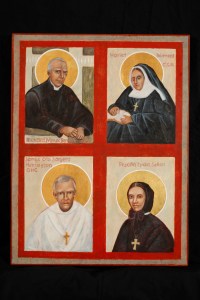
Four Anglo/Catholic Saints
Four Anglo/Catholic Saints written by Christine Hales

My newest Icons were all shipped off to their new homes: Two to Seattle, The one with the Four Anglo/Catholic Saints, Father James Otis Sargent Huntington, OHC founder of the Order of the Holy Cross, Fr. Richard Meux Benson, SSJE, Mother Harriet Monsell, CSJB, and Priscilla Lydia Sellon.  Also to Seattle went the Icon of Allan Rohan Crite, known as the Dean of Liturgical painting in Boston.  Each of these people were inspiring in the way God moved through them in the worlds they lived in, to affect and change the status quo around them.  Showing them to my five year old granddaughter prompted her to ask “Can I be a Saint?”.  What a good question! So sweet!

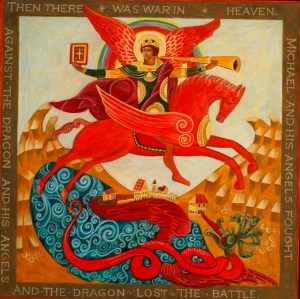
The other new one is my recent St. Michael  Fighting the Dragon which is now in Miami.

St. Michael in Battle Icon
St. Michael in Battle by Christine Hales

I particularly like the way the Scripture quotation in this one calls us to remember who won/wins the heavenly battle!

The Canons in Creating Icons

One of the things I deal with often with students and clients is the question “what is it that makes an Icon a good contemporary  Icon?”  While it’s impossible to come up with a concise definition, there are some guidelines that apply. In this month’s blog, I want to speak a little about the Canons of Iconography.

Icons are sacred, or holy pictures in that they represent either a Gospel story or a Saint and are intended to draw us into the world of heaven as we look at them. They are created by an Iconographer who lives a prayerful, fasting lifestyle and who prays while they paint the Icon. It therefore is the bearer of prayers and beauty to the viewer.

On Canonicity in Icons, the following is an excerpt from  a “Road to Emmaus” interview with well-known French Iconographer, Emilie Van Taack. She was a faithful student of Leonid Ouspensky

…There is only one rule, Rule 82, decreed by the Council in Trulo, part of the Sixth Ecumenical Council. This is the iconographic canon, in which it is stated that icon painter must follow older painter, that they must be in this stream of tradition, but exactly how they are to do this is not described. What is stated is that an icon must show both the humility of the Man Jesus and His glory as God; that is, it must manifest the Incarnation. In an icon of the Lord, you must be able to see that this man who is preseneted is not only man, but also God. You must see the Person of Christ. The Council made this rule because at this period there were still some symbolic representations, like in the early Church, representing Christ by a fish, or as a sheperd, or as a lamb – not the hypostatic representation of the Person of Jesus Christ. The Council said that all of these symbolic representations are like the shadows of the Old Testament. Since we have been illumined by the truth of the New Testament, we no longer use these old and outdated symbols, but we must present Christ Himself. Who incarnated into a human body and can be represented in the body. This is the only canon, the only rule of the Church. 

In defining what is “canonical” in icon painting, we have, of course, many beautiful old canonical icons to refer to. But canonicity is difficult to define. I cannot tell you what is canonical, because icons themselves define the canons. It is a circle, and we must accept it like this. By looking at these beautiful icons, studying them, copying them, little by little they help you to see yourself this image of Christ, and then you will be able to paint it without looking to the old, because you will have it in your own heart. This is a saving situation, because in this way we cannot possess the canon: it is a free gift that God gives or takes back as He wills.”

The above is an excerpt from Anna Dumoulin’s Iconography website.  (Daughter of  Father Andrew Tregubov)

Here are some Icon writing Resources I’ve come across this past month that you might enjoy:

A short video by Iconographer Gilles Wessman that shows stages of writing an Icon of Anne&Joachim.

Water gilding sort video by Ian Knowles – gives a quick overview of the process,

Article about supports for Icon writing– egg tempera painting and new absorbent ground.

 An article about Fr. Gregory Kroug.

Christ Icon by Gregory Krug

Also, please note that there is now on this site an Icon Resources page .  Please email me with suggestions about links to add there in the future.

I’d like to close here with a quote from Father Andrew Tregubov taken from the book, published by St. Vladimir’s Seminary Press,  “Light of Christ”  Father Tregubov compiled on the works of contemporary Iconographer Gregory Kroug:

“One of the wonders of our Creator is that everything in His creation is unique.  The ” Great Artificer” touches the tiniest creature with a very special personal touch, expressing His love for it.  He never comes to us in an impersonal way, but instead reveals Himself in the context of a real personal relationship . The Icons , in the same way, are never made for the Church in general but for individual persons who pray before them and venerate them.  God, in His boundless love, already knows all people, even those in the future; and He inspires the Iconographer in such a way that the Icon will truly be His personal revelation for those who will see it.”

May your Icon writing be blessed,

Christine Hales

Icon Website                Icon Writing Classes Website             Fine Art Website


Heat Wave and Icons!

Hello Fellow Iconographers and Greetings:

Christine at the High Line Garden in NYC

Polar Bear Zinnia in Christine's garden in Hudson Valley
Polar Bear Zinnia in Christine’s garden in Hudson Valley

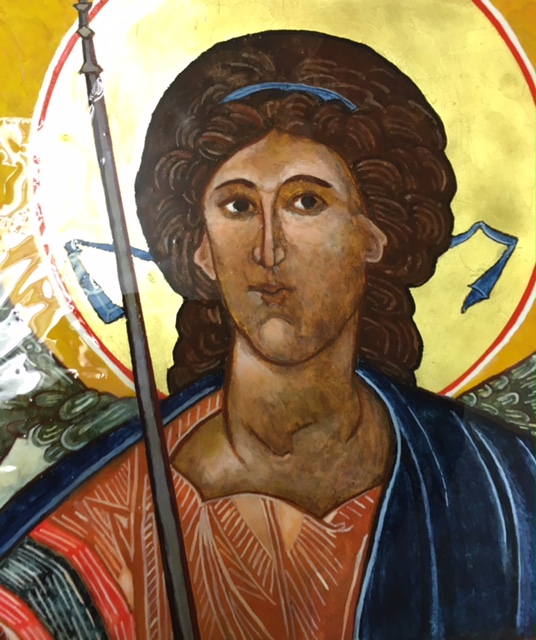
The month of July has been consistently hot and so beautiful here in the Hudson Valley. Although temperatures usually reach 90 degrees+ each day, Icons are still being created and the Monday night class keeps working right on throughout all!  Here’s a photo of Carol MacNaughtons’ Saint Michael in the process of being olifa-ed.

FullSizeRender

Also, now some works in progress photos for the Saint Kateri and Saint Isaac Jogues I am working on for the RCDA new Mausoleum.  I love working large!

The Monday Night Advanced Icon writing class will be accepting new students after Labor Day: September 12.  Please email if you would like to begin at that time. christine@newchristianicons.com

Also, Starting a 10 week Icon Writing Class in the Hudson, NY area, Thursday evenings, 6-9PM, September 15- December 1.  email if you’re interested in attending: christine@newchristianicons.com

THE VALUE OF ICONS IN THE POST MODERN WORLD

Icons are conveyors of holiness, sacredness, beauty and God’s love for mankind. Because Icons are vessels containing these attributes, they are essential in the continuing formation of our society and culture.  In a world seemingly gone mad, they are light filled and providers of God’s peace and love.

Icons that are created in an atmosphere of prayer to God, and with training in art principles and spiritual discipline cannot help but provide a spiritual compass to those viewing them.  This kind Icon becomes a visible testimony of God’s grace as it blesses the creator and the viewer.

” There is a deeper realization of God’s Presence available to us.  Through the coming of Christ and the Holy Spirit, God wishes to dwell within us in a new way: not in a mode of which we are largely unconscious, or as a kind spiritual atmosphere in which we simply live and move and have our being (Acts 17:28), but as a lover and a friend. (Song of Solomon 5:10). God wants His Presence to be consciously experienced by us.”

Above quote from the The Glenstal Book of Icons, Praying with the Glenstal Icons, Gregory Collins OSB.

To be consciously experienced, it is helpful to have holy images that serve as reminders and point the Way, even when our minds are engaged in worldly activities. It only takes a few seconds to shift our perspective to God’s perspective – truly the secret to a joy filled life!

Face of Christ Icon written by C.Hales

One last thing worth mentioning:  I attended the Kremer Pigments workshop on “Grounds” a through workshop on materials, conditions, and possible variations, and I would recommend it highly the next time they teach it. Kremer Pigments regularly gives classes and workshops on making paints and provides a wonderful resource of technical, hands-on information.

That’s all for this month.  Enjoy the beautiful summer and please keep me in your prayers, as you are in mine.

Blessings,

Christine

www.newchristianicons.com        www.christinehales.com     www.kingdomartsministry.com

www.halesart.com

The Joy of Sharing Icons

Hello Fellow Iconographers:

This month, on June 24 at 7PM, my advanced class of Icon writers and I will be sharing some of our newest Icons at a special organ concert by Al Fedak at the Westminster Presbyterian Church, 262 State Street, Albany. The concert is at 7PM and all are invited.  Free will donations will be accepted.

ezekielweb

I’m very excited about this opportunity to share our new work in the context of an amazing organ concert, and an added joy is the Icon Coloring Book the students are putting together for the concert and beyond. We are using our original Icon drawings and including a short description of that Icon.  Coloring books are so popular these days for adults and children. It’s a great way to center your thoughts for a few minutes and come up with something creative.  We are making the coloring book to be user friendly to all age groups and will be asking for a donation to help with printing costs. They will be amazing!

_MG_6523__So all of you former and present Iconography students – please come and bring a friend! We need to connect and share our joy of Icons together!

More local news: the Icon writing retreat at Holy Cross was really wonderful. Such a great group of people and a wonderful setting to learn and practice in. We were able to join in with the rhythm of daily prayer with the monks – heavenly!
photo 2


Here’s a video Michael made for us of that retreat:

One last thing: there are two rather long but important articles that I would like to share with you all about the correct schooling of Iconographers. These links are to The Orthodox Art Journal blog:

Introduction to Principles of Icon Training part 1

Principles of Icon Training Part 2  by Aidan Hart

For my part, the revelation I experienced when first exposed to Sacred icons was that they embodied the principles of good art.  In my art school training, those principles were not presented, although other important ones were.  I am interested in hearing what each of you thinkbirdsprint about the articles.

“We are pilgrims on a journey, and companions on the road.

We are here to help each other walk the mile and bear the load…

When we sing to God in heaven we shall find such harmony,

born of all we’ve known together, of Christ’s love and agony”

excerpted  from Celtic Daily Prayer, Northumbrian Community.

Peace, love and prayers,

Christine

Meditation and Contemplation

Dear Fellow Iconographers:

How do we meditate and contemplate God through the Icons?  A good question now that at least more than half the world I live in here in upstate New York associates the word “meditation” with Eastern philosophy.

IMG_0671 IMG_0680 IMG_0683

But Icons have a long history of being used in contemplation and meditation, and we specialize in bringing the valuable truths of the past into our present time.  Mystical Eastern spirituality has as its aim for the Icons “to open the heart in contemplative prayer to the transforming vision of God’s Glory.” The Glenstal Book of Icons.

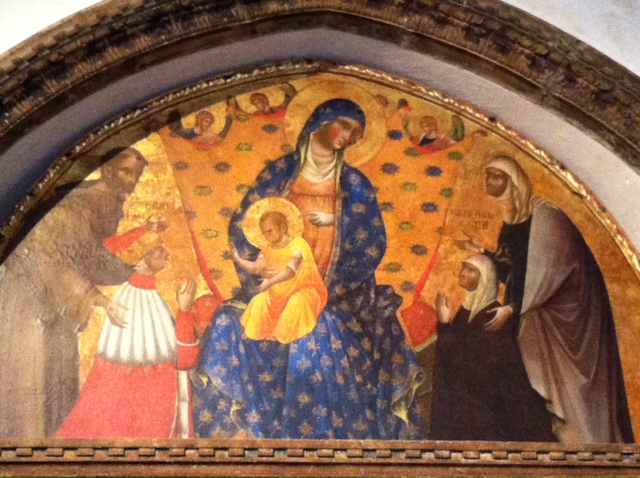
Carl Jung wrote extensively on the power of symbols on our unconscious minds.  Symbolic imagery in Icons helps to bypass our intellect and send a message straight to our hearts. For example, I can’t see an image of Mary and the Christ child without immediately identifying with the the Christ Child, and sensing what it was like to be mothered by the gentle, sweet Mary, or identifying with Mary and deeply experiencing what it was like to hold Christ in her arms and nurture him so that he could flourish.  Whenever I see that image I think of my newest painting or Icon and ask in prayer, how can I be Mary to my painting? How can I be the Christ child in Mary’s arms to my art work?  Each time, in contemplation and meditation new facets and ideas come as a result. Ideas I would not have had otherwise.Top Met Paintings Before 1860 04 Duccio di Buoninsegna Madonna and Child

“Through the symbolism of the icons, access is gained to the absolute otherness of God in the silent union of mystical prayer: one goes through the sense of sight to the one who is beyond all vision. The meditative work demanded in absorbing the imagery of the icons is essential if  prayer is to reach such a state beyond ideas, images, and acts- beyond the work of the head.  Only thus can the prayer we make with the body and the mind become a real “heart work”, a deep transforming union with God in love. The mystical traditions of Christianity, East and West, all teach that such prayer is the only source of inner peace and stability.  It is the pearl of great price, the treasure hidden in the field, of which the Gospel speaks. Matthew 13:44-46″  The Glenstal Book of Icons, Gregory Collins, OSB    IMG_1580

The Saint Luke’s Guild of Iconography will be sharing our newest Icons with outreaches to the community this spring and early summer. We will try to share the stories of each saint in our Icons as well as have dialogue with the public about prayer and meditation with the Icons.  The first two venues are planned to be: Westminster Presbyterian Church in Albany, 1st Presbyterian church in Hudson. We plan to create a traveling exhibition so if your church would like to host one, and perhaps hear a lecture on Icons, let me know.  “Never forget the joy of spreading Icons throughout the world”!

RECOMMENDED SOURCE FOR ICON MATERIALS:

Natural Pigments  is an excellent source of tempera materials, gold leaf, anything you need to make Icons- they probably have.  They also have a section called “articles” another page on their website that is full of useful materials information.

UPCOMNG ICON WRITING CLASSES:

Albany, New York Westminster Presbyterian Church, Chestnut St., Monday evenings 6-9PM. Class size is limited-email to ensure space.

Holy Cross Monastery, West Park, NY  May 6-8 Friday night, all day Saturday and Sunday afternoon, Introduction to Icon Writing.

Here is a video that my husband, Michael who most of you know, made recently about art and the Creator.. Hope you enjoy it!

Until next month, be blessed!

Christine

ADVENT

Hello Fellow Iconographers:maryChrist.small

Yesterday was the lighting of the first candle of Advent. Hope! And today the President is in France and Pope Francis is returning from Africa. So many things to pray about in addition to our more intimate family and friends as well as for our own intentions.  You can see why life as an Iconographer is always a full one!  Praying and painting, painting and praying.

The Albany Advanced Icon Writing Class will be focusing on drawing in the New Year. Beginning February 8, there will be some new suggested readings as well as exercises and teachings to deepen the understanding of how prayer and drawing of the Icon work together.  We will use the Egon Sendler book “The Icon, Image of the Invisible” for 2016, exploring the chapters on inverse perspective and geometric structures with an understanding of how these relate to contemporary Icons.takeoffJPG

The three worlds of theology, art making, and science come together in the creation of an Icon to give it it’s transcendent quality. These three spheres of creativity open up the viewer to a new way of seeing things, through faith and contemplation. Understanding  the role these elements play in the creation of an Icon is increased through prayer, fasting, and practice.kahndetail

Many of the Icon students in the Albany class are deeply involved in faith communities and social justice. It is an ecumenical group with Methodist Ministers, Episcopalians, Independent Catholic priests, and regular Holy folk who are able through love and fellowship to discuss a variety of theological and social justice issues in a mutually supportive way.

Some of us are reading Walter Wink’s “The Powers That Be“, Theology for a New Millennium. Wink talks about how Jesus broke the spiral of violence through His death and resurrection and showed us a new way of living through non-violence. “Nonviolence leads not just to a new politics and a new society, however;it also involves the very personal task of forgiving our enemies.” Paraphrasing, Wink states that Jesus’ teachings of non violence and love of enemies will hold a central place in the re-forming of American culture. “Not because they are more true than any others, but because they are crucial in the struggle to overcome domination without creating new forms of domination.”burnignbush.web

Back to Egon Sendler’s reminders that the creation of an Icon is threefold- theology, art, and science.  How to create an Icon that functions with the power and faith that Icons did in the Byzantine era?  Pray for us! God will help us, because our century needs them too!

Here is a link to Natural Pigments – a good source for Iconography supplies of all kinds. This link is actually to a page that George O’Hanlon produces which has excellent technical information on painting practices.

UPCOMING CLASSES:  Holy Cross Monastery, May6,7&8 Introduction To Icon Writing

Arts Center of the Capital Region March 3-31, Thursday Evenings 6-9PM


May God bless you and keep you save and in His Love all through the Christmas season!


Christine

www.christinehales.com

www.newchristianicons.com

www.kingdomartsministry.com

Travels to the UK and Italy

Hello Fellow Iconographers:photo 1

The Beginning of September was the start of our trip to the UK for a family wedding in Leeds, but we were able to make a detour to Shropshire and interview Aidan Hart, Iconographer and author of the book we use in Icon writing class: “Techniques of Icon and Wall Painting”,  for Yale University Radio.

photo 4

I was so happy that Aidan could make time for us, and upon leaving he said that he had just completed a large Icon for a church in Leeds! We were in Leeds at Michael’s sister’s home about 15 minutes when we realized that church was a fifteen minute walk- so off we all went. The icons were beautiful, and Father Michael of St. Urban’s invited us to come the following morning to his other church, also in Leeds,  to see another Aidan Hart Icon. Once there, we were amazed to see the 16′ fresco of the Transfiguration that Aidan had recently completed – in ten days according to Fr. Michael. It is the largest commissioned fresco since the Reformation, he told us.

Here’s the interview:    photophoto 2


Our next travels took us to Venice to see the Biennale and the wonders of the Byzantine Cathedral of San Marco.  I’ll be giving a gallery talk this Saturday, Sept 26, 6-8pm at the McDaris Gallery on Warren St. Hudson that will touch on the Biennale and Byzantine art.  (You’re all welcome to attend!).


From Venice, we got to Rome, where we stayed at a convent within walking distance of the Vatican-our destination! God blessed me with achieving my heart’s desire to give Pope _MG_0831 (1)Francis the portrait I had done of him! At breakfast, the nun suggested that I might give my portrait of the Pope to him if the guards would help me. By God’s grace, we met a friendly Italian music composer at breakfast who offered to walk with us to the Vatican. after Mass, he began asking the guards around the Vatican if I could give my portrait to the Pope. He pleaded eloquently, in Italian, to seven sets of guards! Finally I was able to write a note to accompany my gift and the last guard _MG_0218 (1)promised that he would personally deliver it to the Pope the next morning! I was the happiest I could be! We had such a wonderful trip but that was the highlight for me. Seeing the Sistine Chapel again and the architecture in St. Peter’s Basilica, too, impressed me with a sense of excellence that can only be experienced in that place.photo 2photo 3

So, back to earth, the Albany advanced Icon writing class has changed venue and is now held on Monday nights 6-9PM at Westminster Presbyterian Church, 262 State St., Albany, NY.

Also coming up is the Introduction to Icon Writing Retreat at St. James Church on Madison Ave, in NYC, Oct 16-18. Registration is still open, email Grace Beecham at: GBeacham@stjames.org to register.

A Few Notes of Interest:photo 3

Stephan Rene will be lecturing at the Prince’s School of Traditional Arts on Coptic Iconography.

British Association of Iconographers will have its annual members exhibition October 14-16 at St. Saviour’s Church, St. George’s Square, London.

Until next month, be blessed,

+ Christine

“”A full reward will be given thee of the Lord God of Israel, under whose wings thou art come to trust.” Ruth 2:12

www.newchristianicons.com

Saint Luke’s Guild of Iconography

Hello Fellow Iconographers:

Such a beautiful summer.  God’s creation is never so felt and experienced as in the beautiful summer months and upstate NY has been in a sweet weather pattern for most of august with beautiful sunny warm days.

Our Saint Luke’s Gild is comprised of eight students, several of whom have studied Icon writing with for several years. The emphasis that I bring to the sacred art of Icon writing is that of color theory, fine art , and sacred geometry principles in composition.  The work of the guild members is unique and interesting, bringing both the spiritual qualities of prayer and sacred reading in an integrated approach to the creation of an icon with good fine art principles as well. _MG_3831

The Guild has a Facebook page: We are an ecumenical community of artists and artisans who are committed to making art that is reflective of a deep Spirituality and Faith in God. We do this primarily through the practice of writing Christian icons and studying the historical background and hymnody, and lectio divina relationships within the visual imagery of iconography. We believe in the didactic value of icons and engage with prayer as part of our painting practice and have exhibitions of our work in order to engage our community with God’s presence and action of His Holy Spirit at work in our Icons.

This month I wanted to mention one of the guild members: Jennifer Richard-Morrow, who is a fine artist, specializing in pastels, oils and icons. She is a long time member of Saint Vincent’s Church in Albany where she serves as a member of the funeral ministry, helping with the funeral services, particularly with elderly people who have no relatives or few friends left.pastels 023

Jennifer has also had a lifelong interest in local New York history and has worked as an historical interpreter for the State at upstate Historic Houses and museums. She is currently on staff at Thomas Cole House in Catskill. Her Icon of Kateri Tekakwitha is one of the most historically accurate ones in existence today.

Richard-Marrow_fnl_downsizedJennifer and the other Iconographers and members of the Guild live a life of prayer and service to their local churches and  communities.

On September 14, we will be moving the location of our Icon writing class to Westminster Presbyterian Church on State Street in Albany, NY. We meet on Monday evenings and it is recommended that interested people take an introduction to Icon Writing class with Christine before starting the Monday evening class.

UPCOMING INTRODUCTION TO ICON WRITING CLASSES

St. James Episcopal Church   Fri evening, 6:00 – 9PM, Saturday, 9-5PM -Sunday, 1:30-5:00PM  October 16-18th  Cost $215 includes materials and lunch Saturday.  Email Grace Beecham to register: gbeecham@stjames.org or christine@newchristianicons.com._MG_3841

INTERESTING ARTICLE ABOUT GREEK ICONOGRAPHY

The following excerpt is taken from The Orthodox Arts Journal blog, and I include this because internationally many of us Iconographers have a similar approach – that of bringing forward the good from the past, but not slavishly copying. The task of creating a fully authentic 21st Century Icon is before us.

“Kontoglou and the rest of the 30’s generation where not turning to the past out of conservativism, but as a step to redefine the path of Greek art.

He was interested in reviving the orthodox aesthetic that had been heavily compromised by Western naturalistic ways of expression. In this aspect he was a real revolutionary; he managed to overturn the established church painting norms of the time (which was heavily influenced by the so-called ‘Munich painters’) by letting in, a “strong breeze from the east”. It was much later in his career, I believe, that his teachings were over-systematized. This led many of his followers to a stagnant and uninspiring way of painting icons based on mere copying with lack of artistic personality.”

Another Greek Iconographer in this article is Spyros Papaloukas who has another interesting approach to the creation of an authentic contemporary Icon, and here again, I quote from the blog :

Spyros Papaloukas saw in Byzantine art elements that were critical to the modern art movement and in many cases realized that solutions to artistic problems posed by his contemporaries were to be found in Byzantium. In several cases these gave him the answers to formal problems that were vital to painters of his time. Flatness and the adherence to the two-dimensional character of a painting, the possibility of the coexistence of multiple view points, the vital part that color played as an expressive and not merely descriptive element – all these were characteristics that modern painting shared with Byzantine art. This has been noticed even by modern painters whose art had no obvious religious focus such as Malevich and the other Russian avant-gardes, or like Henri Matisse. Matisse made a statement very much in accordance to Papaloukas, about 20 years later, in 1947, when he confronted for the first time Byzantine icons on his trip to Russia: “It was before the icons in Moscow, that this art touched me and I understood Byzantine painting. You surrender yourself that much better when you see your efforts confirmed by such an ancient tradition. It helps you jump the ditch.”  You can read the entire blog and see the color illustrations here.

These ideas and issues help us here in America to join with our international counterparts in thinking and praying our way to what God is asking us to do with His Icons today.  st lukeprint

Thank you all for reading, and we ask your prayers for us in this work.

Many blessings,
Christine Simoneau Hales

www.newchristianicons.com

www.christinehales.com