“He who forms the mountains, who creates the wind, and who reveals His thoughts to mankind, who turns dawn to darkness, and treads on the heights of the earth– the LORD God Almighty is His name.” –Amos 4:13
Saint Patrick of Ireland
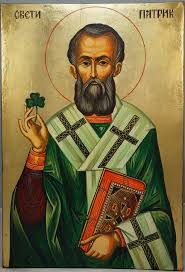
Saint Patrick Icon
As a young boy, Patrick was kidnapped by brutal pirates and carried away to Ireland where he was sold as a slave. For the next six years he was a shepherd in Northern Ireland. This is where he learned to pray. “In a single day I would say as many as a hundred prayers, and at night only slightly fewer.”The Confession of St. Patrick.
“I arise today
in a mighty strength
calling upon the Trinity,
believing in the Three Persons
saying they are One
thanking my creator.”
In the experience of slavery and exile, the young boy discovered God . In the midst of this terrible alienation brought on by his exile from family and country, Patrick experienced a deep abiding connection that enabled him to feel strengthened by God.
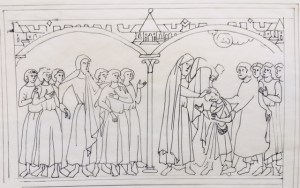
St. Patrick baptizing the Irish drawing by Christine Hales
He is a legend in Irish history and spirituality. Patrick’s story of being kidnapped by Irish pirates eventually gave rise to a remarkable inner transformation that led him eventually to return to Ireland, serving the Irish people by bringing God’s love to them.
Like St. Francis, Patrick chose a lifestyle of poverty, preferring to single-mindedly focus on the Divine connection within. “For I know full well that poverty and adversity suit me better than riches and delights.”
Saint Patrick Icon
One often sees Icons of St. Patrick holding a shamrock, an illustration of how he used the humble clover leaf to illustrate the Trinity- three in one- to the largely pagan population Ireland. Pre-Christian Ireland was where God sent Patrick. His spiritual story is told in “The Confession of St. Patrick”, along with many Scriptural references that relate to his experiences.
Patrick was born in Britain about 385, and began his mission in Ireland during the early 400’s.He became fluent in the Irish dialect during his period of slavery, and despite much hostility and danger, he was very effective in bringing the Gospel to Ireland.
Saint Patrick founded many churches and monasteries across Ireland.
Saint Patrick Icon
Holy Bishop Patrick,
Faithful shepherd of Christ’s royal flock,
You filled Ireland with the radiance of the Gospel:
The mighty strength of the Trinity!
Now that you stand before the Savior,
Pray that He may preserve us in faith and love!
Icon notes for March:
The American Association of Iconographers now has a Facebook Page which you are welcome to join. The rules of the page are that postings may be submitted by any member and the content needs to be of interest and benefit to Iconographers.
Video of Iconographer George Kordis beginning a Christ Pantocrator dome:
What is a worldview? We all have one. Our culture has a pervading worldview that changes with the times. Having recently emerged from a postmodernist cultural viewpoint, we now experience the effects of pluralism, relativism, and syncretism in the world around us.
God, Creator of the Universe by Christine Hales
Our world view is a concept which we hold, both consciously and unconsciously that determines our ethics, behavior, and makes up the nature of our ultimate reality.
As a Christian, our worldview is identified with the truths of the Bible, Christ, the Trinity, and the Gospel- essentially, Christian theism. The reason we choose Icons created before the seventeenth century as our models to create new Icons is because Christian theism was the pervading worldview in the Western world until the advent of the Renaissance when Humanism began to emerge. The worldview of the early Icons was one of a personal, triune God of the Bible, the universe was God’s creation and human beings were God’s special creation, created in His Image.
Early Christian Icon
“During the period from the early Middle Ages to the end of the seventeenth century, very few challenged the existence of God…….Christianity had so penetrated the Western world that whether or not people believed in Christ or acted as Christians should, they all lived in a context of ideas influenced and informed by the Christian faith.” The Universe Next Door, James Sire
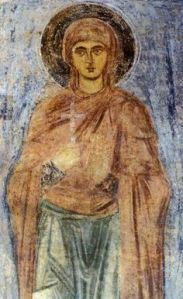
Paleologic Icon of Saint Marina
As Iconographers, we want to first understand the world and people around us, and then genuinely communicate God’s reality, His Truth, to our world through the practice of Icon writing. We use the examples of the early Icons as our models to help us portray a worldview that we ourselves are not able to experience in our contemporary culture.
A worldview is a commitment , a fundamental orientation of the heart, that predisposes us to a particular reality. And that worldview provides the very foundation on which we live, work, play, and love others.
St. John the Evangelist Icon
If it’s true that all of one’s thoughts and actions originate in the heart, our relationship to God becomes central to us as artists and Iconographers. More important even, than whether one uses acrylic paint, egg tempera, or use a particular style of painting Icons.
The Christian worldview is the central defining perspective and it encompasses notions of wisdom, spirituality, emotion, desire, and will. So when we say that prayer is the first and most important part of Icon painting, it is also important to keep clear about this Christian worldview, and that it is different from the worldview of the culture around us.
Early Christian Icon from St. Sophia Cathedral, Kiev
Ideally, our Icons become a bridge that unites the Christian worldview with whatever worldview popular culture is experiencing. It is only through our compassionate understanding with those people and institutions around us that our Icons can go out into the world and be the blessings they are meant to be.
“Mother Teresa of Calcutta used to say that “the money in your pocket is not yours, it belongs to God.” The same is true of all the gifts you have received. They have been given to you by the Holy Spirit to bring the world back to God. ” Deacon Lawrence
May God inspire each of you, may you hear His voice, and may your Icons truly be a blessing to the world you inhabit.
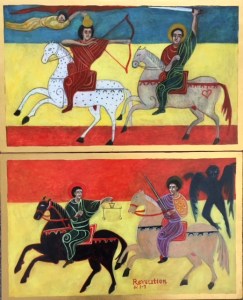
Four Horsemen of the Apocalypse Icon by Christine Hales
Christine
Christine Simoneau Hales
“If we want clarity about our own worldview, we must reflect and profoundly consider how we actually behave.” “The Universe Next Door” by James Sires
First, a thank you to all of you who have been subscribers to this blog over the last couple of years. Particularly, thank you for being patient with all the changes in format and stylistic content as I try to understand the needs and purpose of this community of Iconographers.
I have changed format again, this time getting closer to my original purpose of having a substantial list of Iconographic resources and links to help Iconographers in creating and learning about Icons. If you look at the left sidebar you will see a page of “resources” on which I have started to add links, and will continue with this throughout the year so that it becomes a valuable resource.
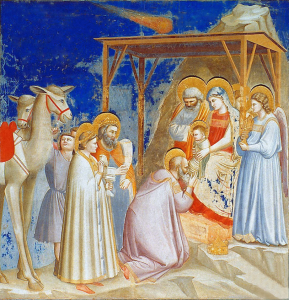
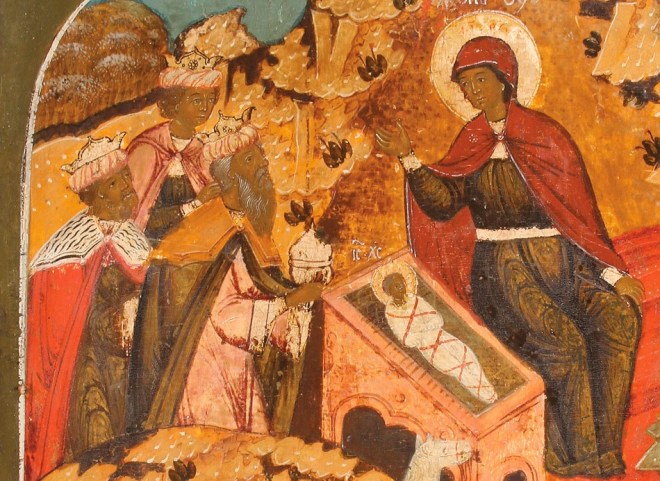
Russian Icon of the Epiphany
As it is New year’s Eve and we are on the verge of the Feast of Epiphany , here are some images of the Epiphany in different Iconographic styles, taken from a more nuanced article by Hokku about the wise men on the blog ” Icons and Their Interpretation”.
Icons for the Epiphany range in subject matter from stories of the wise men finding Jesus in a manger, to the Baptism of Jesus in the river Jordan.
Epiphany is described as the manifestation of Jesus to the Gentiles as represented by the Magi- who were not Jews but were from the East; it is also the church feast day commemorating the Epiphany on January 6; and a manifestation of a divine, supernatural being. Webster’s dictionary describes Epiphany as “ a sudden, intuitive perception of or insight into the reality or essential meaning of something, usually initiated by some simple, homely, or commonplace occurrence or experience.”
Russian Epiphany Icon
The birth of Jesus, the Son of the most high God in a manger certainly fulfills that definition. Epiphany represents the discovery that Jesus was born for not only the Jews, but also the Gentiles- for the whole world.
Baptism of Jesus Icon by Christine Hales
In the Baptism of Jesus Icon, we see in the central axis of the Icon, the God the Father, represented by the half circle at the center; The Holy Spirit, represented by the rays of gold coming from the half circle,and Jesus, the Son of God. In the Gospel, God’s audible voice announces “This is My Son, the Beloved, with whom I am well pleased.” Matthew 3:17
It is a revelation similar to the one of the magi- a sudden perception that transforms mundane, earthly existence into one of light, meaning, and grace.
Icons bring to our remembrance important Gospel and Old Testament stories that brighten our everyday existence. As we move into this coming week towards the celebration of Epiphany and then the Baptism of Jesus, let us pray together to receive an Epiphany of God’s grace in each of our lives today, and as Baptism makes permanent and concrete the role of God’s grace in us, may that sudden awareness be awakened and kindled as an important part of our lives in 2018.
With world catastrophes like the Hurricane devastation in Puerto Rico, the Caribbean, and earthquakes in Mexico, we have so many urgent applications for our prayers during our icon writing practice. May God continue to send help in many forms to those people afflicted by violent storms. Provide homes, food and safety, O Lord, and bring forth your victory and hope where there is despair and destruction, we humbly pray.
Recently, during the Healing Icon writing Retreat I gave at Holy Cross Monastery, we daily put our prayer requests in a basket on the Icon table and prayed over them during our prayer times together. The subject for the retreat was the Archangel Raphael, and we completed the icons in time to be blessed on the feast day of St. Michael and the Archangels! Each day we spoke about different aspects of the story of Tobit, Tobias, and Archangel Raphael and contemplated the healing aspects of the story, from the fish trying to bite Tobias’ foot, to Archangel Raphael bringing transforming a dangerous woman into a suitable wife. Our Icons are reminders for us of God’s intervention in our lives, and the role his heavenly angels play in bringing His divine will into the experiences of our lives.
In working to understand and define what is meant by American Iconography, I think that religious freedom plays an important role. This country was founded, in part, on the hopes and dreams that new settlers from many different European countries had for freedom to worship in their individual ways. They wanted to express their ideas of how God manifests in their lives and form communities to worship and pray together. There was a great diversity of expression in the Christian communities, and yet each was given the space to develop and grow, peacefully.
Ideally, America is still that country that respects and allows for individual religious freedom. Just as Icons are meant to depict a transfigured reality, I think we iconographers are asked to call forth the best in our worlds, to stand for positive change, and to show others how we can pray and experience God even in a very troubled world.
In Icon writing, we look for examples from the early centuries in order to understand and be inspired by the universal spiritual truths they contain. The American philosopher, John Dewey says of a work of art, eg. the Parthenon, that it ” is universal because it can continuously inspire new personal realizations in experience.”…”The works that fail to become new are not those that are universal but those that are “dated”. He goes on to say “The enduring art product may have been, and probably was, called forth by something occasional, something having its own date and place. But what was evoked is a substance so formed that it can enter into the experiences of others and enable them to have more intense and more fully rounded out experiences of their own.” (Taken from “Art as Experience” by John Dewey)
All this to say that an Icon writer must not only use examples from the past, but must also be able to convey the action and presence of God and the saint depicted through his/her prayers and spiritual efforts of today in order to be an authentic Icon.
Early Celtic Prayer from St. Patrick’s Breastplate
Christ as a light illumine and guide me. Christ as a shield overshadow me.
Christ under me, Christ over me, Christ beside me on my left and my right.
This day be within me and without, lowly and meek yet all powerful.
Be in the heart of each to whom I speak, in the mouth of each who speaks unto me.
This day be within and without me, lowly and meek yet all powerful.
This summer I have been working on developing the school of American Iconography. When I say “school” I mean it in the Benedictine sense of a committed community of people who study, pray, and work together united by common goals and principles. We would be working, using artistic skills and prayers to further the work of God’s Kingdom, here on earth. In this school, God would be the teacher! Putting together a reading list would be a good start, so do email suggestions on that.
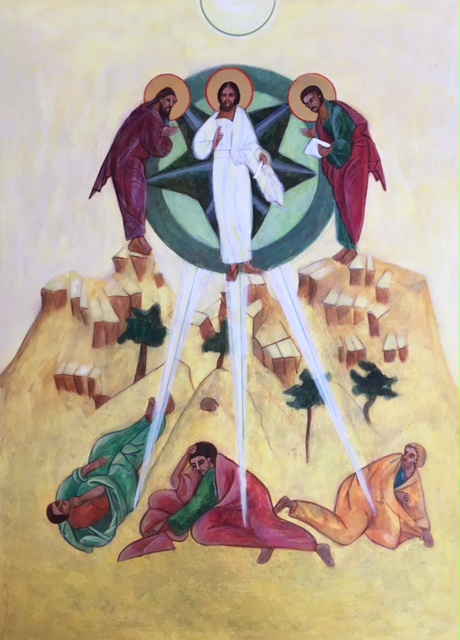
Transfiguration Icon almost finished!
I’d like to share with you some of the goals and objectives I am setting for myself for the next three years. Please think about where you might participate and in what ways you can contribute. Volunteers, ideas, and suggestions are welcome!
Icon Goals 2017-2020
Exhibit Iconographic Imagery at museums, universities and seminaries.
Run Icon writing training classes, giving talks, and participating in symposiums.
Book and video documentation to provide future development of online Icon writing classes.
Complete Icon commissions in churches and for private collections.
Participate in Symposiums or panel discussions on art and theology.
Collaborating with seminaries and universities to make Icon writing an integral part of a fine arts curriculum.
I see these goals as laying a groundwork for future advanced workshops, and to creating a coherent system of training Icon writers.
I see Icon writing as an important activity to the future of our culture. Our thoughts and prayers together can be effective in creating an ethical and responsible society. Perhaps there are others already active in this area. If so, please contact me to being a conversation about how we can work together.
Happily, a similar effort is happening currently in Romania. The following quotes are taken from a blog post of the Orthodox Arts Journal : 2015 “The New Romanian Masters: Innovative Iconography in the Matrix of Tradition”
” Iconography, a recovered artistic language
It would have been impossible to imagine a public conversation on icons and their veneration a quarter of a century ago in communist Romania. It would have been impossible as well to imagine iconography taught in a public school and the technique of painting icons at the department of Fine Arts….Today it is a common gesture to order an icon for your house or to offer an icon as a present. Four of the twelve Orthodox faculties of theology in the country have created departments of sacred art, preparing iconographers and specialists in the preservation of medieval iconography; and many of their graduates have become proficient in painting icons and frescos….the icon has become a common presence in homes and offices.
The most remarkable aspect of this revival is that the abundant iconographic demand and the high number of skilled iconographers gave rise to a competitive ambiance that led to an obvious advance in the quality of iconography and, subsequently, to a new iconographic movement.
“… As with any profession, the new iconographers and church painters demonstrate an uneven value; it is not enough to learn the technique and follow the Byzantine herminia (the painter’s manual) to become a skilled and appreciated iconographer.
Important to Iconographic training:
1. A thorough education in classical art.
2. A personal spiritual life….a spiritual dimension is a necessary ingredient to painting an icon. Painting an icon is not a mere artistic activity but a facet of the larger spiritual growth, both personal and part of the community in which the iconographer lives.
3. They do not imitate but innovate within the canons of tradition. Probably the most interesting value gradually assumed by the iconographers of the new generation is that they cherish artistic originality and freedom of expression. They do not accept to create in a mannerist way and to reproduce the masters of the past while making a concession to a common, popular taste. Paying attention to the smallest technical and theological detail, they strive to avoid not only religious kitsch but also religious clichés. After assimilating the skills, the Byzantine canon, a rich documentation and a general knowledge of the medieval art, some of them have been able to define their own style. And this fact has allowed them to rethink classical iconography and innovate in terms of style, colours and composition as well as to find new themes and become “hagiographers”. All these elements have led them to reach an unprecedented quality of the iconographic act in which they commit themselves to artistic originality”
I think the first two paragraphs of quotes above are inspiring. The last three paragraphs can help to define a best practices manual that can be applicable to the American School of Iconography.
Our Lady of Guadalupe Icon by Christine Hales
“An Icon is therefore is always either more than itself in becoming for us a heavenly vision or less than itself in failing to open our consciousness to the world beyond our senses.” St. Dionysus Aeropagite.
I will be attempting to collect and notate sources of Iconographic references that will help define this American School go Iconography over the next couple of years.
Thank you for your patience and contributions!
That’s all for this month, have a blessed Labor Day,
This month has been busy with writing Icons and teaching classes. The Holy Cross Monastery Icon Retreat was wonderful, each participant wrote their own St. George Icon, and we had them blessed by Brother Roy on Sunday before Diurnum. It is a wonderful place to study Icon writing since we are able to be part of each day’s morning prayer and Eucharist and share meals with the Brothers and other guests in the octagonal dining room over looking the Hudson River. Truly a joy to teach there!
St. George Icon
Icon Blessing at Holy Cross
The prayer of St. George: “Obtain for us the Grace of heroic Christian courage that should mark soldiers of Christ” Amen.
Icon Class at Holy Cross
As many of you know, the Icon is a kind of synthesis of the spiritual truths and values of the Church. It is much more than just a religious painting. It is a meeting point between the Divine and the human heart. It is a visible, created beauty, a place where prayer joins us to the image of God. It truly is an honor and privilege to be called to this beautiful practice of writing Icons.
Here are two new ones I am working on – one of Our Lady of Guadalupe and the other a Transfiguration Icon. Here are some work in progress photos:
Our Lady of Guadalupe in progressTransfiguration Icon in Progress
The following is an important on line Iconographic Resource for those of us interested in the early Icons:
“In 1956, Professor George Forsyth, of the University of Michigan, invited Kurt Weitzmann, of Princeton University, to join him on an exploratory trip to Sinai. From 1958 to 1965, the University of Michigan, Princeton University, and the University of Alexandria carried out four research expeditions to the remote Monastery of Saint Catherine at Mount Sinai—the oldest continuously inhabited Orthodox Christian monastery in the world, with a history that can be traced back over seventeen centuries. The documentation collected by the Michigan-Princeton-Alexandria Expeditions to Mountain Sinai, under the direction of Professor George Forsyth (below, right) and Professor Kurt Weitzmann (pictured below left), is a profoundly important resource for Byzantine studies.” (Quote from the website link below.)
This website displays all the color transparencies and color slides in the possesion of the Department of Art and Archaeology at Princeton. The online images are limited to a size of 1024 pixels. These images are available to download and use for teaching and scholarly purposes.
St. Luke’s Guild of Iconographers- a group of Iconographers who pray and write Icons- many of whom have studied with me. Their primary focus is community through prayer and writing Icons. Here’s a link to their Facebook Page
Praying a blessing over your Icon writing, until we meet again!
This month, I have two articles that have, at heart, a re-examination of two central issues to Icon making:
First, the Getty Museum has just announced a new digital art history protest of Medieval art and it’s relationship to Christianity and culture – all issues that are part of the invisible foundations of Icon writing.
Second, Mary Jane Miller, an Iconographer in Mexico, wrote and asked if she could guest blog on a topic pertinent to Icon writing- Women in Icons- cultural biases and concerns. It’s a good topic with many more points that could made in the future. Hope you enjoy them both! As always, we look forward to your comments and thoughts as long as they are given a constructive and kind spirited manner!
THE GETTY
A new digital art history project seeks to correct biases in how databases represent meaning in medieval Christian imagery
The French Institut National d’Histoire de l’Art (INHA) is launching an ambitious project for scholars and the broader public that proposes an innovative way of accessing medieval Christian images. By building complex and nuanced vocabularies of keywords and terms, the “Ontology of Medieval Christianity in Images” (OMCI) will allow databases to better represent how such images depict philosophical and spiritual themes that have been diminished or even ignored in current approaches.
Detail of the Bernward Doors, circa 1015
Traditionally, Western art history has favored examining narrative aspects of medieval Christian images over conceptual ones. As art historians have adopted digital media in their work, this preference has been reflected in the structure of databases, which have tended to organize information about medieval Christian artworks around themes related to biblical and Christian places, events, characters, and objects.
However, medieval Christian artworks depict much more than narratives. In the Christian tradition, the material and spiritual worlds, and the course of history itself, are expressions of God’s law for the universe. The very structure of medieval Christian images—as expressed in their content and composition—often mirrors that overarching cosmological order.
In other words, the relationship between pictorial content and religious ideology in medieval Christian images is much more nuanced, and more expressive, than simple storytelling. The OMCI is concerned with this ontological level of analysis: the OMCI team of art historians, graduate students, and technology experts intends to build a web resource that will identify keywords and iconographical themes linked to medieval Christian knowledge and belief systems. These will be augmented by examples from the art of that period—such as the images featured above—that reflect both cultural values and Christian ideals.”
“I HAVE been a practicing Christian all my life and half of that time dedicated to the practice of painting (writing) icons. Biblical text, liturgy, and prayer are my source of strength and comfort, just like millions of people around the world. I would like to share some of the observations I have made while painting icons and at times disturbing reflections on some familiar Bible verses. Adam and Eve: the biblical story interpreted often defines Eve as being created second to Adam and responsible for original sin, which of course became all women’s greatest sin, the temptation of sexual sin. 1 Corinthians 14:34 : “Women should remain silent in the churches. They are not allowed to speak…”, the new testament continues with verses that ultimately prohibiting them from serving in positions of authority, the like of which has effected every women’s place in society. In actuality, beginning as early as the fourth century the dominant Christian leaders, all men, twisted and distorted Holy Scriptures to thwart the ascendant positions for women within the religious hierarchy and in christian societies in general.
Mary Jane Miller art work and Icon
The underlying teachings of Jesus Christ, the Apostle Paul, Moses and the prophets, – all call for the proper and equitable treatment of God’s children. I have always known in my heart and soul, women are not inferior to men; without a doubt, God loves humanity equally. Tragically, as an iconographer of 25 years, self taught and inspired, I have not had to look far to see that in this great tradition that I so love, the place of women in the iconographers community or in the images depicted thy have been noticeably absent until recently.
Now ironically, women may be holding the means to this great sacred art forms survival. Those who are graced with the desire to paint sacred text, have an obligation as prayer practitioners to re-examine how or why Women are not mentioned in the great feast days like Pentecost, at the last supper, or the baptism of Christ, etc. It is not God’s commandment that they are not heard of in text or seen in sacred image. When the feminine voice and new icon images are ushered into today’s church community, the addition will benefit us all. When you stand before an icon for any amount of time you cannot help but see first the beauty they have as a work of art. A well done icon is a powerful tool and often provokes insights and visions. This interior conflict for women because of our absence within the fullness of societies and the church is a worthy discussion we all need to engage in. We live in an age of great bigotry, self righteousness and personalized isolation. Including more women in Icons stimulates new perspectives on a theological issue which is still in it’s infancy.
Some might ask, why would I care about such details. If you are an iconographer you are supposed to transcribe the Bible word for word and uphold the theological doctrines which the church maintains. The problem for me is my thinking mind. Mary being portrayed as the perfected quiet servant and silent mother I feel has been a hindrance to the development of women and their voice in the Christian church institutions.
Teaching the Women by Mary Jane Miller
I am asking for a simple review to rectify what we all are beginning to see as misguided behavior of the past. That must change if we are to going to have a thriving church in the future. When the feminine voice and new icon images are ushered into today’s church community, the addition will benefit us all.
Inquisitive women like myself have always been around Christ listening to His message, they were there cooking and cleaning at the Last Supper, at the wedding at Canon and when He fed the five thousand. When Christ invited the children, you can be sure the mothers were there, too. These women were imbued with unrecognized human qualities: those who speak and those who contemplate, those who teach and those who administer and, finally, those who are mystics with their wisdom, living and walking among us. If we believe that God’s boundless presence is reflected through sacred text and in iconographic image, then the New Eve can and should live in communion with the New Adam to offset the gender imbalance in science, art, government, religion and all other facets of life.
Mary and the Holy Spirit Icon by Mary Jane Miller
World leaders have recently published a statement that declares: “The justification of discrimination against women and girls on grounds of religion or tradition, as if it were prescribed by a Higher Authority, is unacceptable.” It is time for the church “fathers” to draft a similar statement.
While I am painting new images of women in iconography, I am also challenging all denominations within the Christian church to re-frame parts of Holy Scriptures which have justified the superiority of men over women. We are told we are One body in God, called to be One mind in Christ. Let us live into that reality where Christian women will served as deacons, priests, bishops, apostles, mystics, healers, teachers and prophets, etc. through image and word. ” By Mary Jane Miller San Miguel Icons
Thank you Mary Jane for your thoughts and observations. If you have a topic or article to submit for review, just send an email. Creating Sacred Images that build our relationship to God in a strong and powerful way is most important in the times we live in. May we all keep this in prayer, for God to guide His Iconographers, women and men, to create the Holy images we need for our time and culture today.
May God bless you and keep you, and may His wisdom fill all that you say and do.
This spring has been rainy and cold here in upstate New York. Normal for Spring, but what seems to be in short supply are warm sunny days in-between! Good weather to begin some new Icons, that’s what I say!
Four Anglo/Catholic Saints written by Christine Hales
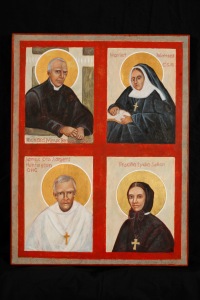
My newest Icons were all shipped off to their new homes: Two to Seattle, The one with the Four Anglo/Catholic Saints, Father James Otis Sargent Huntington, OHC founder of the Order of the Holy Cross, Fr. Richard Meux Benson, SSJE, Mother Harriet Monsell, CSJB, and Priscilla Lydia Sellon. Also to Seattle went the Icon of Allan Rohan Crite, known as the Dean of Liturgical painting in Boston. Each of these people were inspiring in the way God moved through them in the worlds they lived in, to affect and change the status quo around them. Showing them to my five year old granddaughter prompted her to ask “Can I be a Saint?”. What a good question! So sweet!
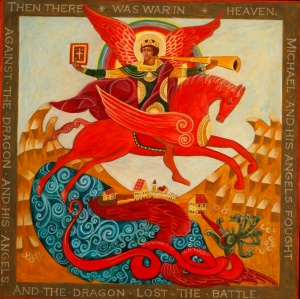
The other new one is my recent St. Michael Fighting the Dragon which is now in Miami.
St. Michael in Battle by Christine Hales
I particularly like the way the Scripture quotation in this one calls us to remember who won/wins the heavenly battle!
The Canons in Creating Icons
One of the things I deal with often with students and clients is the question “what is it that makes an Icon a good contemporary Icon?” While it’s impossible to come up with a concise definition, there are some guidelines that apply. In this month’s blog, I want to speak a little about the Canons of Iconography.
Icons are sacred, or holy pictures in that they represent either a Gospel story or a Saint and are intended to draw us into the world of heaven as we look at them. They are created by an Iconographer who lives a prayerful, fasting lifestyle and who prays while they paint the Icon. It therefore is the bearer of prayers and beauty to the viewer.
On Canonicity in Icons, the following is an excerpt from a “Road to Emmaus” interview with well-known French Iconographer, Emilie Van Taack. She was a faithful student of Leonid Ouspensky
“…There is only one rule, Rule 82, decreed by the Council in Trulo, part of the Sixth Ecumenical Council. This is the iconographic canon, in which it is stated that icon painter must follow older painter, that they must be in this stream of tradition, but exactly how they are to do this is not described. What is stated is that an icon must show both the humility of the Man Jesus and His glory as God; that is, it must manifest the Incarnation. In an icon of the Lord, you must be able to see that this man who is preseneted is not only man, but also God. You must see the Person of Christ. The Council made this rule because at this period there were still some symbolic representations, like in the early Church, representing Christ by a fish, or as a sheperd, or as a lamb – not the hypostatic representation of the Person of Jesus Christ. The Council said that all of these symbolic representations are like the shadows of the Old Testament. Since we have been illumined by the truth of the New Testament, we no longer use these old and outdated symbols, but we must present Christ Himself. Who incarnated into a human body and can be represented in the body. This is the only canon, the only rule of the Church.
In defining what is “canonical” in icon painting, we have, of course, many beautiful old canonical icons to refer to. But canonicity is difficult to define. I cannot tell you what is canonical, because icons themselves define the canons. It is a circle, and we must accept it like this. By looking at these beautiful icons, studying them, copying them, little by little they help you to see yourself this image of Christ, and then you will be able to paint it without looking to the old, because you will have it in your own heart. This is a saving situation, because in this way we cannot possess the canon: it is a free gift that God gives or takes back as He wills.”
Also, please note that there is now on this site an Icon Resources page . Please email me with suggestions about links to add there in the future.
I’d like to close here with a quote from Father Andrew Tregubov taken from the book, published by St. Vladimir’s Seminary Press, “Light of Christ” Father Tregubov compiled on the works of contemporary Iconographer Gregory Kroug:
“One of the wonders of our Creator is that everything in His creation is unique. The ” Great Artificer” touches the tiniest creature with a very special personal touch, expressing His love for it. He never comes to us in an impersonal way, but instead reveals Himself in the context of a real personal relationship . The Icons , in the same way, are never made for the Church in general but for individual persons who pray before them and venerate them. God, in His boundless love, already knows all people, even those in the future; and He inspires the Iconographer in such a way that the Icon will truly be His personal revelation for those who will see it.”
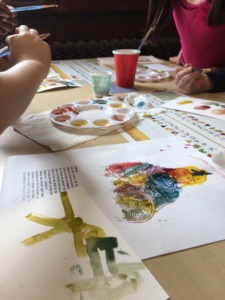
This month, sharing Icons with kindergarten children in Boston was a special joy – I used pages from the Icon coloring book that they could “paint” and I demonstrated making egg tempera- they loved trying it!
Also was blessed to lead an Introduction to Icon writing workshop in Miami and Morningstar Renewal Center, directed by Sue de Ferrari. Many of the participants were students of Sue’s in a unique Spiritual Direction Training program through St. Thomas University. It was a blessed workshop in so many ways, including a Good Friday Stations of the Cross prayer walk, using my Stations Icons.
Stations the Cross Icons
The weekly Albany Icon writing class is up and running again. To view class times and schedules got to www.iconwritingclasses.com.
In teaching Icon workshops and classes,, and particularly in giving talks about Icons to a more general audience, I realize how important it is to explain the difference between an Icon and a religious painting. I think that issue warrants more thought and explanation amongst the Icon writing community. When we consider the history of Icons, and the development of Icon writing particularly from the eighth century forward, there seems to be a development that begins to decline in levels of artistic and spiritual quality particularly in the seventeenth through nineteenth centuries.
Religious Paintings vs Icons
Madonna & Child Icon by Christine Hales
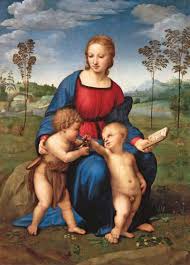
We can see that in the elongation of forms, the more naturalistic rendering of people and objects, and in the gradual loss of that flatness of spatial relationships. What begins to happen is that the “heavenly world” that world that operates not on the same laws as earth, but instead, the miraculous space that God inhabits.
Raphael
I believe that most of us Iconographers are aware of this and the importance of not copying Icons from the Renaissance forward is part of that understanding. Does anyone know of more clearly articulated articles or books that define this difference between “good Icons” and ones that are considered “corrupted”? I think it would be useful for the Iconographic community to consider various ideas and opinions on this subject, so please email or forward relevant writings on the topic and I will try to continue to post regarding this notion of “what makes a Good Icon?”. Below is an in depth video that is interesting and informative.
“God in all that is most living and incarnate in Him, is not far away from us. altogether apart from the world we see, touch, hear, smell and taste about us. Rather he awaits us every instant in our action, in our work of the moment… he is at the tip of my pen, my brush, my needle- of my heart and of my thought.” Teilhard de Chardin
For Lent, I have been re-reading “Seeking God”, The Way of Saint Benedict by Esther DeWaal. In thinking about Icon Writing, teaching students, and community formation, there are many thoughts and concepts within the “Way of St. Benedict” that are worth bringing forward to the formation of an Icon writing community. A quote from her book from St. Benedict’s prologue:
“The Lord has himself given us the time and space necessary to learn and put into practice the service love that He continues to teach us. In this school of His let us hope that following faithfully his instructions nothing distasteful or burdensome will be demanded of us, but if it has to be so in order to overcome our egoism and lead us into the depths of true love, let us not become disheartened nor frightened and so ignore the narrow path in spite of its tight entrance-that path which leads directly to the fulness of life”.
As we move forward, please email or send your thoughts or suggestions about community formation as Iconographers.
Christine Hales’ Icon writing class Holy Cross Monastery Chapel
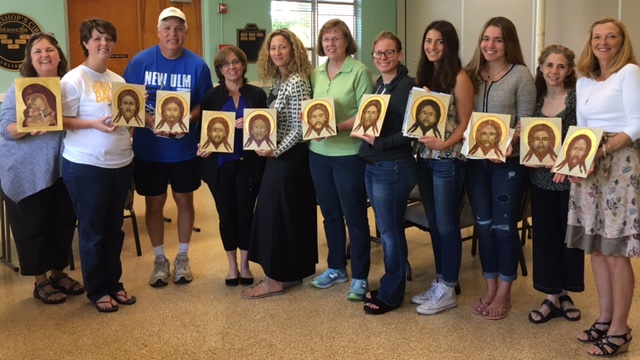
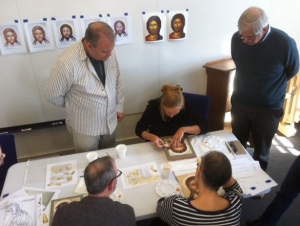
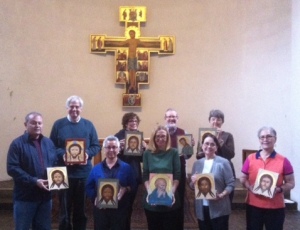
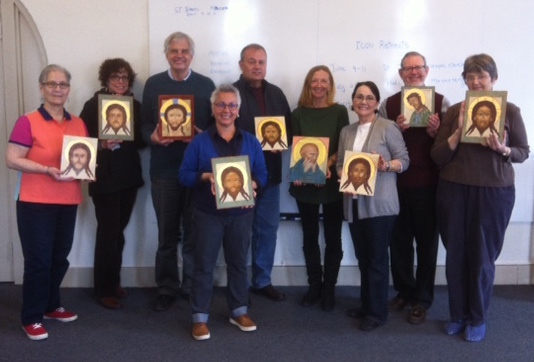
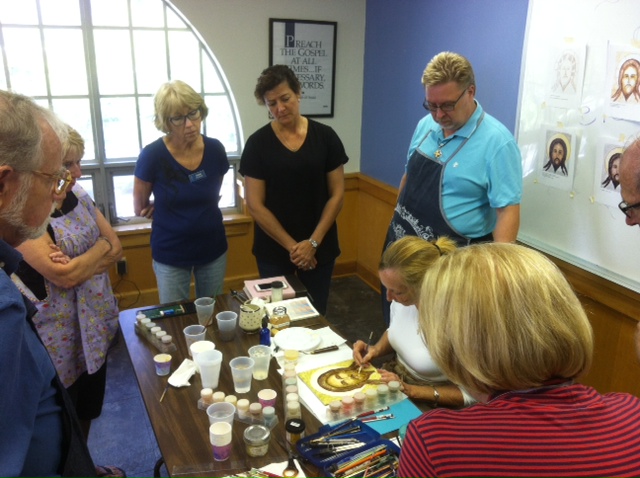
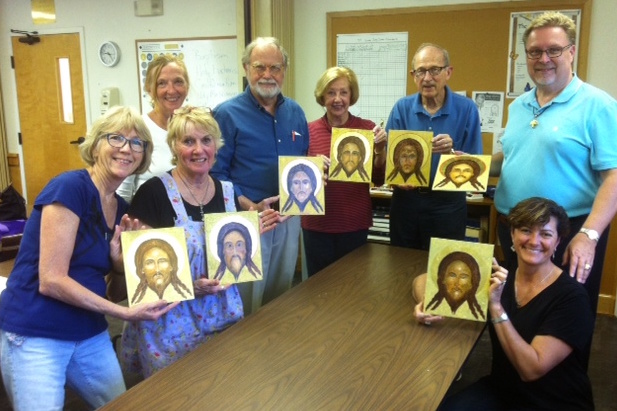
While in Icon classes we need to teach the principles of imagery research, drawing, composition, and paint application, the spiritual life is also an important part of the process. The recent Icon retreat I taught at Holy Cross Monastery was a wonderful time of combining both as we entered into the prayer rhythm of the Monks and ate our meals and prayed with regularity and holy community as well as creating beautiful Icons of the face of our Savior.
I think everyone went away deeply happy, rested, and with their own Icon of Christ to complete the Lenten process of prayer and fasting.
Holy Cross Icon writing class with Christine Hales group photo
Anne Marie Prono, Architect and Iconographer, was in the Holy Cross class and shared with me an article about how she brought Icons to children in Queens.
The above link is a new post by Iconographer Deacon Paul O. Iacono that is very worth reading, in that its intention is to articulate some of the principles inherent in creating sacred art.
This month I am so grateful and happy that CIVA- Christians in the Visual Arts, published a piece I wrote about Icons entitled “American Iconography”. Hope you like it!
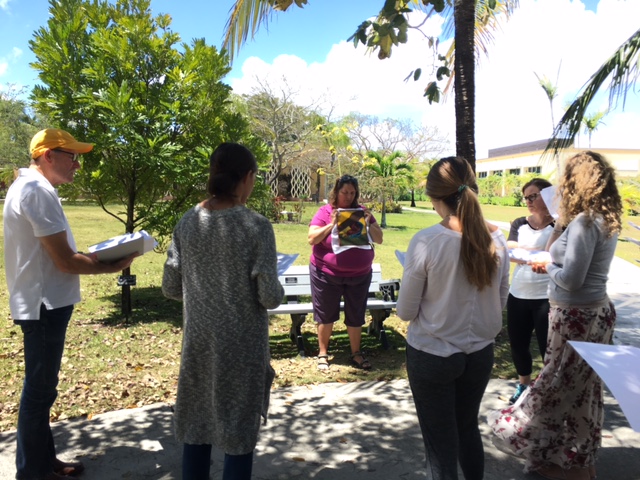
This month, I have given two Icon writing retreats one in Sarasota,Florida, and one in Holy Cross Monastery, West Park, NY, photos follow:
Icon class Sarasota
And here is the Sarasota Church of the Redeemer new Iconographers :
Church of the Redeemer, Sarasota, Iconographers
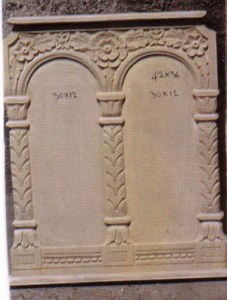
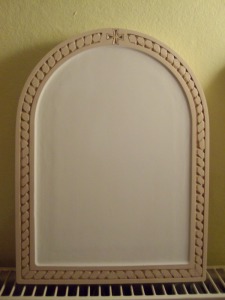
Two last notes: Miroslav, an Icon board preparer in Serbia has reached out to me regarding receiving orders for Icon boards. His prices seem competitive, even with shipping, and I will be sending him an order in the next week or so. Here are some photos of his work, and he also does just gessoed panels in regular sizes, so let me know if any of you are interested in ordering one of his boards.
Miroslav Icon Boardsicon boards by Miroslav
Last, but not least, I will be teaching an Icon writing class at Morningstar Renewal Center in Miami Florida, April 13-15 for Holy week with a special presentation on Good Friday with Stations of the Cross Icons in the garden. Please join us if you can.
Sending you all prayers for a Holy Easter and joy in Icon writing,














 American Association of Iconographers