Making Pigments, A Fine Summer Project!

Lately I’ve become very excited about making some of my own pigments. It all started with my discovery of a book written by Ellie Irons “Feral Hues”, A Guide to Painting with Weeds. It’s a lovely book, packed with examples, color samples, pigment charts and insights into gathering, experiencing, and creating pigments from weeds, or common plant that currently grow in the Hudson Valley- my former home. https://www.publicationstudio.biz/books/feral-hues-a-guide-to-painting-with-weeds/

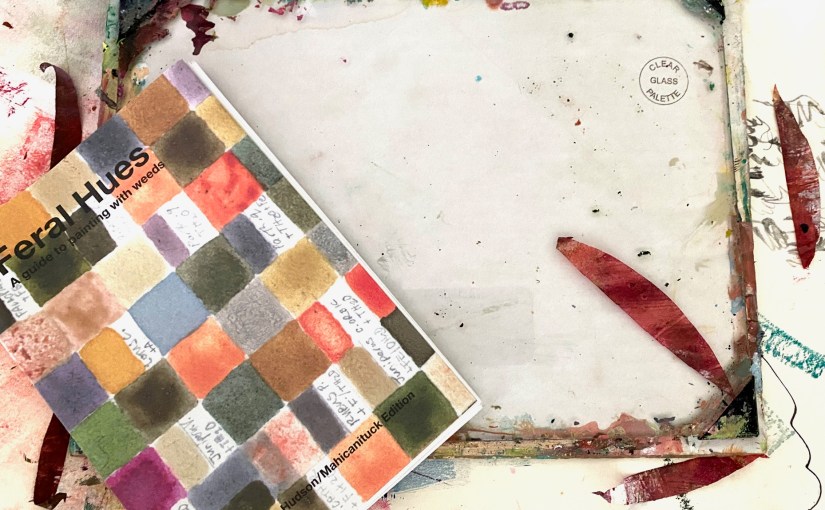
The Feral Hues Book on My Studio Table

The colors are so delicate and resonate with a natural authenticity that I realized I wanted to include something like this in my icon writing practice.  I often enjoy experimenting and incorporating new techniques in my painting practice and this idea of connecting more with the natural world around me seems like a new facet of praying and painting. It’s inspiring to engage with nature and makes me happy to think of how this duplicates artist practices from the ancient world.

So I have done some research, which I provide here, along with some links to YouTube videos demonstrating different approaches to pigment making from natural sources to maybe inspire you to collect some natural materials from your environment this summer to incorporate in your icons or icon sketches.  I would love it if any of you make your own pigments, or just experiment with doing so, would send photos and descriptions to me and I will post them all at the end of summer!

The Historical Context of Icon Pigments

The making of pigments for icons is deeply rooted in tradition. Orthodox Christian iconographers of the Byzantine and Russian schools, for instance, inherited their pigment recipes and with these traditions, making pigments is not merely a technical exercise—it is experienced as a sacred act, performed with prayer and reverence.

Early iconographers relied on the natural world to supply their colorants: minerals, plants, earths, and even insects. Over time, as trade routes expanded, so too did the palette, with rare minerals and exotic substances making their way into the hands of skilled artisans.

Today, we can enjoy the sense of connection with nature, authenticity and spiritual resonance inherent in the process.  But first, a short video to define qualities and properties of different pigments.

Raw Materials: The Source of Color

Pigments for icons originate from a remarkable array of materials, each with its own story:

  • Minerals: Lapis lazuli (yielding ultramarine blue), malachite (green), cinnabar (vermilion red), and ochres (yellows, reds, browns) are classic examples. These minerals are prized for their intensity, permanence, and rich symbolism.
  • Earth Pigments: Natural earths provide warm tones, such as siennas and umbers. Their subtlety and stability are essential for creating flesh tones and backgrounds.
  • Plant and Animal Sources: While less common, certain reds (like carmine) are derived from insects, and greens can be obtained from plant extracts. However, these tend to be less stable over time.

The Process of Making Pigments

Pigment-making is a precise and often labor-intensive process, requiring patience and a thorough understanding of both material and method. Let us walk through the general stages:

1. Sourcing and Preparing Raw Materials

Sourcing is the first challenge. Authentic pigments demand high-quality, uncontaminated raw materials. Stones must be carefully selected for color and purity. Once acquired, the raw material—be it a mineral or earth—is cleaned of any impurities. For stones, this can involve washing, sorting, and initial crushing.

2. Grinding and Levigation

The heart of pigment-making lies in the grinding. The raw material is broken down, traditionally using a mortar and pestle, into ever finer particles. This step is crucial: the fineness of the pigment determines its brilliance, texture, and how it mixes with the binder.

Levigation follows: the ground material is suspended in water, and the heavier, coarser particles are allowed to settle while the finer, more suitable material remains in suspension. This is then collected, dried, and stored.

3. Washing and Purification

Some pigments require further washing to remove soluble salts or other contaminants that could affect long-term stability. For certain minerals, repeated washing and filtering are essential to preserve both color and integrity.

4. Testing for Quality

Not all ground minerals make suitable pigments. Quality tests—rubbing a small amount onto a glazed tile, exposing it to light, mixing it with a test binder—help the iconographer judge hue, granulation, opacity, and permanence.

Spiritual and Symbolic Dimensions

For the iconographer, making pigments is more than craft; it is a spiritual discipline. Every act—from choosing the finest lapis lazuli or malachite to breaking and grinding local river stones is done prayerfully, often accompanied by the recitation of psalms or other devotions. In the tradition, the humility demanded by such painstaking labor is itself a form of worship, aligning the artist with the saints and ancestors who have gone before.

Making Pigments From Flowers

Color holds profound symbolic meaning in the icon. Gold, for example, does not symbolize worldly wealth, but rather the uncreated light of God. Red conveys divine life and resurrection; blue, mystery and transcendence; green, renewal. The careful selection and preparation of each pigment ensures the icon communicates not just beauty, but theological truth.

Challenges and Considerations in Modern Practice

While modern chemistry offers synthetic pigments of impressive intensity and consistency, many iconographers still prefer natural pigments for their authenticity and spiritual resonance. However, challenges abound:

  • Availability: Some minerals, like true lapis lazuli, are rare and expensive.
  • Ethical Sourcing: Ensuring that materials are procured responsibly and sustainably is increasingly important.
  • Health and Safety: Some traditional pigments, such as lead white or cinnabar, are toxic. Proper protective measures are essential.
  • Conservation: Icons must be made with materials that will endure, and so a careful balance between tradition and innovation is often sought.

Conclusion

The making of pigments for icons is a testament to the union of art, science, and faith. It is a craft that honors the natural world, reveres tradition, and aspires toward the sacred. In every grain of crushed stone, in every brushstroke of egg tempera, lies a profound continuity with the past—a legacy of devotion and excellence. Obviously, if we are painting with egg tempera, then egg will be our binder. But if you read some of the comments, there are other natural binders as well.

For those who practice the art of icon writing, making pigments can be a transformative journey. It is an invitation to slow down, to engage deeply with one’s materials, and to approach the act of creation as a form of prayer. In honoring the old ways, iconographers not only preserve a heritage, but also manifest, through color and light, the inexpressible mysteries of the spirit.
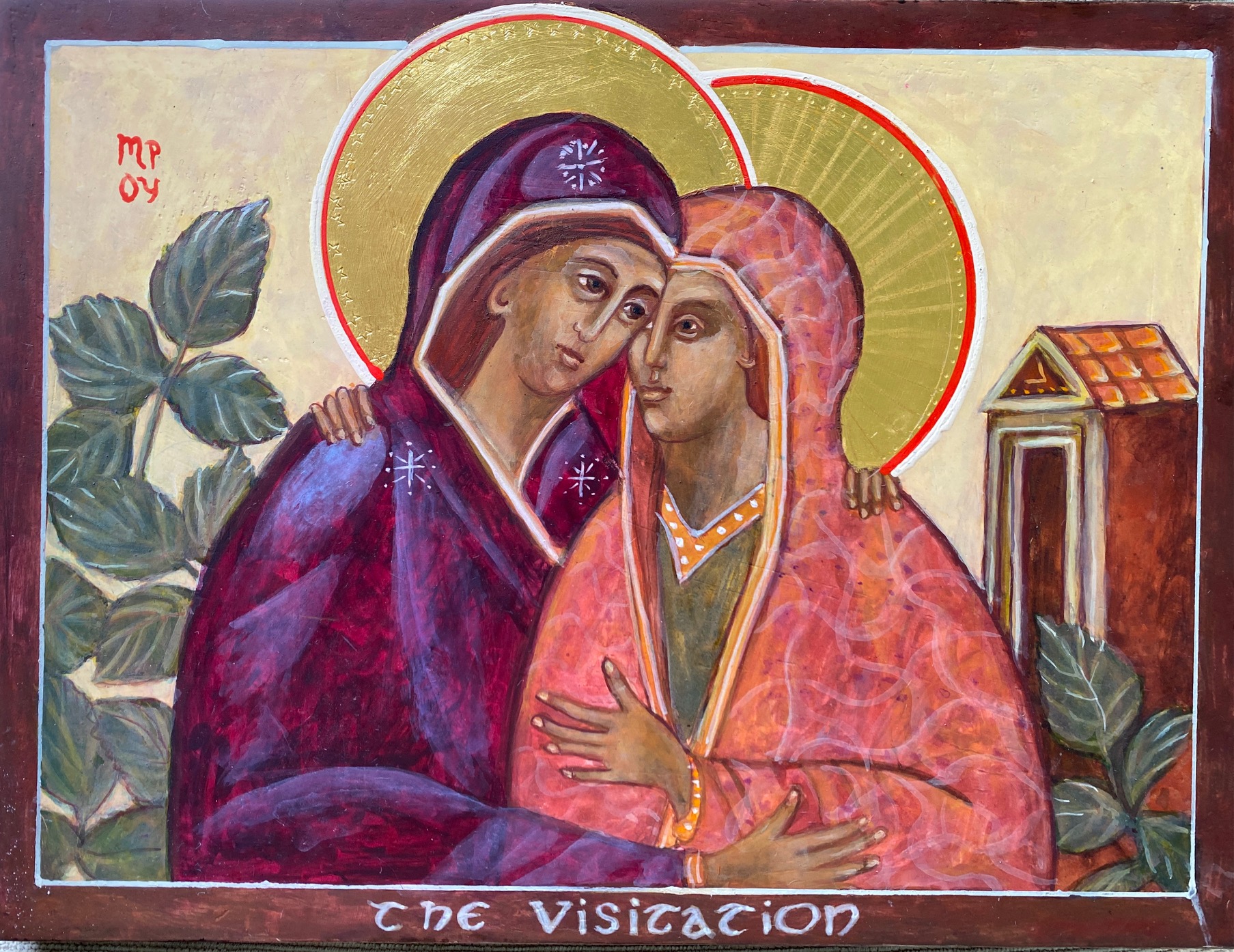
One of my new Icons, “The Visitation”. Christine Hales

I hope that you are enjoying reading this blog and invite those who have an interesting article or review that would contribute to iconography practice to email those to me for possible inclusion in future blogs.

May God continue to bless the work of your hands,

And may the grace of our Lord Jesus Christ, and the love of God, and the fellowship of the Holy Spirit be with us all forever.

Christine

Christine Simoneau Hales

Interesting Links for Iconographers:

These links were provided by Dorothy Alexander, an Iconographer and friend from California:

Here are most of my links:

LINKS For  Christine Simoneau Hales   2025

  1. https://newchristianicions.com   my main website
  2. Https://christinehalesicons.com  Prints of my Icons
  3. https://online.iconwritingclasses.com  my online pre-recorded icon writing classes
  4. https://www.youtube.com/channel/UCK2WoRDiPivGtz2aw61FQXA  My YouTube Channel
  5. Facebook: https://www.facebook.com/ChristineHalesFineArt     or  https://www.facebook.com/NewChristianIcons/
  6. Instagram:   https://www.instagram.com/christinehalesicons/?hl=en
  7. American Association of Iconographers:  FB Group:  https://www.facebook.com/groups/371054416651983

American Association of Iconographers Website: https://americanassociationoficonographers.com

Iconoclasm

Iconoclasm in Church Art (600-1000)

Image from Class Chuludov Psalter, 9th Century, scene of Iconoclasm

Key Issues of Iconoclasm

Iconoclasm, the destruction or rejection of religious images, was a major controversy that profoundly impacted the Byzantine Empire from the 7th to the 9th centuries. The debate centered around the Second Commandment, which forbids idolatry, raising the question of whether holy images competed with God or enhanced Christians’ experience and knowledge of God. This controversy tore apart the Byzantine Empire, pitting the iconodules, who venerated icons as a logical progression of Christian art, against the iconoclasts, who believed that any image in a church was idolatry.

The East-West Divide

Sts. Theodore of Amasea and George conquering their enemies; 9th century, Mt. Sinai

In the Western Christian church, where Latin had become the church’s language, the Greek distinction between latria(worship for only God) and dulia (a lesser form of veneration) was not easily understood or accepted. Eventually, however, the Western church allowed images for veneration. Despite sharing one Christian faith, Latin Christendom and Byzantium developed distinct spiritual, intellectual, and institutional traditions, shaping cultural identities that persist today as two distinct divisions of the Church.

Byzantium Under Justinian and Theodora

Theodora, Mosaic, 9th century

In Byzantium, the Emperor Justinian (527-565 AD) and his wife Theodora implemented caesaropapism, ensuring that the emperor controlled both political and religious affairs. This mosaic shows Empress Theodora holding a chalice, with figures standing frontally and almost floating in space, signifying a stylistic break from the Greco-Roman tradition. This new style was associated with the divine world, rather than the naturalistic world. Theodora was murdered for opposing the removal of the Jesus icon on the Chalke Gate of the Great Palace of Constantinople during the iconoclasm movement.

The Iconoclast Controversy

Christ Mosaic, Hagia Sophia

According to traditional accounts, Iconoclasm began when Emperor Leo III removed an icon of Christ from the Chalke Gate of the imperial palace in Constantinople in 726 or 730, sparking widespread destruction of images and persecution of their defenders. In the East, Caliph Yazid issued a decree in 723 banning all holy images in Christian churches. In the West, Emperor Leo banned icons in all public places in 726. Pope Gregory III responded in 731, excommunicating those who denied the sanctity of icons or violated sacred images.

Opposition and Resolution

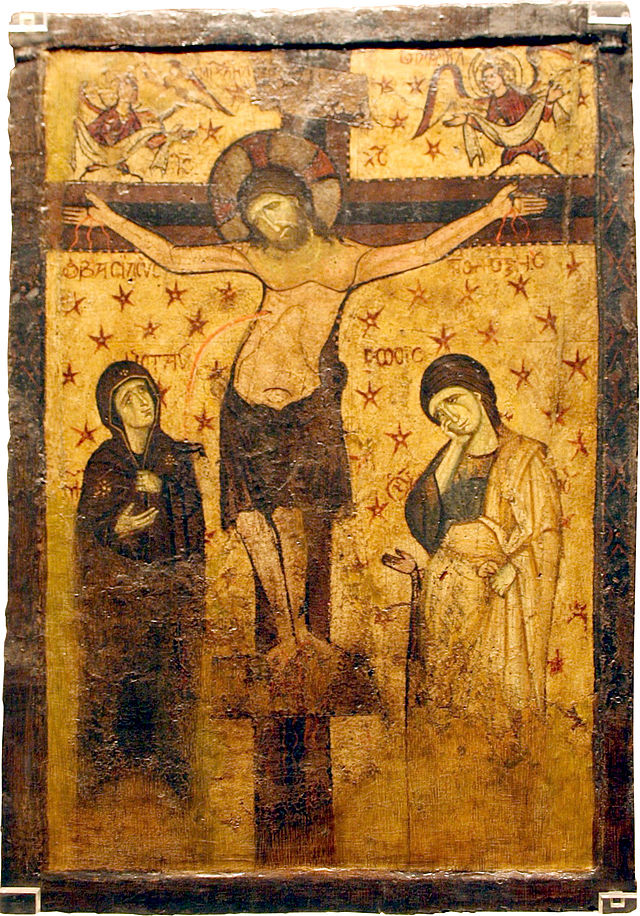
Crucifixion, Byzantine Museum, Athens. Circa 9-13th centuries.

St. Theodore the Studite (b. 759, Constantinople) was a leading opponent of iconoclasm, which disturbed relations between the Byzantine and Roman churches. The period of iconoclasm lasted until 797, with proponents of icons like Saint John of Damascus and the edicts of the Seventh Ecumenical Council supporting the veneration of icons. John of Damascus, an Arab Christian monk and theological doctor, was a prominent figure in the 8th-century Iconoclastic Controversy.

Cultural Impact and the Great Schism

Byzantine Iconoclasm, initiated by Emperor Leo III and continued by his successors, included widespread destruction of religious images and persecution of supporters. The period saw growing divergence and tension between the East and West, though the Church remained unified. The Western Church supported the use of religious images, while the Eastern Church was more divided.

Seventh Ecumenical Council Icon

The Great Schism of 1054 was caused by doctrinal differences, the rejection of universal Papal authority by Eastern patriarchs, and sociopolitical differences. This schism created lasting divisions that affect the study and practice of iconography today.

Modern Perspectives on Iconography

Iconoclasm, Clasm Chuldov Psalter, 9th Century

Today, a schism still exists between Western and Eastern iconographers regarding the nature and purpose of icons. Former Archbishop of Canterbury, Lord Rowan Williams, explained the significance of icons in his talk “Idol, Image, and Icon.” He described an idol as an empty illusion, whereas an image bridges the gap between absence and presence. Icons, made and used in prayer, open us up to God and embody the tension between divine presence and absence. They challenge and transform the viewer, claiming our attention and inviting us to experience the sacred.

Conclusion

Iconoclasm was a pivotal controversy in the history of the Byzantine Empire and the Christian Church, shaping the development of religious art and theological thought. Its legacy continues to influence the study and practice of iconography today, highlighting the enduring tension between tradition and innovation in religious expression.

I’m hoping to achieve Peace in our lifetime, with all those who call themselves Christians actively spreading the Doctrine of brotherly love to all of our neighbors.

INTERESTING LINKS:

Lord Rowan Williams, former Archbishop of Canterbury, Lecture at Birmingham University: Idols, Images, and Icons.

Wax Tempera and Modern Icons

May God continue to bless the eyes of your hearts with His love, until next month,

Christine Simoneau Hales, New Christian Icons

Upcoming Icon Painting Classes

A Christmas Journey

A Christmas Journey: Lessons from the Nativity Icon

As we joyfully concluded my latest icon writing class, the crowning achievement was a breathtaking depiction of the Nativity. Beyond the demonstrations and questions, the process became a conduit for spiritual revelations about the Nativity Icon during our retreat. The shared exchange of thoughts and questions revealed the profound spiritual wisdom residing within each class member. I am so grateful for the divine synchronicity that brings such beautiful souls into my classes, contributing to a shared journey of growth and revelation in the span of just four days.

In the spirit of post-retreat reflection, my thoughts turned to the iconic journey of the three wise men. Weary yet resolute, they traversed long and perilous roads, guided only by a celestial star lighting their way to Jerusalem. Their journey, fraught with challenges, reached its culmination under the brilliant radiance of the star directly above, revealing the long-promised redemption in the form of a humble baby nestled in a manger. This divine encounter brought the wise men to their knees in worship and adoration before the embodiment of God’s power and glory.

The resonance between the wise men’s Christmas journey and our own spiritual quests is striking. As we usher in the festivities of 2024, I pray that we may emulate the wise men, offering our heartfelt praise and worship in response to the wonder of the incarnation.

Drawing inspiration from Sarah Young’s “Jesus Calling” (pg. 372), let our perseverance along God’s ordained path be sustained by His strength. Miracles, though not always visible to the naked eye, become apparent to those who live by faith. As we navigate our individual paths, let us watch and wait, expecting miracles and acknowledging that living by faith grants us the clarity to witness divine interventions.

The Nativity Icon by Christine Hales

In this festive season, my heartfelt Christmas prayer for you is to embrace the faith-driven approach of the three wise kings. May your Christmas be filled with the warmth of faith rather than mere sight, positioning you to experience the unfolding glory and power of God in your life. As 2024 unfolds like a gift waiting to be unwrapped, may you draw nearer to Him than ever before, embracing the Christmas spirit with anticipation and receptivity. May your Christmas be blessed with joy, peace, and the wonder of His love.

Christine Hales. Artist, Iconographer

My Website

My Next Online Icon Writing Retreat is April 9-12, 2024

Nativity Icon

You might wonder, why an article on the Nativity icon in October? It seems to me that the element of joy is mightily endangered these days with all the news of climate change disasters, war, etc.  And joy is one of the strongest defenses we have against the spiritual forces of this dark world.  “The joy of the Lord is my strength.”  Nehemiah 8:10  Also, The Nativity icon is a marvelous example of the way icons make Holy Scripture visible in iconographic form.

The Feast of the Nativity of Jesus is one of the most joyful days of the Orthodox Church. It ranks right next to the greatest holiday, the Resurrection of Jesus. The Feast of the Birth of Jesus is also known as the “Incarnation of Christ”, God taking on human form out of His immeasurable love for us. We also call this joyous feast Christmas, so, in preparation, here is the Nativity Icon explained:

“And this shall be a sign unto you; Ye shall find the babe wrapped in swaddling clothes, lying in a manger.” Luke 2:12

Icon of the Nativity

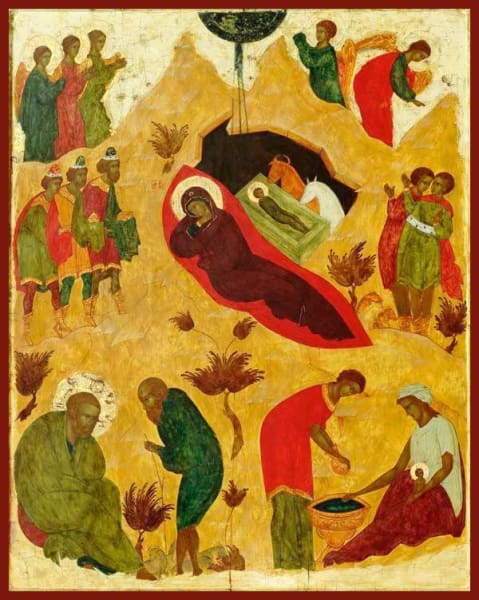
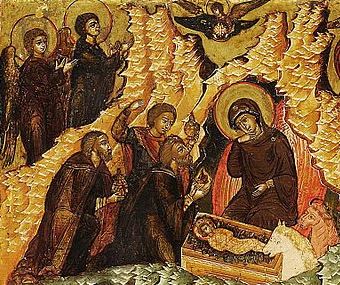
The icon of the Nativity tells the story of Christ’s birth as relayed through the Holy Scriptures. It also shows that all creation is taking part in Christ’s birth. As God gave His only Son to us, the angels give thanks with their song; the heavens give the star; the Wise Men give their gifts of gold, frankincense, and myrrh,the poor, humble shepherds give their praise and amazement, the earth gives the cave, and humanity gives the Virgin.

“In its content the icon of Christ’s nativity has two fundamental aspects: first of all, it discloses the very essence of the event, the immutable fact of the incarnation of God; it places us before a visible testimony of the fundamental dogma of the Christian faith, underlining by it’s details both the Divinity and the human nature of the Word made flesh. Secondly, the icon of the nativity shows us the effect of this event on the natural life of this world.”   L. Ouspensky, “The Meaning of Icons”

The Story of Birth of Christ Made Visible

The Holy Icon of the Nativity reminds one to praise and glorify the Birth of Christ. The celebration of Christmas each year serves to remind each and everyone of us of the joyful news that Christ came for you and me.

“The traditional Orthodox icon of the Nativity tells us what the Bible tells us, and does so in a very clear, vivid, effective manner, by means of forms and colors. “Ouspensky

The story of the Nativity of Christ is beautifully told in the Holy Scriptures. The story is found in Matthew 1:18-25 and in Luke 2:1-20. No matter how often the Birth of Jesus is told, we can experience the wonder of it anew through the responses of the angels, shepherds, and wise men in this icon.

A Timeless Story

Mary and Joseph, who were expecting a baby, travelled to Bethlehem to register for the census. Since there was no room at the inn, Joseph found a cave-like place where they could rest. This place was used by shepherds to protect their sheep in stormy weather. It was here that Mary gave birth to Jesus. The baby was wrapped in swaddling clothes and laid in the straw in the manger.

Opposite the Wise Men is the scene are the humble shepherds with whom heaven enters into direct communication, amid their everyday working life.  An angel proclaims the glad tidings. A young shepherd plays a reed instrument. This scene reveals that the music of the humans was added to the hymn of the angels. Above the shepherds is the heavenly choir of angels. They are giving glory to God. The angels serve two purposes in the Nativity of Christ. They give glory to God and announce the good news to all mankind.

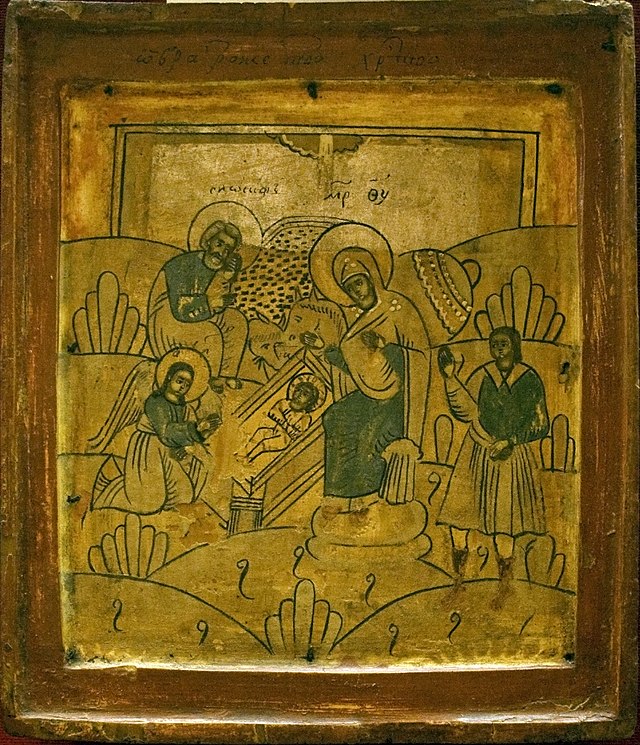
Birth of Christ, 18th Century, Russian Icon

That night the shepherds were out in the fields guarding their sheep. Suddenly, there was a bright light which startled the shepherds. The light was so bright that it turned the night into daylight. An angel appeared and said:

“Fear not for behold, I bring you good tidings of great joy, which shall be to all people. For unto you is born this day in the city of David a Savior; which is Christ the Lord. And this shall be a sign unto you: You shall find the babe wrapped in swaddling clothes, lying in a manger” (Luke 2:11-12).

Angels Praising This Wondrous Event

Then a larger group of angels appeared praising and glorifying God in their songs, “Glory to God in the highest, and on earth peace, and good will toward men” (Luke 2:14). The angels came to glorify God and also to bring glad tidings to men. The shepherds were awed. They didn’t know what to do, but they listened to the angels’ message. They decided to leave their flocks of sheep and go to Bethlehem to see for themselves what the angels had told them. When they got to Bethlehem, they found Mary, Joseph, and the infant Jesus. They fell to their knees and adored Jesus.

“Kings of Distant Lands Will Come”~ Psalm 72:10

On the other side, the Wise Men came from the East for they knew of the coming of Jesus. They had seen a star that told them that a new king had been born to the Jews.  A long ray from this star symbolizes heaven and points directly to the cave and the child they were looking for. The Star led them to Jesus and Mary where they fell down on their knees and worshipped Him. They gave Jesus gifts of gold, frankincense, and myrrh. 

“A virgin shall conceive and bear a son, and they shall call his name Emmanuel.” (Isaiah 7:14)

“For unto us a Child is born, Unto us a Son is given; And the government will be upon His shoulder. And His name will be called Wonderful, Counselor, Mighty God, Everlasting Father, Prince of Peace.” (Isaiah 9:6)

Russian Postage Stamp, 1995

This Holy Icon is an icon with many scenes. First, it stresses the importance of the Theotokos, the Mother of Jesus, who is placed in the center of the icon, and is the largest figure in the icon. In this icon, she is reclining with crossed arms. The Christ Child, just above her in the center of the icon, is in swaddling clothes and is lying in the manger. In the background is the dark cave where He was born. In the cave are an ox and a donkey guarding the newborn Babe. Even though the Gospels say nothing of the cave, this information is from Holy Tradition. Neither do the Gospels speak of the ox and the donkey, but all icons of the Nativity include these animals. Including the animals in the icon fulfills the prophecy of Isaiah 1:3, “The ox knows his master, and the donkey his master’s crib; but Israel does not know me, and the people have not regarded me.” The long ray of light from the star points directly to the cave. This ray comes from the star and travels to all parts of the world. It teaches that this bright star was not only an astronomical happening, it was a messenger from heaven announcing the birth of Jesus.

Icon Details

On the upper left hand side of the icon are the angels. The Wise Men, just below them, who were led by the star, bring their gifts of gold, frankincense, and myrrh to Jesus. These Wise Men, men of learning, have to accomplish a long journey to see the miracle from heaven, and they are of various ages.

One is without a beard. In those days, young men did not wear beards. The other Wise Man has long hair and a long beard, which indicates that he is much older. These details teach that regardless of age and appearance, the Good News was given to each and everyone.

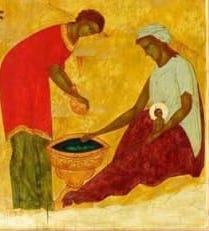
In the lower part of the icon are two more scenes. In the right hand corner are the two women Joseph brought to take care of the Christ child. They are bathing Him just as any baby is bathed. The humanity of Jesus is clearly shown in this setting.

Opposite the bathing of Jesus scene sits a sad and worried Joseph. He is not part of the central group of the Christ Child and the Theotokos, and is not the natural father, but the betrothed of Mary. As Joseph sits troubled by doubts, the devil, disguised as an old man, is tempting Joseph to doubt the virgin birth. Satan is telling Joseph that virgin birth is impossible. He’s telling Joseph that he’s a fool if he believes this. This story comes to us from Holy Tradition. The sad Joseph shows us not only his personal predicament but the dilemma of all mankind the difficulty of accepting that which is “beyond words or reason.”

The tree, which is in the middle of the lower part of the icon, is a symbol of the Tree of Jesse. This tree refers to Isaiah 11:1-2, “But a shoot shall sprout from the stump of Jesse, and from his roots a bud shall blossom. The spirit of the Lord shall rest upon Him.” King David was often mentioned as the son of Jesse and Jesus was from the House of David.

The Holy Icon of the Nativity reminds one to praise and glorify the Birth of Christ. The celebration of Christmas each year serves to remind each and every one of us that Christ came for you and me. And that’s the Good News!

“The Lord is my strength and my shield; my heart trusts in him, and he helps me. My hear leaps for joy, and with my song I praise him.”  Psalm 28:7

Online Advent Icon Writing Class, Egg Tempera and Gold Leaf

I’ll be teaching an Advent Online Icon Writing Class, December 5-8, 2023 on Zoom https://online.iconwritingclasses.com/courses/nativity-icon-Dec-5-8-2023-on-zoom   It will be a wonderful opportunity to pray and write icons to honor Christmas. Hope you can join us.

Blessings and prayers,

Christine Simoneau Hales. New Christian Icons

Icons as Visio Divina

Hello Fellow Iconographers:

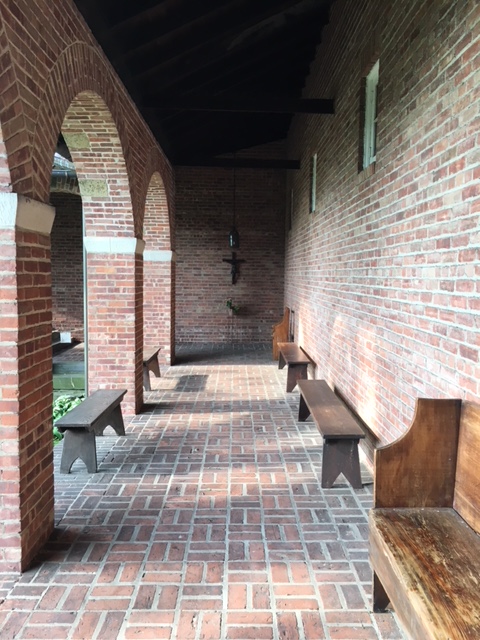
Cloister holy Cross Monastery, West Park, NY
Cloister Holy Cross Monastery, West Park, NY

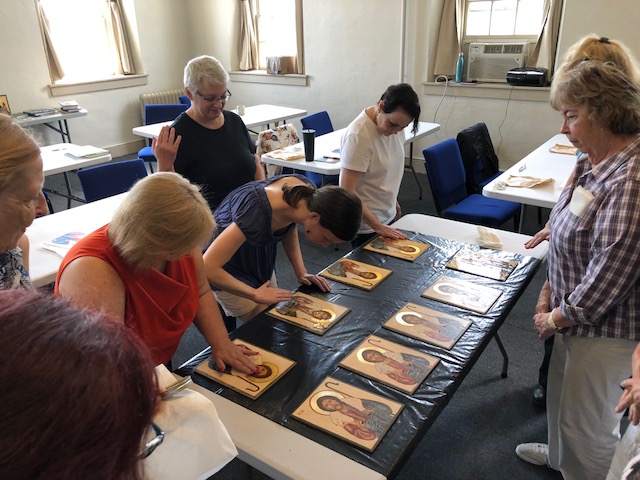
This month, teaching the “Color and Light in Icons” class at the Holy Cross Monastery in West Park, NY was truly a Holy experience. With such a beautiful monastery, warm and gracious hospitality of Abbot Bernard and all the Brothers, and wonderful people enrolled in the class, how could it not be amazing?

We painted the icon of the Good Shepherd and read aloud Psalm 23 and meditated on it day and night, while writing the icon.

Sine icons are theology in picture form, there is a deep relationship between Holy Scripture and the icon.  The icon is the symbolic picture that the words of scripture describe, enhanced by the prayers and love of God the iconographer brings to the process.

Russian icons, Icon painting retreat, modern icons
Putting the olifa on the finished icon

Through the act of creation we enter into a relationship with God the creator that is enhanced with the addition of His word in Holy Scripture. The resulting icon from this co- creative process becomes a vessel containing God’s presence through His imagery and the iconographer’s prayers.

Good Shepherd Icon, Icon Painting Class, Byzantine icon
Good Shepherd Icon, Icon Painting Class

Meditating on Scripture, and/or on the life of the saint being depicted in the icon is of primary importance in icon writing.  It’s important to make oneself ready to receive divine revelation and then translate that into the painting process with the icon.

Holy Cross Monastery, icon painting retreat, Christine Hales
He makes me to lie down in green pastures, He leads me beside the still waters, He restores my soul… Holy Cross Monastery 2018

In teaching icon writing/painting classes, I like to emphasize our shared Christian faith that is being made visible in the revelation and shared spiritual knowledge that is being made available through the process of icon writing. Each student has their own unique conversation with God during the icon writing process, and sharing that communion with others in the class increases the level of revelation available to the group as a whole.  We have a strong belief in the intrinsic value of the icons being created and understand that they affect both the maker and the viewer.  Icon writing is a powerful ministry!

Icon retreat with Christine Hales at Holy Cross Monastery 2018

Membership in the American Association of Iconographers

Membership in the American Association of Iconographers is now open to all iconographers who have a sincere desire to “spread the joy icons throughout the world”.

Email Christine with your name, website and any additional information. Volunteers to help by being on the steering committee are appreciated.

Blessings,

Christine Hales

Icons