Are you an Icon collector? Collecting Icons is similar to collecting fine art in that the beauty is often times in the eye of the beholder. Icons carry meaning in addition to the esthetics we expect from visual art. That meaning, or content, might relate on a very personal level to the viewer and thus have a high degree of value, regardless of the aesthetic qualities. For example, an Icon of Saint Luke will resonate with artists, Iconographers, physicians, and bachelors because Saint Luke is their patron saint. Icons have the ability to enhance our prayer life as we venerate the saints depicted.
St. Luke Icon by Christine Hales
Venerating Icons
We use the word venerate to talk about our interactions with Icons. To venerate means to cherish, honor, exalt, be in awe of, appreciate and reverence. In old Russia, during times of religious persecution, people who could afford it would create a beautiful corner in their homes, or a small chapel. This would hold the Icons that this family particularly revered and understood as important parts of their family prayer lives.
Icons can deepen our prayer life with specific, focused prayer.
Icons can enhance our connection to the God we adore through specific, focused prayer. Therefore, collecting Icons is a means of keeping our vision on God’s Kingdom in our homes, and sharing that with our families and friends.
Collecting Icons from Antiquity
Another aspect of collecting Icons is that of finding Icons from earlier centuries that have added value because of their age and provenance. One of the foremost Icon Galleries for ancient Icons is the Temple Gallery in London, UK. It was founded in 1959 as a center for study, restoration and exhibition of ancient Icons and sacred art. With ancient Icons, their monetary value rises in accordance with their condition, provenance, size, and age.
People often ask about the value about the icons they have discovered in their travels or have had handed down in their families. TheMuseum of Russian Icons, in Clinton, Massachusetts, will do Icon evaluations on certain dates. They will also provide conservation and appraisal services upon request. The museum has a beautiful permanent collection as well as changing exhibitions.
A Living Traditon
Nativity Icon Melissotopos Olishta 19 Century
Iconography is a living tradition, bringing the elements of the Christian faith to believers through the centuries. Icons are often painted in the same way that they have been for hundreds of years. And, as a living Tradition, Icons painted today are bringing along the traditions of the past and marrying them to contemporary faith and art practices. Truly it is an exciting time to be collecting Icons!
May God bless your Icon creating and collecting especially this Advent Season!
Teaching Icon classes as I do in monasteries, churches and art centers, the question that always arises at the end of class: How can I continue with Icon painting? Practice is what I always say. For that reason, this month’s blog for the American Association of Iconographers is a collection of information and links to help with further studies.
Ideally, someone who is learning to write Icons will choose a style or a teacher which whom to study. But even with that, one can only realistically take one or two workshops per year. What to do in the meantime? Here are my suggestions:
Practice
Using sketch paper and pencil, draw as much as possible. Copy Icons from books, prints, or the internet. Drawing is the number one art skill needed in Icon writing, as it is in all painting. Learning to think on paper is a valuable skill. A book that I recommend to beginners is: Drawing on the Right Side of the Brain by Betty Edwards. You can copy Icons in some of her exercises and you will be surprised at how quickly your drawing will improve.
Raising of Lazarus Icon Sketch in Black and White. Christine Hales
Sketch of Icon
Tonal sketch of Icon
Icon to be copied
Simplified Palette
Use watercolor paper and the four basic color of Icon writing: red ochre, black, white and yellow ochre. Make color and tonal studies of Icons on water color paper. Again, this simple practice will yield large results.
John the Baptist watercolor sketch Christine Hales
Icon Retreats and Workshops
For those who choose to study with me, here is a link to upcoming classes. My teaching method is always evolving and inspired by my prayer life. I particularly enjoy helping students who have had some experience writing Icons and now want to create their own Icon (still copied from before the Renaissance). If you do sign up for one of my classes and wish to do this, please email me well before the class date so that we can prepare you for getting the most out of the retreat.
Resources for viewing Iconographic Imagery
Kolomenskaya Versta is a site selling Icon books and materials. It is based in Russia and they regularly post free images to copy as well as links to all kinds of Iconographic information. Also known as Russian Modern Orthodox Icon, here is a link to their FB page.
A beautiful FB page with many good examples of Byzantine Icons- Byzantine Art
Museum of Russian Icons, 203 Union Street, Clinton, Mass. There is an exhibition of Prosopon Icons currently in addition to their permanent collection.
Jacob Wrestling with the Angel, Nikita Andreiv
Resources for Icon Materials
Natural Pigments They have pigments, red clay, gold leaf adhesives, brushes, etc..
Kremer Pigments has a shop in NYC but you can also order on linear an immense array of pigment choices and other materials like stand oil, linseed oil, etc.
East X West online Icon Course with Sr. Petra offers many video tutorials and a thorough grounding in Iconographic history, drawing and painting.
That’s all for this month. Please let me know if this has helped you, and I wish you peace and joy in spreading the beauty of Icons throughout the world!
This month I am recommending two articles that have been published in an on-line journal- The Orthodox Arts Journal– as elements contributing to good training for Iconographers. As I go around the country teaching an “Introduction to Icon Writing Class”, I am aware of how little knowledge people in general have about Icon painting. It is impossible to gain enough knowledge of this art from a few classes to be able to make truly authentic Icons. I recommend two things: look at as much art and as many Icons as you possibly can. Books, online resources, museums, all of these will help your painting to become mature as you practice what you see. The second thing I recommend is to read as much as you can about the history as well as the technique of Icon writing. Both of these activities go hand in hand with taking workshops and practicing at home.
Two Articles for Iconographers in Training.
First Article
Mustard Seed Manual of Painting
The first article is written by English Iconographer Aidan Hart and it is entitled, ” The Mustard Seed Garden Manual of Painting,: A Chinese Painting Manual Offers Inspiration to Iconographers.” This article contains quotes from the Chinese manual as well as comments by Aidan Hart as to their usefulness for Iconographers. It is quite a beautiful and clear article that speaks to some of the nuances of Icon painting. Here is a quote from that article. The italics are quotes from the manual, and the regular text is Aidan Hart’s commentary:
“You must learn first to observe the rules faithfully; afterwards, modify them according to your intelligence and capacity. The end of all method is to seem to have no method. (17)
When we learn a second language, we consciously study its rules of grammar and learn its norms. But as we gain knowledge and confidence, we find our own voice. Iconography should be the same.
I have heard it said by some Orthodox thinkers that iconography is not art. I disagree. The icon is indeed more than art because it is part of the liturgy and exists for more than aesthetic delectation. But it is at least art. Although the icon’s sacred purpose means that its aesthetic categories are more extensive than those of secular art, it should nonetheless include them. The same universal colour theories and composition principles apply.”
One more quote:
“If you aim to dispense with method, learn method. If you aim at facility, work hard. If you aim for simplicity, master complexity.(19)
Hard work is the only path to the authentic abstraction. In the years that I have taught iconography I have found that drapery is the most common stumbling block for learners. Prolonged and analytical study is required to understand the drapery that the icon tradition abstracts. Drapery’s complexity needs to be mastered in order to make sense of its simplification, otherwise it becomes irrational, not supra-rational. Lines need to be understood as horizons of forms and not strings hanging in space.
The Second article is written by Anton Daineko “The Living Icon”, also published in the Orthodox Arts Journal. In this article, Anton grapples with the issue of what is the criterion used to make authentic Icons? This is not a simple or easy question to answer. He cites examples of Iconographers from the past such as Andrei Rublev, Hilandar and Panselinos in order to visually show the necessary qualities of good Icons.
In this article, he also speaks about the importance of the Iconographer’s direct experience, through prayer, with God.
“The Criterion
Commenting on copying in iconography, Father Igor, a priest from Minsk and himself an icon painter, noted that “There are no icon copies; each icon is a REVELATION”. Naturally, this raises questions: is it even possible to define such a delicate matter as REVELATION, and what aspects should be included under the resultant definition?
It cannot be answered in a few simple words. With some icons, everything is easy: one look at the Redeemer from the Zvenigorod deesis tier, and you feel that it really is a REVELATION. But with most icons, the matter is far more complicated.
Confession of St. Peter Icon
“It would be appropriate here to recall the words in the epigraph to this article, the Apostle Peter’s reply to Our Lord’s question “Who do you say that I Am?” – “YOU ARE THE CHRIST, THE SON OF THE LIVING GOD“.
Perhaps this line holds the key to understanding much about the Church, including the canonical texts: in those texts, the early Christians saw an image of the LIVING GOD, crucified and raised from the dead. And that is what is most precious in the Church. It is precisely the PRESENCE of the Living God that sets the Christian Church apart from other religions and other communities. And it is precisely this PRESENCE that we can observe in scripture as well as virtually everything else in church life. The icon is no exception in this regard.
The iconic image consists of many simple elements: strokes, stripes, and smudges, while the different colors are obtained by various combinations of minerals and egg yolk. Taken separately, none of these elements carry any artistic – let alone spiritual – meaning in and of themselves. But when these elements come together in a particular combination, a miracle occurs: the strokes, the stripes, and the smudges cease to exist, and we see the Face of the Living God looking directly at us. It is as much of a miracle as the image of the Living God emanating from the simple words of the Gospels’ narrative.”
I suggest again, reading the entire article in order to fully understand the nuances and also to see more examples of the Icons mentioned in the article. We are so blessed today to have great contemporary Iconographer who are sharing their wisdom and experience to those who are eager to learn.
Enjoy, as we come to the official close of summer, and may God bless all of your Icon writing with His Presence.
“The Lord will be your everlasting light, and your God will be your Glory.” Isaiah 60:19
The summer stretches out before us with plenty of opportunity for good reading. This past month I have been reading Francoise Gilot’s “Life with Picasso”. While I am surely not a fan of Picasso’s, I believe that the creative output of that era has many important facets worth gleaning for art practice today. You may be surprised, as I was, with the following quote of Picasso’s, as related by Gilot in the book:
Egyptian painting
” You have to go all the way back to the Greeks and the Egyptians. Today we are in the unfortunate position of having no order or canon whereby all artistic production ism submitted to rules. They- the Greeks, the Romans, the Egyptians – did. Their canon was inescapable because beauty, so-called, was, by definition, contained in those rules. But as soon as art had lost all link with tradition, and the kind of liberation that came in with Impressionism permitted every painter to do what he wanted to do, painting was finished. When they decided it was a painters sensations and emotions that mattered, and every man could recreate painting as he understood it from any basis whatever, then there was no more painting; there were only individuals….what the artist gains in the way of liberty he loses in the way of order, and when you’re no longer able to attach yourself to an order, basically that’s very bad.”
The Value of Order in Icon Writing
Surprising as this quote is coming from Picasso, it underscores what we as Iconographers have been blessed to experience, i.e., the order and beauty of Icons brings with it a sense of peace and fulfillment that can be found in no other form of art. If you’ve read my book, Eyes of Fire, you know that I have made the correlation between contemporary art making and Icons. The reason for this is that Icon writing is a living art form for today. While we seek to incorporate the canons of Iconography into our work today, we also need to allow God to speak to our hearts as we work. We need this practice of praying and painting in order for the Icons we create today to be authentic to our time.
Christ Icons at Holy Cross Icon Class taught by Christine Hales
Icon Writing Retreats
Order was very apparent in the recent Icon writing retreat at Holy Cross, an Episcopal Benedictine Monastery in West Park, NY. Here we were able to participate in the Monk’s reciting of the daily hours: Morning prayer at 7AM, Breakfast at 7:45, Eucharist at 9AM, then Icon writing until Diurnum at noon. After lunch we had more Icon writing until Vespers at 5, then supper, and at 8pm, Compline. Great Silence was observed from 8PM until 8AM. We were able to fit these intervals of prayer and silence in between Icon writing sessions and experience the refreshment this practice gives. Painting and praying all through each day, being part of a living community of praying people allows us to experience the lift and support needed to practice the spiritual discipline of Icon writing.
That’s all the news for this month! Please keep us in your prayers as you are in ours. Never forget the joy of spreading Icon writing through out the world.
This month is a continuation of last month’s article on Hesychasm and Icons. There is an interesting book that was produced in fifteenth century Russia called, “Message to an Iconographer.” Message to an Iconographer is believed to have been written by St. Joseph of Volokolamsk. It is helpful in explaining the role and meaning of sacred art and Iconography. It is believed that this book was put together at the request of the famous Iconographer, Dionysius for the purpose of training future Iconographers.
Part of the reason for creating Message to an Iconographer was a concern that after Andrei Rublev’s Icons, there was a progressive lack of focus on the spiritual depth and meaning of the Icon in favor of beauty of artistic form. Message to an Iconographer provides an answer to the prevailing heresy of the time and is a defense of the Icon and its veneration. It is also a positive contribution that explains its spiritual content. Here is a quote from “Theology of the Icon, Volume II” by Leonid Ouspensky:
“How much more appropriate is it then, in this new time of grace, to venerate and bow down before the image of our Lord Jesus Christ painted on the Icon by human hands…and to adore His deified humanity taken up into heaven. This also holds true for His All Pure Mother. Likewise, to paint images of all the saints on icons, to venerate and bow before them is equally appropriate. By painting images of the saints on Icons, we do not venerate an object but, starting from this visible object, our mind and spirit ascend toward the love of God, object of our desire.” This statement echoes the defense of Icons by Gregory of Palamas. Taboric light and the divine energies form the basis of this treatise.
Dionysus Fresco, Mary
The Jesus Prayer
Here is another quote from the Message to an Iconographer: “When adoring your Lord and God…let your whole heart, spirit, and mind be lifted toward a contemplation of the holy, consubstantial and life giving Trinity, in purity of thought and heart…Let your bodily eyes ascend to the divine …venerate them spiritually in your soul and visibly with your body. Be completely turned toward the heavens.”
“The Message” is about a lifestyle of asceticism and inner prayer that is appropriate to an Iconographer.
“Wherever you may be, O beloved, on sea or on land, at home, walking, sitting or lying down-ceaselessly pray with a pure conscience, saying, “Lord Jesus Christ, Son of God, have mercy on me.’, and God will hear you. ” “Close your eyes to the visible and look at the future with your inner eye.” These are instructions to an Iconographer from The Message. They are intended to create a platform of prayer and faith from which to work on the Icon.”
Christ Fresco, Dionysus
I would suggest reading this chapter in its entirety to fully understand the context and intent of the author. It is from Chapter 13 Hesychasm and the flowering of Russian Art, in Theology of the Icon, Volume II, Leonid Ouspensky. There is a great deal of value in the rest of the book also, and I highly recommend it for Iconographers.
One last quote that is a gem:
“The painter must be acutely aware of the responsibility that rests upon him when creating an Icon. His work must be informed by the prototype it represents in order for its message to become a living, active force, shaping man’s disposition, his view of the world and of life. A true Iconographer must commune with the prototype he represents, not merely because he belongs to the body of the Church, but also on account of his own experience of sanctification. He must be a creative painter who perceives and discloses another’s holiness through his own spiritual experience. It is upon this experience of communing with the archetype that the operative power of an Iconographers work depends.”
Dionysus Icon
May God bless your Icons, as you grow in wisdom and understanding in the practice of writing the Holy Image. Next month will be an article on the fifteenth century Iconographer Dionysus.
This article is extrapolated from the chapter, Hesychasm, the Flowering of Russian Art in Leonid Ouspensky’s Theology of the Icon, Volume II. I’ve chosen to share this particular material because of the understanding common to most Iconographers that Andrei Rublev is one of the greatest Iconographers and his work is fruit of the Hesychast period in Russia. Since this article points to some of the conditions present that contributed to Rublev’s ability to create Icons that spoke to his time we can discern important truths to apply to modern Icon writing. Hesychasm and Russian Icons are a unique combination that had a powerful effect on the art of its day.
Message To An Iconographer
Next month, part two of this article will give a synopsis of the “Message to an Iconographer”. This was a document widely circulated for and amongst Iconographers of that day. It attempts to set standards of Iconographic practice and is worth reading and understanding forts bearing on creating Icons today.
Andrei Rublev, Christ Savior Icon
Thirteenth. Fourteenth and Fifteenth Century Russia
During the thirteenth century, an original artistic language specific to Russia began to appear. It reflected the spiritual life of the people, their holiness and their way of assimilating Christianity. Russian sacred arts from this time are inspired by a direct, living knowledge and experience of Revelation.
In the fourteenth and fifteenth centuries, the spiritual leader, Sergius of Radonezh, consecrated his church to the Holy Trinity, “so that contemplation of the Holy Trinity might conquer the fear of this world’s detestable discord”. It was a time of feudal wars, Mongol raids, and general unrest, but Radonezh was confident of the power of the sacred image to influence his world.
Revival in Russia
Russia, through its own suffering of the Tartar invasion, experienced the Gospel intensely. There was widespread understanding that the power of Christ was participating actively in the lives of the Russian people, helping them in time of need. From this intensity of faith, Russia’s pictorial art reached its highest expression. Today we appreciate these examples of Iconography for their intense and joyful colors, expressive form and their freedom and spontaneity.
During this period, hesychasm and Orthodox Christianity were closely linked. St Sergius’ monastery became the spiritual center of Russia and the hesychast influence. The theology of hesychasm is reflected in the spiritual content and character of the Icons of that period. Zealous in the life of prayer and fasting, the famous iconographers, Daniel and Andrei Rublev were able to receive divine grace and perceive the divine, immaterial light that we see in the colors of their Icons.
Virgin of Vladimir, Andrei Rublev Icon
Dionysius
Master Iconographer Dionysius was also guided by hesychasm and the teaching of inner prayer. These great Iconographers were not concerned with earthly things but always prayed to raise their spirits and thoughts toward the divine, immaterial light.
As Iconographers today, may we always seek to keep prayer as the central focus of our praxis, and learn from those who went before us.
Links to Books on Russian Icons
Here are a few links to websites that have books on Russian Icons:
December 2, we enter into that period of Advent that is so full of excitement and anticipation. How appropriate that it comes for us in the Americas at a time of profound seasonal change- the end of summer and the beginning of winter. Advent marks the end of all that we know belonging to the old Testament and the beginning of the fulfillment of the Old Testament prophesies with the birth of Christ, our Redeemer.
Advent is a journey into the heart of promise and fulfillment with the Birth of Christ.
We share the hope of the Archangel Gabriel and Mary and witness the incredible faith journey that began the earthly life of Jesus Christ. Mary models for us the essence of spiritual preparedness, the willingness of a faith filled acceptance of God’s will manifesting in her life. Her surety and preparedness for this miracle is again a model for us to develop such a surety and willingness for all that God has for us.
Annunciation Icon by Ohrid, 14th Century
Byzantine Iconography and Advent
And there is a similarity between Byzantine Iconography and Advent. Canon Edward West, in his article on Byzantine Religious Art said that an Icon is “notably the reflection of something which exists, but in its own way, it conveys something which actually exists and conveys it really….Byzantine religious art is concerned with conveying truth, witnessing to the truth, and indeed, making it possible for the sensitive and aware Christian to have some part in that truth…”. The birth of Christ 2000 years ago allows us to be in the present tense with God today, to experience His love, protection and guidance. One could also say that Icons share in that ability to bring us into God’s presence, as symbols of the incarnation.
Canon West, who was a noted Iconographer in addition to serving at the Cathedral of Saint John the Divine in New York City for over forty years, goes on to say that what makes an Icon important is, “that it is a meeting point of this continuum from the past with the vertical thrust of the Spirit of God at the right moment- in terms which the individual Christian can understand. It is essential that we remember this attitude about Tradition. The Byzantines were concerned in Witnessing to the Truth.”
Icons in 2019
May we all be blessed with Mary’s patience, devotion, and willingness to carry out God’s plan in the coming year. May our Icons be bearers of God’s Grace and Presence as we move towards a world where Holy Scripture is made visual through the sacred imagery of Icons and made available to all those who seek Him.
When we open our eyes to see the sacred geometry inherent not only in nature, but also in Iconographic composition we enter into the world of sacred symbolic language. The Byzantine culture understood that it is essential to understand and use abstract symbolic representation. The primary reason is that we are depicting God’s universe, that heavenly realm that operates differently from our humanistic, materialistic world. We want to convey this God centered point of view in Icons and the best way to do that is to understand and implement sacred geometry within our compositions.
Shapes and Patterns
Identifying shapes and patterns helps us understand principles of symmetry, balance, and motion within the Icon. When we cooperate with and work in agreement with universal principles handed down through the centuries, we can participate in creating a universal visual language that can speak the truth of God, the Bible, and the Gospels, bringing our everyday lives into this sense of harmony and cooperation.
Simple Geometric Constructs
Blessed Pauli Murray Icon by Peter Antonci
A simple geometric composition for single figure Icons is the triangle which is set upon a plinth. By measuring the height and width of the Icon composition, finding the vertical and horizontal axis, and drawing the diagonals from each corner of the base to the central axis point at the top of the composition, one can create an Icon using sacred geometry.
In the recent Sacred Geometry Icon Retreat at Holy Cross Monastery in West Park, NY, students used this method for the construction of their Saint Francis Icon.
Olifa of Saint Francis Icon
One of the most famous Icons using sacred geometry is the Rublev Holy Trinity Icon. With this drawing, you can see the figures are arranged in relationship to the circle and contained within the square. The circle is the symbol of unity, and God, in that it has no beginning and no end, but is energy in eternal motion. Rublev had been asked by Saint Sergius of Radoneh to create an Icon of unity and harmony which the community could pray with. This now famous Icon was lost to the world until the early 1900’s when a resurgence of interest in Russian Icons caused an art restorer to clean the centuries of black soot and dirt from the icon, revealing a true masterpiece.
May 9-12, 2019 Sacred Geometry retreat
Sacred Geometry is a foundational concept for Iconographers who wish to paint in the Byzantine Tradition. The next Sacred Geometry Retreat at Holy Cross Monastery, West Park, NY, will be May 9-12, 2019.
New Icon Book
“Eyes of Fire, How Icons Saved my Life as an Artist” by Christine Simoneau Hales is an in-depth study on the evolution of religious arts and iconography, this book is about spiritual strength, timeless artistry , and groundbreaking personal transformation achieved through experiencing Icons. The power of religious images is well documented in this book, as well as their influence on contemporary art. There is an appendix containing valuable information to creating sacred art for the twenty-first century.
“Eyes of Fire” Book by Christine Hales
This book will be available on Amazon and a Kindle version will be available for a short period of time at no cost during the book launch in early October . Email to receive a link for the free Kindle book (available during the book launch in early October only).
In his blog, “Way of Beauty”, David Clayton, Pontifex University, posted recently an article on “Artist as Priest”. He makes the connection that both the priest, in ministering the sacraments, and the artist, in creating beauty, make visible the invisible Kingdom of God.
“The role of the artist is to present new revelations of the divine, to show the beauty of the world, lit by the grace of God to a people who have become blind to it. The artist presents transcendent truths in a form that can be seen and comprehended by all. He also shows us the spiritual world in such a way that we can grasp its meaning and impact on our lives, if not its actual appearance.”
Deacon Lawrence, a deacon in Sacramento, CA, in a related blog post, Artist as Teacher, says that the artist teaches through his art. “The work of the artist reflects the splendor of God, brings hope and joy to His people, and lifts hearts and minds to His Divine.”
In both of these blog posts, the writer is speaking about artists, and that would include Iconographers, but would also include artists who create religious art.
On the topic of correct behavior and training specifically for Iconographers there are two other posts to consider.
Aidan Hart and Irina Gannota
British Iconographer Aidan Hart has written an article for Orthodoxy in Dialogue, “Icons and Culture: Transformation or Appropriation ?”. In his article, Aidan states that healthy Iconography is Pentecostal because it declares eternal truths in the language of its viewers. He reminds us that Iconographers today have a difficult task that requires both discernment and creativity.
Aidan goes on to say that, “our postmodern society puts iconography in an even more challenging situation than the early Church, for we are exposed to a plethora of images on a scale like no other culture before us.”
This article is informative and very useful to those who are beginners or continuing to learn Icon writing. It covers the important aspects of authenticity and sacredness and shows historical documentation that allows the reader to see and understand the nuanced world of Icon writing today.
The second article, Iconography as Byzantine Portraiture, was written by Irina Gannota in response to Aidan Hart’s article and also published on the Orthodoxy in Dialogue website. Irina states that Iconography could be thought of as a style of medieval painting and should be taught as such at Iconography schools.
Both of these articles help to flesh out some of the disturbing elements that can infiltrate Icon writing, and they help to bring into our awareness the need to carefully consider our methods and motives in Icon writing.
Theoria
We know that in the Old Testament, God assigns specific jobs and roles to people who are artists and artisans. In Exodus 36, God calls His artists and craftsmen to design and make craft work, and to pass on their skill and spirit by teaching, Exodus 36:1-2. Teaching is a gift of the Spirit, 1 Corinthians 12:28.
The Greek word, “theoria”, means intelligent contemplation and encompasses the process of understanding Scripture. It is a gift of the presence and activity of the Holy Spirit. The early Church fathers perceived a depth of meaning when reading and meditating on the Holy Scriptures that we can only approximate today. But it is this very depth that is indicative of the Iconographic vision and perspective.
One can deduce then, the importance of Biblical study and interpretation in the light of Icon writing and training. In this way, Icon writing becomes a form of lectio divina, sometimes referred to as “visio divina”.
The Lifestyle of an Iconographer
Symbolical realism in the Icon that is based on spiritual experience and vision needs its link to Tradition and meaning in order to flourish. It is not an easy thing to manifest this perspective. It takes discipline, being rooted in a life giving Church that nurtures an ongoing relationship with God, good spiritual directors, good art/Icon writing training, and quality fellowship with other believers.
“He who forms the mountains, who creates the wind, and who reveals His thoughts to mankind, who turns dawn to darkness, and treads on the heights of the earth– the LORD God Almighty is His name.” –Amos 4:13
Saint Patrick of Ireland
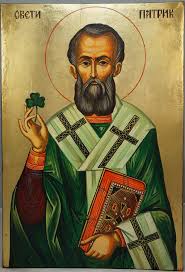
Saint Patrick Icon
As a young boy, Patrick was kidnapped by brutal pirates and carried away to Ireland where he was sold as a slave. For the next six years he was a shepherd in Northern Ireland. This is where he learned to pray. “In a single day I would say as many as a hundred prayers, and at night only slightly fewer.”The Confession of St. Patrick.
“I arise today
in a mighty strength
calling upon the Trinity,
believing in the Three Persons
saying they are One
thanking my creator.”
In the experience of slavery and exile, the young boy discovered God . In the midst of this terrible alienation brought on by his exile from family and country, Patrick experienced a deep abiding connection that enabled him to feel strengthened by God.
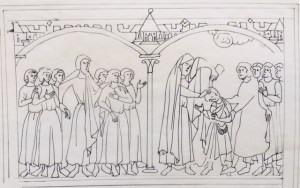
St. Patrick baptizing the Irish drawing by Christine Hales
He is a legend in Irish history and spirituality. Patrick’s story of being kidnapped by Irish pirates eventually gave rise to a remarkable inner transformation that led him eventually to return to Ireland, serving the Irish people by bringing God’s love to them.
Like St. Francis, Patrick chose a lifestyle of poverty, preferring to single-mindedly focus on the Divine connection within. “For I know full well that poverty and adversity suit me better than riches and delights.”
Saint Patrick Icon
One often sees Icons of St. Patrick holding a shamrock, an illustration of how he used the humble clover leaf to illustrate the Trinity- three in one- to the largely pagan population Ireland. Pre-Christian Ireland was where God sent Patrick. His spiritual story is told in “The Confession of St. Patrick”, along with many Scriptural references that relate to his experiences.
Patrick was born in Britain about 385, and began his mission in Ireland during the early 400’s.He became fluent in the Irish dialect during his period of slavery, and despite much hostility and danger, he was very effective in bringing the Gospel to Ireland.
Saint Patrick founded many churches and monasteries across Ireland.
Saint Patrick Icon
Holy Bishop Patrick,
Faithful shepherd of Christ’s royal flock,
You filled Ireland with the radiance of the Gospel:
The mighty strength of the Trinity!
Now that you stand before the Savior,
Pray that He may preserve us in faith and love!
Icon notes for March:
The American Association of Iconographers now has a Facebook Page which you are welcome to join. The rules of the page are that postings may be submitted by any member and the content needs to be of interest and benefit to Iconographers.
Video of Iconographer George Kordis beginning a Christ Pantocrator dome: