The History and Development of Christian Icons. Part III

This is the third in a four-part series of articles that examine the historical evolution of Christian icons that I have written for the Anglican Digest.  This article appears in the fall issue.  In this article we will explore the significance of a symbolic visual language of icons in contrast to a more realistic one that began to develop from the late Byzantine period through the beginnings of the Italian Renaissance paintings. 

Saint Epifani, Mosaic, 1030

This stylistic change is very important.  It helps to define the difference between holy icons and the religious painting that grew out of the Renaissance.  This difference became ever more pronounced as time went on, and the shift from symbolic to realistic imagery and storytelling can be compared to the difference between a parable and a narrative story.  The parable can have more eternal, universal and varied meanings, while realism points to a particular moment in time, a specific meaning.  Eastern church traditions preserved the integrity and spiritual function of icons, while Western Europe began to explore art’s potential to engage both the senses and the intellect.

Church Art From the 11-15th Centuries
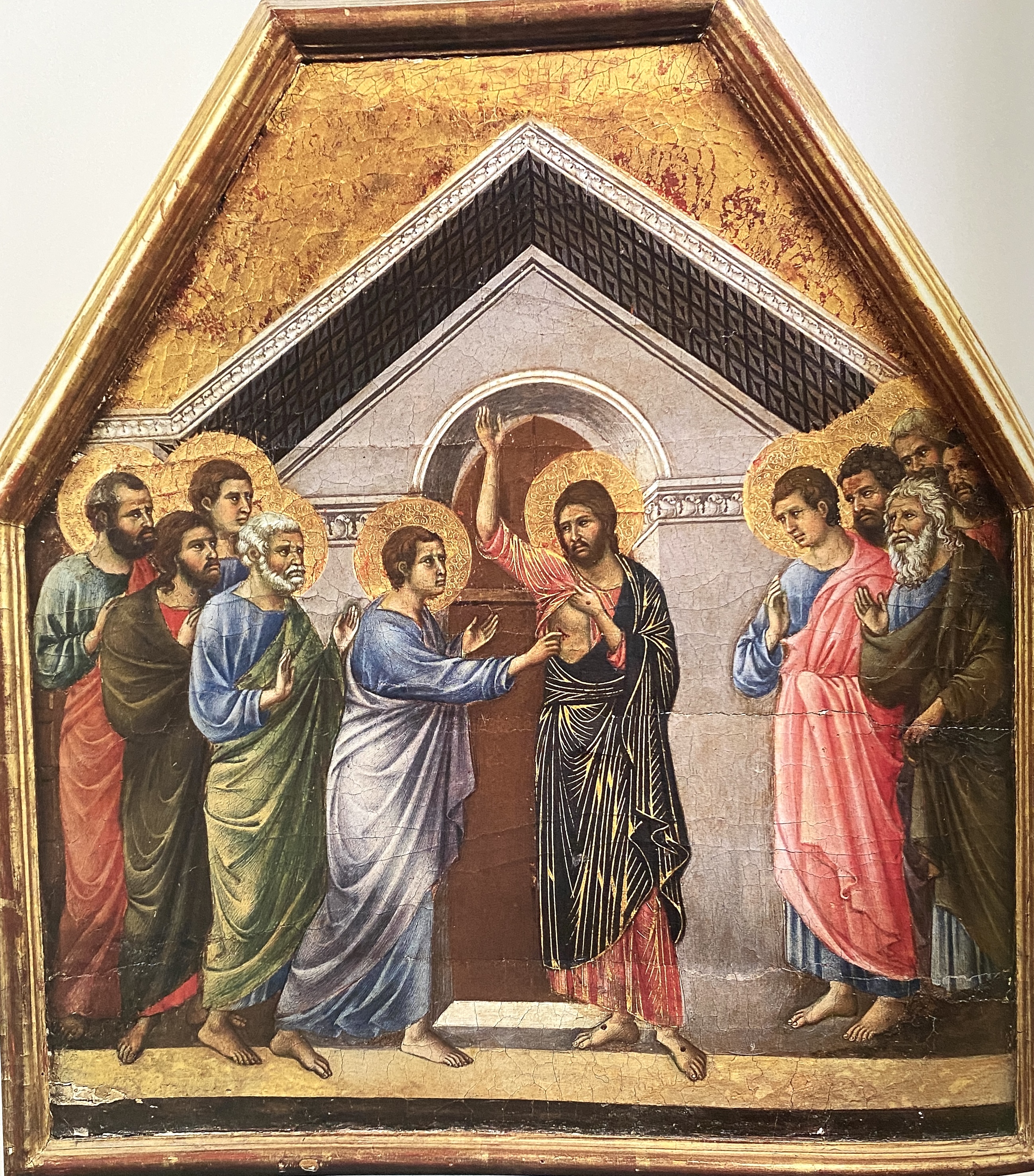
Duccio, 1230, Maesta

From the 11th to the 15th centuries, art saw significant development, transitioning from medieval styles to the Renaissance.  The rise of Romanesque and Gothic art occurred in the Middle Ages, with Romanesque art taking shape in the eleventh century, initially developing in France then spreading to Spain, England, Flanders, Germany, Italy, and other regions. 

Annunciation, St. Sophia’s Cathedral, Kiev. 1050

One of the most spectacular achievements of medieval artists which was their desire to pursue heavenly light in their creation of the worship space.  The importance of this play of light had its beginnings in the 12th century when the heavy, dark Romanesque architecture began to be replaced by Gothic development of pointed arches, vaulted ceilings, and flying buttresses- all of which made it possible to admit more light into the sanctuary than would have been possible before.

Light for Christian culture had great significance because of the extensive Biblical associations of light with God himself, beginning with Genesis, “Let there be light”, and in the writings of Saint John the Divine.  At this point, the Bible had become an important source of ideas about beauty, both esthetically and also in a moral sense.  Illuminated Manuscripts flourished.

Icons and Art of the Eastern European Church

The developments of Church art in the East can be understood in several stages, or periods of Byzantine Culture: The Macedonian period, from 867-1056, the Komnenian period from1081-1185,and the Palaeologan Period 1259-1453.  These political and cultural periods influenced the style of icons as we will see.

Macedonian Period (867-1056)

Macedonian Workshop at Paraskevi

Macedonian art grew with advancements in learning and significant church construction and restoration following the period of Iconoclasm. (see my previous article). The artistic achievements of the Macedonian dynasty reflected grace, drawn from the fourth century, with the strength and beauty of earlier Hellenistic traditions. This blend of qualities infused religious art and icons with a distinctive dignity, refinement, and balance. These characteristics became synonymous with Byzantine design, aligning harmoniously with religious themes.

Komnenian Period (1081-1185)

Mosaïque des Comnène, Sainte-Sophie (Istambul, Turquie)

The Komnenoi were great patrons of the arts, and with their support Byzantine artists continued to move in the direction of greater humanism and emotion, of which the Virgin of Vladimir  is an important example. Ivory sculpture and other expensive mediums of art gradually gave way to frescoes and icons, gaining widespread popularity across the Empire. Although the art produced in the Byzantine Empire was marked by periodic revivals of a classical aesthetic, it was above all marked by the development of a new aesthetic defined by its abstract or anti-naturalistic character. If classical art was marked by the attempt to create representations that mimicked reality as closely as possible, Byzantine art seems to have abandoned this attempt in favor of a more symbolic approach.

Palaeologan Period (1259-1453)

Fresco from Leshovsky Monastery, 1347

Paelogan Byzantine artists developed icons, which became a popular medium for artistic expression, and were characterized by a less austere attitude. This appreciation for purely decorative qualities of painting and meticulous attention to details is sometimes referred to a Palaeologan Mannerism. Russian icon painting began by entirely adopting and imitating Byzantine art, as did the art of other Orthodox nations, and has remained extremely conservative in iconography. 

The fall of Constantinople in 1453 was a significant event in the history of the Byzantine Empire, and it had a profound impact on the art world. Many Byzantine artists migrated to Italy, where they played a vital role in shaping the  Italian Renaissance. of the Byzantine Empire in the preceding centuries.

The splendour of Byzantine art was always in the mind of early medieval Western artists and patrons, and many of the most important movements in the period were conscious attempts to produce art fit to stand next to both classical Roman and contemporary Byzantine art.

Religious Painting and Icons in the Western Church

The influence of Byzantine art on Italian art was significant, with Byzantine artists bringing their techniques and knowledge to Italy, especially the use of gold leaf and mosaics.

Three Italian painters of the 14th century, Cimabue, Duccio, and Giotto, are generally considered the link between the earlier iconic style of painting with its flattened pictorial space, and simple, abstract compositions and little if any naturalistic details, and the Renaissance.  In their work you will see that transition and the theme of the early development of naturalism that is the precursor to the Renaissance and the end of iconographic perspective.

Cimabue 1240-1302

Cimabue Maesta, di Santia Trinita

The paintings of Cimabue were heavily influenced by Byzantine iconography, and gradually they began to break away from that tradition into a more naturalistic rendering of human forms and space. His work is a transitional step in the development of western painting bridging the Medieval and Renaissance periods.  His work clearly influenced the styles of other Italian artists at the time such as Duccio di Buoninsegna and showcases the ongoing evolution of Italian art.

Duccio  1250-1391.  Sienna, Italy
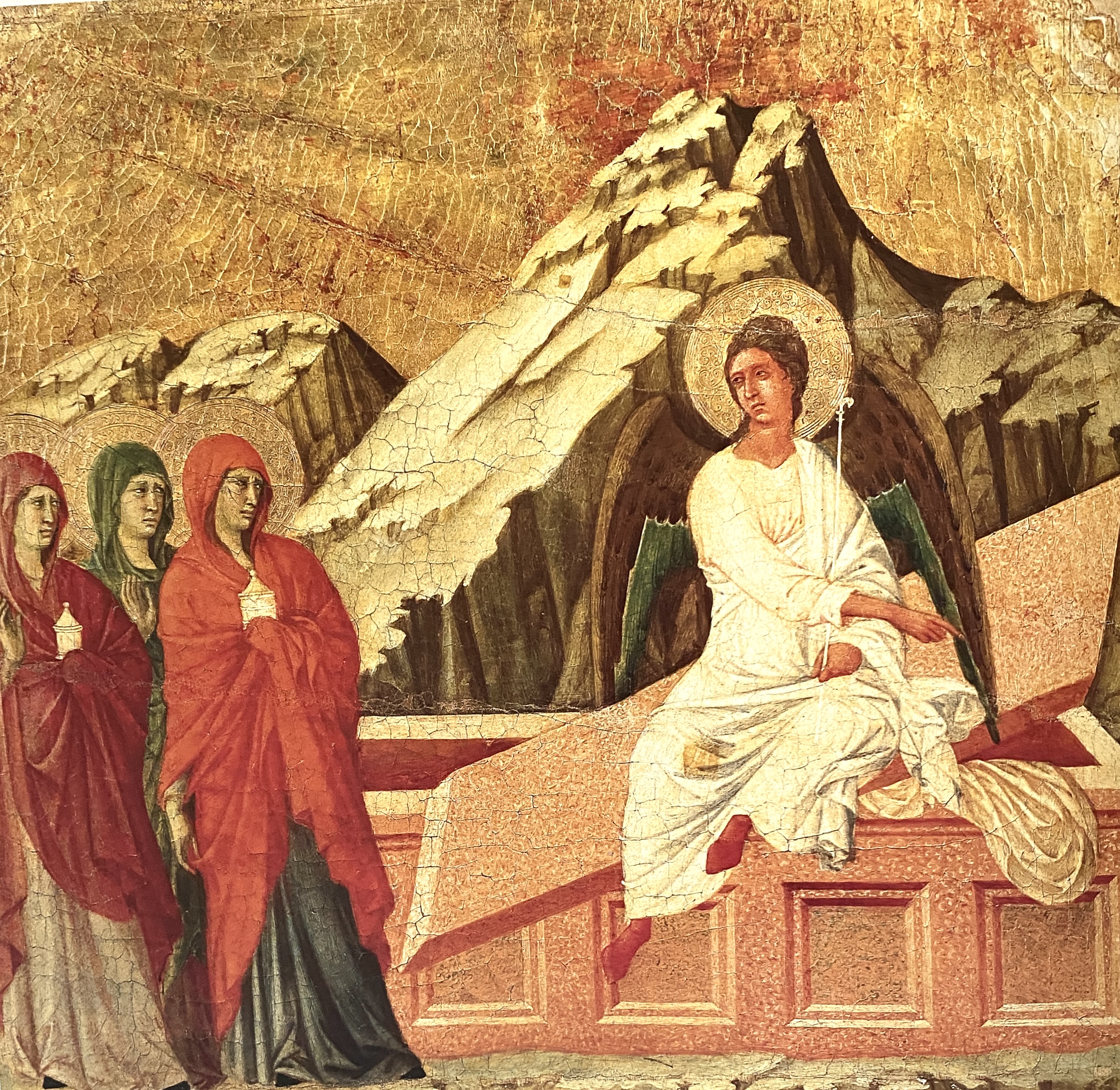
Duccio, The Three Mary’s at the Tomb

 Duccio , as the founder of the Sienese school of painting,was the predominant painter of the 14th century.He ran a large workshop which shaped generations of Sienese artists.   His religious paintings brought a lyrical expressiveness and intense spiritual gravity to the Italo-Byzantine tradition.  In a small devotional panel of the Madonna and Child, Duccio bridged the gap between the spiritual world of the figures and the real world of the viewer in very much the same way that Icons do.   His holy figures were majestic, his pupils were influential in Florentine art, and his greatest work was the double-sided altarpiece, the ‘Maestà’, made between 1308-11.  Both Duccio and Cimabue began their careers producing iconic altarpiece paintings in the flat, two dimensional style of Byzantine icons, and ended their careers with more naturalistic paintings.  Both were enlivened and inspired by the Franciscan spirituality of their time.

Giotto di Bondone, Italian,   1267-1337
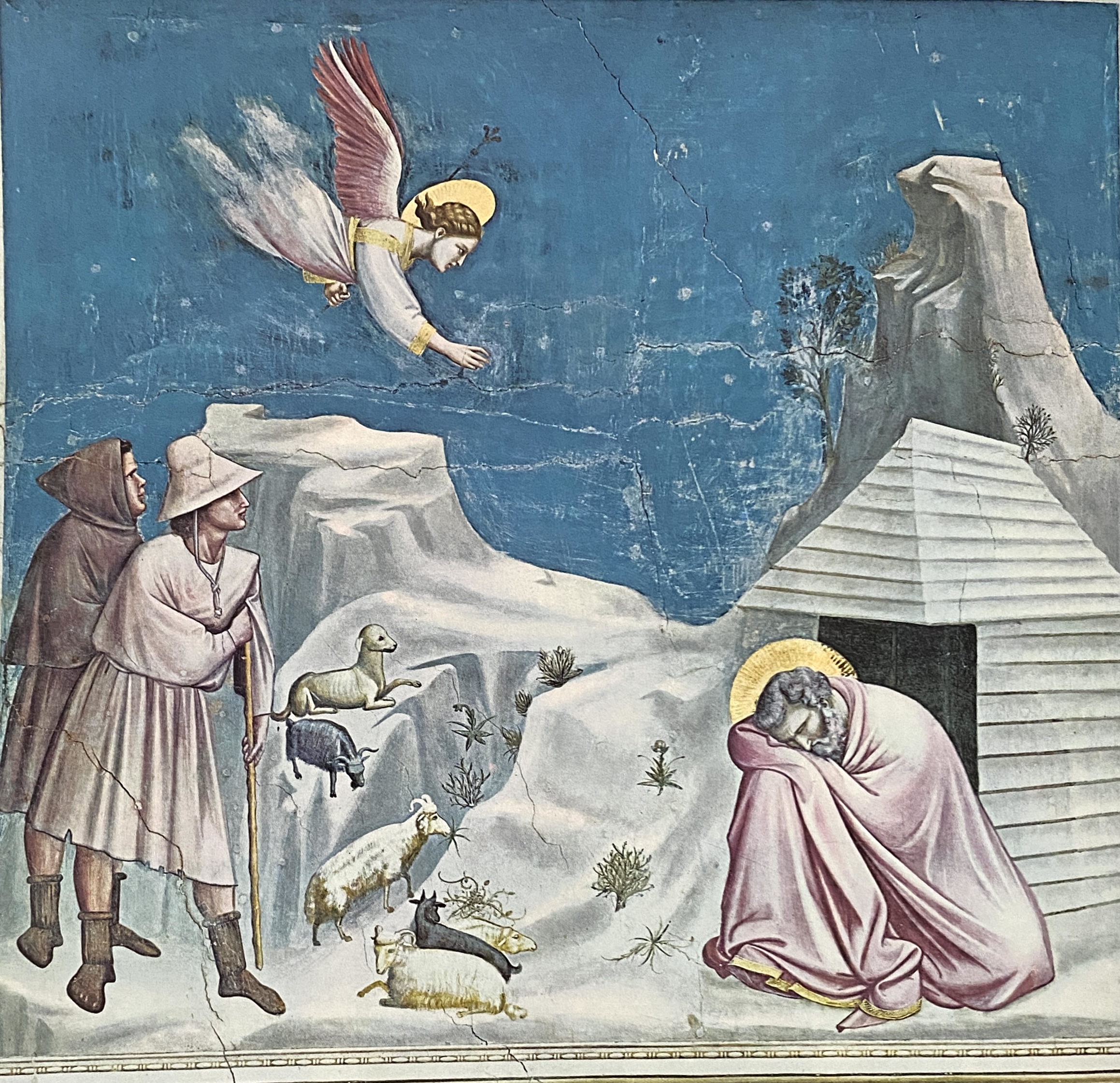
Giotto, The Dream of Joachim, 1330

Giotto was a Florentine painter and architect who is revered as the father of Western painting. It is believed that he was a pupil of Cimabue, and to have decorated chapels in Assisi, Rome, Padua, Florence, and Naples with frescoes and panel paintings in egg tempera. 

Giotto’s figures are volumetric rather than linear, with varied human emotions expressed in a human style rather than the stylized faces of Byzantine icons.  He also created a new kind of pictorial space with an almost measurable depth, transforming the flat world of thirteenth century painting in a more naturalistic view of the real world.  For this, he is considered the father of modern European painting.

The great accomplishment of Giotto’s painting was to make the events of the Gospel and the lives of the holy saints both credible, beautiful, and appealing to the ordinary people of his day.

Conclusion

These artists were followed by the Renaissance in the 14th-16th centuries. Renaissance art, particularly in Italy, focused on realism, classical themes, and a renewed interest in the human form. It moved away from symbolism and abstraction in favor of naturalistic rendering of light, form and nature. In the next and final article in this series, I will explain the effect this development has had on religious painting and contrast Renaissance painting with Icons.  Why is the Renaissance such a strong dividing line in religious art? Because it ushered in a humanistic world view as opposed to the theocratic world view prevalent before. The focus of our culture has gradually progressed from honoring God as creator to revering man’s creations, the truth of science over religious principles, and eventually to a nihilism in our culture that doesn’t recognize any power greater than ourselves.  And that is why as an artist, I have chosen Icons as my art form, desiring to promote and demonstrate visually, God’s universe over man’s universe! 

I hope you have enjoyed this article! Perfect for an end of summer, beginning of fall reading!

Here is a lovely video that talks about Siennese Icon Painting

May God continue to bless the work of your hands. Please join with me in prayer for the world :

“God is our refuge and strength, an ever present help in trouble. Therefore we will not fear, though the earth give way and the mountains fall into the heart of the sea, though its waters roar and foam and the mountains quake with their surging…..”Be still and know that I am God. I will be exalted in all the earth.” Psalm 46:1-3, 10.

Christine Simoneau Hales

https://newchristianicons.com

Illuminating the Spirit: A Summer Reading Guide for Iconographers

Books and Inspiration to Enrich Your Icon Writing Practice

Summer unfurls like a painted scroll—light streaming through open windows, quiet hours stretching across the day, and, for the iconographer, a rare invitation to rest, reflect, and replenish the wellspring of inspiration. Whether you are a seasoned writer of icons, a beginner who has just dipped their brush into the egg tempera, or simply a lover of sacred art, the summer months offer an ideal time to step back from the demands of daily creation and immerse yourself in the wisdom, history, and spirituality that underpin the venerable and holy tradition of iconography.

Why Read in Summer? The Sacred Pause

In the stillness of summer, reading becomes a sacred pause—a time to deepen your understanding of icons not just as objects of devotion, but as living prayers in color and line. Iconographers often speak of their art as an act of contemplation: every stroke is a prayer, every layer a meditation. So too can reading be a contemplative act, enriching the mind and spirit while opening new vistas for creativity.

Foundational Texts: Revisiting the Roots

  • The Meaning of Icons by Leonid Ouspensky and Vladimir Lossky. This classic introduces the theological, spiritual, and artistic foundations of iconography. Through its pages, readers are led to understand the icon as a window to the divine, a theology in pigment, and a bridge between heaven and earth.
  • Icons and Saints of the Eastern Orthodox Church by Alfredo Tradigo. Tradigo’s compact yet richly illustrated guide offers both historical context and practical wisdom. Each page is a pilgrimage through time, introducing saints, feasts, and the symbolic language of orthodox sacred art.
  • Icons as Communion by George Kordis. Kordis brings the ancient tradition into the present, with notes and observations on the drawing stages in icon painting. Amazon Link
  • Orthodox Icon Patterns, Patterns and sketches for Iconographers: This is the revised version of Patterns & Sketches for Iconographers, with added content and additional patterns. A valuable resource for iconographers, this book contains a wide variety of patterns and sketches. Content including; icon patterns of the Nativity, the Theotokos, archangels, male and female saints, as well as halo patterns and 2 beautiful crucifixion crosses. Buildings and fabric/ background designs and icon borders. Each pattern is accompanied by color recommendations which are meant as a general guide allowing for adjustments due to differences in color names between pigments used with egg tempera and acrylic paints.  (There is also a Volume II if you like this one.). Amazon Link

Summer reading need not always be heavy with theory or thick with history. Sometimes, lighter fare—biographies, memoirs, and even novels—can kindle the imagination and nurture the soul of the artist. You might consider adding a few of these to your summer list:

  • Praying with Icons by Jim Forest. Accessible and warmly written, Forest’s reflections on the role of icons in prayer lift the heart and draw the reader into a deeper appreciation of how icons shape and are shaped by the life of faith.
  • The Mystical Language of Icons by Solrunn Ness.  Nes explores in depth a number of famous icons, including those of the Greater Feasts, the Mother of God, and a number of the better-known saints, enriching her discussion with references to Scripture, early Christian writings, and liturgy. She also leads readers through the process and techniques of icon painting, showing each step with photographs, and includes more than fifty of her own original works of art. Amazon Link
  • And if you would enjoy a deep dive into the life of the Blessed Mother Mary, I recommend “The Life of the Blessed Virgin” from the visions of Ann Catherine Emmerich, Incredibly revealing and edifying background of Our Lady, her parents and ancestors, St. Joseph, plus other people who figured into the coming of Christ. also available on Amazon: Amazon Link
  • And also “True Devotion to Mary” by Louis de Montfort: Considered by many to be the greatest single book of Marian spirituality ever written, True Devotion to Mary is St Louis de Montfort’s classic statement on the spiritual way to Jesus Christ though the Blessed Virgin Mary. Amazon Link
  • And last, but not least, is my own book on Icon writing, “Eyes of Fire, How Icons Saved My Life As an Artist”, with an appendix full of directions as well as an explanation of how modern art has been influenced by icons and how some of those principles can be used in present day icon creation.  Amazon Link

As the art historian Roger Lipsky says in his book, “An Art of Our Own, the Spiritual in Twentieth Century Art”, “One of the tasks of the spiritual in art is to prove again and again that vision is possible; that this world, thick and convincing, is neither the only world nor the highest, and that our ordinary awareness is neither the only awareness nor the highest of which we are capable.”

And so my purpose in sharing this list of inspirational summer reading is to encourage you to engage with the ‘pause” of the longer summer days, and ponder on the beauty of nature and be open to glimpses of eternity that a fresh perspective can often foster. And then let this “higher”perspective inform your icon practice in the coming year,. In the words of Aidan Hart, in his book, “Beauty, Spirit, Matter, Icons in the Modern World, “The Icon invites us to see the world as God sees it.” With nature all around of us. may God bless us with His perspective and insights to carry forward into our work.

Until next month,

Christine Simoneau Hales, Iconographer/artist

My Websites:

  1. https://newchristianicions.com   my main website
  2. Https://christinehalesicons.com  Prints of my Icons
  3. https://online.iconwritingclasses.com  my online pre-recorded icon writing classes
  4. https://www.youtube.com/channel/UCK2WoRDiPivGtz2aw61FQXA  My YouTube Channel 
  5. Facebook: https://www.facebook.com/ChristineHalesFineArt     or  https://www.facebook.com/NewChristianIcons/
  6. Instagram:   https://www.instagram.com/christinehalesicons/?hl=en
  7. American Association of Iconographers:  FB Group: https://www.facebook.com/groups/371054416651983
  8. American Association of Iconographers Website: https://americanassociationoficonographers.com

Epiphany and New Beginnings

Embracing the Light of New Possibilities

Happy New Year!  It’s a time for new beginnings, a chance to refresh our minds, hearts and spirits, a time to reevaluate our goals and plans in light of a change of perspective. 

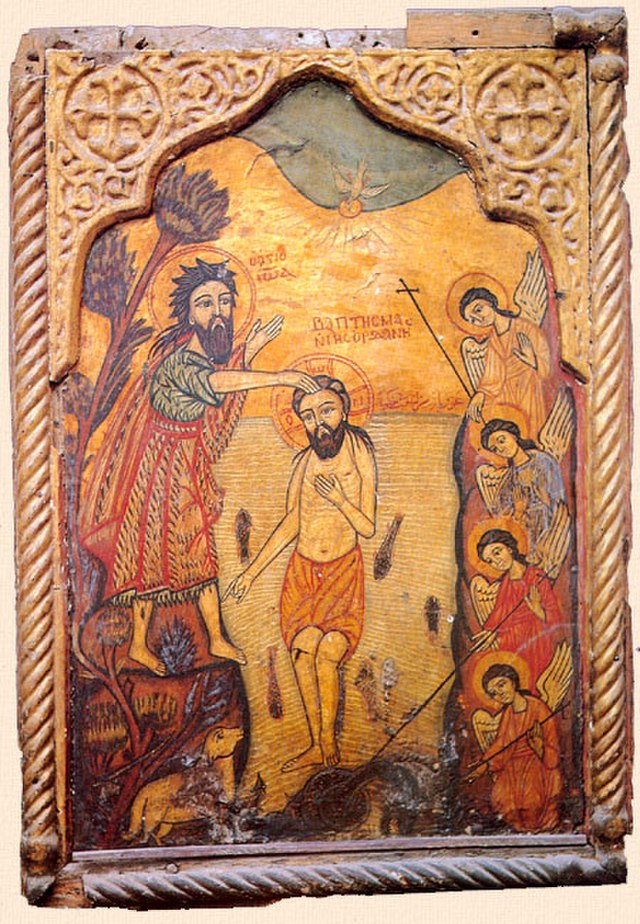
The Eastern branch of the Church originally celebrated Epiphany as the Baptism of Jesus as early as 200AD. In the Western Church, gradually the appearance of the three kings at the nativity of Christ’s birth and the wedding feast of Cana were additionally  associated with Epiphany. 

Giotto Wedding at Cana. 13th Century

Thinking about all this, it seems to me that each of those Holy events signifies a time of new beginnings.  The three kings came to honor a newborn king- the beginning of a radical shift in the world’s perspective on sin, freedom, and God.  

The Baptism of Jesus occurred when he was in his early thirties and signified his great humility in identifying himself as human. At the same event, God’s voice declared Jesus to be His son, in whom he is well pleased.  This was the first public demonstration of both Jesus’ humanity and divinity and serves as an example for us to follow. It is for us to be humble, asking for God’s blessing at Baptism and eagerly listening to every word that comes from the Father.

Coptic Icon, Baptism of Jesus

Jesus said, ‘Out of your heart shall flow rivers of living water’. John 7:38

The wedding of Cana was the first manifestation of the miraculous marking the beginning of the miraculous ministry of Jesus. How do we enter into this ancient mystery? We might remember that when God is asked for help, He can turn even ordinary facts of reality – no wine left-  into the extraordinary fulfillment of desires and needs. 

“Since the creation of the world the invisible things of God are clearly seen by means of images. We see images in the creation which, although they are only dim lights, still remind us of God.” John of Damascus

And so, at this time of new beginnings, a New Year, let us contemplate how this feast day can affect our icon writing practice.  Any of the three aspects of Epiphany can be used to strengthen and inspire our practice in multiple ways.  Keeping a spiritual journal and recording our thoughts and drawings can make our work a process of sanctification. Sanctification is a Christian concept that refers to the process of becoming holy or sacred, or being set apart for a special purpose. It is a gradual process of spiritual growth and transformation that involves effort, commitment, and personal sacrifice. 

My Baptism of Jesus Icon at the Cathedral of Saint Peter, Saint Petersburg, FL

Sanctification is a gift from God to those he loves, and is a result of grace. 

Happy New Year!

The arrival of a new year often brings a sense of anticipation and hope—a time to refresh our minds, hearts, and spirits. It is a moment for reevaluating our goals, plans, and perspectives, and for embracing the potential of new beginnings.

In the Christian liturgical calendar, Epiphany—celebrated on January 6th—marks a significant point in the journey of faith. This feast day invites us to reflect on profound moments of revelation, transformation, and divine manifestation. As we step into a new year, it’s an opportunity to consider how these themes of new beginnings can inspire and strengthen our own spiritual practices, particularly in the art of icon writing.

The Significance of Epiphany

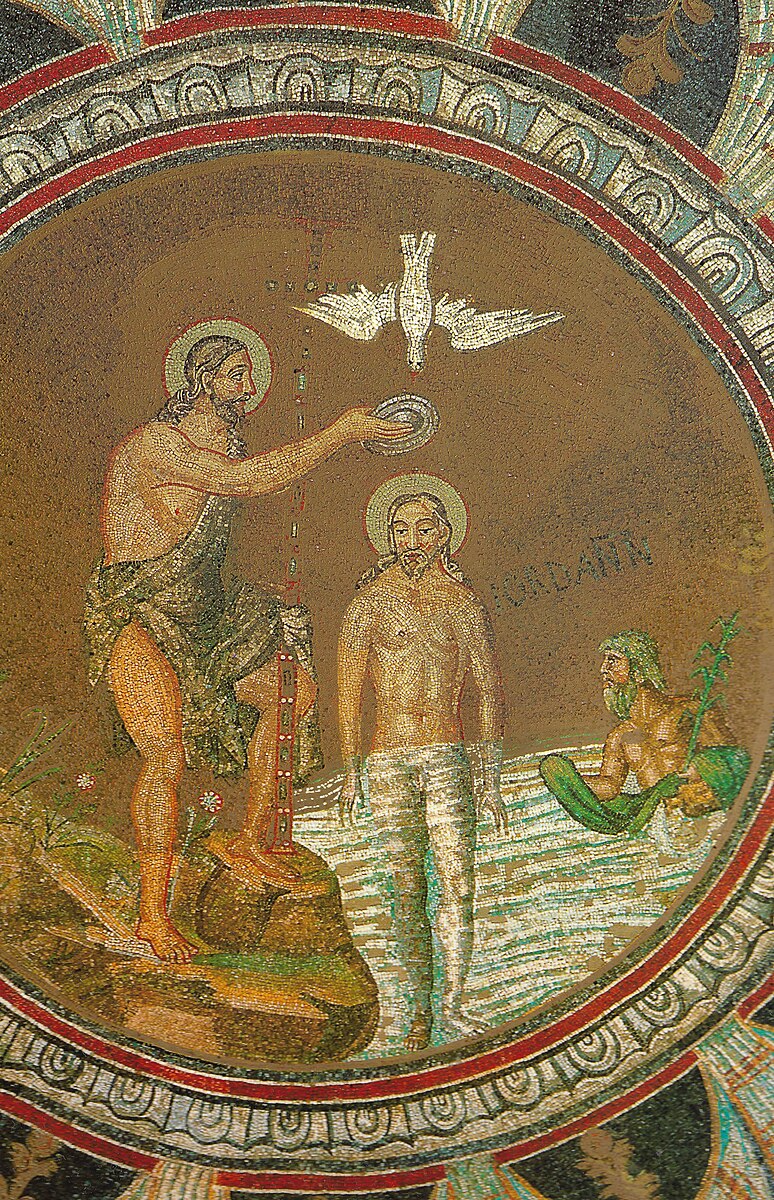
Epiphany Mosaic Ravenna 14th century

Epiphany is traditionally a feast that celebrates the revelation of Christ to the world. The Eastern branch of the Church originally recognized Epiphany as the celebration of Jesus’ Baptism in the Jordan River, dating back to as early as 200 AD. Meanwhile, in the Western Church, the focus gradually expanded to include the visit of the three kings (the Magi) to the newborn Christ and the wedding feast at Cana, marking the first public miracle of Jesus.

What unites these events is their profound symbolism of new beginnings.

Codex Egbert. 10th Century Visit of the Three kings
  • The Visit of the Three Kings: The Magi came to honor the newborn king, an event that marked a radical shift in the world’s perspective on sin, freedom, and God’s plan for salvation. Their journey was not just one of homage, but also a declaration of the start of a new era in the world’s understanding of the divine.
  • The Baptism of Jesus: At around thirty years old, Jesus underwent baptism, not because He needed it, but to demonstrate His profound humility and identification with humanity. In this moment, God’s voice declared, “This is My beloved Son, in whom I am well pleased” (Matthew 3:17). It was a public affirmation of both Jesus’ humanity and divinity, setting an example for us all to follow—humility, obedience, and openness to God’s will.
  • The Wedding at Cana: The first of Jesus’ miracles, turning water into wine at a wedding feast, was the beginning of His miraculous ministry. It shows how, when we seek God’s help, He can transform even the most ordinary situations into extraordinary ones, fulfilling desires and needs in ways we may not expect.

New Beginnings: The Call to Sanctification

When we consider the events of Epiphany—the kings, the baptism, and the miracle at Cana—we are reminded that new beginnings come with new insights, new possibilities, and the potential for transformation. These moments of revelation can serve as inspiration for our own lives, particularly in how we approach our spiritual practices.

One practice that can particularly benefit from these reflections is the art of icon writing. For those of us who engage in this sacred work, Epiphany offers an invitation to approach our iconography with a renewed sense of purpose and devotion.

The Role of Sanctification in Our Work

Sanctification is a Christian concept that refers to the process of becoming holy, or being set apart for a special purpose. It involves spiritual growth, effort, commitment, and sacrifice, and ultimately results from God’s grace. As we enter this time of new beginnings, Epiphany provides us with the perfect context to view our work—not just as art, but as an act of sanctification.

In the icon writing tradition, the creation of sacred images is not merely an artistic endeavor. It is a spiritual practice—a way of deepening our relationship with God and of participating in the divine work of revealing God to the world. As we create, we invite God’s grace into our work, and we seek His discernment and guidance.

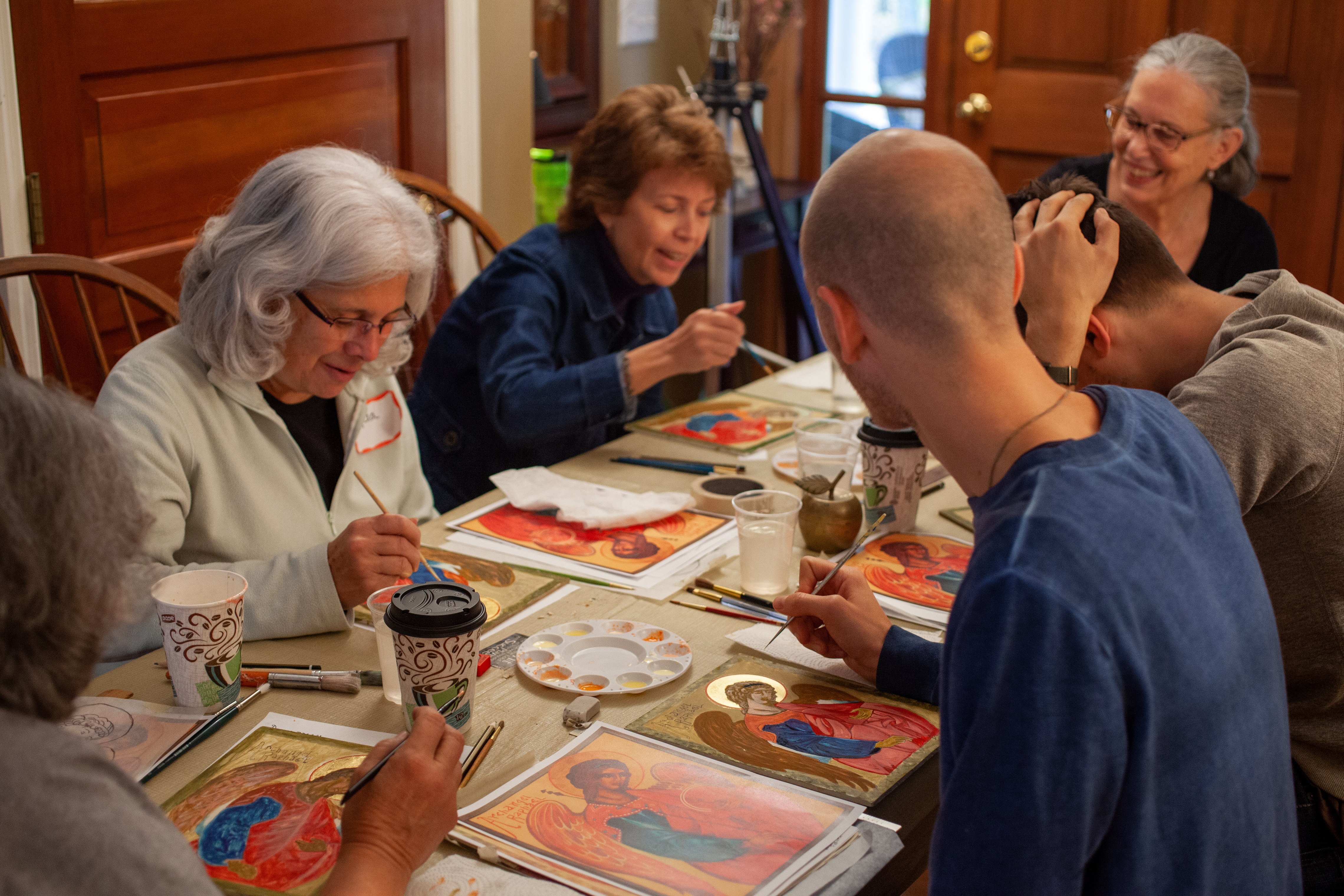
One of my icon writing classes in New York

Practical Ways to Embrace Epiphany in Icon Writing

  1. Keep a Spiritual Journal: Epiphany is an ideal time to begin—or renew—a spiritual journal. Write down your reflections on the feast day, your thoughts on the new year, and any drawings or sketches that come to mind. Let this journal be a space for contemplation and prayer as you reflect on the mysteries of God’s revelation.
  2. Approach Your Icon Writing as a Process of Sanctification: Remember that icon writing is not just about technique, but also about the transformation of the soul. Let the process itself be one of spiritual growth. Each stroke, each color, each detail can be offered up as a prayer for God’s blessing and guidance.
  3. Draw Inspiration from the Three Aspects of Epiphany: Whether you focus on the humility of the Baptism, the honor of the Magi’s visit, or the miraculous transformation at Cana, let these themes inspire your work. Ask yourself how each event relates to your journey and how it can be expressed through your icons.
  4. Seek God’s Blessing and Discernment: Just as Jesus humbly sought the Father’s blessing at His Baptism, approach your work with a similar humility. Ask for God’s guidance and discernment as you create, and trust that He will equip you with the skill and insight to faithfully depict His Holy Word in visual form.

A Prayer for the New Year

Dionisius’ Russian Icon of Wedding at Cana

As we begin this new year, let us pray for the grace to approach every task, including our icon writing, as an act of sanctification. May we seek new beginnings in our spiritual lives, just as the three kings, the baptism of Christ, and the miracle at Cana brought about radical transformation. And may our work be filled with the light of Epiphany, bringing us closer to God and to the world’s deepest truths.

Epiphany is a beautiful time to celebrate new beginnings, clarity, and the light that guides us forward. Just as the wise men followed the star, we too are invited to follow our own paths of growth and transformation. May this Epiphany bring you fresh insight, new opportunities, and the courage to begin anew.


May God continue to bless the work of your hands with His gifts of discernment and skill, and may you experience the joy of new beginnings in your creative and spiritual journey through icon writing.

INTERESTING ICON LINKS:

Video with Metropolitan Kallistos Ware on Iconography:  Doorway into Heaven (39 minutes)

Birch Panels suitable to gesso for icons: Trekell Art Supplies

Blessings,

Christine Simoneau Hales. New Christian Icons

My Icon Writing Retreats in 2025

A Christmas Journey

A Christmas Journey: Lessons from the Nativity Icon

As we joyfully concluded my latest icon writing class, the crowning achievement was a breathtaking depiction of the Nativity. Beyond the demonstrations and questions, the process became a conduit for spiritual revelations about the Nativity Icon during our retreat. The shared exchange of thoughts and questions revealed the profound spiritual wisdom residing within each class member. I am so grateful for the divine synchronicity that brings such beautiful souls into my classes, contributing to a shared journey of growth and revelation in the span of just four days.

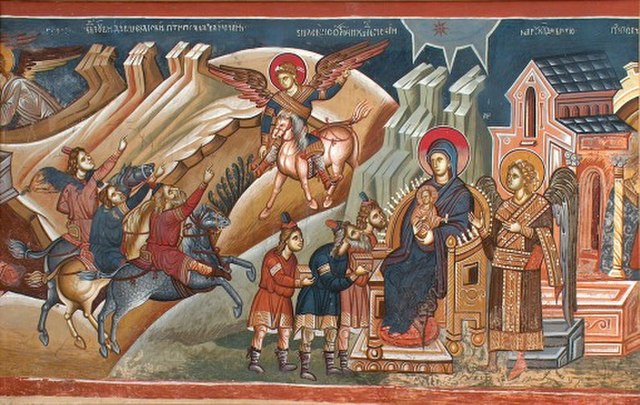
In the spirit of post-retreat reflection, my thoughts turned to the iconic journey of the three wise men. Weary yet resolute, they traversed long and perilous roads, guided only by a celestial star lighting their way to Jerusalem. Their journey, fraught with challenges, reached its culmination under the brilliant radiance of the star directly above, revealing the long-promised redemption in the form of a humble baby nestled in a manger. This divine encounter brought the wise men to their knees in worship and adoration before the embodiment of God’s power and glory.

The resonance between the wise men’s Christmas journey and our own spiritual quests is striking. As we usher in the festivities of 2024, I pray that we may emulate the wise men, offering our heartfelt praise and worship in response to the wonder of the incarnation.

Drawing inspiration from Sarah Young’s “Jesus Calling” (pg. 372), let our perseverance along God’s ordained path be sustained by His strength. Miracles, though not always visible to the naked eye, become apparent to those who live by faith. As we navigate our individual paths, let us watch and wait, expecting miracles and acknowledging that living by faith grants us the clarity to witness divine interventions.

The Nativity Icon by Christine Hales

In this festive season, my heartfelt Christmas prayer for you is to embrace the faith-driven approach of the three wise kings. May your Christmas be filled with the warmth of faith rather than mere sight, positioning you to experience the unfolding glory and power of God in your life. As 2024 unfolds like a gift waiting to be unwrapped, may you draw nearer to Him than ever before, embracing the Christmas spirit with anticipation and receptivity. May your Christmas be blessed with joy, peace, and the wonder of His love.

Christine Hales. Artist, Iconographer

My Website

My Next Online Icon Writing Retreat is April 9-12, 2024

“Unveiling the Secrets of Medieval Icon Painting”

There are so many exciting principles we modern icon painters can learn from medieval icons. The secrets of Sacred geometry and painting are profound, but no less important are the concepts behind medieval iconographic paint application.

St, Nicetas with Deesis and Selected Saints, 15th Century

The simplest statement that icon painting is the consecutive application of layers of colored paint applied on the white surface of a wood board that is primed with gesso- white chalk and animal glue.

This notion of “consecutive layers of paint” is a hallmark of medieval painting because beginning with the Renaissance and the use of oil painting, the Renaissance painter used modeling- application of shadows- thereby obviating the need for the consecutive layers to achieve a modeling effect of figures and shapes.

Holy Trinity Icon by Andrei Rublev

Icon painters can use a few layers, or many, depending on the time available and the effects needed. Although early Christian artists used encaustic (wax) as their painting medium, from the ninth century onward, egg tempera was the medium icon painters used, almost exclusively.Egg Tempera

Egg Tempera

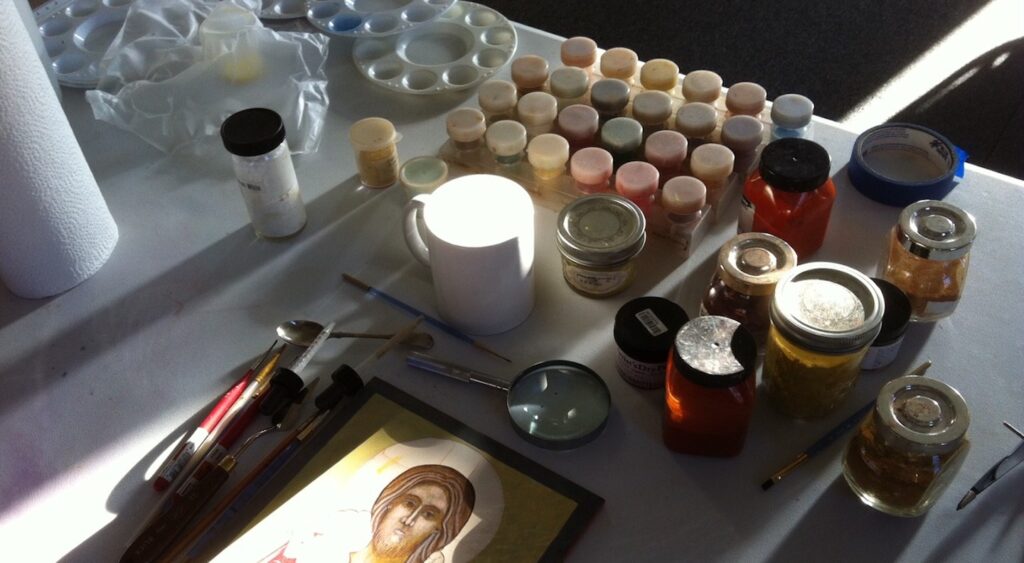
Egg tempera painting consists of painting with dry powdered pigment using egg emulsion as the binder to cause adhesion of pigment to the gessoed surface area. This dry powder was often found in soil and stones finely ground as well as in some plants, roots and insects that could be boiled or pressed to release specific colors.

“Of crucial importance are the choice of the right pigments, the ability to mix them properly, and the application of each consecutive layer when the one below it is quite dry so that the fresh, wet paint does not mix with it.”  A. Yakovleva, “A History of Icon Painting”.

Which Pigments were used in Early Icons?

Studies show that vermillion, red ochre and lead red were the reds commonly used by early iconographers.  Light yellow ochre, yellow sienna, lead tin yellow, and auripigment were the yellow pigments used, natural ultramarine (obtained from azurite) and indigo for blue, malachite and glauconite for greens, charcoal for black, lead white, umber, hematite were the browns and various ochres depending on what was naturally available.

Christ Pantocrator Icon, Svanetia, 13th Century

Three Ways of Mixing Colors

I find it so interesting that the three ways that medieval iconographers mixed their colors could have such a significant effect on the final results of their work.  The first method of mixing colors was simply to mix a powdered pigment with the egg emulsion. (egg emulsion is usually the yolk of an egg mixed with a small amount of water, and a very small amount of vinegar or alcohol as a preservative.) Some of the pigments lent themselves to being ground to a fine powder, but others could only be ground to larger crystals and this variety of textures was put to good use in the third method.

The second method of color mixing is called optical mixing.  This consists of relying on the different color layers to mix optically. This is achieved when rays of light hit the surface, they penetrate through the layers of color and reflect back the impression that it is one color when in reality it is the combination of all the color layers together.  This gives the viewer a very rich viewing experience and is what allows the icons to have a jewel like appearance.  Egg tempera excels at being able to deliver this effect.  For this to happen, the artist needs to apply the layers very thinly in order for this imperceptible color mixing to occur.

The Forty Martyrs of Sebaste, 13th Century. Georgia

The third method employs the use of the rougher pigments with larger particles to be mixed for the lower layer of the icon.  This allows for subsequent layers to settle into the lower layer in irregular and interesting ways.  This method unites the upper layers and lower layers of color, allowing for the appearance of visual harmony.  A combination of all three methods is used by the experienced iconographer.

I hope this explanation of medieval color mixing has been helpful.  Sometimes we need to go back to basics and understand nuances in order to achieve the results we want in our icons. If you would like to pursue the topic further, here is some reading you may appreciate:

“A History of Icon Painting”, L. Evseyeva, Moscow Publishing but available on Amazon

“The Materials and Techniques of Medieval Painting” Daniel V. Thompson, Dover Publishing

Interesting Links For Iconographers:

These are from Dorothy Alexander, an Iconographer in California!:

  • A gold sale? Yes, this is very rare because of a factory overrun on 22kt loose leaf gold and continues through 8/31/23 only. Use the code: SUMMER23 when you check-out. I ordered from them before; for this sale I purchased the 22 kt loose leaf gold (which I use for backgrounds) and it shipped quickly. Here is their website: https://www.goldenleafproducts.com/order-22k-gold-leaf.html    (THIS LINK WAS MORE THAN A MONTH AGO, SO NOT SURE IF THE SALE IS STILL GOING ON BUT THEY ARE GOOD GOLD SUPPLIERS)
  • Russian iconographers in a Greek monastery in California – this article (https://orthochristian.com/113398.html) takes you to the Life-Giving Spring Monastery in Dunlap, CA. It is a very interesting description of the lives and work of iconographers.
  • My Next Online Icon Writing Class is specially prepared for celebrating Advent where we will be painting an icon of the Nativity. Dec 5-8 on Zoom, each session is recorded for playback.   Read more here.

That’s all for this month.  Icon writing is a commitment to a life of prayer, study, and blessing the community with our work.  May you all be blessed and guided by the hand of God.  Our work is even more important especially in these difficult times.

O Almighty God, kindle, we beseech Thee, in every heart the true love of peace, and guide with thy wisdom those who take counsel for the nations of the earth, that in tranquility they dominion may increase till the earth is filled with the knowledge of thy love; through Jesus Christ out Lord, who liveth and reigneth with thee, in the unity of the Holy Spirit, one God, now and forever, amen.”  A Collect for Peace from the Book of Common Prayer.

Blessings,

Christine Hales

Newchristianicons.com

Nativity Icon

You might wonder, why an article on the Nativity icon in October? It seems to me that the element of joy is mightily endangered these days with all the news of climate change disasters, war, etc.  And joy is one of the strongest defenses we have against the spiritual forces of this dark world.  “The joy of the Lord is my strength.”  Nehemiah 8:10  Also, The Nativity icon is a marvelous example of the way icons make Holy Scripture visible in iconographic form.

The Feast of the Nativity of Jesus is one of the most joyful days of the Orthodox Church. It ranks right next to the greatest holiday, the Resurrection of Jesus. The Feast of the Birth of Jesus is also known as the “Incarnation of Christ”, God taking on human form out of His immeasurable love for us. We also call this joyous feast Christmas, so, in preparation, here is the Nativity Icon explained:

“And this shall be a sign unto you; Ye shall find the babe wrapped in swaddling clothes, lying in a manger.” Luke 2:12

Icon of the Nativity

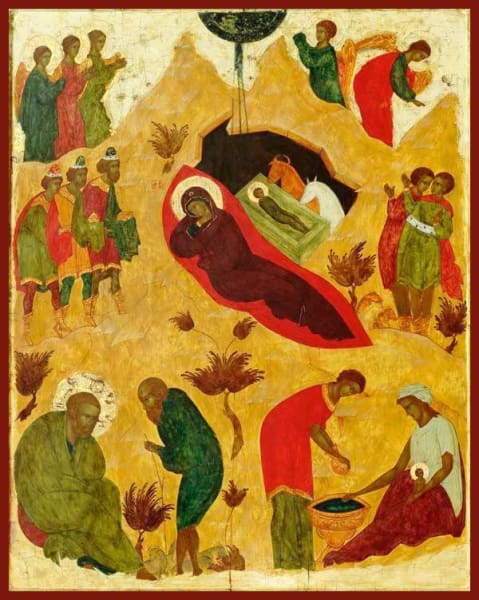
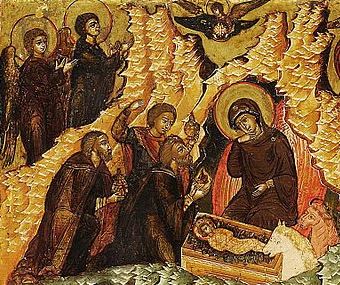
The icon of the Nativity tells the story of Christ’s birth as relayed through the Holy Scriptures. It also shows that all creation is taking part in Christ’s birth. As God gave His only Son to us, the angels give thanks with their song; the heavens give the star; the Wise Men give their gifts of gold, frankincense, and myrrh,the poor, humble shepherds give their praise and amazement, the earth gives the cave, and humanity gives the Virgin.

“In its content the icon of Christ’s nativity has two fundamental aspects: first of all, it discloses the very essence of the event, the immutable fact of the incarnation of God; it places us before a visible testimony of the fundamental dogma of the Christian faith, underlining by it’s details both the Divinity and the human nature of the Word made flesh. Secondly, the icon of the nativity shows us the effect of this event on the natural life of this world.”   L. Ouspensky, “The Meaning of Icons”

The Story of Birth of Christ Made Visible

The Holy Icon of the Nativity reminds one to praise and glorify the Birth of Christ. The celebration of Christmas each year serves to remind each and everyone of us of the joyful news that Christ came for you and me.

“The traditional Orthodox icon of the Nativity tells us what the Bible tells us, and does so in a very clear, vivid, effective manner, by means of forms and colors. “Ouspensky

The story of the Nativity of Christ is beautifully told in the Holy Scriptures. The story is found in Matthew 1:18-25 and in Luke 2:1-20. No matter how often the Birth of Jesus is told, we can experience the wonder of it anew through the responses of the angels, shepherds, and wise men in this icon.

A Timeless Story

Mary and Joseph, who were expecting a baby, travelled to Bethlehem to register for the census. Since there was no room at the inn, Joseph found a cave-like place where they could rest. This place was used by shepherds to protect their sheep in stormy weather. It was here that Mary gave birth to Jesus. The baby was wrapped in swaddling clothes and laid in the straw in the manger.

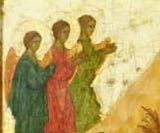
Opposite the Wise Men is the scene are the humble shepherds with whom heaven enters into direct communication, amid their everyday working life.  An angel proclaims the glad tidings. A young shepherd plays a reed instrument. This scene reveals that the music of the humans was added to the hymn of the angels. Above the shepherds is the heavenly choir of angels. They are giving glory to God. The angels serve two purposes in the Nativity of Christ. They give glory to God and announce the good news to all mankind.

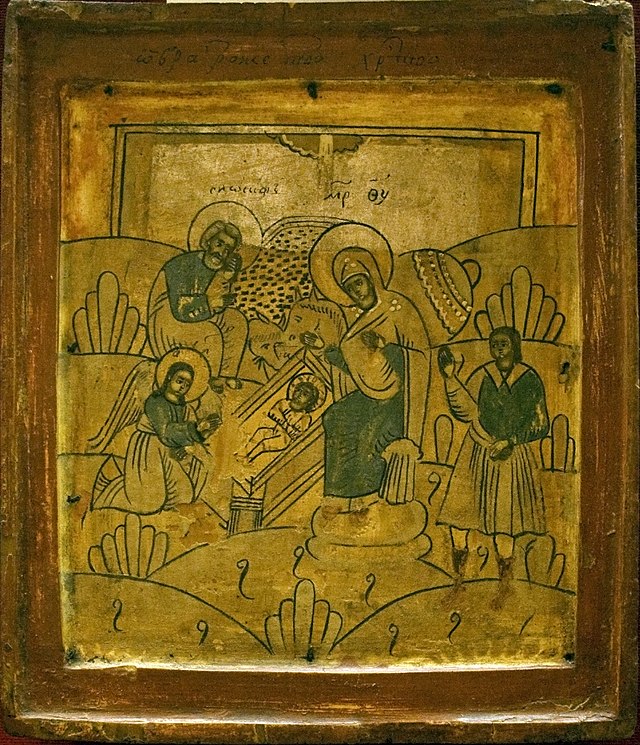
Birth of Christ, 18th Century, Russian Icon

That night the shepherds were out in the fields guarding their sheep. Suddenly, there was a bright light which startled the shepherds. The light was so bright that it turned the night into daylight. An angel appeared and said:

“Fear not for behold, I bring you good tidings of great joy, which shall be to all people. For unto you is born this day in the city of David a Savior; which is Christ the Lord. And this shall be a sign unto you: You shall find the babe wrapped in swaddling clothes, lying in a manger” (Luke 2:11-12).

Angels Praising This Wondrous Event

Then a larger group of angels appeared praising and glorifying God in their songs, “Glory to God in the highest, and on earth peace, and good will toward men” (Luke 2:14). The angels came to glorify God and also to bring glad tidings to men. The shepherds were awed. They didn’t know what to do, but they listened to the angels’ message. They decided to leave their flocks of sheep and go to Bethlehem to see for themselves what the angels had told them. When they got to Bethlehem, they found Mary, Joseph, and the infant Jesus. They fell to their knees and adored Jesus.

“Kings of Distant Lands Will Come”~ Psalm 72:10

On the other side, the Wise Men came from the East for they knew of the coming of Jesus. They had seen a star that told them that a new king had been born to the Jews.  A long ray from this star symbolizes heaven and points directly to the cave and the child they were looking for. The Star led them to Jesus and Mary where they fell down on their knees and worshipped Him. They gave Jesus gifts of gold, frankincense, and myrrh. 

“A virgin shall conceive and bear a son, and they shall call his name Emmanuel.” (Isaiah 7:14)

“For unto us a Child is born, Unto us a Son is given; And the government will be upon His shoulder. And His name will be called Wonderful, Counselor, Mighty God, Everlasting Father, Prince of Peace.” (Isaiah 9:6)

Russian Postage Stamp, 1995

This Holy Icon is an icon with many scenes. First, it stresses the importance of the Theotokos, the Mother of Jesus, who is placed in the center of the icon, and is the largest figure in the icon. In this icon, she is reclining with crossed arms. The Christ Child, just above her in the center of the icon, is in swaddling clothes and is lying in the manger. In the background is the dark cave where He was born. In the cave are an ox and a donkey guarding the newborn Babe. Even though the Gospels say nothing of the cave, this information is from Holy Tradition. Neither do the Gospels speak of the ox and the donkey, but all icons of the Nativity include these animals. Including the animals in the icon fulfills the prophecy of Isaiah 1:3, “The ox knows his master, and the donkey his master’s crib; but Israel does not know me, and the people have not regarded me.” The long ray of light from the star points directly to the cave. This ray comes from the star and travels to all parts of the world. It teaches that this bright star was not only an astronomical happening, it was a messenger from heaven announcing the birth of Jesus.

Icon Details

On the upper left hand side of the icon are the angels. The Wise Men, just below them, who were led by the star, bring their gifts of gold, frankincense, and myrrh to Jesus. These Wise Men, men of learning, have to accomplish a long journey to see the miracle from heaven, and they are of various ages.

One is without a beard. In those days, young men did not wear beards. The other Wise Man has long hair and a long beard, which indicates that he is much older. These details teach that regardless of age and appearance, the Good News was given to each and everyone.

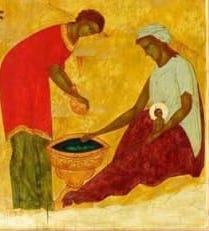
In the lower part of the icon are two more scenes. In the right hand corner are the two women Joseph brought to take care of the Christ child. They are bathing Him just as any baby is bathed. The humanity of Jesus is clearly shown in this setting.

Opposite the bathing of Jesus scene sits a sad and worried Joseph. He is not part of the central group of the Christ Child and the Theotokos, and is not the natural father, but the betrothed of Mary. As Joseph sits troubled by doubts, the devil, disguised as an old man, is tempting Joseph to doubt the virgin birth. Satan is telling Joseph that virgin birth is impossible. He’s telling Joseph that he’s a fool if he believes this. This story comes to us from Holy Tradition. The sad Joseph shows us not only his personal predicament but the dilemma of all mankind the difficulty of accepting that which is “beyond words or reason.”

The tree, which is in the middle of the lower part of the icon, is a symbol of the Tree of Jesse. This tree refers to Isaiah 11:1-2, “But a shoot shall sprout from the stump of Jesse, and from his roots a bud shall blossom. The spirit of the Lord shall rest upon Him.” King David was often mentioned as the son of Jesse and Jesus was from the House of David.

The Holy Icon of the Nativity reminds one to praise and glorify the Birth of Christ. The celebration of Christmas each year serves to remind each and every one of us that Christ came for you and me. And that’s the Good News!

“The Lord is my strength and my shield; my heart trusts in him, and he helps me. My hear leaps for joy, and with my song I praise him.”  Psalm 28:7

Online Advent Icon Writing Class, Egg Tempera and Gold Leaf

I’ll be teaching an Advent Online Icon Writing Class, December 5-8, 2023 on Zoom https://online.iconwritingclasses.com/courses/nativity-icon-Dec-5-8-2023-on-zoom   It will be a wonderful opportunity to pray and write icons to honor Christmas. Hope you can join us.

Blessings and prayers,

Christine Simoneau Hales. New Christian Icons

Icons and Community

“Between us there is but a narrow wall,

And by sheer chance; for it would take

Merely a call from your lips or from mine

To break it down, and that without a sound.

The wall is builded of your images.”

R.M. Rilke, the Book of Hours

Community can be difficult and takes time.  When I started this blog and the American Association of Iconographers back in 2014 I wasn’t sure what direction it would take.  I recognized a need for an American School of Iconographers- people who were learning from the Greek, Russian, Romanian and English iconographers who are actively teaching this ancient art world wide, but who would eventually, through much study, practice, and guidance, begin to evolve a style of icon writing that was uniquely their own.  

Last Supper Icon by Christine Hales

Last Supper Icon written by Christine Hales

It has to do with identity and all the things that influence the healthy growth of identity.  Our primary identity is in God, and we all have that in common.  But even a cursory study of the history of iconography shows that different styles have developed over many places and times.  And, theoretically, this growth needs to continue.

Creative community is vulnerable to many difficulties, but with God’s help, I believe we have begun to attract some highly creative, open minded iconographers who are willing to put aside individual differences in order to encourage and further this important opus dei in their fellows.

St. Benedict wrote his famous “Rule” in the sixth century to serve as a guide to forming and maintaining a community dedicated to glorifying God with their work, rest, and worship.  Saint Benedict’s model for the monastic life was the family with the abbot as father and all the monks as brothers.

Saint Benedict Icon written by Christine Hales, based on the fresco of Fra Angelico

Saint Benedict’s Rule organises the monastic day into regular periods of communal and private prayer, sleep, spiritual reading, and manual labour – ut in omnibus glorificetur Deus, “that in all [things] God may be glorified” (cf. Rule ch. 57.9).

Some adaptation of this rule might be beneficial to those of us seeking to form community as iconographers, albeit a global virtual community.  The FB group page (American Association of Iconographers) would be a good place to share ideas on this.

Early 19th Century Icon, Russian “Union of Love” (Sourced from Temple Gallery Catalogue Christmas 2004)

The FB group for the American Association of Iconographers is open to all who care to join with the spirit of unity, peace, and kindness.  It is intended to be a place where iconographers can share their experiences, ongoing projects, questions, or relevant links and articles that will serve to widen the education and perspective of iconographers today.  More recently, it seems, iconographers have wanted to use that platform for self promotion.

TO address this issue, I am offering to create a separate page for this website that will list members, show a photo, give their website, and a short description of their work. 

Membership in the AAI has always been and will remain without financial cost, but to join at the level of being represented worldwide on a separate page to other people interested in icons, there will be a fee of $35 to cover the costs of maintaining that page.

If you are interested in participating on this level, please email me at: chales@halesart.com to begin.  Meanwhile, keep taking the icon retreats, drawing classes, and religious studies, and reach out with emails and FB comments and be willing to share your gifts and to help others.

“Resurrection and Feasts” Russian, Late 17th Century, (Sourced from Temple Gallery Catalogue, Christmas, 2004)

May God continue to bless the work of your hands, and guide your thoughts, plans and actions to all that is pleasing to Him, Almighty God.

Christine Hales

newchristianicons.com online.iconwritingclasses.com Icon Prints

Holy Trinity Icon

Holy Trinity Icon
Holy Trinity Icon by andrei Rublev

Every icon has a theological background. Using images, forms and colors, the icon shows what Holy Scripture is teaching us by the Word.  The icon offers us truth as a vision, and thereby is a direct approach to our non-reasoning mind and heart, allowing us thereby to reach a deeper understanding of the Biblical message.  From the early development of icons to the present, the theological meaning of the icon is always connected to a concrete representation.

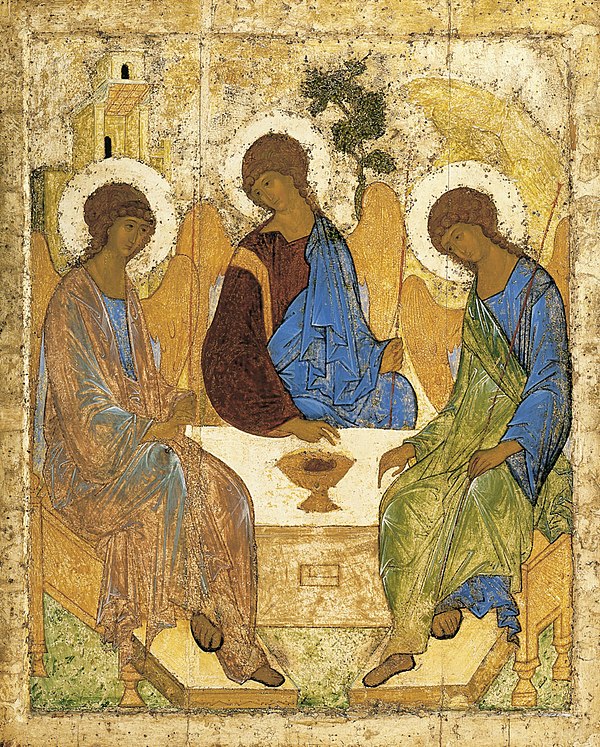
Considering the icon of the Holy Trinity painted by Russian iconographer Andrei Rublev in the fifteenth century, we have a very clear representation of the biblical passage Genesis 18:1-8.  The Trinity represents the three angels who visited Abraham at the Oak of Mamre.  Rublev’s intention for this icon was for it to embody spiritual unity, peace, harmony, mutual love and humility.

The composition of the icon uses sacred geometry to create a perfect circle that encloses the figures of the three angels. The left angel represents God the Father who is blessing the cup. The central angel represents Jesus Christ- his blue robe represents his divinity. He accepts the cup, bowing, and it is generally believed that this cup symbolizes the Eucharist and  the sacrifice of Jesus.

The oak of Mamre symbolizes not only the tree of life, but also the death of Jesus on the cross. The mountain is a symbol of spiritual ascent that man accomplishes with the help of the Holy Spirit. The inclination of the angels’ heads demonstrate submission to the Father on the left.

Typical of Rublev’s icons, the faces of the angels are shown illuminated by an inner light, and not as a reflection of an exterior light source.   His technique foregoes the white lines often used in painting faces in icons, using instead a method of paint application called “plav”.  This method crates a radiance and a glowing countenance that achieves nuances of form and expression which also suggest unity and harmony.

In the icon of the Trinity, Rublev preferred transparent colors in blue-green tones that he combined with the technique of scumbling to achieve a luminous presence that also speaks to the heavenly nature of the three angels.  The term “dymon pisano”, meaning transparent like a cloud”, is sometimes used to describe this technique.

Rublev’s icons appear to be more natural than those of the Palaeologue period. Their transparency reflects harmony of matter and mind.  The essential nature of the icon is that it is the expression of Christian revelation. For Rublev, the drawing-design dominated the process of icon writing.  His intention was to create harmony and unity through perfect contours and lines. 

In the Trinity icon, the drawing of the central angel’s garment is very geometric.  The angels on the sides, in contrast, are drawn with a gentle, calm movement. Similarly, the blue garment of the central angel is opaque and built up with layers, but the two side angels’ garments are transparent with touches of white.

In the Trinity icon, the complex theology of the Holy Trinity is represented by the  unity of the three angels.  The spiritual nature of God’s Divine Essence as the triune God is depicted as simply three angels. In this icon, we are invited not to look at three separate angels, but instead, to the Holy Trinity, the Triune God.

All-Holy Trinity, have mercy on us.
Lord, cleanse us from our sins.
Master, pardon our iniquities.
Holy God, visit and heal us
For Thy Name’s sake.

My next Zoom, online icon writing class will be April 18-21 and we will be painting the Holy Trinity Icon using egg tempera and gold leaf gilding. For more information click here.

May God continue to bless your interest in creating and praying with Holy Icons.

Kind regards,

Christine Hales

Newchristianicons.com

Sources for this article: Primarily excerpted from “The Icon, Image of the Invisible” by Egon Sendler

How To Gesso Icon Boards

Painting Icons using egg tempera paints requires that we use a solid, stable support that is also absorbent for the many layers we need to result in the jewel like appearance of icons.

Traditionally, poplar boards have been used that are coated in rabbit skin glue (as a sealer) and then between 8 – 14 layers of natural gesso, sanded in between layers.  The result should be a polished, smooth surface that is also highly absorbent.  Natural gesso is not the same as the acrylic gesso most people are familiar with.  Natural gesso is made using rabbit skin glue and chalk or marble dust.

Today there are many more modern materials that iconographers are experimenting with in part because the process of preparing an icon board is lengthy and requires a lot of physical effort and time.   Natural Pigments makes a product, “easy Gesso”, that seems much easier to use and works well, especially for beginning students.  https://www.naturalpigments.com/mediums-grounds/gesso-primers/gessoes/easy-gesso.html

Also, I tend to use Baltic Birch Wood panels because I feel they are less prone to warping than more traditional woods.

Below I will provide an explanation of how to prepare and gesso an icon board that I trust will be helpful.  If you should choose to experiment with other materials and find success, do write to me and I will add that to this list.

Icon Board Materials

Baltic birch panels of various sizes, a sauce pan and another container for mixing the gesso. I use recycled plastic or glass containers about the size of a large yogurt container. Distilled water, measuring spoons, measuring cup, wood spoon to stir, oxgall liquid, glycerin, marble dust or chalk, rabbit skin glue, 2″ bristle paint brush from the hardware store, 3 grades of sand paper- 300, 600, 1200 grit. Muslin or linen large enough to overlap the icon boards’ dimensions by 1 inch all around.

Set up your workspace with a long table covered with a painter’s drop cloth. I like to use one that I can dispose of when the whole process is finished because it will get quite messy.

Steps to Gesso Icon Boards

Linen drying on the boards, having been soaked in rabbit skin glue.

  1. Measure 2 Tablespoons of Rabbit Skin glue into 2 cups of distilled water, stir well. Let sit until glue is completely absorbed and expanded- 2-4 hours.
  2. Place glue mixture in a container that rests in a saucepan , double boiler is good), containing 3 inches of boiling water and let the glue melt. Be careful it doesn’t get too hot- do not boil the glue mixture! 135 degrees Farenheit is too hot!!
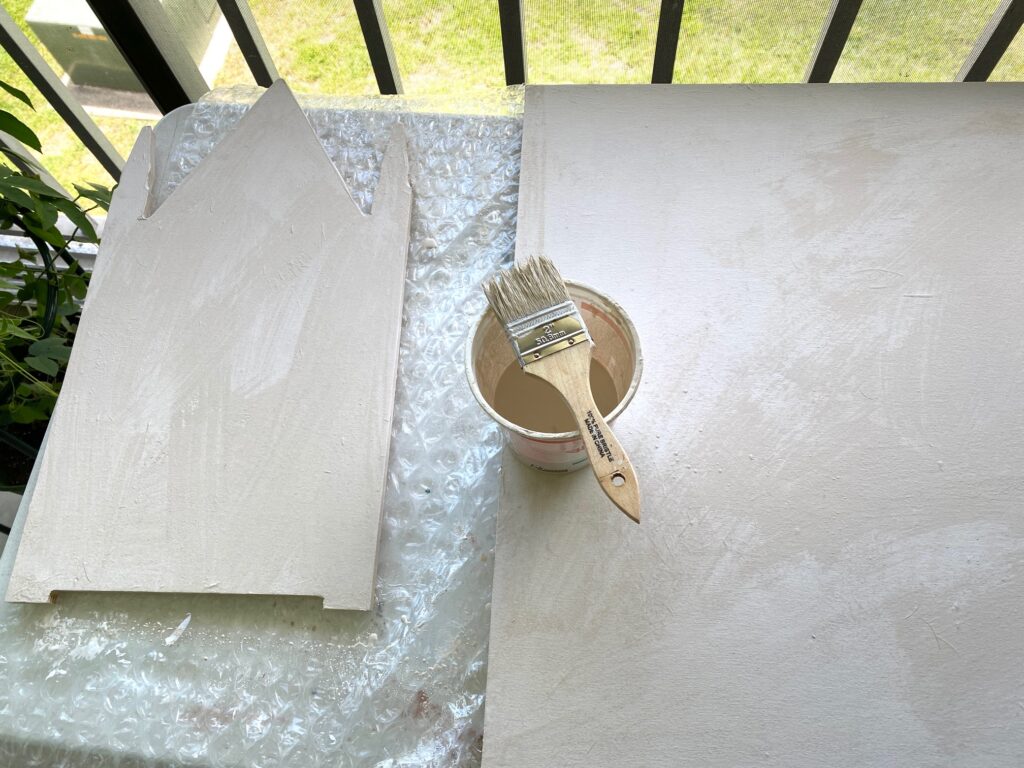
  3. Next, using the 2″ Bristle brush, coat both sides and edges of each board with the glue. Let each side dry about 2-4 hours. This will prevent the board from warping and will keep out atmospheric moisture in the future.
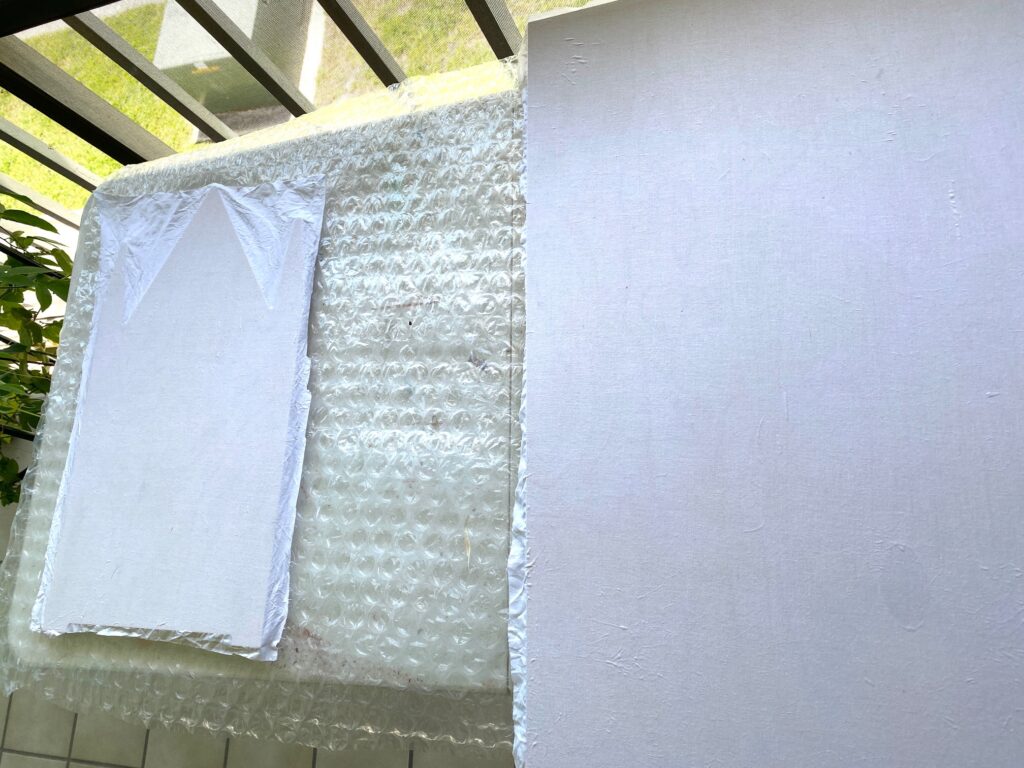
  4. When the boards have dried, the next day, you can mix up some more glue This you will use to, first, coat the dry icon boards with it. Second, dip the pre cut linen into this glue mixture and spread evenly on the board. Smooth out wrinkles- I use plastic gloves.
  5. Next day, use a mat knife to trim edges of over lapping linen.

Time to trim the edges of the linen- when they are completely dry.

Making the Gesso

  1. Now it’s time to make the gesso itself! Make the glue- 2Tbs rabbit skin glue added to 2 cups of water – as before. Let soak, then warm until completely dissolved, as above.
  2. When the glue is ready, using a sieve, gradually add approx 3 cups of whiting – chalk or marble dust. I also add 1 teaspoon of oxgall liquid and 1 tsp of glycerin. These are dispersion agents and they are optional. I use Kremer Chalk from Champagne K 58000, and/or marble dust K 58500. I often make a mixture of chalk and marble dust but you can use just the chalk as well.
  3. When this is ready, start putting layers of gesso on the boards, letting them dry in between layers. It doesn’t take too long for each layer to dry- in the summer it might take 1/2 hour.

Sanding the Boards

  1. After 3 or 4 layers, I usually give the boards a rough sand to take off any bumps or rough spots. This can be done with a wet sanding method described in the video below, or with regular sandpaper. The wet sand method is my choice, usually. Don’t forget to coat the edges of the board. After 6 layers I sand again. Then, a final sand after the last 2 layers. You can make anywhere from 4-8 layers. Use the finest sand paper for the final sand and you will get a beautiful smooth surface ready to paint on!

There are several videos on you tube showing different approaches to gessoing an icon board. You might want to watch this, or one like it, all the way through before starting. Icon boards video by Paul Stetsenko. Or, if this is too much bother, you can always order an icon board!! I have included some new sources on my website on the student resources page.

Happy Icon Painting!

May God bless you and guide you in all of your endeavors in this Holy ministry.

Christine Hales

Christinehales.com My Icon Print Website

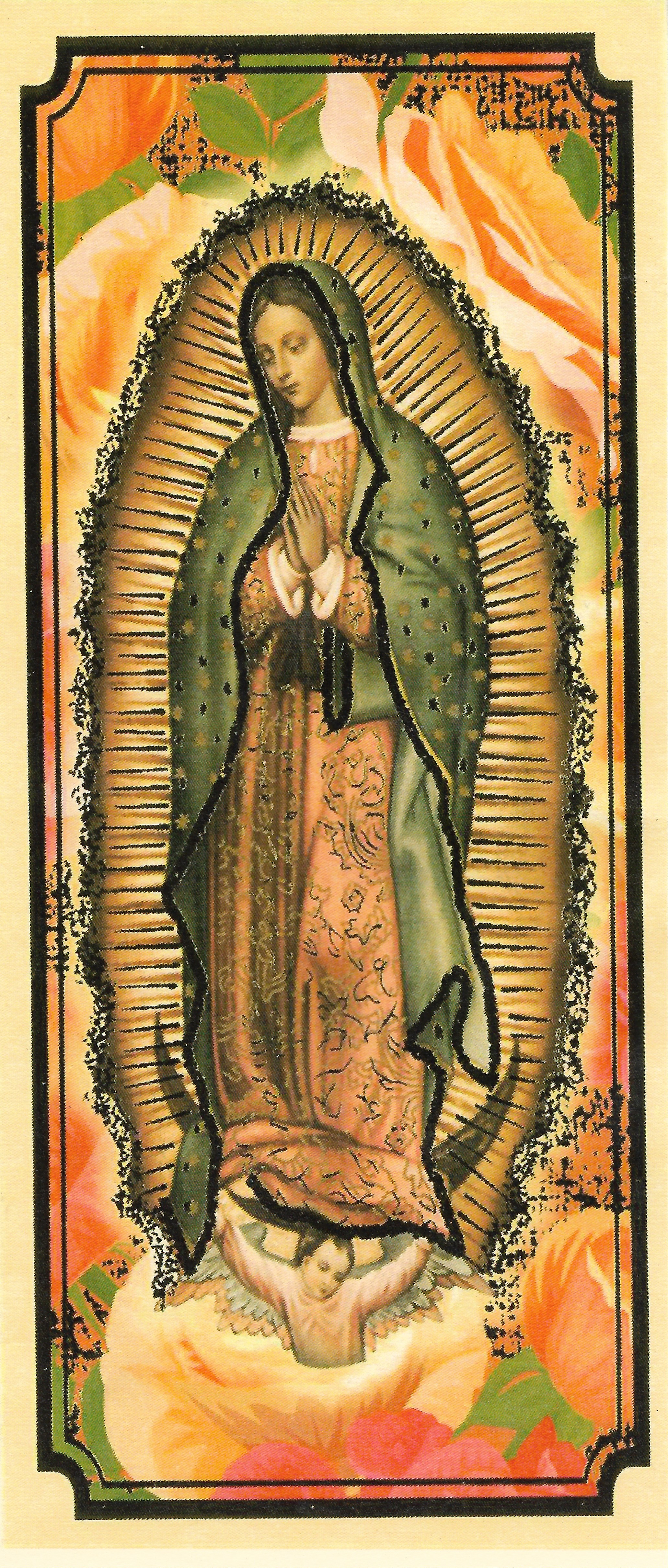
Our Lady of Guadalupe

One of the most important icons of the western world is Our Lady of Guadalupe, sometimes called the Virgin of Guadalupe.

While the history of the apparition and subsequent miracles are fodder for speculation, there are certain facts that all agree on.

A series of five apparitions occurred in December of 1531 within the Basiclic of Our Lady of Guadalupe in Mexico City.  This basilica is the most visited Catholic shrine in the world, and the world’s third most visited sacred site.

According to legend, the Virgin Mary appeared four times to Juan Diego, an indigenous Mexican peasant, and once to his uncle, Juan Bernardino.  The first apparition occurred on the morning of Saturday, December 19, 1531.  Juan Diego experienced a vision of a young woman at a place called the Hill of Tepeyac.  The woman spoke to Juan in his native language, Nahuatl, and identified herself as the “Virgin Mary, mother of the very true deity”.  She asked for a church to be erected at that site in her honor.  Juan Diego then told the  Archbishop of Mexico City what had happened.  Unsurprisingly, Juan wasn’t believed.  Later that same day, Juan Diego saw the second apparition. The young woman asked him to continuing pressing the Archbishop for a church to be built.

Our Lady of Guadalupe Icon written by Christine Hales

The next day, a Sunday, when Juan Diego spoke to the Archbishop a second time, the Archbishop asked for a truly miraculous sign to prove her identity.  Later that day, the third apparition appeared when Juan Diego returned to Tepeyac Hill. He again encountered the same young woman and told her of the request for a miraculous sign. She agreed to provide this the next day.

By Monday, Juan Diego’s uncle, Juan Bernardino, became ill and Juan Diego had to care for him.    Unfortunately, the uncle’s condition worsened and In the very early hours of Tuesday, Juan travelled to find a Catholic priest to hear his uncle’s confession and minister to him on his deathbed.  On this journey, Juan Diego traveled around the place of is previous encounters with the young woman because he was ashamed by not meeting her as promised the previous day.  But still, the young woman found him and asked where he was going.  This was the fourth apparition.  When Juan Diego explained what had happened, she gently reminded him that he should have sought her assistance.  She asked “ No estoy yo aqui que soy tu madre?”  (AM I not here, I who am your mother?  She assured him that his uncle was now recovering and told him to gather flowers from the top of Tepeyac Hill.  This hill was normally barren in December.  Juan obeyed her instructions and found Castilian roses, not native to Mexico, blooming there. The Virgin arranged the flowers in Juan’s tilma (cloak), and when he opened his cloak later that day for the Archbishop, the flowers fell to the floor, revealing the image of the Virgin of Guadalupe.

The next day, Juan Diego found his uncle completely healthy, just as the Virgin had told Juan.  Juan Bernardino said that he had also seen her praying at her bedside and that she had instructed him to tell the Archbishop about his miraculous cure and that she had told him she wanted to be known as the Virgin of Guadalupe.

The Archbishop kept the mantle in the church where it attracted many visitors.  On December 26, 1531, a procession formed to transfer the miraculous image back to Tepeyac Hill where it was installed in a small chapel.  During this procession, the first miracle occurred when a young native who was accidently mortally wounded was completely healed when brought before the Virgin’s image with many prayers and supplications.

The Virgin of Guadalupe is known as the Queen of Mexico, the Paton saint of both North and South America, and titles given by Pope John Paul II, “Empress of Latin America and Protectress Of Unborn Children”.

It’s so interesting to hear the stories behind icons. Please contact me if you have other examples to share. (chales@halesart.com).

INTERESTING LINKS FOR ICONOGRAPHERS

Greek Iconographer, George Kordis, gave this talk on “Tradition as Creativity” at Saint Vladimir’s Seminary in April 2022: . https://www.youtube.com/watch?v=Jg6ts-8Kiaw

This link is to a video by iconographer Antonis demonstrating two methods of blending while painting in egg tempera: https://www.youtube.com/watch?v=hnaImXOEvuI

This is a link to an EWTN tv show called Living Divine Mercy, it features an interview and video about my icons.

That’s all for this month. If you would like to take my online Icon writing class January 17-20, 2023, please click here for more information.

Blessings, Prayers, and Best Wishes for a God Filled New Year!

Christine Simoneau Hales

christinehales.com