Innovation and Change

Innovation and change- not two words one usually associates with Iconography! But in order to have authentic icons today, they need to be able to relate to our culture today as well as to be expressions of our relationship to God today.  In the words of a noted Romanian iconographer today, Todor Mitrovic, “…it is impossible to create authentic ecclesiastical art if we do not engage in a dialogue with contemporary art .   

Last Supper, Todor Mitrovic

Of course, what that dialogue looks like visually, when translated through the filter of Byzantine Iconography, will look different for each iconographer.  And this is right and correct, for each of us are products of different countries and cultures, but one faith.  Our faith is what provides unity in our efforts to serve God with the talents He has blessed us with.

Take Giotto, As an Early Innovator Example

Consider Giotto Bondonne, born approx..1267, taught by the Italian artist Cimabue, known today as the father of the Renaissance.  He always believed that art should be the handmaiden of the Church, but he also believed that art needs to be able to connect with the common man and his faith.  

The Virgin and Child with Saints and Allegorical Figures, Giotto, 1315. Egg Tempera and Gold leaf

Giotto is famous for the Peruzzi Altar Piece, the Bardi Chapel, and Scrovegni Chapel fescoes, among much other sacred art. While the subject matter of his work was Scriptural, it had a strong bias towards depicting everyday life.

Byzantine art was prevalent even in Italy from the sixth century onward since Emperor Justinian brought craftsmen from Constantinople to build churches and monasteries.  Some of these are still seen in San Vitale in Ravenna, San Marco in Venice and Monreale in Sicily. Giotto was influenced and  informed by this Byzantine art as part of his early training. 

During his lifetime, Giotto was heralded as an artist who revived the art of painting, which some felt had fallen into ruin over the course of the Middle Ages. He was famous for painting on a monumental scale, demonstrated by his majestic frescoes in the Scrovegni Chapel in Padua. 

Giotto…”brought back to light an art which had been buried for centuries…So faithful did he remain to Nature…that whatever he depicted had the appearance, not of a reproduction, but of the thing itself, so that one very often finds, with the works of Giotto, that people’s eyes are deceived and they mistake the picture for the real thing.”

Giovanni Boccaccio, a contemporary of Giotto

One of the main stylistic differences from Byzantine art that Giotto introduced was depicting the human form as it appears in nature.  The figures appeared more natural and showed human expressions appropriate to the depicted scene.

The Virgin and Child with Saints and Allegorical Figures, Giotto, 1315. Egg Tempera and Gold leaf, detail

I understand that as Iconographers, we are taught to avoid this kind of naturalism in favor of  stylized , expressionless figures on a flat surface.  So what is my point? Only that it is possible to introduce artistic innovations into church art in order for that art to reach the common man.

Neon Artist , Stephen Antonakos, Icons

Here are a couple of”icons” created in 1989 that incorporate gold leaf, wood, light, and theology. Compare these with Giotto and they seem to apply more to a Byzantine definition of icon than Giotto’s religious art and those of the Renaissance that followed. And yet, Antonakos’s icons are entirely abstract. Do they relate better to our modern culture and create a holy image that brings God to mind? 

“Transfiguration”. By Neon Artist, Stephen Antonakos 1989. Neon, Gold Leaf on Wood

Saint Peter Icon. by Neon Artist, Stephen Antonakos. Neon, gold leaf on wood, 1989

INNOVATION AS A WAY TO ENGAGE THE VIEWER

How do we innovate within a Byzantine Iconographic context today at a time when art making is so widely diverse and even technological?  I don’t have any answers, except to say that it is a worthy challenge for iconographers and religious painters today!

Saint Nicholas.  Todor Mitrovic

I’d like to close with another quote from one of my favorite contemporary Iconographers, Todor Mitrovic:

“In my opinion, church art, approached through its liturgical perspective, must be brought to life by people in actual time. This also means it must be brought to life in an actual cultural context – comparable with, but – at the same time – incomparable with, previously existing cultural contexts. 

We are invited to transform this actual cultural context however impossible it may seem.

It is not expected of us to express the faith of people who once lived on the land we inhabit today, but instead – our own faith.

No matter how primitive and rudimentary our expression is, it has to be done from the heart, through the mind and body, otherwise we are avoiding the responsibility of being part of the Body of Christ. Such expression is part of our attempt to make the Body of Christ present, which is, when speaking about art, making it visible in a material and cultural context. This is why all we can give, all our talent, must be included in the process – otherwise we are denying our skill, burying talents to the ground (to use the Gospel parable), and at the same time doing little more than telling pleasant stories about the Middle Ages.”

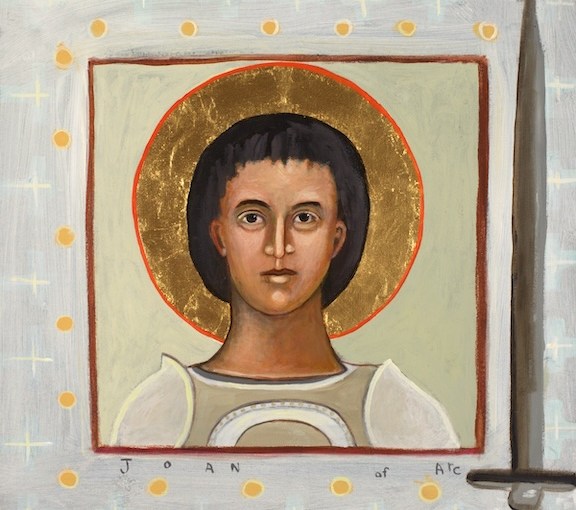
Joan of Arc, Christine Hales


May this article serve as both a challenge and an encouragement for each iconographer, urging us toward exploration, experimentation, and a celebration of diverse styles within contemporary iconography. Let the love of Christ infuse every stroke of our brushes and guide our collective journey as a group of artists profoundly devoted to Christ.

Christine Simoneau Hales

New Christian Icons     My Patreon Page


Sources for this article:

https://www.getty.edu/news/everyones-talking-about-giotto/

Antonakos , by Irving Sandler

“

A Christmas Journey

A Christmas Journey: Lessons from the Nativity Icon

As we joyfully concluded my latest icon writing class, the crowning achievement was a breathtaking depiction of the Nativity. Beyond the demonstrations and questions, the process became a conduit for spiritual revelations about the Nativity Icon during our retreat. The shared exchange of thoughts and questions revealed the profound spiritual wisdom residing within each class member. I am so grateful for the divine synchronicity that brings such beautiful souls into my classes, contributing to a shared journey of growth and revelation in the span of just four days.

In the spirit of post-retreat reflection, my thoughts turned to the iconic journey of the three wise men. Weary yet resolute, they traversed long and perilous roads, guided only by a celestial star lighting their way to Jerusalem. Their journey, fraught with challenges, reached its culmination under the brilliant radiance of the star directly above, revealing the long-promised redemption in the form of a humble baby nestled in a manger. This divine encounter brought the wise men to their knees in worship and adoration before the embodiment of God’s power and glory.

The resonance between the wise men’s Christmas journey and our own spiritual quests is striking. As we usher in the festivities of 2024, I pray that we may emulate the wise men, offering our heartfelt praise and worship in response to the wonder of the incarnation.

Drawing inspiration from Sarah Young’s “Jesus Calling” (pg. 372), let our perseverance along God’s ordained path be sustained by His strength. Miracles, though not always visible to the naked eye, become apparent to those who live by faith. As we navigate our individual paths, let us watch and wait, expecting miracles and acknowledging that living by faith grants us the clarity to witness divine interventions.

The Nativity Icon by Christine Hales

In this festive season, my heartfelt Christmas prayer for you is to embrace the faith-driven approach of the three wise kings. May your Christmas be filled with the warmth of faith rather than mere sight, positioning you to experience the unfolding glory and power of God in your life. As 2024 unfolds like a gift waiting to be unwrapped, may you draw nearer to Him than ever before, embracing the Christmas spirit with anticipation and receptivity. May your Christmas be blessed with joy, peace, and the wonder of His love.

Christine Hales. Artist, Iconographer

My Website

My Next Online Icon Writing Retreat is April 9-12, 2024

“Unveiling the Secrets of Medieval Icon Painting”

There are so many exciting principles we modern icon painters can learn from medieval icons. The secrets of Sacred geometry and painting are profound, but no less important are the concepts behind medieval iconographic paint application.

St, Nicetas with Deesis and Selected Saints, 15th Century

The simplest statement that icon painting is the consecutive application of layers of colored paint applied on the white surface of a wood board that is primed with gesso- white chalk and animal glue.

This notion of “consecutive layers of paint” is a hallmark of medieval painting because beginning with the Renaissance and the use of oil painting, the Renaissance painter used modeling- application of shadows- thereby obviating the need for the consecutive layers to achieve a modeling effect of figures and shapes.

Holy Trinity Icon by Andrei Rublev

Icon painters can use a few layers, or many, depending on the time available and the effects needed. Although early Christian artists used encaustic (wax) as their painting medium, from the ninth century onward, egg tempera was the medium icon painters used, almost exclusively.Egg Tempera

Egg Tempera

Egg tempera painting consists of painting with dry powdered pigment using egg emulsion as the binder to cause adhesion of pigment to the gessoed surface area. This dry powder was often found in soil and stones finely ground as well as in some plants, roots and insects that could be boiled or pressed to release specific colors.

“Of crucial importance are the choice of the right pigments, the ability to mix them properly, and the application of each consecutive layer when the one below it is quite dry so that the fresh, wet paint does not mix with it.”  A. Yakovleva, “A History of Icon Painting”.

Which Pigments were used in Early Icons?

Studies show that vermillion, red ochre and lead red were the reds commonly used by early iconographers.  Light yellow ochre, yellow sienna, lead tin yellow, and auripigment were the yellow pigments used, natural ultramarine (obtained from azurite) and indigo for blue, malachite and glauconite for greens, charcoal for black, lead white, umber, hematite were the browns and various ochres depending on what was naturally available.

Christ Pantocrator Icon, Svanetia, 13th Century

Three Ways of Mixing Colors

I find it so interesting that the three ways that medieval iconographers mixed their colors could have such a significant effect on the final results of their work.  The first method of mixing colors was simply to mix a powdered pigment with the egg emulsion. (egg emulsion is usually the yolk of an egg mixed with a small amount of water, and a very small amount of vinegar or alcohol as a preservative.) Some of the pigments lent themselves to being ground to a fine powder, but others could only be ground to larger crystals and this variety of textures was put to good use in the third method.

The second method of color mixing is called optical mixing.  This consists of relying on the different color layers to mix optically. This is achieved when rays of light hit the surface, they penetrate through the layers of color and reflect back the impression that it is one color when in reality it is the combination of all the color layers together.  This gives the viewer a very rich viewing experience and is what allows the icons to have a jewel like appearance.  Egg tempera excels at being able to deliver this effect.  For this to happen, the artist needs to apply the layers very thinly in order for this imperceptible color mixing to occur.

The Forty Martyrs of Sebaste, 13th Century. Georgia

The third method employs the use of the rougher pigments with larger particles to be mixed for the lower layer of the icon.  This allows for subsequent layers to settle into the lower layer in irregular and interesting ways.  This method unites the upper layers and lower layers of color, allowing for the appearance of visual harmony.  A combination of all three methods is used by the experienced iconographer.

I hope this explanation of medieval color mixing has been helpful.  Sometimes we need to go back to basics and understand nuances in order to achieve the results we want in our icons. If you would like to pursue the topic further, here is some reading you may appreciate:

“A History of Icon Painting”, L. Evseyeva, Moscow Publishing but available on Amazon

“The Materials and Techniques of Medieval Painting” Daniel V. Thompson, Dover Publishing

Interesting Links For Iconographers:

These are from Dorothy Alexander, an Iconographer in California!:

  • A gold sale? Yes, this is very rare because of a factory overrun on 22kt loose leaf gold and continues through 8/31/23 only. Use the code: SUMMER23 when you check-out. I ordered from them before; for this sale I purchased the 22 kt loose leaf gold (which I use for backgrounds) and it shipped quickly. Here is their website: https://www.goldenleafproducts.com/order-22k-gold-leaf.html    (THIS LINK WAS MORE THAN A MONTH AGO, SO NOT SURE IF THE SALE IS STILL GOING ON BUT THEY ARE GOOD GOLD SUPPLIERS)
  • Russian iconographers in a Greek monastery in California – this article (https://orthochristian.com/113398.html) takes you to the Life-Giving Spring Monastery in Dunlap, CA. It is a very interesting description of the lives and work of iconographers.
  • My Next Online Icon Writing Class is specially prepared for celebrating Advent where we will be painting an icon of the Nativity. Dec 5-8 on Zoom, each session is recorded for playback.   Read more here.

That’s all for this month.  Icon writing is a commitment to a life of prayer, study, and blessing the community with our work.  May you all be blessed and guided by the hand of God.  Our work is even more important especially in these difficult times.

“O Almighty God, kindle, we beseech Thee, in every heart the true love of peace, and guide with thy wisdom those who take counsel for the nations of the earth, that in tranquility they dominion may increase till the earth is filled with the knowledge of thy love; through Jesus Christ out Lord, who liveth and reigneth with thee, in the unity of the Holy Spirit, one God, now and forever, amen.”  A Collect for Peace from the Book of Common Prayer.

Blessings,

Christine Hales

Newchristianicons.com