
Dear Fellow Iconographers:

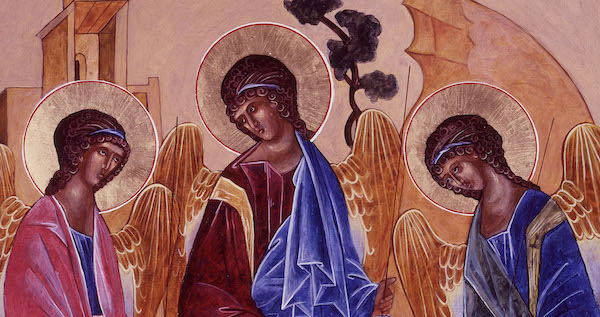
Recently, while sharing with good friends my current Icon exhibition at All Angels Church in Sarasota, I was pleasantly reminded about the importance of the concept of the “uncreated light” within icons. Having promised to reflect more on this topic, I now share with you some thoughts and research on that very important but sometimes overlooked aspect of icon writing/painting.
The Light of Mt. Tabor: The Light of the Transfiguration and Paul’s Conversion
In the 14th century, Gregory Palamas, an Athonite monk and proponent of Hesychasm, explored the concept of the Uncreated Light. According to the Hesychast mystic tradition of Eastern Orthodox spirituality, a completely purified saint who has attained divine union experiences a vision of divine radiance, the same ‘light’ that was manifested to Jesus’ disciples on Mount Tabor at the Transfiguration and to Saint Paul at his conversion. This profound experience is referred to as theoria. The doctrine of the uncreated light is rooted in Palamas’ interpretation of the teachings of Gregory of Nyssa.
Orthodox Christians also find instances of the Uncreated Light in the Old Testament, such as the Burning Bush.

Joseph the Elder, Hesychast
Joseph the Elder, a 20th century Hesychast and Greek Orthodox monk from Mount Athos, longed for unceasing prayer but faced numerous challenges, including the difficulty of finding a spiritual father and the indifference of many monks toward constant prayer. In his yearning for divine connection, Joseph was ultimately granted a vision of the uncreated light, receiving the gift of ceaseless prayer.
“At once I was completely changed and forgot myself. I was filled with light in my heart and outside and everywhere, not being aware that I even had a body. The prayer began to say itself within me…
O Master, our sweetest Lord Jesus Christ, send forth Your grace and free me from the bonds of sin. Enlighten the darkness of my soul, so that I may apprehend Your infinite mercy, and so that I may love and thank You worthily, my sweetest Savior, Who is worthy of all love and thanks.” Amen
Egon Sendler on Iconic Light
Egon Sendler, in his book “Icon, Image of the Invisible”, explained that the light depicted in icons is distinct from natural light. Iconic light represents incarnate grace and must be received in contemplation.
“In the icon, we see a divine reality that transcends this earthly world while respecting it because it is created by God, to be transfigured in His spirit. If an icon reduces the mystery of God to mere material forms, it loses its soul and spiritual character, becoming an illusion of reality.”
Sendler emphasized that the dynamic nature of icons involves all the pictorial elements moving towards the observer, with light following this movement, creating a transfigured world and bringing the viewer into union with God..
Leonid Ouspensky from “The Meaning of Icons”

Leonid Ouspensky, in his book entitled “The Meaning of Icons”, highlighted that Church art, particularly icons, visually testifies to the dual realities of God and the world, grace and nature.
“Through the icon, as through the Holy Scriptures, we not only learn about God but also know God. The transfiguration, an illumination of the entire man through prayer by the uncreated light of Divine Grace, manifests man as a living icon of God. The icon represents this transfiguration, depicting a man filled with the Holy Spirit’s grace.”
Ouspensky concluded that liturgical art represents both our offering to God and God’s descent into our midst, facilitating a profound meeting between God and man, grace and nature, eternity and time. Perceiving the uncreated light of God’s grace in an icon leads us toward Holy Communion with God, transcending our natural world.
Conclusion:
The concept of the Uncreated Light in Eastern Orthodox spirituality and iconography emphasizes the profound connection between the divine and the material world. Through the transformative experiences of saints like Joseph the Elder and the theological insights of figures like Gregory Palamas, Egon Sendler, and Leonid Ouspensky, we understand that icons are not merely art but manifestations of divine reality and grace, guiding believers towards a deeper communion with God. And so, when writing, or painting icons, choosing colors that reflect the uncreated light of God’s grace becomes a subtle, but highly important imperative of icon creation.
Here are some interesting links for Iconographers:
Icon Museum and Study Center, Clinton Massachusetts
Introduction to Icons Video by Patristix
Icon Writing Pigments and other Supplies for Icon Painting
That’s all for this month. May God continue to bless the work of your hands,
Christine Simoneau Hales
 American Association of Iconographers