
This is the third in a four-part series of articles that examine the historical evolution of Christian icons that I have written for the Anglican Digest. This article appears in the fall issue. In this article we will explore the significance of a symbolic visual language of icons in contrast to a more realistic one that began to develop from the late Byzantine period through the beginnings of the Italian Renaissance paintings.

This stylistic change is very important. It helps to define the difference between holy icons and the religious painting that grew out of the Renaissance. This difference became ever more pronounced as time went on, and the shift from symbolic to realistic imagery and storytelling can be compared to the difference between a parable and a narrative story. The parable can have more eternal, universal and varied meanings, while realism points to a particular moment in time, a specific meaning. Eastern church traditions preserved the integrity and spiritual function of icons, while Western Europe began to explore art’s potential to engage both the senses and the intellect.
Church Art From the 11-15th Centuries
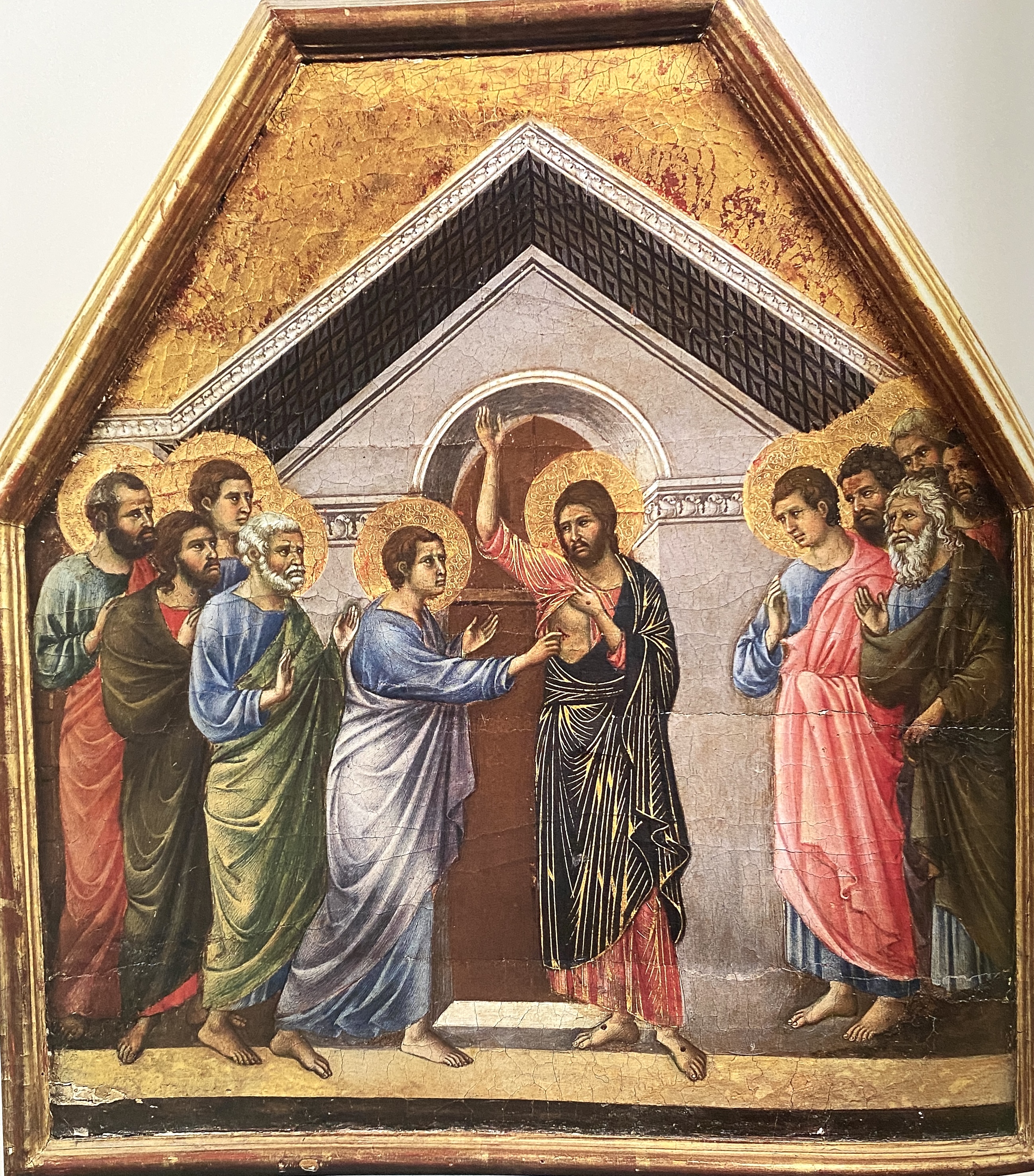
From the 11th to the 15th centuries, art saw significant development, transitioning from medieval styles to the Renaissance. The rise of Romanesque and Gothic art occurred in the Middle Ages, with Romanesque art taking shape in the eleventh century, initially developing in France then spreading to Spain, England, Flanders, Germany, Italy, and other regions.

One of the most spectacular achievements of medieval artists which was their desire to pursue heavenly light in their creation of the worship space. The importance of this play of light had its beginnings in the 12th century when the heavy, dark Romanesque architecture began to be replaced by Gothic development of pointed arches, vaulted ceilings, and flying buttresses- all of which made it possible to admit more light into the sanctuary than would have been possible before.
Light for Christian culture had great significance because of the extensive Biblical associations of light with God himself, beginning with Genesis, “Let there be light”, and in the writings of Saint John the Divine. At this point, the Bible had become an important source of ideas about beauty, both esthetically and also in a moral sense. Illuminated Manuscripts flourished.
Icons and Art of the Eastern European Church
The developments of Church art in the East can be understood in several stages, or periods of Byzantine Culture: The Macedonian period, from 867-1056, the Komnenian period from1081-1185,and the Palaeologan Period 1259-1453. These political and cultural periods influenced the style of icons as we will see.
Macedonian Period (867-1056)

Macedonian art grew with advancements in learning and significant church construction and restoration following the period of Iconoclasm. (see my previous article). The artistic achievements of the Macedonian dynasty reflected grace, drawn from the fourth century, with the strength and beauty of earlier Hellenistic traditions. This blend of qualities infused religious art and icons with a distinctive dignity, refinement, and balance. These characteristics became synonymous with Byzantine design, aligning harmoniously with religious themes.
Komnenian Period (1081-1185)

The Komnenoi were great patrons of the arts, and with their support Byzantine artists continued to move in the direction of greater humanism and emotion, of which the Virgin of Vladimir is an important example. Ivory sculpture and other expensive mediums of art gradually gave way to frescoes and icons, gaining widespread popularity across the Empire. Although the art produced in the Byzantine Empire was marked by periodic revivals of a classical aesthetic, it was above all marked by the development of a new aesthetic defined by its abstract or anti-naturalistic character. If classical art was marked by the attempt to create representations that mimicked reality as closely as possible, Byzantine art seems to have abandoned this attempt in favor of a more symbolic approach.
Palaeologan Period (1259-1453)

Paelogan Byzantine artists developed icons, which became a popular medium for artistic expression, and were characterized by a less austere attitude. This appreciation for purely decorative qualities of painting and meticulous attention to details is sometimes referred to a Palaeologan Mannerism. Russian icon painting began by entirely adopting and imitating Byzantine art, as did the art of other Orthodox nations, and has remained extremely conservative in iconography.
The fall of Constantinople in 1453 was a significant event in the history of the Byzantine Empire, and it had a profound impact on the art world. Many Byzantine artists migrated to Italy, where they played a vital role in shaping the Italian Renaissance. of the Byzantine Empire in the preceding centuries.
The splendour of Byzantine art was always in the mind of early medieval Western artists and patrons, and many of the most important movements in the period were conscious attempts to produce art fit to stand next to both classical Roman and contemporary Byzantine art.
Religious Painting and Icons in the Western Church
The influence of Byzantine art on Italian art was significant, with Byzantine artists bringing their techniques and knowledge to Italy, especially the use of gold leaf and mosaics.
Three Italian painters of the 14th century, Cimabue, Duccio, and Giotto, are generally considered the link between the earlier iconic style of painting with its flattened pictorial space, and simple, abstract compositions and little if any naturalistic details, and the Renaissance. In their work you will see that transition and the theme of the early development of naturalism that is the precursor to the Renaissance and the end of iconographic perspective.
Cimabue 1240-1302

The paintings of Cimabue were heavily influenced by Byzantine iconography, and gradually they began to break away from that tradition into a more naturalistic rendering of human forms and space. His work is a transitional step in the development of western painting bridging the Medieval and Renaissance periods. His work clearly influenced the styles of other Italian artists at the time such as Duccio di Buoninsegna and showcases the ongoing evolution of Italian art.
Duccio 1250-1391. Sienna, Italy
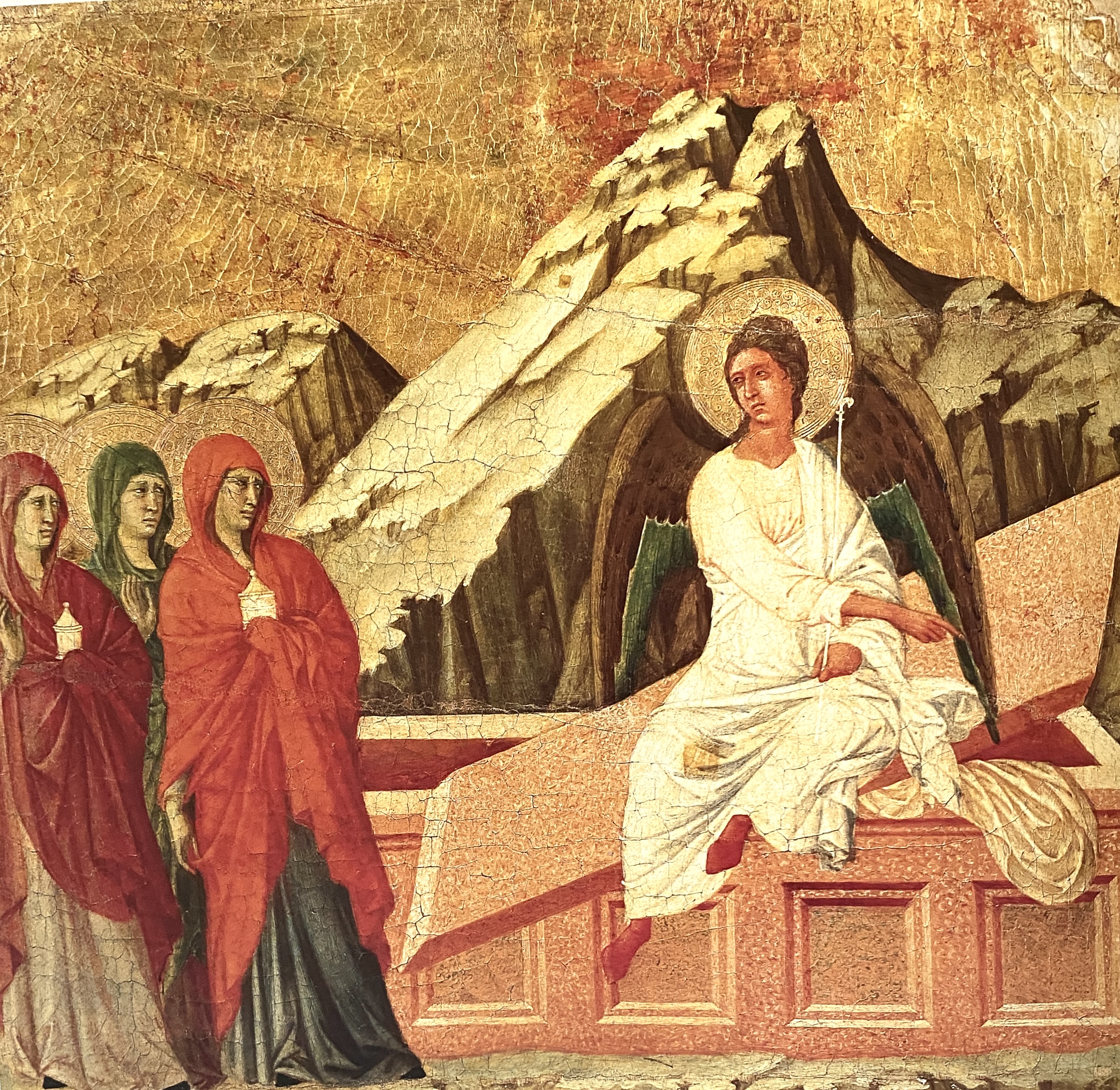
Duccio , as the founder of the Sienese school of painting,was the predominant painter of the 14th century.He ran a large workshop which shaped generations of Sienese artists. His religious paintings brought a lyrical expressiveness and intense spiritual gravity to the Italo-Byzantine tradition. In a small devotional panel of the Madonna and Child, Duccio bridged the gap between the spiritual world of the figures and the real world of the viewer in very much the same way that Icons do. His holy figures were majestic, his pupils were influential in Florentine art, and his greatest work was the double-sided altarpiece, the ‘Maestà’, made between 1308-11. Both Duccio and Cimabue began their careers producing iconic altarpiece paintings in the flat, two dimensional style of Byzantine icons, and ended their careers with more naturalistic paintings. Both were enlivened and inspired by the Franciscan spirituality of their time.
Giotto di Bondone, Italian, 1267-1337
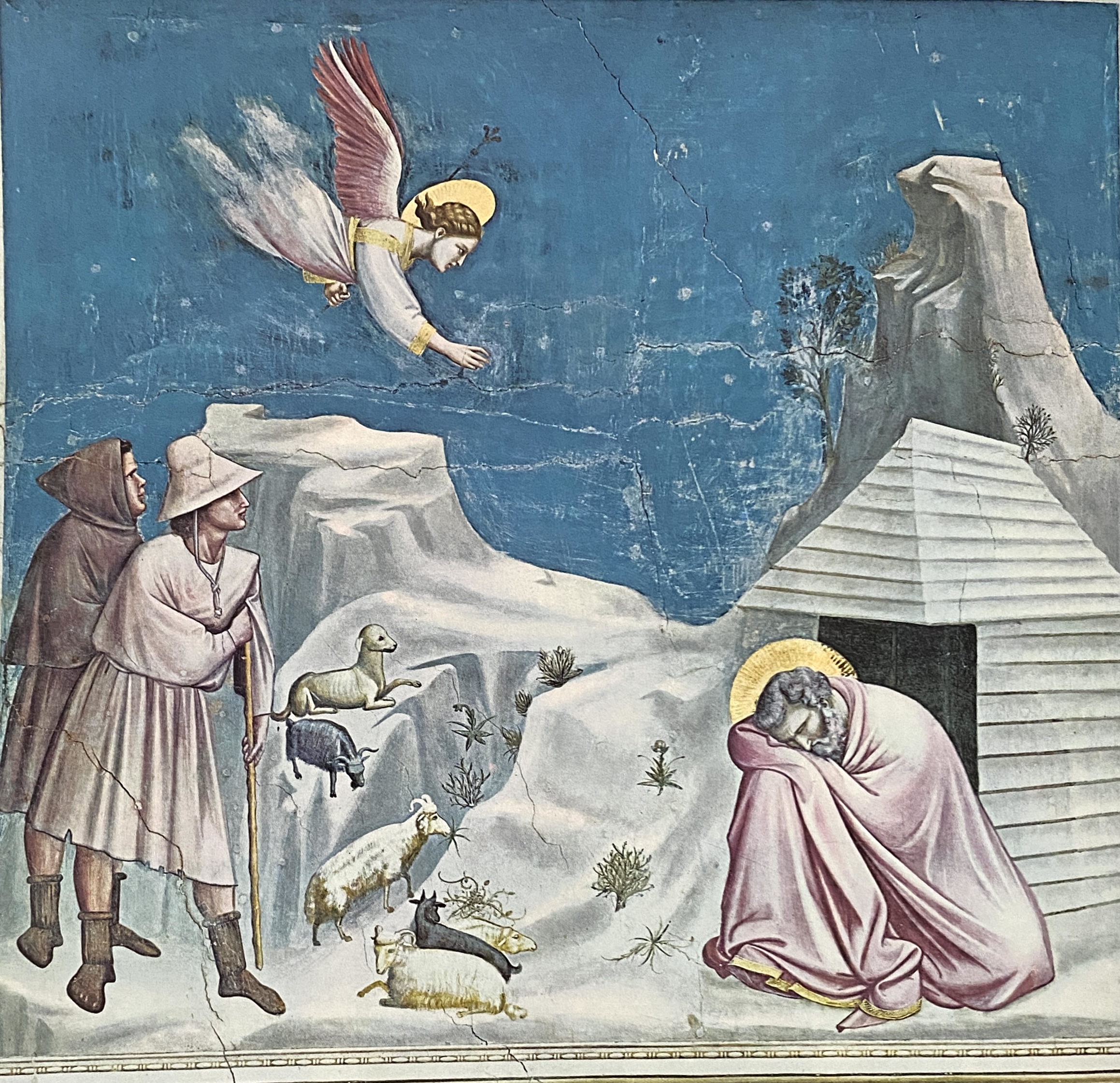
Giotto was a Florentine painter and architect who is revered as the father of Western painting. It is believed that he was a pupil of Cimabue, and to have decorated chapels in Assisi, Rome, Padua, Florence, and Naples with frescoes and panel paintings in egg tempera.
Giotto’s figures are volumetric rather than linear, with varied human emotions expressed in a human style rather than the stylized faces of Byzantine icons. He also created a new kind of pictorial space with an almost measurable depth, transforming the flat world of thirteenth century painting in a more naturalistic view of the real world. For this, he is considered the father of modern European painting.
The great accomplishment of Giotto’s painting was to make the events of the Gospel and the lives of the holy saints both credible, beautiful, and appealing to the ordinary people of his day.
Conclusion
These artists were followed by the Renaissance in the 14th-16th centuries. Renaissance art, particularly in Italy, focused on realism, classical themes, and a renewed interest in the human form. It moved away from symbolism and abstraction in favor of naturalistic rendering of light, form and nature. In the next and final article in this series, I will explain the effect this development has had on religious painting and contrast Renaissance painting with Icons. Why is the Renaissance such a strong dividing line in religious art? Because it ushered in a humanistic world view as opposed to the theocratic world view prevalent before. The focus of our culture has gradually progressed from honoring God as creator to revering man’s creations, the truth of science over religious principles, and eventually to a nihilism in our culture that doesn’t recognize any power greater than ourselves. And that is why as an artist, I have chosen Icons as my art form, desiring to promote and demonstrate visually, God’s universe over man’s universe!
I hope you have enjoyed this article! Perfect for an end of summer, beginning of fall reading!
Here is a lovely video that talks about Siennese Icon Painting
May God continue to bless the work of your hands. Please join with me in prayer for the world :
“God is our refuge and strength, an ever present help in trouble. Therefore we will not fear, though the earth give way and the mountains fall into the heart of the sea, though its waters roar and foam and the mountains quake with their surging…..”Be still and know that I am God. I will be exalted in all the earth.” Psalm 46:1-3, 10.
Christine Simoneau Hales


 American Association of Iconographers