El Greco

And the Enduring Influence of Byzantine Icon Training

Hello Fellow Iconographers:

As you probably already know, I love making connections between Byzantine iconography and modern art. I always think that icons were the contemporary art of their time, so how can we bring a contemporary approach to our icon writing? This article about the work of ElGreco shows how one iconographer of the 16th century made that transition. The approaches each iconographer takes to contemporary iconography will be as individual as the iconographers themselves, but some things will remain. Here is an account of how this issue played out in the life and work of ElGreco.
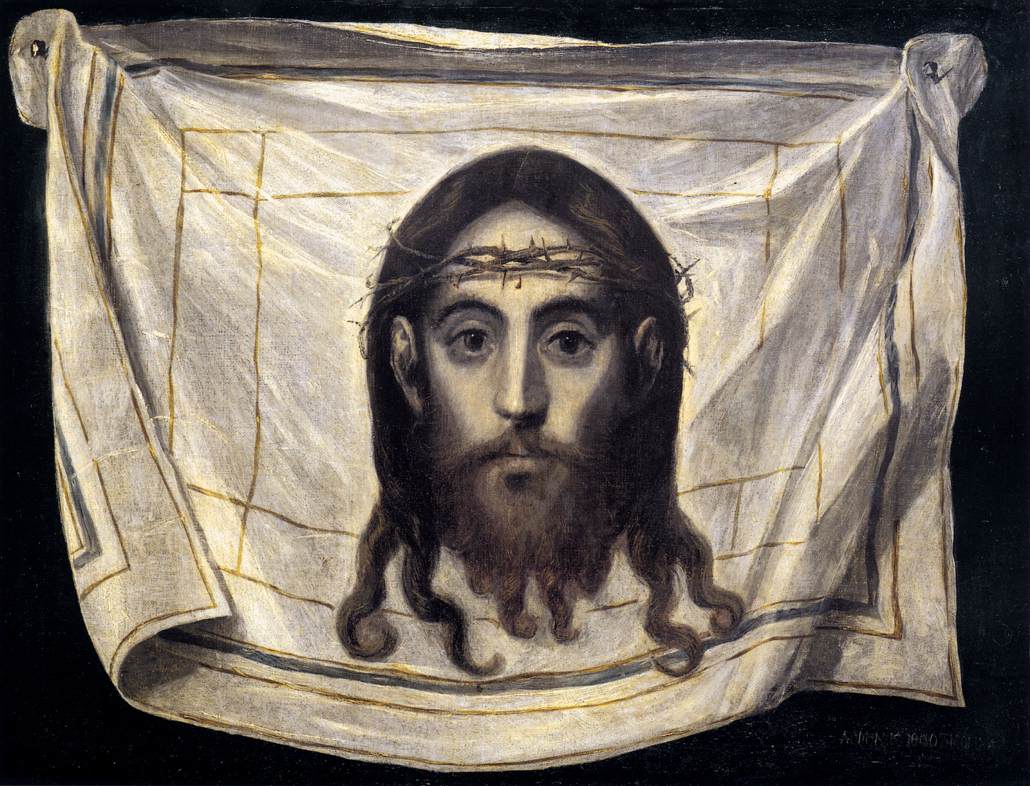
Veronica’s Veil, El Greco

Doménikos Theotokópoulos—better known as El Greco—has long fascinated scholars of Early Modern art. While his mature works in Toledo are celebrated for their dramatic elongations, expressive color, and visionary intensity, less often explored in depth is the formative influence of his early training in the Byzantine icon tradition. This article examines how the discipline of icon-painting, rooted in the post-Byzantine Cretan School, left an enduring imprint on El Greco’s aesthetic, technique, and theological vision. His icon training, I argue, was not a youthful chapter to be overcome, but a structural foundation that underlay his later innovations.
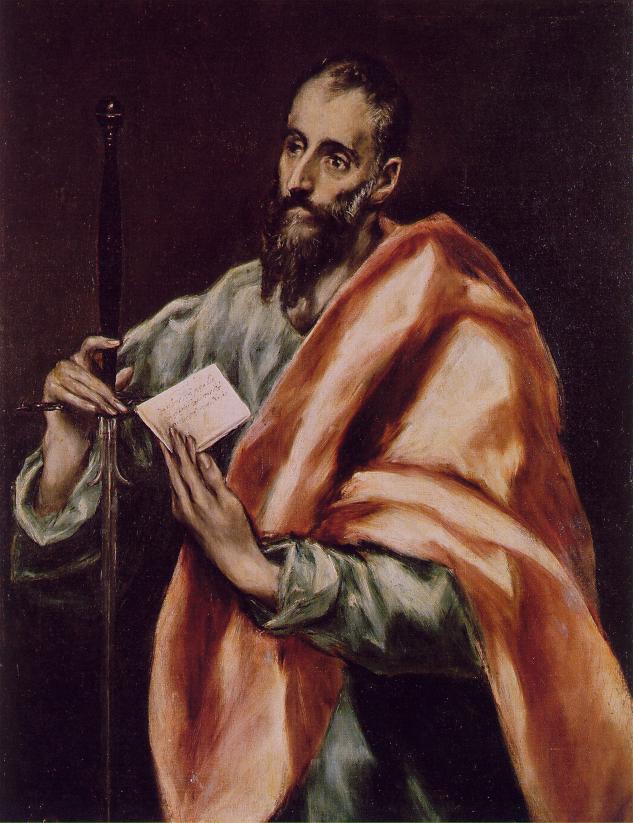
Saint Paul by El Greco

From Crete to Venice

Although he was born in Crete in 1541, after receiving icon painting training in his early life, Domenikos left Crete in 1567 for Venice. Some key characteristics Domenikos learned from the icon painters were:

A hieratic vocabulary of elongated, stylized figures and flattened pictorial space intended for devotion.

The use of traditional materials and techniques—tempera, wooden panels, and gilding.

An emphasis on spiritual vision over empirical realism.

But in Venice he was encountering the artistic milieu of the Italian Renaissance and Mannerism, absorbing the vibrant color, dynamic composition and spatial experimentation of artists such as Tintoretto and Titian.  This Western training did not supplant his icon-foundation but merged with it. One of his trademark features—elongated, upward-reaching figures, almost defying gravity—can be traced back to the hieratic verticality of icons, in which figures are often elevated beyond the earthly realm. In his mature altarpieces in Toledo, this physical stretching expresses a spiritual tension: the human yearning toward the Divine.

Annunciation by El Greco

Rome, Toledo, and the Transformation of a Style

From Venice, El Greco moved to Rome (1570–1576), where he sought patronage but struggled to achieve success amid the competitive papal art world. In 1576, he relocated to Spain, where his career flourished under the patronage of the Church and the Spanish nobility. His first major commission came from the dean of Toledo Cathedral: three altarpieces for the Church of Santo Domingo el Antiguo, works that already reveal a synthesis of iconographic form, Mannerist stylization, and Venetian color.

Even as his technique evolved, the influence of icon-painting persisted. The vertical elongation of figures—one of El Greco’s most recognizable traits—can be traced to the hieratic verticality of Byzantine icons, where figures are elevated beyond the earthly realm. In El Greco’s mature altarpieces, this elongation expresses a spiritual tension, a reaching upward toward the Divine.
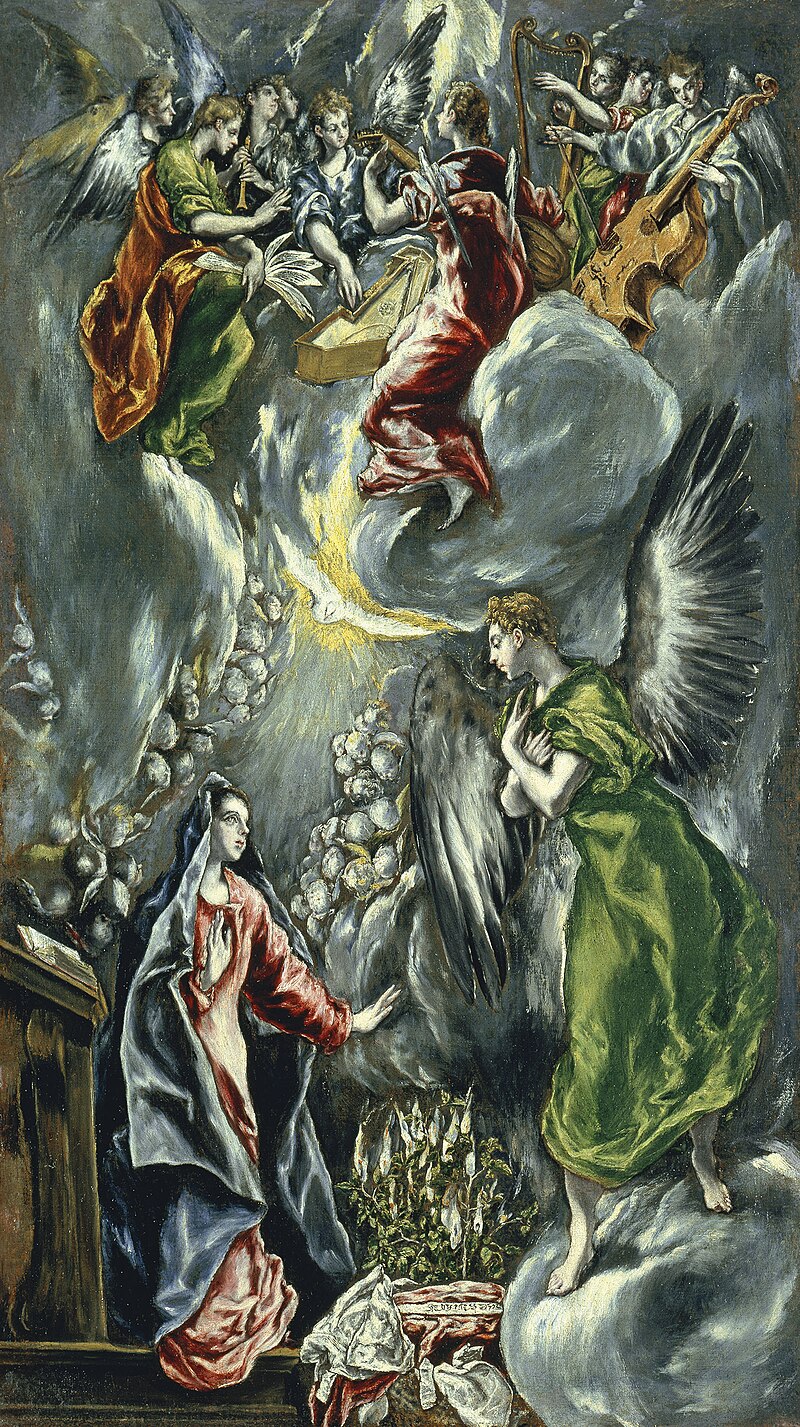
Annunciation El Greco

Similarly, his treatment of space often resists Renaissance perspectival illusion. Instead of a fully realistic spatial construction, El Greco employs stacked planes and compressed layers to evoke a metaphysical dimension. Scholars have linked this to his Byzantine roots, where sacred space functions symbolically rather than empirically.

Theological Continuities: Painting as a Spiritual Act

Beneath the stylistic parallels lies a deeper continuity: El Greco’s theological conception of painting. In the icon tradition, the painter’s task is to serve as a mediator of divine light, not merely an imitator of nature. This conception of sacred art as a spiritual discipline—requiring prayer, fasting, and inner illumination—found new expression in El Greco’s Spanish works.

His figures seem animated not by physical energy but by spiritual light, glowing from within. In this, El Greco remained faithful to the iconographer’s conviction that beauty reveals the presence of God.

Pentecost, El Greco

Reception and Legacy

“El Greco is one of the few old master painters who enjoys widespread popularity,” writes Keith Christiansen of the Metropolitan Museum of Art. Rediscovered in the nineteenth century by collectors, critics, and artists, El Greco was hailed as both the quintessential Spaniard and a proto-modern painter of the spirit.

For members of the Blue Rider school, including Franz Marc, El Greco embodied a mystical resistance to materialism—a painter who, as Christiansen writes, “felt the mystical inner construction of life.”

Conclusion: The Icon as Foundation of Innovation

El Greco’s artistic evolution cannot be fully understood without acknowledging the foundational role of his icon-training on Crete. Far from being a mere apprenticeship, this discipline remained the structural ground of his mature art—shaping his understanding of color, form, space, and the sacred.

His work ultimately represents a synthesis of:

  • The spiritual economy of the icon,
  • The painterly brilliance of Venice and Rome, and
  • The religious fervor of Counter-Reformation Spain.

For students of sacred art and iconographers today, El Greco offers a powerful model: discipline does not restrict creativity—it frames and empowers it. His art demonstrates that fidelity to tradition can be the very source of visionary originality.

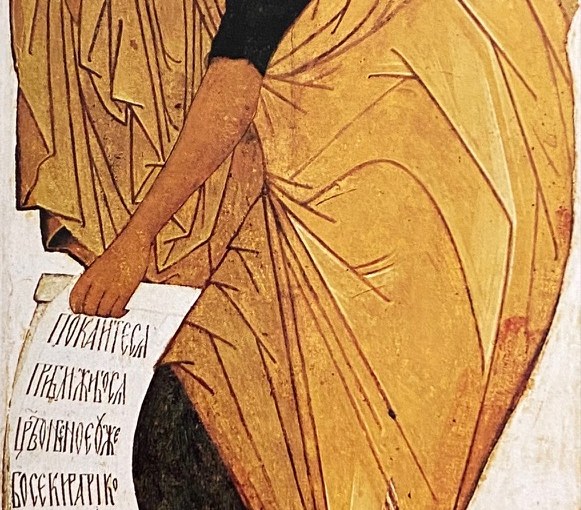
My Baptism of Jesus Icon at the Cathedral of Saint Peter, Saint Petersburg

I hope you have enjoyed this article and that it is food for thought. The battle for art is not won or lost in an academic tradition, but in the spiritual realm where God is all powerful. God wants each of us to give glory to His name in each individual way that he has created us.

Here are some interesting links that are passed on from Dorothy Alexander, a friend and iconographer in California:

1.How Icons Are Made” is the fourth and final lecture by Aidan Hart presented at St. Julian’s Church in Shrewsbury, England. https://www.youtube.com/watch?v=Of2eq-NiDVE&t=82s. He speaks on both the theology as well as the practical details of making an icon.

2.You can see the beauty of natural pigments as you watch how vivianite is made from the mineral. This also helps to understand why it is not cheap to buy. The example at the end shows the versatility of the color

https://www.youtube.com/watch?v=Ww2QRpSG4fA&t=40s&pp=2AEokAIB

3. This slow moving video is an example of Instacoll gilding, faulting (repairing or filling in any holes) and burnishing with a cloth. https://youtu.be/bK1gKiO2sSo?si=CaLsBN_NLJbjt85g

That’s all for this month!

God bless you all,

Christine

These are my links if you’d like to see more of what I do:

LINKS For  Christine Simoneau Hales   2025

  1. https://newchristianicions.com   my main website
  2. Https://christinehalesicons.com  Prints of my Icons
  3. https://online.iconwritingclasses.com  my online pre-recorded icon writing classes
  4. https://www.youtube.com/channel/UCK2WoRDiPivGtz2aw61FQXA  My YouTube Channel 
  5. Facebook: https://www.facebook.com/ChristineHalesFineArt     or  https://www.facebook.com/NewChristianIcons/
  6. Instagram:   https://www.instagram.com/christinehalesicons/?hl=en
  7. American Association of Iconographers:  FB Group: https://www.facebook.com/groups/371054416651983
  8. American Association of Iconographers Website: https://americanassociationoficonographers.com
Building Blocks

Christian Art After the Iconoclasm. 1000-1400 AD

Bayeux Tapestry

As Iconographers, I think we all realize that the Byzantine culture was influential in creating a nuanced visual language that was able to convey important principles of religious art .  Can we today consider and contemplate how the Byzantine style developed in order to create a visual language that can bring Christian concepts to our culture today?

An important influence of the development of Christian art in the 11th century was the schism, or split, in Christianity in 1054, which resulted in the Eastern Orthodox Church and the Western Roman Catholic Church. In the next centuries, each division of the church would develop its own culture and approach to worship, prayer, liturgy, and art.

Let’s Take a Look First at the Eastern Church’s Artistic Development

Santa Maria Church, Barcelona, Spain

The expansion of  monasticism was the main force behind the unprecedented artistic and cultural activity of the eleventh and twelfth century. In 963 AD, Athanasius of Trebizond founded the first monastery on Mt Athos, Greece.  Legend has it that early hermits were visited by The Virgin Mary who gave the place her blessing and there are many icons that convey this story and remembrance of the visitation .

In 988, Russia adopted Christianity and in 1017, Prince Yaroslavl the Wise erected the  Cathedral of St. Sophia in Kiev.  A Byzantium team of artists and iconographers, Russian and Greek, decorated the cathedral with beautiful frescoes and mosaics.

Biblia de Burgos, 12th Century

1054 began the schism between the Holy thrones of Rome and Constantinople, resulting in a wide divergence stylistically in religious art making that reflected differences in theological values between the two cultures.  The Eastern Church continued to develop the Icon, keeping the flat pictorial space of Egyptian art, and the simplicity of rendering human forms borrowed from the Greco Roman tradition of the early centuries.

In 1130, A miracle working icon, Our Lady of Vladimir Icon of the Virgin Mary was brought to Kiev. This icon has lasted through the centuries and today is a symbol of Love and Tenderness.

Our Lady of Vladimir

The Paleologue dynasty in Constantinople, 1259-1453, was the last resurgence of Byzantium. The attempt to have a rebirth of Byzantium after the sack of Constantinople in 1204, resulted in the rebuilding and decoration  of many churches, including Chora Church, which is considered one of the highest artistic achievements of that era.

Gregory Palamas, (1296-1359), was the Archbishop of Thessalonica and an eminent theologian  who supported Hesychasm, a mystical movement in Eastern monasticism that promoted fervent prayer, silence, and contemplation.  

Transfiguration by Theophanes

In 1378,  according to legend, Theophanes the Greek came to Russian from Byzantium, and painted the Church of the Transfiguration in Novgorod and many others, along with his student, Andrei Rubylev. This period of icon painting is considered by many to be one of the greatest achievements of Russian Iconography.

St. Sergius of Radonezh was a great Russian saint who promoted Russia’s spiritual revival.  He dedicated his monastery to the Holy Trinity and preached unity in love.  He taught brotherly love and divine service and commissioned the Holy Trinity Icon to be painted by Andrei Rubylev. Rubylev and St. Sergius were in large part responsible for Russia becoming one of the great centers of spiritual enlightenment in this time. St. Sergius passed away in 1392.

Holy Trinity. by Andrei Rubylev

In the West….

Religious art in 10th century Europe, also known as Romanesque art, was symbolic, vibrant, and hierarchical. It was characterized by its emphasis on the suffering of Christ and other sacred figures, and depicted saints and religious leaders as larger and more important than ordinary people. Artists also used animals, flowers, and fruits to convey religious messages and ideas. Some common symbols used in medieval Christian iconography include: Fire, light rays, or wind to symbolize the Almighty God; Lamb or fish: symbolize Jesus Christ and his love; Crucifix: Depicts Chrstianityand eternal life; a dove symbolizes the holy spirit from heaven or an individual’s soul, and lilies in a vase or water to portray the purity and spirituality of the Virgin Mary.

One of the most spectacular achievements of medieval artists in the west was their desire to emphasize heavenly light in their creation of places of worship.  Beginning with the 12thcentury, heavy, dark, Romanesque architecture began to be replaced by Gothic vaulted ceilings and flying buttresses that made it possible to bring more light into the churches than ever before. Light for a Christian had great significance because of the extensive Biblical associations of the nature of God with Light.

Cimabue, Trinita Madona

 After the sack of Constantinople in 1204 by Christian armies of the Fourth Crusade, precious objects from Byzantium made their way to Italian soil and profoundly influenced the art produced there, especially the brightly colored gold-ground panels that proliferated during the thirteenth century. 

Romanesque Art, one of the first innovative and coherent styles to spread across the western Church,was greatly influenced by the Byzantine art that preceded it.

 European countries of Italy, France, England, and Spain responded to this stylistic innovation that was more in keeping with shifts in cultural values.

The main purpose for the development of Romanesque art was to visually record biblical events and to chronicle important figures, like influential leaders and saints in a more naturalistic way, hoping to bring the viewer into closer contact with God.  

The Bridge Between Eastern and Western Art

At the end of the thirteenth century and beginning of the fourteenth, three great masters appeared who changed the course of painting from the more abstract Byzantine style, to a more naturalistic one:

Cimabue, Italian, (1240-1302) painted religious paintings that were heavily influenced by Byzantine models, yet he was also innovative and eventually broke away from the Byzantine style of religious painting.  For this reason, his work is considered to be a transitional bridge between icon painting and the more naturalistic developments of Renaissance painting.

Ognissanti Madonna, Giotto

Giotto di Bondone, (d. 1337), is believed to have been a pupil of Cimabue, and to have decorated churches in Padua, Florence, Naples, Assisi, and Rome. His volumetric figures are in sharp contrast to the linear, stylized  shapes of Eastern religious art of the same period. In his work, the flatness of icons began to disappear in favor of a new kind of pictorial space that achieved the illusion of depth visible in the natural world. With Giotto, considered by many to be the father of modern European painting, the flat world of thirteenth-century Italian painting was transformed into an analogue for the real world. Giotto’s figures are volumetric rather than linear, and the emotions they express are varied and convincingly human rather than stylized. He created a new kind of pictorial space with an almost measurable depth that prefigured the pictorial developments of the Renaissance.. 

Duccio, (1278 – 1318), is considered to be the father of Sienese painting. Together with Giotto he is considered to be one of the founders of Western art.  His religious paintings introduce lyricism and a refined color sense into the Byzantine tradition he inherited. He became interested in portraying human emotions and a more naturalistic space- both in conflict with Byzantine art principles.  His purpose was to bridge the gap between the spiritual world of the figures he painted and the real world of the viewer by an illusionistic rendering of objects and space- the first of its kind in Western painting, and not a style embraced by Eastern iconography until later centuries.

Maesta. Duccio

Overlapping  of Panel Painting with Icon Painting

Through the fourteenth century in Europe, the primary support for portable paintings was the wooden panel. The lengthy and complex preparation of the panels  had already been the way of icon creation as well, hailing from the very early centuries of Christianity. Many of these methods of icon board preparation are continued in the practice of icon painting today. They are described in detail in Cennini’s Il Libro dell Arte.

So, to summarize, the schism of the Church into an Eastern and a Western Church resulted in different approaches to creating a visual language that would best convey concepts of God, Bible stories and saints. Western culture evolved from a more theocratic culture to a humanistic one with, in my opinion, disastrous results. I think I am more drawn to the Byzantine visual language because of its ability to convey purity, focus on God, and demonstrate a clear difference between God’s world and the naturalistic world we live in.  And I think this ability to transcend the moment and connect with the Divine reality is crucial to humans coping with an increasingly stressful world today. The question is: Can we create a visual spiritual language that will engage modern men and women in a meaningful way?  How will we do that?  What do we learn from the simplified account of religious art development above?  I believe that each of us will be inspired by God to create a variety of approaches, for it is of great importance to the modern world that we do.

Until next month, when we take a look at…The Renaissance and Icon Painting!! Glory to God whose power, working within us, can do infinitely more that we can ask or imagine.

Christine Simoneau Hales

My website: New Christian Icons. My Youtube Channel