What Happened to Icons in the Protestant Church?

I was brought up Catholic, changed to Anglican when I got married, and then graduated from Global Awakening, a charismatic mission based ministry school, and I love each of these denominations for how they have helped to deepen and expand my faith.  

This month’s blog could be called, “What Happened to Icons in the Protestant Church?”  Of course, many Protestant Churches today do have icons and other religious art in them today, and there is a general movement towards more ecumenical understanding  among denominations today.  But, for my own benefit, and also for yours, I think it’s worth delving into some of the historical relationships between Protestantism and holy imagery.

Our Lady of the Sign Icon written by. Christine Hales

THEOLOGY OF THE ICON

The theology of the icon is based on the Incarnation, the revelation of the Image of God in the human form of Jesus Christ. This first icon was one made without human hands and revealed in the temple of Christ’s body. By imitating the divine artist, the iconographer not only participates in sacred creation, but theologically asserts the reality of Jesus’ humanity.

Theology, the study of God in words, and iconography, the study of God in images, are two major expressions of one single faith, or we might say that an icon is a visible gospel.

However, in the early days of the Protestant Reformation, while Martin Luther was quite tolerant of images in churches, John Calvin, another leading theologian of the Protestant Reformation, was vigorously opposed to images in the church. For Calvin, God was invisible and hidden, therefore it is impossible to visually depict God.

This belief is similar to Eastern Orthodoxy in the belief that God cannot be represented in the icons. But additionally, the Orthodox believe that because God’s Son took on human flesh in the Incarnation, it is possible to depict the Son of God in icons.  Did John Calvin ever read John of Damascus’ defense of icons?

Christ Enthroned Icon written by Christine Hales

HISTORY OF ICONS IN THE CHURCH

In Eusebius’ 4th Century “History of the Church”, mention is made of colored portraits that were made of Christ and his apostles, The presence of icons in the early church implies that icons were an integral part of the early Christian tradition.  The presence of sacred images in both church and synagogue tells us that the early Church did not invent icons but carried them over from its Jewish predecessors.  This also indicates that the presence of icons in Orthodox churches today represents a profound continuity with Jewish worship.  If icons have Jewish roots, Calvin’s historical arguments are rendered nonsensical.

However, in the Western Church, during and after the Renaissance, religious art became so affected by humanism that it ceased to keep God as the main focus but instead the achievement of artists of the day became spectacular creations for their own sake. The extravagance of religious art was compounded by the absence of a regulating principle.  Eastern artistic tradition had an art-manual sand a shared understanding about proper iconography, in the West there was no centralization of its artistic tradition, thus leading to excesses that contributed to Calvin’s desire to abolish church art.

CALVINISM

Calvinism had other theological ideas and principles not commonly shared with other Protestant denominations, such as the doctrine of predestination and human depravity. According to the Calvinist, man cannot choose good, cannot obey, cannot believe, but can only choose to do evil.  Calvin was largely opposed to art and music in the service of religion and vestiges of his doctrines remain like dark shadows over Protestantism at times.

Holy Trinity Icon written by Andrei Rublev

Lutheran Churches allow the presence of images as long as they have a pedagogical or decorative purpose.  Anglicans have two places in the Book of Common Prayer where the meaning of the second commandment could be construed as against using icons in worship.

Historically , the Seventh Ecumenical Council of Nicea decisively affirmed the use of icons for worship and recognized that icons are an integral part of the historic Christian Faith.

Diversity and controversy are simply facts of life, even within religious beliefs.  However, I believe that the icon of God exists in each of us for we are made in God’s image. This gives man the ability to communicate with God, to be transformed by His presence, and become like God, participating in His divine character. The Icon can serve as a bridge of prayer between God and the human person, and an icon gives the viewer the occasion to commune with the divine.

“Icons of the sacred not only set an atmosphere for prayer, but by contemplating the holiness of the person represented in the icon, one can experience the presence of God which is “contagious.” One becomes aware of praying and worshipping in the presence of angels and saints. Icons are used to enhance the beauty of the church, but also to teach us about our faith initially and then to remind us of this teaching. By bringing us in contact with holy persons, we are enthused to imitate them, helping to transform and sanctify us. Ultimately the icon is a means of worshipping God and venerating his saints.”

Our Lady of Perpetual Help written by Christine Hales

I hope that this article has helped to stimulate your faith and curiosity.  Below are links to three articles I have used extensively in this article.  Reading these articles will give a much more comprehensive and detailed view of the ideas presented here.

May God bless you in your understanding , until next month,

Christine Simoneau Hales

https://www.newchristianicons.com

LINKS TO ARTICLES:
http://www.udayton.edu/mary/resources/icon.html

Saint George

The Popularity of Saint George

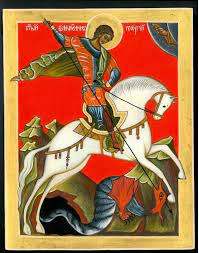
What is it that makes one saint more popular that others? Why do so many of the icons we paint tend to be of the same saints? Certainly there are many answers to those questions, but also, there are some saints who exist powerfully in the imagination of many people and thus are frequently used to focus prayers and our understanding of God’s power . Saint George is one of those, and since we recently painted his icon in the recent color theory and icons class I taught on line, I share with you some of the important aspects of Saint George that we discovered.

Saint George was one of the saints most highly regarded in ancient Russia. He was venerated not only as a warrior but also as a protector of agriculture. His feast day is April 23, which coincides with the beginning of the agricultural season. The icon we painted is Saint George and the Dragon. This one shows Saint George with his spear ready to pierce the dragon, who symbolizes evil. The hand of God in the upper corner completes the meaning that man, with God’s help, conquers evil in the world.

Both Catholics and Protestants maintained fidelity to St. George through the Reformation and its aftermath.  During the seventeenth and eighteenth centuries, England’s Catholics observed his feast each year as a holy day of obligation. 
In Henry V, Shakespeare has the title character invoke St. George at Harfleur before the battle of Agincourt:  “Follow your spirit, and upon this charge cry ‘God for Harry, England, and Saint George!'” And of course, Saint George is the patron saint of England.

In French, the word “cheval” means horse, and so it happens, as Chesterton once observed, that in the concept of chivalry, the very name of the horse has been given to the highest mood and moment of man.  The combination of man and horse, he continues, evokes feelings of so high an order that earlier ages happily portrayed in their art Christian heroes on winged stallions.  The most famous of these images was that of St. George, the mounted knight, defender of the good, piercing with his lance the dragon, that representation of evil rampant in the world. Some of this material is excerpted from ( Fr. James’ Newsletter, April 21, 2021, St. Procopious Abbey).


George’s real importance in the lives of Slavic peasants was as the mythical hero “Yegoriy the Brave,” the militant protector of cattle from wolves and bears, associated not only with the well being of horses but also with the greening of the grass after winter and the pasturing of the cattle. St. George became a kind of nature god, like the Prophet Elijah, whose chariot rolling across the heavens made the thunder. George was, in Russian peasant lore, the one who brought the spring. (Icons and their Interpretation)

The Significance of Saint George Today

Yet another reason for Saint George’s popularity with people today is that he symbolizes a spiritual truth which places the power of God firmly on the throne. It is only with God’s help that victory is achieved. Just as David, in 2 Samuel 5:6-6:23, asked God before he went into battle if he should go forth or not, giving God’s will preference over his own, here Saint George’s message is similar. He doesn’t trust in his own strength, but in God’s Strength. And this message is in contradiction to the message of humanism that our culture has inherited from the cultural developments after the Renaissance. Before the 1300’s, the world was defined with a theistic world view. As part of that world view, every creature as well as heaven had a clearly defined place in the hierarchy established by the laws of God. The good of all required devotion, community and cooperation with one’s neighbor. Humanism cultivated the reliance of man upon his own strength and abilities for answers and salvation from life’s problems. So, Saint George is a visual reminder to us to always seek our help for above, from God himself, and then our victory is assured.

May God bless the work of your hands and protect you from all that is not of Him,

Christine Hales

EXTRA LINKS FOR ICONOGRAPHERS

PRE-RECORDED ONLINE ICON PAINTING CLASSES

NEXT LIVE ON ZOOM ICON WRITING CLASS “SACRED GEOMETRY IN ICONS”

ARTICLE ON HOW TO GESSO ICON BOARDS WITH VIDEO LINK

Christian Courage

St Benedict Icon
St. Benedict Icon by Christine Hales

Greetings!

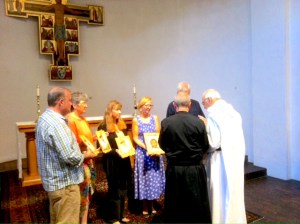
This month has been busy with writing Icons and teaching classes.  The Holy Cross Monastery Icon Retreat was wonderful, each participant wrote their own St. George Icon, and we had them blessed by Brother Roy on Sunday before Diurnum.  It is a wonderful place to study Icon writing since we are able to be part of each day’s morning prayer and Eucharist and share meals with the Brothers and other guests in the octagonal dining room over looking the Hudson River.  Truly a joy to teach there!

St. George Icon
St. George Icon


Icon Blessing
Icon Blessing at Holy Cross

The prayer of St. George: “Obtain for us the Grace of heroic Christian courage that should mark soldiers of Christ” Amen.

Icon Class at Holy Cross


As many of you know, the Icon is a kind of synthesis of the spiritual truths and values of the Church.  It is much more than just a religious painting.  It is a meeting point between the Divine and the human heart.  It is a visible, created beauty, a place where prayer joins us to the image of God.  It truly is an honor and privilege to be called to this beautiful practice of writing Icons.

Here are two new ones I am working on – one of Our Lady of Guadalupe and the other a Transfiguration Icon.  Here are some work in progress photos:

Our Lady of Guadalupe in progress

Transfiguration Icon
Transfiguration Icon in Progress

The following is an important on line Iconographic Resource for those of us interested in the early Icons:

“In 1956, Professor George Forsyth, of the University of Michigan, invited Kurt Weitzmann, of Princeton University, to join him on an exploratory trip to Sinai. From 1958 to 1965, the University of Michigan, Princeton University, and the University of Alexandria carried out four research expeditions to the remote Monastery of Saint Catherine at Mount Sinai—the oldest continuously inhabited Orthodox Christian monastery in the world, with a history that can be traced back over seventeen centuries. The documentation collected by the Michigan-Princeton-Alexandria Expeditions to Mountain Sinai, under the direction of Professor George Forsyth (below, right) and Professor Kurt Weitzmann (pictured below left), is a profoundly important resource for Byzantine studies.”  (Quote from the website link below.)

This website displays all the color transparencies and color slides in the possesion of the Department of Art and Archaeology at Princeton. The online images are limited to a size of 1024 pixels. These images are available to download and use for teaching and scholarly purposes.

Here is a link to the Icons of Mt. Sinai that are documented through Princeton University.

Below are more Resources I’ve collected for you this past month:

Iconographic  Resources

Current Exhibition at the Museum of Russian Icons in Clinton, Massachusetts “Fantastic Beasts in Iconography”

Jacques Bihin , Iconographer  has posted on garments:  a Flickr post by Jacques Bihin on Garments that is helpful for drawing and painting garments

St. Luke’s Guild of Iconographers- a group of Iconographers who pray and write Icons- many of whom have studied with me.  Their primary focus is community through prayer and writing Icons.  Here’s a link to their Facebook Page

Praying a blessing over your Icon writing, until we meet again!

Christine Hales

Icon Website

Fine Art Website

Ministry Website