Travels to the UK and Italy

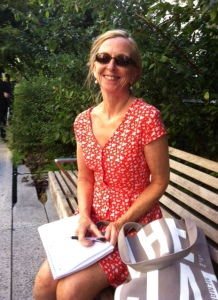
Hello Fellow Iconographers:photo 1

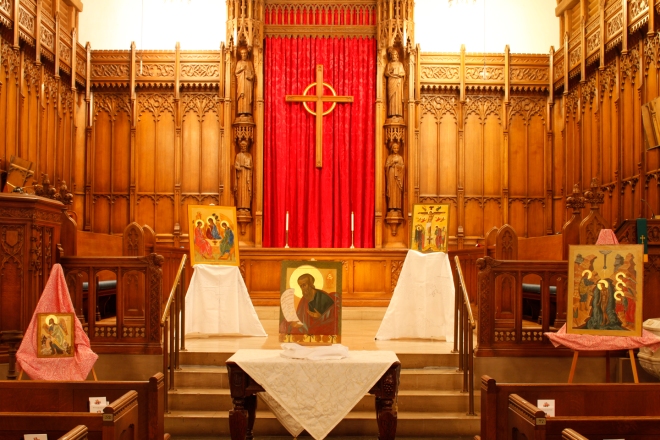
The Beginning of September was the start of our trip to the UK for a family wedding in Leeds, but we were able to make a detour to Shropshire and interview Aidan Hart, Iconographer and author of the book we use in Icon writing class: “Techniques of Icon and Wall Painting”,  for Yale University Radio.

photo 4

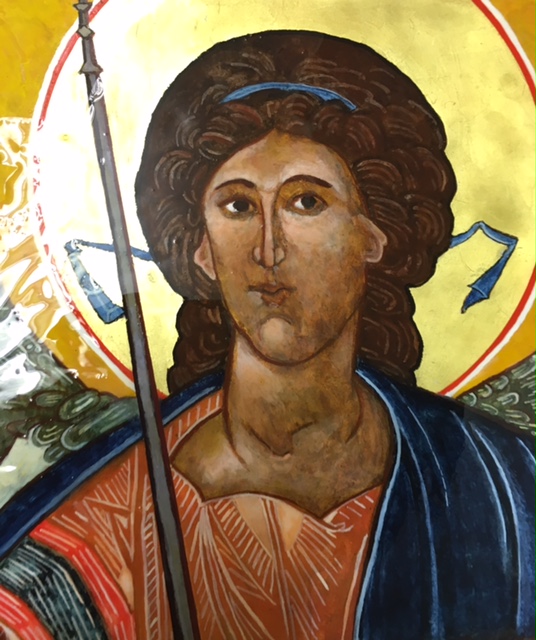
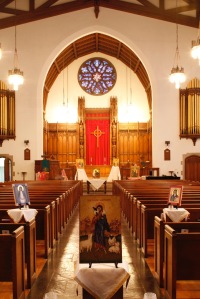
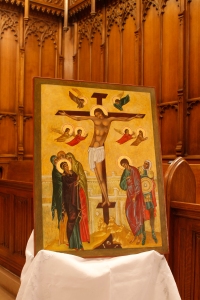
I was so happy that Aidan could make time for us, and upon leaving he said that he had just completed a large Icon for a church in Leeds! We were in Leeds at Michael’s sister’s home about 15 minutes when we realized that church was a fifteen minute walk- so off we all went. The icons were beautiful, and Father Michael of St. Urban’s invited us to come the following morning to his other church, also in Leeds,  to see another Aidan Hart Icon. Once there, we were amazed to see the 16′ fresco of the Transfiguration that Aidan had recently completed – in ten days according to Fr. Michael. It is the largest commissioned fresco since the Reformation, he told us.

Here’s the interview:    photophoto 2


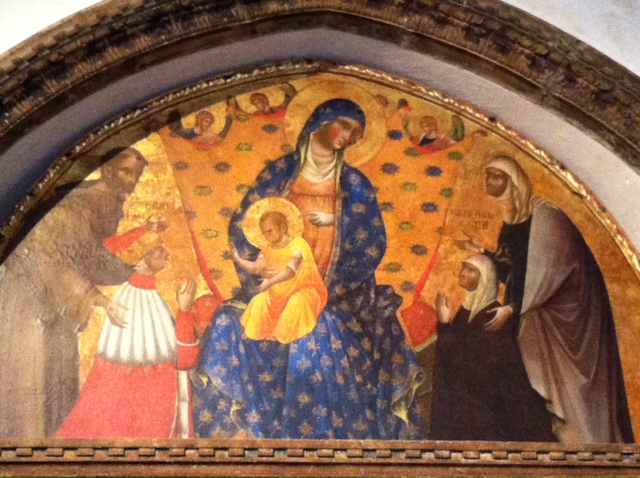
Our next travels took us to Venice to see the Biennale and the wonders of the Byzantine Cathedral of San Marco.  I’ll be giving a gallery talk this Saturday, Sept 26, 6-8pm at the McDaris Gallery on Warren St. Hudson that will touch on the Biennale and Byzantine art.  (You’re all welcome to attend!).


From Venice, we got to Rome, where we stayed at a convent within walking distance of the Vatican-our destination! God blessed me with achieving my heart’s desire to give Pope _MG_0831 (1)Francis the portrait I had done of him! At breakfast, the nun suggested that I might give my portrait of the Pope to him if the guards would help me. By God’s grace, we met a friendly Italian music composer at breakfast who offered to walk with us to the Vatican. after Mass, he began asking the guards around the Vatican if I could give my portrait to the Pope. He pleaded eloquently, in Italian, to seven sets of guards! Finally I was able to write a note to accompany my gift and the last guard _MG_0218 (1)promised that he would personally deliver it to the Pope the next morning! I was the happiest I could be! We had such a wonderful trip but that was the highlight for me. Seeing the Sistine Chapel again and the architecture in St. Peter’s Basilica, too, impressed me with a sense of excellence that can only be experienced in that place.photo 2photo 3

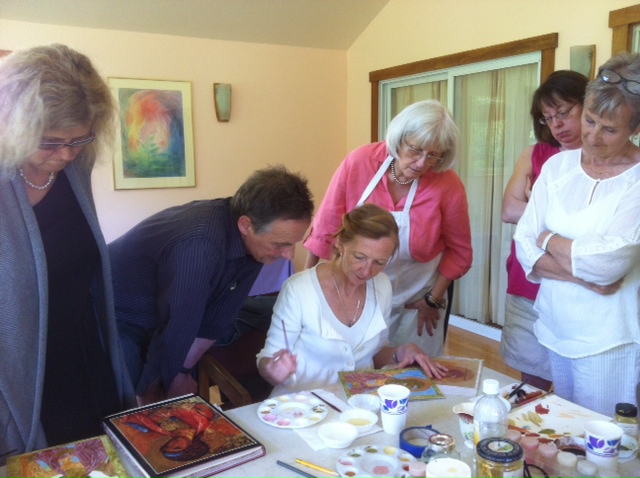
So, back to earth, the Albany advanced Icon writing class has changed venue and is now held on Monday nights 6-9PM at Westminster Presbyterian Church, 262 State St., Albany, NY.

Also coming up is the Introduction to Icon Writing Retreat at St. James Church on Madison Ave, in NYC, Oct 16-18. Registration is still open, email Grace Beecham at: GBeacham@stjames.org to register.

A Few Notes of Interest:photo 3

Stephan Rene will be lecturing at the Prince’s School of Traditional Arts on Coptic Iconography.

British Association of Iconographers will have its annual members exhibition October 14-16 at St. Saviour’s Church, St. George’s Square, London.

Until next month, be blessed,

+ Christine

“”A full reward will be given thee of the Lord God of Israel, under whose wings thou art come to trust.” Ruth 2:12

www.newchristianicons.com

Principles of Iconography: Sacred Geometry

Dear Fellow Iconographers:

This month I want to focus on one of the important (to me) principles of Iconography: Sacred Geometry.  I think that as Iconography evolves into a twenty-first century authentic expression of spirituality for our time, one of the principles and traditions that is important to bring forward is that of incorporating principles of sacred geometry in our composition and colors.

What is Sacred Geometry?  

It has its roots in the study of the mathematical principles in nature, i.e. the hexagonal cells created by honeybees, the chambered nautilus, are just a few examples. This reflects the belief that God created the universe according to a geometric plan. Geometric rations are often used in architecture as can be evidenced in the works of Leonardo DaVinci, and Michelangelo.  It’s interesting that back in 500BC, Pythagoras discovered that an oscillating string stopped halfway along its length produces an octave relative to the string’s length, while a ratio of 2:3 produces a perfect fifth and 3:4 produces a perfect fourth. The belief was that using these harmonic rations gave music and art powers of healing that could harmonize the person experiencing them.christinglory

How does this  manifest in Icon writing?  

Composition, figure placement, relative scape and body proportions all benefit by having the principles of sacred geometry as the underlying structure. In a simple portrait Icon, the triangle is the basic geometric compositional structure. It produces a feeling of centeredness, grounding and balance. In order to avoid a static appearance, the face is usually a 3/4 view, or slightly turned.

George Kordis, in his book “Icon As Communion “ addresses the issue of stations and gives excellent examples of how to additional incorporate directional flow outwards toward the viewer. George Kordis also speaks of how a composition is purified and refined when the compositional elements are arranged symmetrically around the vertical axis, and this can produce dynamic balance. There is a sense of unity and energy that radiates out towards the viewer when these compositional elements are observed.BaptismofJesus18

I think one of the very best sources for clarification of sacred geometry in the Icon is Egon Sendler’s “The Icon, Images the Invisible”.  He provides an analysis of many classic Icons as examples of geometric structures for composition and explains how to use right angles to obtain the four points of a square as well as explaining the cross, grid and circle compositions of festal Icons.

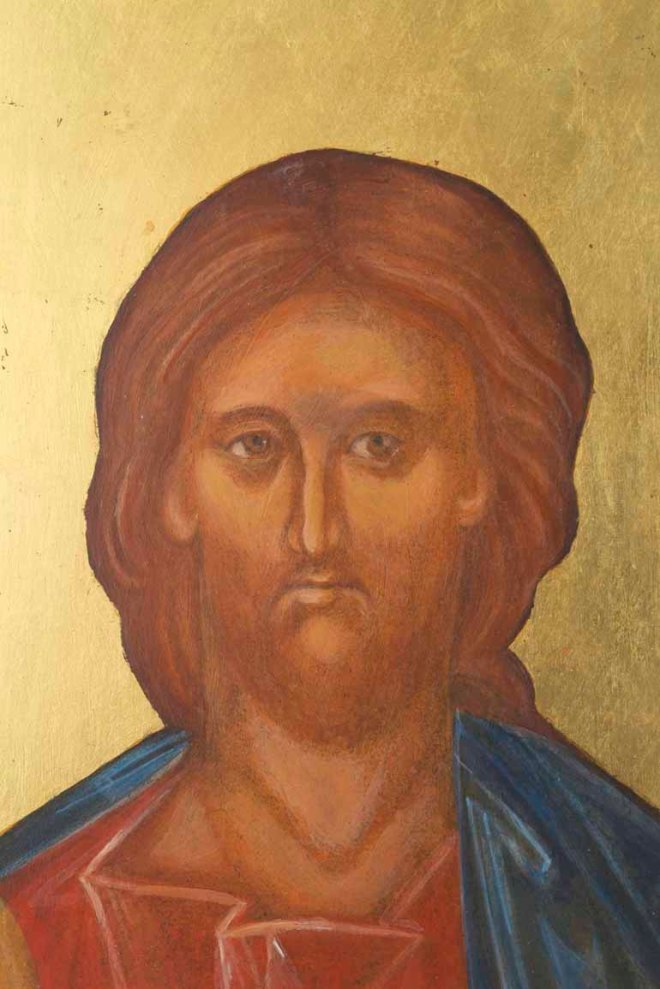
The two images above: Christ in Glory and Baptism of Jesus were both written in egg tempera by myself and are based on sacred geometry principles handed down through the centuries.  You can see clearly the vertical axis in the Baptism Icon as well as the slightly turned faces.  The symbol center top is that of God the Father, the radiating gold rays symbolize the Holy Spirit, so that, symbolically, the vertical axis is the Unity of the Trinity.

I hope this provides material for thought and helps to create understanding as a community of Iconographers, of what principles are and are not important to retain in our work. To each his own, and I look forward to hearing your comments.

Blessings and prayers,

Christine

www.newchristiancicons.com

www.christinehales.com

www.kingdomartsministry.com
Icons-Evolving As A Message for the Twenty-First Century

Dear Friends and Fellow Iconographers:

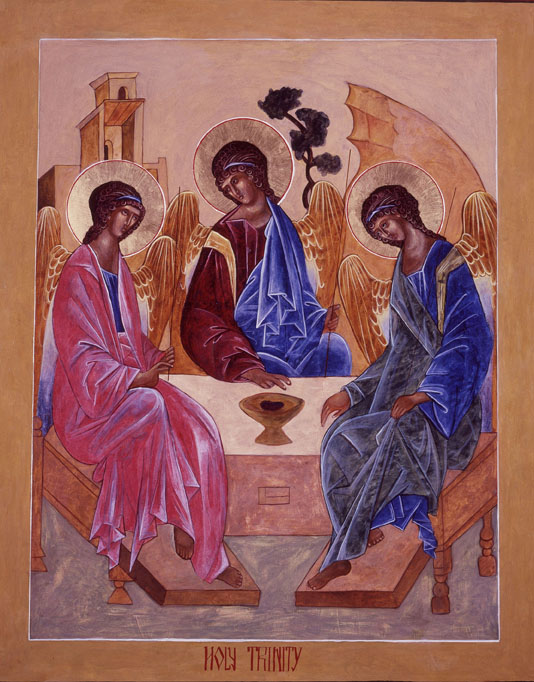
It is an exciting time to be writing Icons.  The inspiration of Andrei Rublev writing the great “Holy Spirit” Icon as a symbol for trinity-webunity – a unity that was so needed in his country at that time, is applicable to us all today.  What are the Icons our culture NEEDS?  What are the issues that need to be addressed in prayer and how can we make timeless images that can help to focus the prayer of a nation?

After attending the icon Workshop held at Wesley Theological Seminary in Washington DC, led by Philip Davydov, I am inspired even more to explore this idea of an American Iconography.  In light of the recent events in Charleston, SC. I feel an urgency to address the needs of our country in prayer and Sacred Imagery.

Dutch Sheets: “I have great hope for America because the depth of a fall never determines God’s ability to restore. I’m not afraid of the powerful strongholds because size and strength are completely irrelevant when measuring His ability to deliver. And I’m not intimidated because statistical odds, whether of success or failure, cease to be relevant when God is involved. His limitless ability negates the very concept of “odds,” and trumps all other winning hands.”

Just a short time before the Charleston shooting, a conference on painting Sacred icons the twenty-first Century was held, also in Charleston.

Here is a link to the “Living Tradition” Symposium organized by the Orthodox Arts Journal in Charleston, South Carolina.  The ideas expressed are interesting ones to thoughtfully consider. It’s my opinion that it would have been good to have some American women Iconographers as well as some of the talented Romanian and other InternationaI Iconographers present to represent their views as well.

In a recent article in The New Liturgical Movement, noted  Iconographer Aidan Hart wrote an article entitled “Diversity within Iconography – An Artistic Pentecost”. Here is an excerpt:

But where does the mean lie between unspiritual innovation on the one hand and mere duplication on the other? Genuine variety in liturgical art occurs when the iconographer unites spiritual vision with artistic ability – energized with courage and the blessing of God. Vision without artistic ability produces pious daubs. Not every saint can paint icons. Although icons are more than art, but they are not less than art.”

This is a blessed time to have such great artists and Iconographers working together to create an authentic sacred art for the twenty-first century.  I feel called to encourage community amongst iconographers, accepting our differences and celebrating our shared strengths. Very much like Pentecost, we can all receive the Holy Spirit but God will give each of us a language that can speak to our countries.photo 4

Locally, one of my students, and a member of the St. Luke’s Iconography Guild, Dahlia Herring, has transformed her contemplative approach to Iconography into action:

“A Refugee Art Exhibit- Resettling In Albany”

Through art work and written stories, the children from some of the most war-torn countries on earth, including Burma, Iraq and Afghanistan, express what it means to leave everything familiar and start a brand new life in the United States. These young artists eloquently and directly voice their hopes and disappointments, their fears and joys as the begin their new lives and education in Albany. The exhibit will be in the City Hall Rotunda until June 30th. You can find pictures of the Open House for this exhibit on FaceBook at https://www.facebook.com/USCRI.Albany. A Refugee Art Exhibit: Resettling in Albany was organized by the Capital Region Refugee Roundtable (co-chaired by Dahlia Herring) and the Albany Office of the US Committee for Refugees and Immigrants.

Also Local News:  Albany Icon Writing Classes Monday nights  June 22, NO CLASS June 29, . For July, Classes July 6,13, 27 ( No Class July 20.)

Also NOTE:  Another member of the St. Luke’s Iconography Guild discovered a pigment company in California that has good pigments at a reasonable cost. Worth looking into!  Agulis Pigments :agulisfarm@live.com

Look forward to hearing from you and have a blessed summer.

Christine

www.newchristianicons.com

www.christinehales.com

www.kingdomartsministry.com