
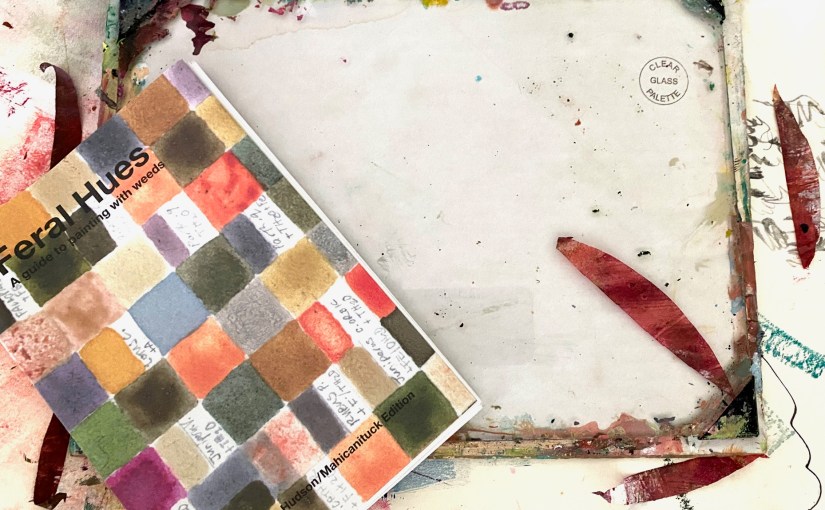
Lately I’ve become very excited about making some of my own pigments. It all started with my discovery of a book written by Ellie Irons “Feral Hues”, A Guide to Painting with Weeds. It’s a lovely book, packed with examples, color samples, pigment charts and insights into gathering, experiencing, and creating pigments from weeds, or common plant that currently grow in the Hudson Valley- my former home. https://www.publicationstudio.biz/books/feral-hues-a-guide-to-painting-with-weeds/

The colors are so delicate and resonate with a natural authenticity that I realized I wanted to include something like this in my icon writing practice. I often enjoy experimenting and incorporating new techniques in my painting practice and this idea of connecting more with the natural world around me seems like a new facet of praying and painting. It’s inspiring to engage with nature and makes me happy to think of how this duplicates artist practices from the ancient world.
So I have done some research, which I provide here, along with some links to YouTube videos demonstrating different approaches to pigment making from natural sources to maybe inspire you to collect some natural materials from your environment this summer to incorporate in your icons or icon sketches. I would love it if any of you make your own pigments, or just experiment with doing so, would send photos and descriptions to me and I will post them all at the end of summer!

The Historical Context of Icon Pigments
The making of pigments for icons is deeply rooted in tradition. Orthodox Christian iconographers of the Byzantine and Russian schools, for instance, inherited their pigment recipes and with these traditions, making pigments is not merely a technical exercise—it is experienced as a sacred act, performed with prayer and reverence.
Early iconographers relied on the natural world to supply their colorants: minerals, plants, earths, and even insects. Over time, as trade routes expanded, so too did the palette, with rare minerals and exotic substances making their way into the hands of skilled artisans.
Today, we can enjoy the sense of connection with nature, authenticity and spiritual resonance inherent in the process. But first, a short video to define qualities and properties of different pigments.
Raw Materials: The Source of Color
Pigments for icons originate from a remarkable array of materials, each with its own story:
- Minerals: Lapis lazuli (yielding ultramarine blue), malachite (green), cinnabar (vermilion red), and ochres (yellows, reds, browns) are classic examples. These minerals are prized for their intensity, permanence, and rich symbolism.
- Earth Pigments: Natural earths provide warm tones, such as siennas and umbers. Their subtlety and stability are essential for creating flesh tones and backgrounds.
- Plant and Animal Sources: While less common, certain reds (like carmine) are derived from insects, and greens can be obtained from plant extracts. However, these tend to be less stable over time.
The Process of Making Pigments
Pigment-making is a precise and often labor-intensive process, requiring patience and a thorough understanding of both material and method. Let us walk through the general stages:
1. Sourcing and Preparing Raw Materials
Sourcing is the first challenge. Authentic pigments demand high-quality, uncontaminated raw materials. Stones must be carefully selected for color and purity. Once acquired, the raw material—be it a mineral or earth—is cleaned of any impurities. For stones, this can involve washing, sorting, and initial crushing.
2. Grinding and Levigation
The heart of pigment-making lies in the grinding. The raw material is broken down, traditionally using a mortar and pestle, into ever finer particles. This step is crucial: the fineness of the pigment determines its brilliance, texture, and how it mixes with the binder.
Levigation follows: the ground material is suspended in water, and the heavier, coarser particles are allowed to settle while the finer, more suitable material remains in suspension. This is then collected, dried, and stored.
3. Washing and Purification
Some pigments require further washing to remove soluble salts or other contaminants that could affect long-term stability. For certain minerals, repeated washing and filtering are essential to preserve both color and integrity.
4. Testing for Quality
Not all ground minerals make suitable pigments. Quality tests—rubbing a small amount onto a glazed tile, exposing it to light, mixing it with a test binder—help the iconographer judge hue, granulation, opacity, and permanence.
Spiritual and Symbolic Dimensions
For the iconographer, making pigments is more than craft; it is a spiritual discipline. Every act—from choosing the finest lapis lazuli or malachite to breaking and grinding local river stones is done prayerfully, often accompanied by the recitation of psalms or other devotions. In the tradition, the humility demanded by such painstaking labor is itself a form of worship, aligning the artist with the saints and ancestors who have gone before.
Making Pigments From Flowers
Color holds profound symbolic meaning in the icon. Gold, for example, does not symbolize worldly wealth, but rather the uncreated light of God. Red conveys divine life and resurrection; blue, mystery and transcendence; green, renewal. The careful selection and preparation of each pigment ensures the icon communicates not just beauty, but theological truth.
Challenges and Considerations in Modern Practice
While modern chemistry offers synthetic pigments of impressive intensity and consistency, many iconographers still prefer natural pigments for their authenticity and spiritual resonance. However, challenges abound:
- Availability: Some minerals, like true lapis lazuli, are rare and expensive.
- Ethical Sourcing: Ensuring that materials are procured responsibly and sustainably is increasingly important.
- Health and Safety: Some traditional pigments, such as lead white or cinnabar, are toxic. Proper protective measures are essential.
- Conservation: Icons must be made with materials that will endure, and so a careful balance between tradition and innovation is often sought.
Conclusion
The making of pigments for icons is a testament to the union of art, science, and faith. It is a craft that honors the natural world, reveres tradition, and aspires toward the sacred. In every grain of crushed stone, in every brushstroke of egg tempera, lies a profound continuity with the past—a legacy of devotion and excellence. Obviously, if we are painting with egg tempera, then egg will be our binder. But if you read some of the comments, there are other natural binders as well.
For those who practice the art of icon writing, making pigments can be a transformative journey. It is an invitation to slow down, to engage deeply with one’s materials, and to approach the act of creation as a form of prayer. In honoring the old ways, iconographers not only preserve a heritage, but also manifest, through color and light, the inexpressible mysteries of the spirit.
I hope that you are enjoying reading this blog and invite those who have an interesting article or review that would contribute to iconography practice to email those to me for possible inclusion in future blogs.
May God continue to bless the work of your hands,
And may the grace of our Lord Jesus Christ, and the love of God, and the fellowship of the Holy Spirit be with us all forever.
Christine
Christine Simoneau Hales
Interesting Links for Iconographers:
These links were provided by Dorothy Alexander, an Iconographer and friend from California:
- https://youtu.be/SNAnguVFgOk?si=trVNJjiFvXHY1BAU A Talk by Aidan Hart “The Beauty of the Face: Icons, As A Door Between Heaven and Earth
- This site is one you will want to bookmark. There are free drawing, timelapse, and about 17 tetrachrome painting videos. Julia works in the Byzantine method, the same as George Kordis, whom she studied under. https://www.ikonographics.net/free-iconography-videos
- Here is a link to Julia Brigit Hayes’ drawing and painting courses on ûdemy: https://www.udemy.com/courses/search/?src=ukw&q=%22Bridget+Hayes%22 these courses are foundational to iconography. The 50% off code for now to the end of June is: JUNESALE25. I have taken her courses and she studied with Greek Iconographer George Kordis.
Here are most of my links:
LINKS For Christine Simoneau Hales 2025
- https://newchristianicions.com my main website
- Https://christinehalesicons.com Prints of my Icons
- https://online.iconwritingclasses.com my online pre-recorded icon writing classes
- https://www.youtube.com/channel/UCK2WoRDiPivGtz2aw61FQXA My YouTube Channel
- Facebook: https://www.facebook.com/ChristineHalesFineArt or https://www.facebook.com/NewChristianIcons/
- Instagram: https://www.instagram.com/christinehalesicons/?hl=en
- American Association of Iconographers: FB Group: https://www.facebook.com/groups/371054416651983
American Association of Iconographers Website: https://americanassociationoficonographers.com

 American Association of Iconographers